What if you already knew half the vocabulary for your next language without even trying? For Korean speakers, learning Mandarin isn’t starting from zero. It’s about unlocking a hidden library of Hanja you’ve known for years. While most students struggle with basic characters, you’re likely ready to sprint ahead. Sitting in a general expat class often feels like a crawl when the pace is tuned for those who don’t share your linguistic roots.
We understand the unique frustration of mastering Mandarin tones or flipping your brain from SOV to SVO sentence structures. You need a path that respects what you already know while tackling the specific hurdles Koreans face. This 2026 guide reveals how specialized mandarin classes for korean speakers in Singapore can fast-track your journey to fluency. We’ll explore how to leverage your Hanja advantage, overcome grammar shifts, and find practical, NTUC UTAP claimable courses near City Hall that fit your professional schedule. You’ll discover how to stop translating in your head and start speaking with confidence in real-world settings.
Key Takeaways
- Leverage your natural “head start” by using Hanja knowledge to bypass months of basic character memorization.
- Learn to navigate “False Friends” and master the critical shift from Korean SOV to Mandarin SVO grammar structures.
- Discover why specialized mandarin classes for korean speakers offer a more efficient path than general courses designed for Western expats.
- Maximize your professional development budget by utilizing NTUC UTAP subsidies to offset your course fees.
- Identify high-quality, adult-focused learning centers near City Hall that prioritize immediate conversational results.
Why Korean Speakers Have a Fast Track to Mandarin Mastery
Learning a new language usually feels like climbing a steep mountain. For you, it’s more like a brisk walk. Choosing mandarin classes for korean speakers means you’re leveraging a massive cultural and linguistic advantage. You already possess a deep “passive” vocabulary that Western learners spend years trying to build. This is the “Fast Track” effect. It allows many Korean students to reach HSK proficiency levels in significantly less time than their peers. You aren’t starting from scratch. You’re simply learning to re-pronounce and reorganize what you already understand.
The Linguistic Connection: Hanja vs. Hanzi
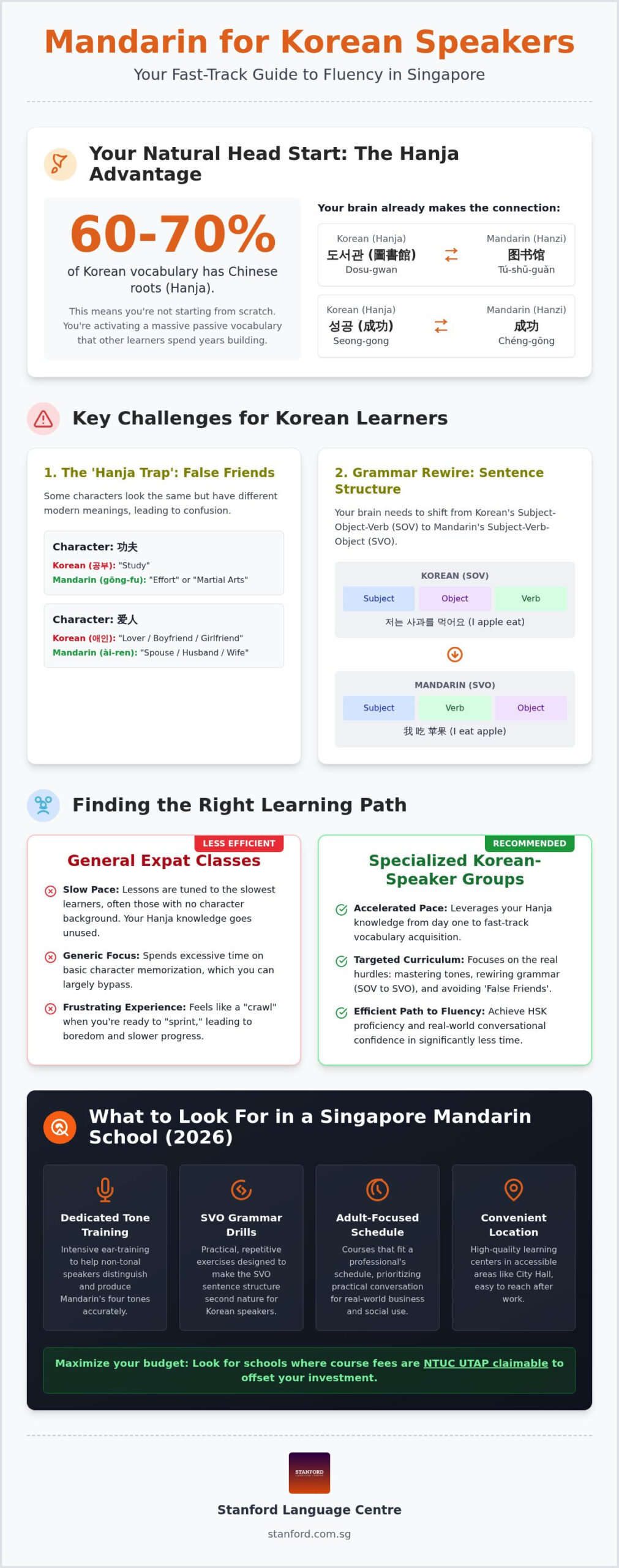
Your secret weapon is the deep history of Sino-Korean vocabulary. Roughly 60% to 70% of the Korean language actually has Chinese roots. Hanja is the Korean name for Chinese characters used in the Korean language. While you might not use them daily in modern Hangul, the linguistic logic is embedded in your speech. When you see a character (Hanzi), your brain often makes an instant connection to the Hanja you already know. This psychological edge turns studying into recognizing. Consider these common cognates:
- Library: Dosu-gwan (KR) / Tú-shū-guǎn (CN)
- Success: Seong-gong (KR) / Chéng-gōng (CN)
- Preparation: Jun-bi (KR) / Zhǔn-bèi (CN)
These similarities make vocabulary retention almost effortless compared to other expat groups. You’ll find yourself skipping past the “what does this mean” phase and moving straight into “how do I use this.” This same character-based advantage applies to other East Asian learners as well; for instance, those exploring mandarin for japanese speakers in Singapore benefit from a similar Kanji head start when building their Mandarin vocabulary.
Overcoming the ‘Tone Barrier’ for Non-Tonal Speakers
The biggest challenge isn’t the words. It’s the music. Modern Korean isn’t a tonal language, so Mandarin’s four tones can feel like a major hurdle. This is where general classes often fail. They treat every student the same. In our specialized mandarin classes for korean speakers, we pivot the focus. We spend extra time on ear-training to help you distinguish between sounds that might seem identical at first.
It’s vital to start with a strong foundation. Our conversational mandarin level 1 is designed to help you build that tonal muscle right from day one. We don’t just teach you what to say. We teach you how to hear it. Our instructors act as supportive mentors, guiding you through the transition from a rhythmic language to a tonal one. We focus on practical, real-world sounds so you can start speaking with confidence in Singapore’s professional environment.
The ‘Hanja Trap’ and Other Challenges for Korean Learners
While your Hanja knowledge gives you a massive head start, it can also lead you into a linguistic ambush. We call this the ‘Hanja Trap.’ This happens when your existing knowledge creates ‘False Friends’—words that look identical in script but have drifted apart in meaning over centuries. For instance, the Korean word for study (gong-bu) sounds like the Mandarin word for effort or martial arts (gōng-fu). Similarly, the Korean word for lover (ae-in) translates to spouse (ài-ren) in Mandarin. Relying solely on your Korean intuition without professional guidance often results in ‘Korean-style’ Mandarin. It might sound right to you, but it often leaves native speakers confused.
The second major hurdle is the fundamental shift in how you build thoughts. Moving from Korean’s Subject-Object-Verb (SOV) structure to Mandarin’s Subject-Verb-Object (SVO) requires a total mental rewire. This is why specialized mandarin classes for korean speakers are so valuable. You need more than just a vocabulary list. You need a path that addresses these specific structural conflicts. Without a supportive mentor to catch these syntax errors early, you might build “Konglish” habits that become incredibly difficult to break later. A mentor provides the cultural context that self-study apps miss, explaining why a phrase might be grammatically correct but socially awkward.
Sentence Structure: Re-wiring the Brain
In Korean, you say “I apple eat.” In Mandarin, it’s “I eat apple.” It sounds simple on paper, but in the heat of a real conversation, your brain will naturally revert to Korean logic. We use practical drills in our small group settings to make the SVO pattern second nature. We also focus heavily on particles like ma (questions), ba (suggestions), and le (completed actions). These don’t have direct equivalents in Korean grammar, making them common tripping points for even advanced learners. Understanding these nuances is a key part of Singapore’s bilingual policy framework, where clear communication across cultures is the top priority. Small groups are perfect for this, allowing for peer-to-peer correction in a low-pressure environment.
Pronunciation Nuances: Beyond the Script
Many Korean learners try to read Mandarin characters using Korean phonology. This is a mistake that leads to heavy accents. You must master Pinyin as a vital bridge. It helps you distinguish initial sounds like ‘zh’, ‘ch’, and ‘sh’ which simply don’t exist in Korean phonology. If you skip this step, your Mandarin will remain difficult for locals to understand. Using proven how to learn a tonal language techniques is essential for beginners to bridge this gap. We focus on mouth positioning and breath control to help you produce these new sounds accurately. If you’re ready to start your journey, our small group sessions provide the perfect space to practice these sounds safely with expert guidance.
General Expat Classes vs. Specialized Korean-Speaker Groups
General expat classes often fall into the “one-size-fits-all” trap. While they’re great for meeting people from all over the world, they usually move at a pace designed for students who have never seen a Chinese character before. For you, this is a major efficiency drain. You shouldn’t spend four weeks learning basic characters if you already know Hanja. Specialized mandarin classes for korean speakers respect your existing knowledge. We skip the repetitive character drills and move straight into the high-value skills you actually need. It’s about working smarter, not harder. If you’re also exploring broader options, reviewing the top mandarin lessons for foreigners in Singapore can help you understand how different programs compare and what to prioritize for your specific goals.
Learning in a specialized group also provides a unique peer motivation. You’re surrounded by people who share your native linguistic logic. When a classmate asks a question, it’s likely a question you’ve had too. This creates a “student-first” environment where the teacher can address specific Korean linguistic pitfalls without confusing the rest of the class. Our instructors act as supportive mentors, focusing heavily on speaking and tones rather than rote memorization. This targeted approach ensures you reach fluency faster while feeling comfortable and understood.
Why Mixed-Nationality Classes Can Be Frustrating
The pacing issue is the biggest hurdle in mixed classes. Western students often struggle for months with character recognition, while East Asian students usually find this part intuitive. If the teacher has to slow down for half the class, you’re left waiting. In a specialized group, we leverage shared cultural context. We use Korean-Chinese cultural parallels to explain complex concepts, making the lessons feel more relatable and less like a textbook exercise. These groups allow for much deeper conversational mandarin classes singapore practice. You’ll spend more time talking and less time waiting for others to catch up.
Private 1-1 Lessons: The Ultimate Customization
Sometimes, even a small group isn’t fast enough. If you have specific business needs or a high-pressure deadline, private 1-1 lessons are the answer. This is the ultimate customization for your learning journey. We can focus entirely on ‘Business Mandarin’ vocabulary that overlaps with your professional Korean background. It’s the perfect choice for busy expats working in Singapore’s CBD who need a flexible schedule. You can set the pace, choose the topics, and get immediate, personalized feedback on your pronunciation. Whether you’re preparing for a corporate presentation or just want to navigate the local food scene, private lessons ensure every minute of your study time is used effectively. Our mandarin classes for korean speakers are designed to fit your life, not the other way around.
What to Look for in a Singapore Mandarin School in 2026
Selecting the right school in 2026 requires looking past glossy brochures. You need a learning partner that fits your professional lifestyle. Location is your first priority. Most working professionals in Singapore prefer schools near City Hall or Tanjong Pagar. Being a few minutes from the MRT means you can jump into a session right after work without a stressful commute. Class size is equally vital. We’ve found that 3 to 8 students is the ‘sweet spot.’ It’s large enough for diverse conversation but small enough that you can’t hide in the back. You want a pragmatic curriculum that teaches real-world Singapore Mandarin; not just dry textbook phrases that locals don’t actually use.
Specialized mandarin classes for korean speakers should also be evaluated on their financial accessibility. While many institutions focus on academic theory, the best schools for adults focus on practical results and cost-efficiency. You’re looking for a center that understands your specific linguistic starting point while respecting your time and budget constraints.
Maximizing Your Budget with NTUC UTAP
It’s a common misconception that all language courses in Singapore are SkillsFuture claimable. In reality, many specialized centers don’t accept SkillsFuture credits. However, you can still find significant support through the NTUC UTAP scheme. As of June 2026, NTUC members can claim 50% of unfunded course fees. This is currently capped at S$250 for members under 40 and S$500 for those aged 40 and above. To verify if your Level 1 course is claimable, check the provider’s status on the NTUC portal and ensure you can hit the 75% attendance requirement. This ‘no-frills’ approach to quality education ensures you get professional training without unnecessary overhead costs.
The ‘Friendly Guide’ Teaching Philosophy
The best learning happens in a low-stress environment. You want a school that acts as a ‘friendly guide’ rather than a distant authority. Native trainers who have years of experience with adult learners understand that your time is precious. They won’t waste it on childish exercises. Instead, they’ll focus on the specific challenges we’ve discussed, such as the SOV to SVO transition. You can evaluate a school’s reputation by reading a comprehensive 2026 guide: adult chinese learning in singapore. This helps you identify centers that prioritize student growth over enrollment numbers. If you’re ready to see the difference for yourself, view our upcoming class schedule and start your fast-track journey today.
Stanford Language Centre: Tailored Mandarin for the Korean Community
Since 2004, Stanford Language Centre has served as a vital bridge for expats integrating into Singapore’s vibrant culture. We don’t just teach a language; we help you find your voice in a new city. Our location at Peninsula Shopping Centre, just minutes from City Hall MRT, puts us right in the heart of the professional district. It’s a professional yet warm space where you can drop the stress of the workday and focus entirely on your personal growth. We’ve built a reputation as the “friendly guide” that busy professionals rely on for fast, pragmatic results. We understand that you aren’t looking for an academic degree. You want to speak with your colleagues, neighbors, and friends. For many families, settling in also means finding the right household support, and Phluid Match is an excellent resource for domestic helper search and placement in Singapore.
Our specialized mandarin classes for korean speakers are not an afterthought. They are a core part of our mission to provide high-quality, accessible education. We prioritize a “student-first” mentality that values practical application over theoretical complexity. This means our Level 1 courses are designed for immediate impact. You’ll walk out of your first few sessions with phrases you can use at the office or the local hawker center that very same day.
Our Course Structure for Koreans
We know you already have a massive passive vocabulary thanks to your background in Hanja. Our curriculum is specifically designed to leverage this linguistic head start. We skip the repetitive character drills that slow down mixed-nationality classes and move straight into conversational practice. This approach allows us to cover more ground in less time. However, we don’t ignore the hurdles. With a strict limit of 8 students per group, our trainers provide constant, real-time correction on your tones. This ensures you develop a clear, natural-sounding accent from the start. For organizations, we also provide Corporate Mandarin Language Training tailored to the specific vocabulary and cultural nuances of Korean firms operating in Singapore.
How to Get Started
You don’t need any prior knowledge or academic prerequisites to join us. Our foundational courses are built for absolute beginners who want a low-stress entry point into a new language. We’ve removed the barriers to entry by keeping our registration process straightforward and transparent. Whether you’re an individual expat looking to enhance your social life or an HR manager arranging team training, we make the transition easy. We focus on a “no-frills” approach to quality, ensuring your investment goes directly into your learning experience. Ready to unlock your linguistic advantage? Book your spot in our next Korean-speaker Mandarin intake and see how quickly you can reach fluency with a supportive mentor by your side.
Unlock Your Linguistic Edge Today
You’ve discovered that your Korean linguistic roots provide a massive advantage. Leveraging your Hanja knowledge while navigating the SOV to SVO shift is the fastest way to fluency. By choosing specialized mandarin classes for korean speakers, you avoid the slow pace of general groups and focus on what truly matters; clear communication and tonal accuracy. It’s about turning your existing knowledge into a professional asset that sets you apart in Singapore’s competitive landscape.
We’re here to be your supportive mentor. Our City Hall location is easily accessible for CBD professionals, and our specialized curriculum is designed specifically for your unique background. Our courses are NTUC UTAP claimable, making professional growth more affordable than ever. Don’t let your linguistic head start go to waste. Start your Mandarin journey with a specialized class for Korean speakers at Stanford Language Centre. Your path to fluency is shorter than you think, and we’re ready to help you every step of the way.
Frequently Asked Questions
Is it easier for Koreans to learn Mandarin than English speakers?
Yes, Koreans typically find it much easier because roughly 60 percent of Korean vocabulary has Chinese origins. This shared history means you already understand the logic behind many words and characters. While an English speaker has to memorize every new sound and symbol, you’re often just learning a new pronunciation for a concept you already know. This linguistic head start allows you to progress through the initial stages much faster.
How long does it take for a Korean speaker to become conversational in Mandarin?
Most Korean speakers reach a basic conversational level within three to six months of consistent study. Because you skip the struggle of character recognition, you can focus your energy on tones and sentence structure from day one. Our mandarin classes for korean speakers prioritize practical results, helping you navigate social and professional situations in Singapore quickly. Your specific timeline depends on your practice frequency and whether you choose group or private lessons.
Can I use SkillsFuture credits for Mandarin classes at Stanford Language Centre?
No, Stanford Language Centre doesn’t accept SkillsFuture credits for its courses. We focus on providing high-quality, specialized training that delivers practical value without the administrative overhead of certain government credit schemes. However, we do offer other financial incentives to keep our classes accessible. Many of our students utilize the NTUC UTAP subsidy instead, which provides significant support for working professionals looking to upgrade their language skills in a focused environment.
What is the difference between Hanja and Mandarin Hanzi?
Hanja refers to the traditional Chinese characters used in the Korean language, while modern Mandarin in Singapore uses simplified Hanzi. The core meanings are usually identical, but the visual appearance of the characters has been streamlined. For example, a character with ten strokes in Hanja might only have four in simplified Hanzi. Your Hanja background makes it easy to recognize the root meanings, even if the written form looks slightly different. Japanese learners experience a similar advantage through their Kanji knowledge, as explored in our 2026 guide to mandarin for japanese speakers in Singapore.
Are the classes conducted in Korean or English?
Our group classes are primarily conducted in English to ensure a clear bridge between the languages. This approach helps you master the SVO sentence structure and Mandarin tones using a common medium. However, our trainers are deeply familiar with the specific linguistic challenges Koreans face. They use this knowledge to explain concepts through a Korean lens, ensuring that the explanations resonate with your native linguistic logic and cultural background.
Is the NTUC UTAP claim applicable to the specialized Korean-speaker class?
Yes, our specialized mandarin classes for korean speakers are NTUC UTAP claimable. As of 2026, NTUC members can claim 50 percent of unfunded course fees, with annual caps of S$250 for those under 40 and S$500 for those aged 40 and above. You’ll need to maintain at least 75 percent attendance to qualify for the claim. This subsidy makes our professional training even more accessible for expats working in Singapore who want to maximize their budget.
Where is the school located and is it convenient for office workers?
Our school is located at Peninsula Shopping Centre, #04-18, 3 Coleman Street, which is extremely convenient for office workers. We’re just a short walk from the City Hall MRT station, making it easy to attend sessions right after work or during a long lunch break. Being situated in the heart of the CBD means you don’t have to waste time on long commutes, allowing you to fit learning into your busy professional schedule.
Do you offer online Mandarin classes for Korean speakers?
Yes, we offer online Mandarin classes for those who prefer the flexibility of learning from home or the office. Our digital sessions maintain the same small group sizes and interactive focus as our in-person classes. This hybrid approach allows you to choose the format that best fits your lifestyle in 2026. Whether you’re in the classroom or joining remotely, you’ll receive the same personalized attention and expert guidance from our trainers.