You already know more Mandarin than you realize. While other expats struggle for years to memorize thousands of characters, your deep knowledge of Kanji gives you a massive head start. Finding the right mandarin for japanese speakers singapore means choosing a program that leverages this secret weapon rather than ignoring it. You aren’t starting from zero; you’re already halfway to the finish line.
We understand the specific hurdles you face as a professional in the city. It’s frustrating to understand a written document perfectly but feel completely lost during a spoken business meeting. Many Japanese expats find that standard classes move too slowly, wasting time on writing while ignoring the tones and pronunciation you actually need. You deserve a path that respects your existing literacy and focuses on your immediate career growth.
This 2026 guide explains how to master Mandarin by bridging the gap between Japanese and Chinese. We’ll show you how specialized courses can cut your learning time in half and help you navigate daily life with ease. From understanding NTUC UTAP claimable options to finding flexible small group classes near the city center, we’ve mapped out the most efficient way to reach conversational fluency.
Key Takeaways
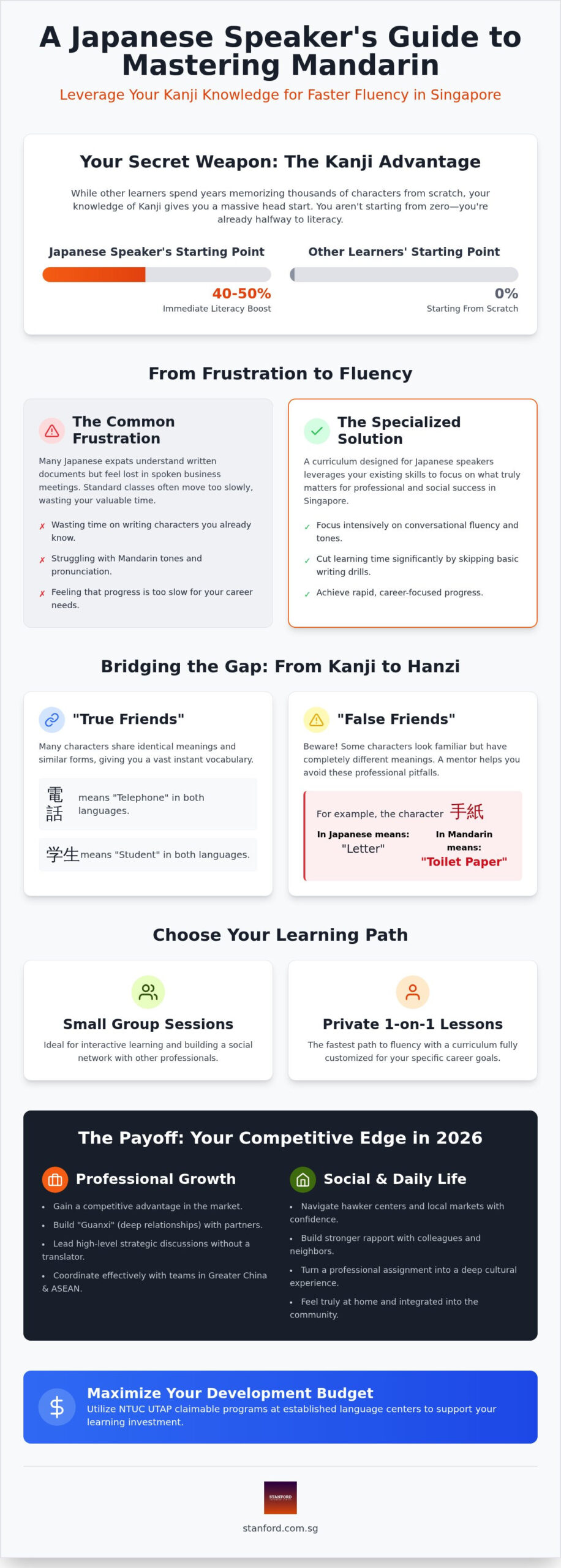
- Leverage your Kanji knowledge to gain an immediate 40-50% literacy boost and skip the struggle of basic character memorization.
- Find the best mandarin for japanese speakers singapore to ensure your curriculum focuses on conversational fluency rather than repetitive writing.
- Choose between interactive small group sessions for social networking or private 1-1 lessons for rapid, career-focused progress.
- Learn specific strategies to bridge the gap between Japanese pitch-accent and Mandarin tones for clearer business communication.
- Maximize your professional development budget by utilizing NTUC UTAP claimable programs at established language centers.
Why Japanese Expats in Singapore Learn Mandarin in 2026
Singapore remains the central hub for Southeast Asian trade and innovation. For the Japanese expat community, 2026 has brought a clear realization: English is the baseline, but Mandarin is the competitive edge. Professionals here are no longer just looking to get by. They want to lead in a market that rewards cultural and linguistic agility. You’ve likely noticed that the most successful leaders in your industry are those who can communicate across boundaries without a translator.
The Business Case for Mandarin Fluency
Many regional headquarters in Singapore now manage complex operations spanning Greater China and the ASEAN region. If your role involves coordinating with partners in these areas, Mandarin is a vital tool for your toolkit. While English is one of the four official languages of Singapore, the most significant business bonds are often forged through the nuances of a shared language. Relying on English alone can sometimes keep you on the outside of high-level strategic discussions. By mastering mandarin for japanese speakers singapore, you gain the ability to build “Guanxi” or deep relationships that are essential for long-term success. This is particularly true when navigating the corporate landscape around professional hubs like City Hall, where bilingualism is the standard for excellence.
Social and Daily Life Advantages
Life in Singapore is rich and varied, extending far beyond the glass towers of the business district. There is a specific joy in navigating local markets or ordering food at a crowded hawker center with total confidence. When you can speak the language, you aren’t just a spectator; you’re a participant. You’ll find it much easier to build rapport with your neighbors and colleagues when you can share a joke or a specific observation in their native tongue. It turns a standard professional assignment into a deeply immersive life experience.
Understanding the local linguistic environment also helps you decode the unique blend of “Singlish” and Mandarin used in daily life. This isn’t just about grammar; it’s about social integration. Feeling at home in a multilingual society requires a bridge, and for Japanese speakers, that bridge is already half-built thanks to your existing literacy. Taking a course in mandarin for japanese speakers singapore helps you cross that bridge faster. It ensures you feel like a local member of the community rather than a temporary guest. This sense of belonging provides a psychological comfort that makes living abroad feel sustainable, rewarding, and truly like home.
The Kanji Advantage: Why Japanese Speakers Learn Mandarin Faster
You have a secret weapon in your language journey. While Western learners spend months struggling with basic stroke order, you already recognize the meaning of most characters on a page. This shared heritage provides an immediate 40-50% literacy boost. It’s the primary reason why Japanese speakers often outperform other foreigners in reading and writing tasks from day one. You aren’t learning a new language from scratch; you’re translating a visual system you already master.
The connection runs deep. You’ll encounter Simplified characters used in Singapore, which often resemble the Shinjitai Kanji you use in Japan. While Traditional characters used in other regions are more complex, the underlying logic remains consistent. Understanding these overlaps is the core benefit of specialized mandarin for japanese speakers singapore. It allows you to focus on the sounds of the language rather than the shapes of the words.
Mapping Kanji to Hanzi
Hanzi serves as the foundation of Mandarin literacy for Japanese speakers. Many characters are “True Friends,” meaning they share identical meanings and similar forms. However, you must stay alert for “False Friends.” These are characters that look familiar but have shifted meanings over centuries. For example, the characters for “Letter” (手紙) in Japanese actually mean “Toilet Paper” in Mandarin. A supportive mentor helps you identify these traps early so you can communicate with professional accuracy.
- True Friends: Characters like “Telephone” (電話) and “Student” (学生) translate directly between both languages.
- Visual Shortcuts: Simplified Hanzi often mirrors the shorthand logic found in modern Japanese scripts, making them easy to decode.
Accelerated Vocabulary Building
Because you don’t need to spend hours on beginner literacy, your progress is significantly faster. You can skip the tedious phases that stall other learners and move straight into high-value communication. Your energy goes exactly where it should: mastering pronunciation and the four tones. This is why our conversational mandarin level 1 program is so effective for Japanese expats. It bridges the gap between what you see and what you say.
This linguistic shortcut aligns perfectly with the history of Singapore’s bilingualism policy, which emphasizes the link between cultural identity and language. By leveraging your Kanji background, you’re tapping into a local standard of functional, high-level communication. If you’re ready to turn your existing knowledge into a career asset, our small group mandarin classes offer the perfect environment to start.
Choosing Between Small Group and Private Mandarin Lessons
With a significant population of Japanese nationals residing in Singapore, the expat community is vibrant and professionally driven. Finding the right format for mandarin for japanese speakers singapore often comes down to your personal learning style and career objectives. Whether you prefer the energy of a classroom or the focus of a private suite, the goal is the same: achieving functional fluency as quickly as possible.
The Benefits of Small Group Learning
Small group classes offer a unique social advantage that private lessons cannot match. You’ll be learning alongside other Japanese speakers who share your linguistic hurdles and Kanji background. This creates a supportive environment where you can practice interactive role-playing for real-world Singaporean business scenarios. It’s a great way to network with peers while mastering the language. Key benefits include:
- Shared cognitive shortcuts based on your existing Kanji knowledge.
- Real-world role-playing for local business and social contexts.
- Cost-effective learning through small group mandarin lessons.
A major advantage in Singapore is that these programs are often NTUC UTAP claimable. This subsidy helps eligible learners offset the cost of their professional development. It makes high-quality education accessible without a heavy financial burden. It’s an excellent way to maximize your training budget while building a local support network.
When to Choose Private 1-1 Instruction
If your schedule is unpredictable or your needs are highly specific, private 1-1 Mandarin lessons are the ideal choice. This format allows you to tailor the curriculum to your specific industry jargon. Whether you work in Finance, Tech, or Manufacturing, your instructor can focus on the vocabulary you actually use in boardrooms. It’s the fastest way to prepare for an urgent relocation or a high-stakes promotion.
Private instruction also offers the ultimate flexibility for those with frequent business travel. You don’t have to worry about missing a session; your mentor works around your calendar. This individual attention ensures that every minute is spent on your specific weaknesses, such as mastering the four tones or navigating complex Pinyin structures.
Corporate and Online Flexibility
Many Japanese firms operating in Singapore now invest in corporate Mandarin language training to empower their teams. These on-site or online classes ensure that your entire department stays on the same page. For those seeking mandarin for japanese speakers singapore with a corporate focus, online classes provide a convenient bridge. You get the same quality instruction without the commute, fitting perfectly into a lunch break or a quiet evening at home.
Overcoming Common Challenges for Japanese Learners
You’ve already seen how Kanji gives you a massive head start in reading. However, the transition to speaking often feels like a different game entirely. While your eyes recognize the characters, your ears and tongue must adapt to a new rhythmic system. Learning mandarin for japanese speakers singapore requires addressing these specific phonetic and grammatical hurdles head-on with a supportive mentor who understands your linguistic starting point.
Mastering Mandarin Tones
Japanese is a pitch-accent language. This means you’re used to words rising or falling in pitch, but Mandarin takes this concept much further. The four tones are distinct and change the meaning of a word entirely. Carrying over the relatively flat intonation of Japanese is a common hurdle. To fix this early, we use specific visualization techniques to help you identify and reproduce each tone with confidence.
- Exaggeration: It’s better to over-emphasize the tones in the beginning. This builds the muscle memory needed for natural speech later.
- Pitch Mapping: We help you contrast the high-level first tone with the rising second tone using familiar pitch patterns.
- Contextual Listening: Practice distinguishing similar-sounding words that only differ by their tone.
Mastering these sounds early prevents “fossilized” mistakes that are harder to correct later. For a deeper dive into these techniques, check out our guide on how to learn a tonal language. It provides the practical foundation you need to start speaking clearly from your very first lesson.
Navigating Sentence Structure
This is often where the most “brain rewiring” happens for Japanese expats. Japanese follows a Subject-Object-Verb (SOV) pattern, but Mandarin uses Subject-Verb-Object (SVO). You’ll also need to drop the heavy use of particles like “wa,” “ga,” and “wo” that define Japanese sentences. Mandarin is much more direct and relies on word order to convey meaning.
We simplify this transition by focusing on high-utility verb-object patterns for immediate conversational use. Instead of over-analyzing complex grammar, you’ll learn to build natural-sounding sentences through repetition and role-play. This approach is a core part of our conversational mandarin classes singapore. It ensures you can contribute to business meetings or social gatherings without stumbling over Japanese-style sentence endings.
The Pinyin Romanization system can also be a temporary hurdle. Some sounds, like the “r” or “zh,” don’t exist in Japanese phonology. Our instructors guide you through these sounds using relatable mouth positions. If you’re ready to turn these challenges into strengths, we invite you to join our next intake at Stanford Language Centre and experience a curriculum designed for your success.
Why Stanford Language Centre is the Preferred Choice for Japanese Speakers
Since 2004, we’ve helped thousands of professionals find their voice in a new language. We don’t believe in a one-size-fits-all approach. For those seeking mandarin for japanese speakers singapore, we’ve refined a curriculum that respects your time and your existing literacy. We aren’t just a school; we’re your supportive mentors located in the heart of the city.
Our Specialized Approach for Japanese Learners
Our Level 1 course is specifically built to fast-track your literacy. While other students are learning basic character strokes, you’re already moving into complex sentence structures. Our instructors are experts who understand the deep Hanzi-Kanji connection. They help you navigate the “False Friends” we mentioned earlier while celebrating the “True Friends” that make your journey faster. Our student-first mentality means we focus on what works for you, not just what’s in a textbook.
Japanese expats often tell us they feel more confident after just a few sessions. This is because we prioritize conversational results you can use in the Singaporean market immediately. You’ll join a community of adult learners who share your professional drive. It’s a low-stress environment where practical skill takes precedence over academic theory. We’ve built a reputation for being a reliable, local partner in your personal growth.
Corporate and Individual Flexibility
We understand that your schedule is demanding. That’s why we offer a mandarin class city hall located conveniently for CBD professionals. Whether you’re coming from a meeting or heading home, our Peninsula Shopping Centre hub is easy to reach. We aim to lower the barrier to entry by making our classes as accessible as possible.
For Japanese MNCs operating here, our corporate training programs are highly customized. We can bring the classroom to your office or host your team in our interactive spaces. Our enrollment process is straightforward and honest. We want you to focus on learning, not paperwork. We pride ourselves on being approachable allies for both individual learners and corporate entities.
Don’t forget the financial incentives available to you. As an established provider, our programs are NTUC UTAP claimable. This means you can maximize your professional development budget while receiving top-tier instruction. It’s a pragmatic choice for any expat looking to increase their value in the local bilingual job market. If you’re looking for the most efficient mandarin for japanese speakers singapore, you’ve found your partner at Stanford Language Centre.
Your Path to Bilingual Success in Singapore
Your journey to fluency is shorter than you think. By leveraging your deep knowledge of Kanji, you’ve already bypassed the hardest part of learning Mandarin. Whether you choose a collaborative small group setting or the focused intensity of private lessons, the key is to start with a curriculum designed for your specific linguistic background. You don’t have to struggle with generic courses that move too slowly for your existing literacy.
Finding the right mandarin for japanese speakers singapore means partnering with experts who understand your unique needs. At Stanford Language Centre, we bring over 20 years of experience in adult language education to help you succeed. Our courses are NTUC UTAP claimable, making professional growth both accessible and affordable. We’ve built a specialized curriculum that turns your Kanji knowledge into conversational power.
Ready to stand out in the local job market and feel truly at home in Singapore? Start your Mandarin journey today with Stanford Language Centre’s specialized classes! You have the tools, the advantage, and now the perfect supportive mentor to guide you. We’re excited to see you thrive in our bilingual community.
Frequently Asked Questions
Is Mandarin hard for Japanese speakers to learn?
Mandarin is significantly easier for you than for Western learners. Your native knowledge of Kanji provides an immediate literacy boost, as many characters share the same meanings and roots. While mastering the four tones and pronunciation requires focused practice, you skip the struggle of learning to read and write from scratch. This makes mandarin for japanese speakers singapore an efficient process that leverages your existing linguistic strengths.
How long does it take to reach conversational fluency?
Most students achieve basic conversational fluency after completing our Level 1 program, which spans ten structured lessons. Because you already understand the logic of characters, you can focus your energy entirely on speaking and listening. Reaching a professional business level usually takes around six to twelve months of consistent practice. Your progress is often twice as fast as learners who have no prior exposure to Chinese characters.
Can I use NTUC UTAP to pay for my Mandarin course?
You can certainly use NTUC UTAP to offset the costs of your professional development at our centre. Our Mandarin programs are listed as claimable under this scheme for eligible union members. This financial support makes high-quality language education accessible for expats and working professionals in the city. It’s a pragmatic way to maximize your training budget while gaining a valuable new skill for the local bilingual job market.
Do you offer Mandarin classes specifically for Japanese speakers?
We provide specialized small group classes designed specifically for the Japanese cognitive profile. These sessions focus on bridging the gap between Kanji and Hanzi while addressing specific pronunciation hurdles. Learning alongside peers who share your linguistic background creates a supportive and relevant classroom environment. This niche offering is a cornerstone of our mandarin for japanese speakers singapore curriculum, ensuring you don’t waste time on irrelevant basics you already know.
What is the difference between learning Mandarin in Singapore vs. Japan?
Learning in Singapore offers an immersive, real-world laboratory that you won’t find in Japan. You can practice what you learn in the morning at a local market or business meeting in the afternoon. Singapore’s environment also exposes you to local nuances and the specific vocabulary used in regional Southeast Asian trade. Our curriculum focuses on the practical application of the language within the local corporate landscape, making your skills immediately useful.
Do I need to learn Simplified or Traditional characters?
In Singapore, Simplified characters are the official standard used in schools, government, and media. Our courses focus on Simplified Hanzi because it’s the most practical choice for daily life and business here. Many of these characters are very similar to the Shinjitai Kanji used in modern Japanese. Learning Simplified characters ensures you can read local signage, newspapers, and official documents with ease throughout the entire country.
What happens if I miss a group class due to work?
We understand that busy professionals often have unpredictable schedules. If you miss a session, our instructors provide catch-up materials and guidance to ensure you stay on track with the rest of the group. For those with extremely high-pressure roles or frequent travel, we often recommend our private 1-1 lessons. This format offers the ultimate flexibility, allowing you to reschedule sessions to fit your changing work commitments without falling behind.
Is there a trial lesson available for Japanese expats?
We focus on providing a thorough introduction and placement process to ensure you join the right level for your needs. While we don’t offer standalone trial lessons, we encourage you to speak with our consultants about your specific goals. Since 2004, we’ve prioritized finding the perfect fit for every student. We want you to feel confident and comfortable with our supportive mentor approach before you begin your language journey.