You don’t need to master thousands of ancient characters just to order a coffee at a local hawker centre or lead a team meeting in the CBD. Most professionals in Singapore find that traditional academic courses focus too much on theory and not enough on the “real world” talk they actually need. It’s frustrating to spend hours on grammar when you just want to connect with your colleagues. We understand that your schedule is tight and the fear of getting tones wrong is real. You deserve a learning experience that respects your time and prioritizes your ability to communicate.
Finding the right mandarin lessons for for foreigners shouldn’t feel like another chore on your to-do list. We believe in a pragmatic, student-first approach that gets you speaking from day one. By focusing on high-frequency vocabulary and practical social scenarios, you can achieve basic conversational fluency without the academic burnout. This article will walk you through the best options for expat-friendly classes in Singapore, showing you how to find a supportive environment that delivers a clear return on your time invested.
Key Takeaways
- Learn why a survival-first approach to Mandarin is more effective for busy professionals than traditional academic theory.
- Understand the practical differences between daily conversational courses and HSK proficiency exams to choose the right path for your goals.
- Compare the social networking benefits of small group classes with the accelerated, personalized progress of private mandarin lessons for for foreigners.
- Identify why choosing a central location like City Hall and small class sizes maximizes your interaction and return on time.
- Discover how a supportive, student-first environment helps expats overcome the common fear of tones and complex characters.
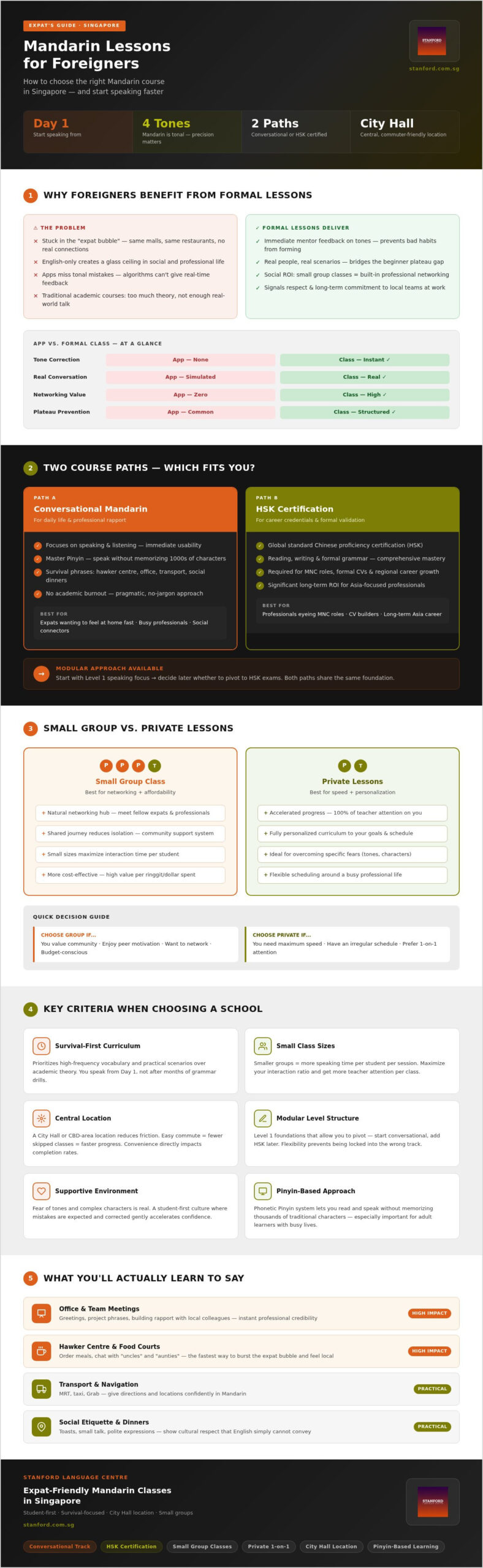
Why Foreigners in Singapore Benefit from Formal Mandarin Lessons
Singapore is a global hub where English is the lingua franca. However, relying solely on English often creates a glass ceiling for your social and professional life. By 2026, the shift toward deeper regional integration means that simply “getting by” isn’t enough for the modern expat. Learning the language helps you transition from a temporary visitor to a true local. Formal mandarin lessons for for foreigners provide the necessary bridge to cross that gap. It’s about moving beyond the surface and truly connecting with the heart of the city.
The “Expat Bubble” and How to Burst It
Classroom Learning vs. Language Apps
It’s tempting to rely on a phone app during your commute. While these tools are great for basic vocabulary, they often fail when it comes to the nuances of tones. Mandarin is a tonal language; a slight slip can change the entire meaning of a sentence. Apps can’t hear those subtle mistakes. A supportive mentor in a classroom provides immediate feedback that an algorithm simply cannot match. Structured Level 1 courses are designed to prevent the common “beginner plateau” where learners get stuck after basic greetings. You gain the confidence to handle real-world conversations because you’ve practiced them with real people. It’s a pragmatic way to ensure your time isn’t wasted on repetitive drills that don’t translate to the street.
There is also a significant social ROI to consider. Small group classes act as a natural networking hub. You meet other professionals and expats who are facing the same challenges. This community makes the learning process feel less like a chore and more like a shared journey. You aren’t just learning words; you’re building a local support system. Choosing a central location like City Hall makes it easy to fit these sessions into a busy work week. It’s a high-value investment in your personal and professional growth.
Types of Mandarin Courses: Conversational vs. HSK
Choosing the right path depends entirely on what you want to achieve by 2026. Do you want to chat with neighbors, or do you need a certificate for a promotion? Understanding the difference between conversational tracks and the HSK (Hanyu Shuiping Kaoshi) is the first step toward success. Most mandarin lessons for for foreigners fall into one of these two categories. One prioritizes the tongue. The other prioritizes the pen. Knowing which one fits your schedule will save you months of misplaced effort.
Conversational Mandarin for Daily Life
This track is built for immediate utility. It focuses on speaking and listening skills that you can use the moment you step out of the classroom. Instead of memorizing hundreds of complex characters, you’ll master Pinyin. This phonetic system is your best friend; it allows you to read and speak without the steep learning curve of traditional writing. You’ll learn survival phrases for the office, social etiquette for dinners, and how to navigate local transport. It’s about building confidence quickly. We avoid over-complicating things with academic jargon. We focus on real talk. This pragmatic approach is perfect for expats who want to feel at home in Singapore without the stress of a heavy academic workload.
HSK and Professional Certification
The HSK is the global standard for Chinese proficiency. It’s academic and rigorous. You’ll need this if you are applying for specific roles in multi-national corporations or seeking a formal credential for your CV. While conversational courses get you talking, HSK courses prepare you for reading, writing, and formal grammar. It requires a deeper time commitment. However, for those with long-term career goals in the region, the ROI is significant. It proves your dedication and skill level to employers. It’s the “gold standard” for professional validation in the Mandarin-speaking world.
At Stanford Language Centre, we believe in a modular approach. Most students start with our specialized Level 1 programs. These foundations give you the flexibility to pivot. You can start with a focus on speaking and decide later if you want to pursue formal HSK exams. Whether you prefer private Mandarin language lessons for faster progress or the energy of a small group, we ensure the curriculum matches your pace. Our goal is to make the language accessible. We bridge the gap between “classroom Chinese” and the vibrant Mandarin spoken on the streets of Singapore every day. We make learning feel like a partnership, not a lecture.
Small Group vs. Private Mandarin Lessons
Choosing the right format is as important as choosing the right school. While some thrive in a social setting, others need the laser focus of a dedicated mentor. Both formats are popular mandarin lessons for for foreigners in Singapore. Your choice will dictate how quickly you reach your 2026 goals and how comfortably you fit learning into your lifestyle. It is about finding the balance between your personal learning style and your professional demands.
The Power of Small Group Dynamics
Language anxiety is a real hurdle for new learners. Small group classes create a safe, inclusive space where everyone is in the same boat. You’ll find that your peers are often fellow expats or professionals facing identical challenges with tones and grammar. This shared experience builds a sense of community that makes the process feel less like a chore. Role-playing real-world scenarios becomes much more effective with classmates. You can practice negotiating at a local market or introducing yourself at a networking event in a low-pressure environment. It provides a level of accountability that self-study lacks. You show up because your friends are there, and the peer-to-peer connection keeps you motivated during the tougher weeks.
Private 1-1 Coaching for Fast Progress
Busy professionals often find it hard to commit to a fixed weekly schedule. This is where individual coaching shines. You can pivot your lessons to match your specific industry needs. If you work in finance, tech, or law, your vocabulary should reflect the conversations you actually have. Private sessions allow for a customized curriculum that skips what you already know and focuses on your specific weaknesses. For those seeking the most efficient route, the private 1-1 mandarin singapore options at Stanford Language Centre offer unparalleled flexibility. You get 100% of the instructor’s attention. This ensures that every minute spent in class is a minute spent improving your specific conversational skills. It is the gold standard for rapid results.
Think about your long-term learning style. If you enjoy the energy of a crowd and want to expand your social circle, small groups are the way to go. They offer a fantastic ROI for social integration and building a local support network. However, if your schedule is unpredictable or you have an urgent deadline for a regional business trip, private lessons are the smarter investment. The higher cost is balanced by the sheer speed of acquisition. You’ll likely reach your conversational milestones in half the time compared to a standard group pace. Both paths lead to the same goal of fluency; the only difference is the rhythm of the journey.
Key Criteria for Choosing a Language School in Singapore
Choosing a school is about more than just finding a teacher. It’s about finding a partner who understands your daily constraints. Many expats start with high energy but drop out when the logistics become too difficult. When you are searching for mandarin lessons for for foreigners, you need to look past the marketing. Focus on the factors that actually keep you showing up week after week. Accessibility, class size, and financial value are the three pillars of a successful learning journey.
Centrality and Convenience
Location is often the deciding factor in whether you finish a course. A central hub like City Hall is a strategic advantage for any professional working in or near the CBD. If your classroom is forty minutes away, a late meeting will likely cause you to skip class. Stanford Language Centre is positioned specifically to serve this need. Being right in the heart of the city means you can transition from your desk to your lesson in minutes. This convenience is the best defense against a busy schedule. It turns a potential chore into a seamless part of your workday routine.
Maximizing Your NTUC UTAP Claims
Many foreigners are disappointed to learn that SkillsFuture credits are only available to Singaporeans and PRs. However, you don’t have to pay full price out of pocket. The NTUC Union Training Assistance Programme (UTAP) is a powerful alternative for EP and S-Pass holders. This subsidy helps union members defray the cost of professional development. It is a pragmatic way to boost your ROI on language learning.
At Stanford Language Centre, our courses are designed to be UTAP claimable. We understand that professional training should be accessible and affordable. Our team provides a straightforward guide to help you navigate the claim process. You can focus on mastering your tones while we help you manage the paperwork. This financial support makes it much easier to commit to long-term fluency goals for 2026 without breaking the bank.
Class size also plays a critical role in your progress. You should always check the instructor-to-student ratio before signing up. Large groups often feel like lectures where your voice gets lost in the crowd. Small groups ensure you get the speaking time you need to build muscle memory. You need a supportive environment where you can make mistakes and receive immediate, friendly correction. If you are ready to take the next step, explore our NTUC Utap claimable Mandarin class options to see how we can help you succeed.
Why Stanford Language Centre is the Top Choice for Foreigners
Success in language learning isn’t about how many hours you spend in a chair. It’s about how those hours are spent. At Stanford Language Centre, we’ve refined our approach since 2004 to ensure every minute counts. Our student-first philosophy means we prioritize your ability to speak and understand in real-world settings. We don’t believe in overwhelming you with theoretical complexity. Instead, we offer a grounded, results-oriented environment where you feel comfortable making progress at your own pace. For those seeking mandarin lessons for for foreigners that actually work, we provide the tools to master the essentials without the academic burnout.
Tailored Lessons for Japanese and Korean Speakers
Learners from Japan and Korea often face a unique set of challenges and advantages. While the grammar might be different, the shared history of Kanji and Hanja provides a significant head start in understanding characters. We don’t ignore this. Our specialized pedagogy leverages your existing linguistic foundations to accelerate your learning. We offer small group Mandarin classes specifically for Japanese and Korean speakers. This allows our instructors to address specific pronunciation hurdles while moving faster through vocabulary you already partially recognize. It’s a customized experience that most generic schools simply don’t offer. You’ll find yourself in a room with peers who share your linguistic background, creating a more efficient and supportive learning dynamic.
Corporate and Online Flexibility
We know that the life of a professional in Singapore is unpredictable. Meetings run late, and business trips happen. That’s why we offer dedicated corporate Mandarin language training for firms looking to upskill their teams. Whether you need us on-site at your office or prefer a virtual setup, we adapt to your needs. Our online Mandarin classes provide a seamless transition for those who can’t always make it to our City Hall location. You get the same high-quality instruction and personal interaction, just from the comfort of your home or office. It’s about making the language fit your life, not the other way around.
Our Level 1 foundations are designed specifically for absolute beginners. We take the fear out of tones and characters by using a practical, “no-frills” approach. You’ll start with the basics of conversational Mandarin and build a solid base that you can use immediately. Choosing mandarin lessons for for foreigners shouldn’t be a gamble; it should be a clear investment in your local integration. If you’re looking for a broader perspective on how to navigate your options, we invite you to explore our 2026 Guide: Adult Chinese Learning in Singapore for more insights. We view ourselves as your partners in this journey. Whether you choose a private 1-1 session or a small group class, our goal remains the same: your personal growth and success in a Mandarin-speaking world.
Start Your Mandarin Journey in the Heart of Singapore
Breaking out of the expat bubble starts with a single conversation. Whether you choose the social energy of a small group or the focused pace of private coaching, the key is a pragmatic approach that fits your life. By prioritizing real-world speaking over academic memorization, you’ll find that mastering the basics is much more attainable than it seems. Choosing the right mandarin lessons for for foreigners means finding a school that values your time and provides a supportive path to fluency. You don’t need years of study to start ordering like a local or connecting with your colleagues.
With over 20 years of language teaching experience, Stanford Language Centre is your dedicated partner in growth. Our City Hall location makes it easy to stop by after work; plus, our NTUC UTAP claimable courses ensure high value for your investment. Don’t let the fear of tones hold you back from a richer professional and social experience in Singapore. Book Your Level 1 Mandarin Trial at Stanford Language Centre Today and see how quickly you can start speaking with confidence. We are here to guide you every step of the way. You’ve got this.
Frequently Asked Questions
Is Mandarin too difficult for adult foreigners to learn?
Mandarin is not as intimidating as it looks if you focus on conversational utility rather than academic theory. Most adults find that mastering Pinyin and basic tones is the biggest initial hurdle. Once you have these foundations, you can start speaking immediately. Our lessons prioritize survival phrases that you can use in daily Singaporean life. This pragmatic approach lowers the barrier to entry and builds your confidence from the very first session.
Can foreigners use SkillsFuture credits for Mandarin lessons at Stanford?
No, SkillsFuture credits are only available to Singapore Citizens and Permanent Residents. Foreigners on EP or S-Pass can instead utilize the NTUC Union Training Assistance Programme (UTAP) to subsidize their costs. This is a practical way to reduce out-of-pocket expenses. We specialize in providing mandarin lessons for for foreigners that are eligible for these claims. Our team will guide you through the membership and claim process to ensure you maximize your financial benefits.
How long does it take to reach basic conversational fluency?
Most students achieve basic conversational fluency after completing a structured Level 1 program, which typically spans ten to twelve weeks. This is a common timeline for mandarin lessons for for foreigners who practice consistently. You’ll learn to handle social introductions, order food, and navigate basic work interactions. By attending weekly sessions and practicing in real-world settings like hawker centres, you’ll find that your ability to understand and respond grows significantly within just a few months.
What is the difference between Level 1 and HSK 1?
Level 1 focuses on practical speaking and listening skills designed for daily life in Singapore. It prioritizes Pinyin so you can communicate quickly without memorizing hundreds of characters. HSK 1 is the first tier of a global standardized exam. It’s more academic and requires you to learn specific vocabulary and grammar for a written test. While Level 1 gets you talking, HSK 1 provides a formal credential for your professional resume or academic applications.
Are there specialized Mandarin classes for Japanese or Korean expats?
Yes, we offer specialized pedagogy tailored to the unique linguistic backgrounds of Japanese and Korean speakers. These learners often have a head start with characters because of their familiarity with Kanji or Hanja. Our instructors use customized materials that bridge these connections while focusing on the specific tonal challenges these demographics face. These small group settings allow for a faster pace and a more relatable learning environment among peers with similar linguistic foundations.
Where is Stanford Language Centre located?
We are conveniently located in the heart of the city near the City Hall MRT station. This central location is ideal for professionals working in the CBD or nearby areas. It makes attending classes after work much easier and minimizes travel time. Being in a major transport hub ensures that you can fit your language learning seamlessly into a busy Singapore schedule. You can easily reach us via the North-South or East-West MRT lines.
How do I claim NTUC UTAP for my Mandarin course?
To claim UTAP, you must first be an NTUC member. Once you’ve registered and paid for your course at Stanford Language Centre, you can submit your claim through the NTUC portal after the course is completed. It’s a straightforward process that helps defray a portion of the course fees. We recommend signing up for the membership before your course starts to ensure eligibility. Our staff can provide the necessary course details to make your application simple.