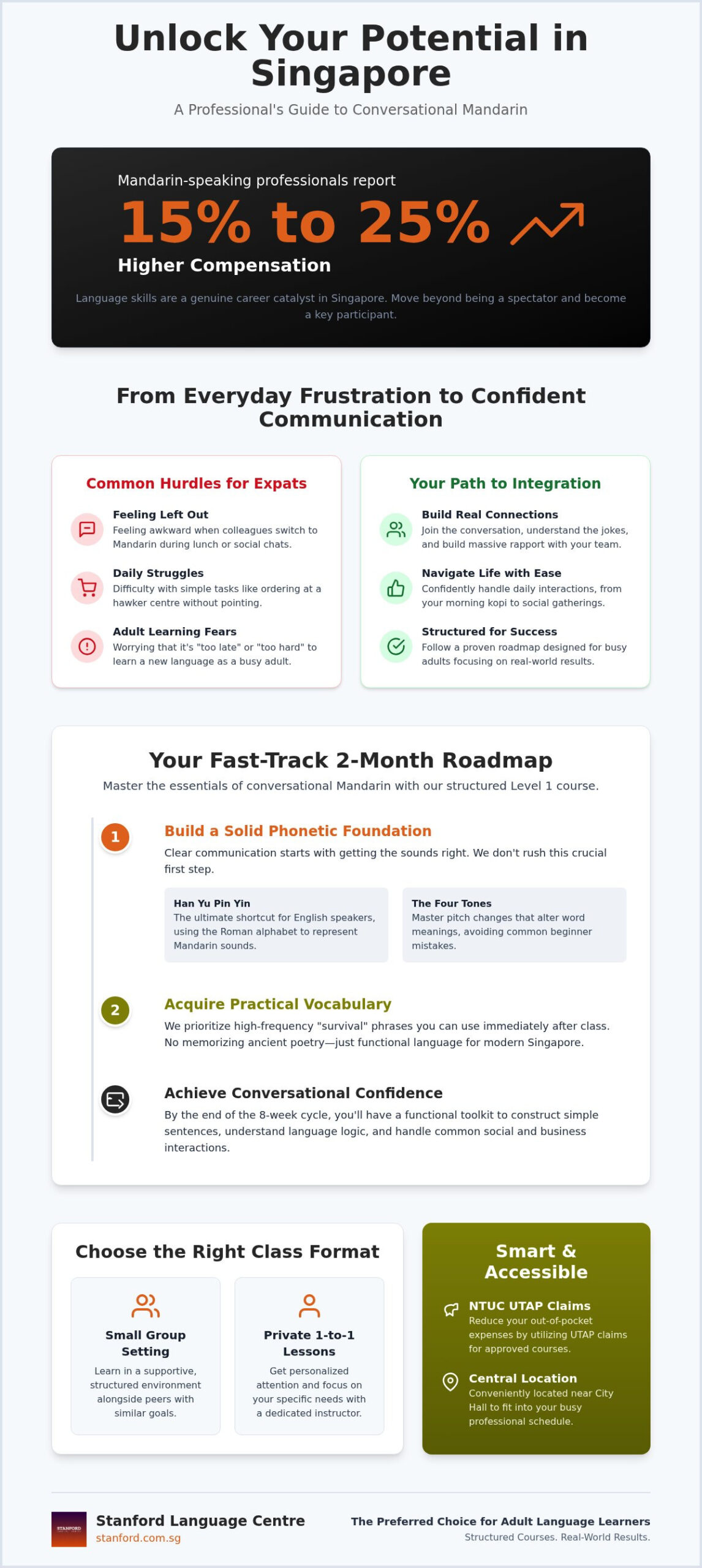
Did you know that Mandarin-speaking professionals in Singapore report between 15% and 25% higher compensation than their monolingual peers in 2026? It’s a striking figure that proves language skills are a genuine career catalyst. Yet, for many, the reality of living here involves feeling awkward when colleagues switch to Mandarin or struggling to order a simple meal at the local coffee shop. You might even fear that learning as an adult is just too hard.
We understand those frustrations. It’s common to feel left out of the conversation, but it doesn’t have to stay that way. You can master practical communication through the most effective conversational mandarin classes singapore has to offer. Our structured, small-group roadmap is designed for busy adults. We focus on real-world results over academic theory. It’s about giving you the confidence to navigate work and life with ease.
This article breaks down how to find a program that fits your schedule and budget. We’ll explore fast-track two-month courses, convenient City Hall locations, and how to utilize NTUC UTAP claims to make your learning journey affordable. You’ll discover a supportive way to bridge the language gap and start connecting with the community around you today.
Key Takeaways
- Discover how practical Mandarin helps you navigate local social settings and bridge the gap between standard language and ‘Singdarin’.
- Master the essentials of Han Yu Pin Yin and the four tones to build a clear phonetic foundation for daily communication.
- Compare small group settings and private 1-1 lessons to find the best conversational mandarin classes singapore has for your specific goals.
- Learn how to reduce your out-of-pocket expenses by utilizing NTUC UTAP claims for approved adult language programs.
- Find out why a central location near City Hall makes it easier for busy professionals to maintain a consistent learning schedule.
Why Conversational Mandarin is the Key to Social Integration in Singapore
Living in the Lion City is exciting, but it can feel isolating when you don’t speak the local tongue. Conversational Mandarin isn’t just a linguistic hobby. It is a vital tool for daily social and professional survival. While English is the primary language of business, Mandarin is the heartbeat of the community. In recent decades, there has been a massive shift from dialects like Hokkien to Mandarin as the primary local Chinese language. Understanding this shift helps you see why Mandarin is now the bridge to the heart of Singapore.
When you start exploring Singaporean Mandarin, you’ll encounter “Singdarin.” This is a unique blend of standard Mandarin mixed with English, Malay, and local dialects. Learning standard Mandarin provides the foundation you need to decode these local nuances. It turns a confusing muddle of sounds into a familiar melody. By joining conversational mandarin classes singapore, you gain the ability to move from being a permanent “outsider” to a welcomed “insider.” Professionals who choose these conversational mandarin classes singapore often find that their social anxiety vanishes as their vocabulary grows.
Navigating Daily Life: From Hawker Centres to Social Circles
The “insider” transition is most visible at work. Many expats feel a sudden chill when the office banter switches to Mandarin during lunch. You aren’t being excluded on purpose; it’s just the natural flow of conversation. When you understand the nuances of these lunch-time chats, you’re no longer left out of the joke. This builds massive rapport with your team. It also impresses Mandarin-speaking clients and regional partners. Showing this level of cultural commitment demonstrates respect. It proves you aren’t just passing through, but are truly invested in the local community and your regional career. If you’re new to Singapore and looking for the right starting point, explore our guide to mandarin lessons for foreigners that prioritize practical, real-world communication from day one.
The Foundations of Conversational Chinese: What You Will Master First
Starting a new language often feels like standing at the base of a massive mountain. We make that climb feel like a steady, manageable walk. Our 2-month roadmap for Level 1 foundational courses focuses strictly on what you need for daily life. You won’t be stuck memorizing ancient poetry or complex academic scripts. Instead, you’ll be learning how to introduce yourself, navigate a business lunch, and handle common social interactions. Most adults find that focusing on high-frequency vocabulary is the fastest way to see real progress.
The first step in our conversational Mandarin classes is building a solid phonetic base. We don’t rush this part. Clear communication depends on getting the basics right from the very first lesson. By the end of the eight-week cycle, you’ll have the tools to construct simple sentences and understand the logic behind the language. It’s about giving you a functional toolkit that you can use the moment you step out of the classroom.
Han Yu Pin Yin: The Secret to Accurate Pronunciation
Han Yu Pin Yin is the phonetic system that uses the Roman alphabet to represent Mandarin sounds. It’s the ultimate shortcut for English speakers. You don’t need to master thousands of characters to start speaking; you just need to master the sounds. However, the real challenge lies in the four tones. Mandarin is a tonal language, meaning a slight shift in your pitch can completely change the meaning of a word. A common pitfall for beginners is ignoring these tones, which leads to confusion in the office or at the hawker centre. We help you correct these mistakes early. For more tips on mastering this, read our guide on how to learn a tonal language.
Practical Vocabulary for Daily and Business Use
We prioritize “survival” phrases that offer immediate utility. This includes greetings, numbers for transactions, and directions for getting around the city. While some learners might look for SkillsFuture Credit eligible courses for general academic study, our curriculum is built for practical application. We introduce basic sentence structures that allow for immediate conversation. You’ll learn how to ask questions, express needs, and build rapport with colleagues. The focus is a healthy balance between speaking and listening. While we touch on basic character recognition, the goal is always to keep you talking. This approach ensures you spend your time on words you’ll actually use during your morning coffee run or a regional team meeting. Mastering these high-frequency terms builds the confidence needed to tackle more complex social settings in the future.
Choosing the Right Class Format: Small Groups vs. Private 1-1
Finding the right fit among the various conversational mandarin classes singapore offers depends on your personal goals and learning style. Most students find themselves choosing between the social energy of a group and the focused intensity of a private tutor. Both paths lead to success, but they serve different needs. Small groups, typically consisting of 6 to 10 students, create a balanced environment. You get plenty of speaking time without the higher cost of a solo session. It’s a pragmatic way to stay motivated while keeping your budget in check.
We also provide specialized tracks for Japanese and Korean speakers. These learners often progress faster because their native languages share deep linguistic roots with Mandarin. Japanese speakers already understand many Kanji meanings, while Korean speakers often find Hanja-based vocabulary familiar. If you’re a Japanese professional looking to leverage your existing literacy, our dedicated program for mandarin for japanese speakers singapore is designed to accelerate your progress by building on what you already know. By grouping students with similar linguistic backgrounds, we can tailor the pace and focus of the lessons. This addresses a common gap in generic language schools that treat every beginner exactly the same regardless of their starting point.
Looking at retention, the choice between online and in-person learning is vital. Online classes offer unmatched convenience for busy professionals. However, in-person sessions often provide better conversational retention. There’s something about the physical presence of a teacher and peers that makes the language stick. You pick up on body language and subtle cues that are sometimes lost through a screen. This real-world interaction is hard to replicate in a purely digital space.
Small Group Mandarin Lessons for Foreigners and Expats
Learning alongside peers who face the same challenges is incredibly motivating. You quickly realize you aren’t the only one struggling with a specific tone or sentence structure. This shared experience builds a strong sense of community. Our small group mandarin lessons rely heavily on interactive role-playing. Instead of just reading from a textbook, you’ll practice real-life scenarios. This might involve simulating a business lunch or navigating a trip to the doctor. It’s a low-pressure way to build confidence before you test your skills in the community. For expats and overseas professionals, our dedicated mandarin lessons for foreigners in Singapore are structured to get you speaking confidently in the shortest time possible.
Private 1-1 Mandarin in Singapore for Fast Progress
If you have a specific deadline or a unique business niche, private lessons are the ideal answer. We customize the curriculum to fit your world. If you need to master industry-specific jargon or prepare for a regional presentation, we focus on that. This format is perfect for busy executives who require flexible scheduling. If a last-minute meeting pops up, your lesson can move with you. Our private 1-1 mandarin Singapore sessions ensure you get 100% of the instructor’s attention. It’s the fastest way to bridge the gap between basic knowledge and professional fluency.
Navigating Course Fees and NTUC UTAP Claims in Singapore
Investing in your future shouldn’t break the bank. Finding quality conversational mandarin classes singapore is easier when you understand the local funding landscape. While many adults search for government credits, the most effective financial tool for learners here is the NTUC Union Training Assistance Programme (UTAP). It’s a dedicated fund designed to help union members upgrade their skills without the stress of high costs. This subsidy is a game-changer for anyone looking to improve their professional presence.
The subsidy is generous. NTUC members can claim 50% of unfunded course fees for approved programs. If you’re under 40, your annual funding cap is $250. For those 40 and older, that cap doubles to $500. It’s a significant saving that makes professional training much more accessible. We need to be clear about one thing: SkillsFuture credits are not accepted for our courses. We prioritize the UTAP system because it offers a reliable and focused way for our students to subsidize their learning journey in 2026.
How to Claim NTUC UTAP for Your Mandarin Course
Applying for your reimbursement is a straightforward task. You must maintain a minimum attendance of 75% to qualify for the claim. Once your course is finished, you have a six-month window to submit your application through the NTUC portal. Keep your invoice and certificate of completion handy for a smooth process. UTAP is about making professional growth a reality for every worker in Singapore. It removes the financial barrier and lets you focus on what matters: your progress.
Value for Money: Comparing Duration and Quality
A lower price tag doesn’t always mean better value. A $385 course for 10 lessons in a small group often provides a better ROI than a cheaper, larger class. This is because you get significantly more speaking time and immediate feedback from your instructor. Always look out for hidden costs like registration fees or expensive materials that aren’t included in the initial quote. We focus on a no-frills, high-quality experience that respects your time and budget. Our long track record in adult education ensures you’re getting the best possible start. View our UTAP claimable Mandarin courses and start your journey today.
Why Stanford Language Centre is the Preferred Choice for Adults
Stanford Language Centre has spent over 20 years perfecting the way adults learn. We’ve seen thousands of students walk through our doors. Many arrive feeling nervous about their ability to pick up a new language. Our mission is to replace that anxiety with genuine confidence. Choosing the right conversational mandarin classes singapore can be overwhelming, but our focus on adult-only learning makes the choice simple. We’ve chosen a strategic location near City Hall to make your journey as easy as possible. It’s a short walk from the station. This means you can drop in for after-work classes without adding a long commute to your day.
Our approach is built on a “Student-First” philosophy. We don’t believe in burying you under piles of academic theory. Instead, we prioritize practical results. If you can’t use what you’ve learned in the real world, it isn’t useful. This pragmatic focus is what sets our conversational mandarin classes singapore apart from traditional academic institutions. We want you to speak, not just study. We’ve refined our curriculum over two decades to ensure it meets the specific needs of busy professionals and expats living in the city.
A Supportive Environment for Non-Native Speakers
We act as your “friendly guide” through the learning process. This lowers the barrier to entry for beginners who might feel intimidated by the complexity of Mandarin. Our small class sizes ensure that every student gets ample speaking time. You won’t be just another face in a crowded room. You’ll be an active participant in every conversation. This hands-on method is the core of our Conversational Mandarin Level 1 program. It’s designed specifically for those who need a practical starting point in Singapore.
Corporate Training Solutions for Diverse Workforces
Modern businesses in Singapore often have diverse, multicultural teams. We offer tailored corporate programs for companies looking to upskill their expat staff. These solutions are flexible. We can provide on-site training at your office or host online sessions to fit your corporate schedule. Language training does more than just teach new words. It improves team cohesion. It builds better rapport with regional clients and partners. When your team can communicate effectively in the local language, it shows a level of commitment that clients truly appreciate. Our corporate training helps bridge cultural gaps and strengthens professional relationships across the board.
Step into Your Next Chapter of Local Connection
Mastering a new language is about more than just vocabulary; it’s about opening doors to new friendships and professional opportunities. You’ve seen how standard Mandarin helps you bridge the gap with local “Singdarin” and why small groups provide the perfect environment for practice. By choosing the right conversational mandarin classes singapore offers, you move from the sidelines into the heart of the conversation. It’s a practical investment in your future and your community.
Financial barriers shouldn’t hold you back from progress. With NTUC UTAP claimable programs making courses more affordable and our convenient City Hall location, fitting lessons into your busy life is easier than ever. We focus on practical results that you can use immediately. Our small group focus ensures you get the attention you deserve. Start your journey with a supportive community that understands your goals and respects your time.
Book Your $385 Conversational Mandarin Course at Stanford Language Centre Today
You have the tools and the roadmap. Now it’s time to take that first step toward fluency. We’re here to guide you every step of the way.
Frequently Asked Questions
Is conversational Mandarin difficult for English speakers to learn?
Mandarin is often seen as difficult, but focusing on conversation makes it accessible. You don’t need to learn thousands of characters to start speaking. By using Han Yu Pin Yin, English speakers bypass the script and focus on phonetics. The grammar is simpler than most European languages because there are no verb conjugations or genders. It’s really about mastering the four tones early to ensure your message is clear from day one.
Can I use my SkillsFuture credits for Mandarin classes at Stanford Language Centre?
No, you cannot use SkillsFuture credits for our programs. We utilize the NTUC UTAP subsidy instead, which offers a reliable way for union members to offset their training costs. This is an important detail for budgeting your learning journey. While government funding for many non-certifiable courses through SkillsFuture ceased in early 2025, our UTAP-approved courses remain a highly affordable option for adult learners and professionals based in Singapore.
How long does it take to reach a basic conversational level in Mandarin?
You can reach a basic conversational level in about 20 to 30 hours of focused instruction. Our foundational course spans two months and includes 10 lessons. During this period, you’ll master high-frequency survival phrases and essential sentence structures. This timeline is perfect for busy professionals who need to see results quickly. You’ll be able to handle daily transactions and simple social interactions with confidence by the end of the two-month cycle.
Are the Mandarin classes claimable under NTUC UTAP?
Yes, our Level 1 conversational mandarin classes singapore are claimable under the NTUC UTAP scheme. Union members can receive up to 50% reimbursement on their unfunded course fees. For those under 40, the annual cap is $250, while members 40 and older can claim up to $500. You must maintain a minimum attendance of 75% and submit your claim through the NTUC portal within six months of completing the course.
What is the difference between Level 1 Mandarin and Business Chinese?
Level 1 Mandarin focuses on daily survival skills and social integration. You’ll learn greetings, numbers, and how to navigate local environments like hawker centres. Business Chinese is more specialized, focusing on industry-specific jargon and formal communication for meetings. Most professionals start with Level 1 to build a solid phonetic foundation before moving to corporate training. It’s the essential first step for any adult learner looking to build rapport with local colleagues and clients.
Do I need to learn how to write Chinese characters in a conversational course?
No, you don’t need to master writing complex characters in our conversational courses. We prioritize speaking and listening skills using the Han Yu Pin Yin phonetic system. While we introduce basic character recognition to help you navigate signs and menus, the primary goal is practical communication. This approach ensures you spend your time practicing pronunciation and sentence flow rather than memorizing individual strokes that you might rarely use in daily speech.
What happens if I miss a class in a small group setting?
We understand that busy professionals have unpredictable schedules. If you miss a class, your instructor will provide the materials and notes from that session to help you catch up. Maintaining 75% attendance is required if you plan to claim the NTUC UTAP subsidy, so we encourage consistent participation. Our small group size makes it easier for the teacher to check in on your progress and ensure you haven’t missed any foundational concepts.
Are there specialized classes for Japanese or Korean speakers?
Yes, we offer specialized conversational mandarin classes singapore specifically for Japanese and Korean speakers. These learners often progress faster because their native languages share linguistic roots with Mandarin. Japanese speakers already have a head start with Kanji meanings, while Korean speakers find certain vocabulary very familiar. If you’re looking to leverage your existing linguistic knowledge, explore our dedicated mandarin classes for Korean speakers designed to accelerate your path to fluency. Japanese professionals can also discover how their Kanji knowledge gives them a unique advantage by reading our comprehensive guide to mandarin for japanese speakers in Singapore. By grouping these students together, we can adjust the teaching pace to leverage their existing knowledge and accelerate their path to fluency in a supportive environment.