You might think a private tutor is the fastest way to master a new language, but your brain actually needs more than one voice to truly "hear" the five Thai tones. Mastering the subtle difference between a rising and a falling tone isn’t just about repetition. It’s about acoustic variety. If you’ve been trying to learn alone, it’s natural to feel a bit lost or demotivated. Joining a small group thai language class solves this by giving you a "social ear" for the language. Many beginners in Singapore worry about sounding "wrong" when they finally try to speak, but learning with others makes the process feel much safer.
You’ll discover why these intimate settings are scientifically superior for mastering conversational Thai. This article explores how group dynamics sharpen your pronunciation and keep your motivation high. We will also help you choose a foundational Thai programme in Singapore that fits your goals, ensuring you find a supportive community of like-minded learners to join you on the journey.
Key Takeaways
- Understand the “acoustic variety” concept and how hearing different voices helps you master tricky Thai tones faster than solo study.
- Discover how a small group thai language class of 4 to 8 adults provides the perfect balance between personal attention and social interaction.
- Compare the cost-effectiveness and sustainable pacing of group learning versus private lessons to find the best value for your time.
- Identify the essential qualities of a top-tier language school, such as native-speaking instructors who specialise in teaching adult beginners.
- Learn how to make your education more affordable by utilising NTUC UTAP claims for foundational Level 1 programmes in Singapore.
What Defines a Small Group Thai Language Class?
A small group thai language class isn’t just about the number of chairs in a room. It’s a structured learning environment typically consisting of 4 to 10 adult learners. This specific range is the industry standard for adult education in Singapore because it hits the "sweet spot" for social interaction. You get enough peer variety to practice with different voices, yet the group remains small enough that you’re never left behind in the back of the class.
The focus here is pragmatic. Instead of getting bogged down in dense academic grammar, these classes prioritise foundational conversational Thai. Your instructor acts less like a distant lecturer and more like a moderator and coach. They guide the flow of conversation, correct your tones in real-time, and ensure everyone stays engaged. This format is popular because it acknowledges that busy professionals need results they can use immediately in the real world.
The Core Components of a Small Group Setting
The most significant benefit is the high teacher-to-student ratio. In a small group thai language class, the instructor has the bandwidth to listen to your individual pronunciation. This is vital for Thai, where a slight shift in pitch changes the entire meaning of a word. By understanding how people learn a second language, these courses leverage social interaction to help your brain map new sounds more effectively.
- Individual Attention: Instructors can spot and fix pronunciation errors before they become habits.
- Structured Level 1 Curriculum: A programme designed specifically for beginners to build confidence step-by-step.
- Interactive Learning: Elements like role-playing and pair-work activities make the two-hour sessions fly by.
Conversational vs. Academic Focus
Many traditional courses start with the Thai alphabet. While important, it can be overwhelming for a beginner. Small groups often pivot toward daily life scenarios first. You’ll learn how to order food, take a taxi, or introduce yourself before tackling complex script memorisation. This ensures you feel a sense of progress from your very first lesson.
To make this easier, instructors use phonetic systems. These systems bridge the gap for English speakers, allowing you to speak clearly without needing to read Thai characters perfectly yet. Conversational Thai is a tool for immediate social integration. It’s about using the language as a bridge to connect with others. This "student-first" approach keeps motivation high because the skills you learn on Tuesday can be used on your next trip to Bangkok or at a local Thai eatery in Singapore by Friday.
The Tonal Advantage: Why Groups Beat Solo Learning
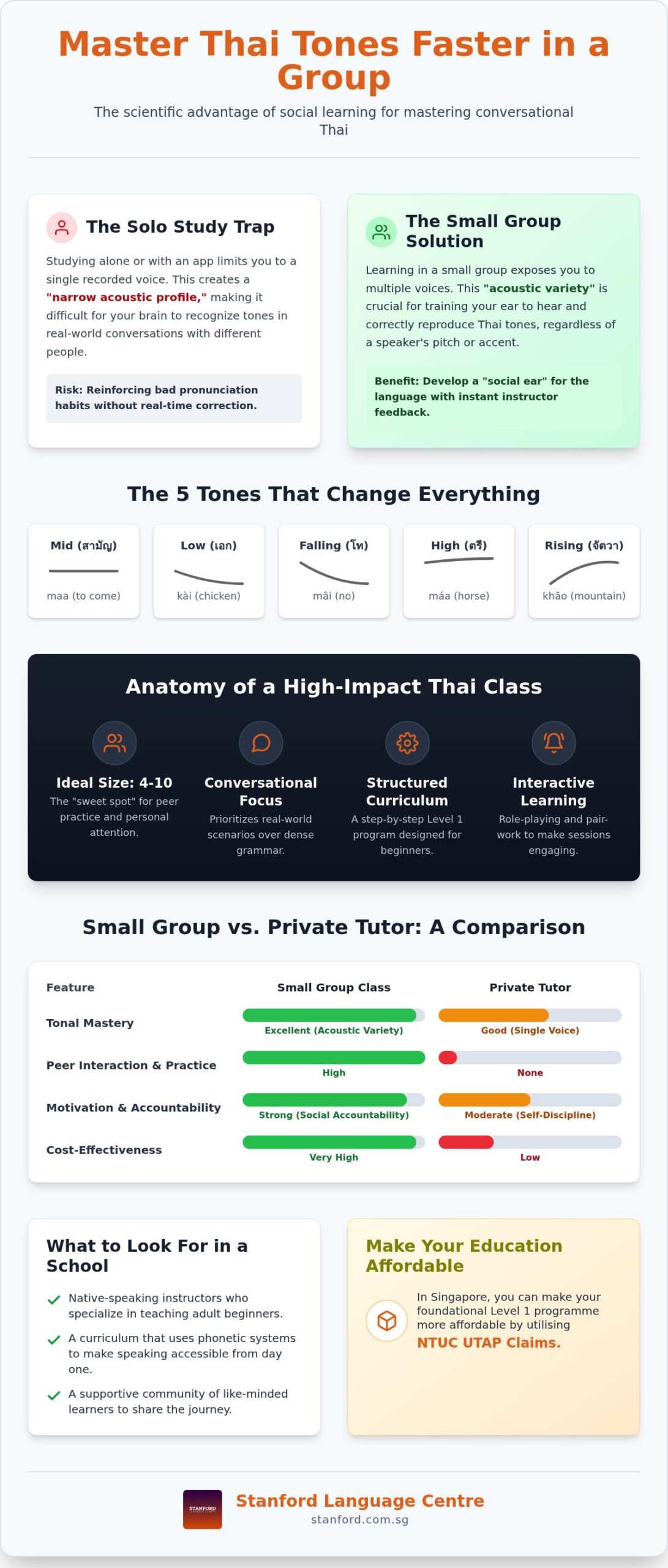
The biggest hurdle for any beginner is the five Thai tones: mid, low, falling, high, and rising. Mastering these isn’t just about memory. It’s about ear training. When you study alone with an app, you’re usually listening to a single recorded voice. This creates a narrow acoustic profile. In a small group thai language class, you hear the same tone produced by five or six different people. This "acoustic variety" is essential. It teaches your brain to recognise the tone regardless of whether the speaker has a deep voice or a high pitch.
Real-time correction is another non-negotiable factor. Tones are slippery. You might think you’re saying "near" (klâi), but you’re actually saying "far" (klaay). Without an instructor there to catch the error instantly, you risk reinforcing bad habits. Research into education models suggests that these small-group interventions have a positive effect on language skills because they allow for immediate, personalised feedback in a social context.
Training Your Ear Through Peer Interaction
Hearing a classmate make a tonal error is actually a learning shortcut. It’s often easier to spot a mistake in someone else’s speech than in your own. When the instructor corrects a peer, you subconsciously check your own pronunciation. This environment reduces the "fear of sounding silly" because everyone is in the same boat. You aren’t the only one struggling with a rising tone; your peers are right there with you. For those looking for specific drills, our guide on how to learn a tonal language offers deeper phonetic strategies to use during your practice sessions.
The Role of Social Accountability
Apps are great until life gets busy. It’s easy to ignore a notification, but it’s much harder to skip a session with people you’ve come to know. Group dynamics prevent the common "drop-out" phenomenon that plagues solo learners. We use a "Friendly Guide" teaching style that balances correction with encouragement. This builds a collective rhythm. The class moves forward together, ensuring no one feels isolated or left behind. If you’re ready to start, exploring a small group Thai class could be the key to finally making those tones stick. This shared journey makes the challenging parts of the language feel much more attainable.
Small Group vs. Private Thai Lessons: A Comparison
Deciding between a small group thai language class and private tutoring often comes down to your personal learning style and schedule. For many, the group format provides a superior return on investment. Private lessons are undeniably focused, but that focus can be exhausting for a total beginner. Without "peer breaks" to listen and reflect while someone else speaks, you might face learner burnout. In a group, you get those vital moments to process a new tone or sentence structure while the instructor works with a classmate.
The social element shouldn’t be overlooked. Singapore is a hub for expats and professionals who want to expand their horizons. Learning in a group puts you in a room with people who are facing the same challenges. These shared "aha!" moments create a bond that solo study simply can’t replicate. It turns a weekly lesson into a social highlight rather than just another item on your to-do list. Use this simple framework to decide:
- Choose a group if you want a social atmosphere and better value for money.
- Choose private if you have a very specific deadline or an unpredictable schedule.
- Choose a group if you’re a Level 1 beginner who benefits from hearing multiple voices.
Analysis of Learning Dynamics
Group dynamics are social and varied, whereas private lessons can feel rigid and intensive. Small groups allow for observational learning. This means you learn just as much from your peers’ questions as you do from your own. The TESOL International Association emphasizes the Benefits of Small-Group Reading Instruction, which include higher levels of interaction and a much lower stress environment. If you require a highly customised schedule due to frequent travel, Private Thai Lessons in Singapore are a great alternative.
Financial Considerations in Singapore
Hourly rates for group sessions are generally much more affordable than one-on-one tutoring. In Singapore, this is even more pronounced when you consider subsidies. Many group programmes are NTUC UTAP claimable, allowing eligible students to offset a portion of their course fees. Group classes are the most accessible entry point for most budgets. This financial flexibility makes it easier to commit to the long-term journey of mastering a new language.
What to Look for in a Thai Language School
Selecting the right school in Singapore is just as important as the learning format you choose. You need a partner that understands your specific goals and provides a clear roadmap to reach them. Start by looking for native-speaking instructors who have specific experience teaching adults. Adults learn differently than children; we need logic, context, and practical application. A small group thai language class led by a professional coach ensures you aren’t just memorising sounds but actually understanding how the language works in real life.
Local credibility matters. Look for institutions with a long-standing history in the Singaporean market. Schools established since 2004 have refined their teaching methods over decades to suit local learners. They should also offer a clear progression path from Level 1 through to Advanced stages. You don’t want to finish your first module only to find there’s no follow-up course available. Flexibility is another major factor for busy professionals. Options for physical attendance or online sessions allow you to keep up with your studies even if you travel for work.
Curriculum and Methodology
A proven phonetic system is the backbone of beginner success. This system bridges the gap for English speakers who aren’t yet ready to tackle the complex Thai script. Before enrolling, ask if the focus is on "Thai for Travelers" or "Business Thai" to ensure the vocabulary matches your needs. If you’re looking for a complete checklist of what to prepare for your first lesson, check our guide on How to Learn Thai in Singapore.
Singapore-Specific Benefits
In Singapore, financial support can make your learning journey much more affordable. Many high-quality programmes are NTUC UTAP claimable, which can offset up to 50% of your course fees for eligible members. It’s a common misconception that all quality schools must accept SkillsFuture credits. Some of the most specialised language centres in the city focus on UTAP instead to maintain high standards for adult learners. Finally, consider the location. A centrally located school makes it easy to attend a small group thai language class straight after work without a long commute, helping you stay consistent with your attendance.
Ready to start your journey with a supportive community? Explore our small group Thai class options and find the right fit for your schedule today.
Start Your Journey with Stanford Language Centre
At Stanford Language Centre, we believe learning should feel like a conversation with friends. Our student-first philosophy ensures you’re in a relaxed, unpretentious environment from the moment you walk in. We don’t do intimidating lectures or academic posturing. Instead, we offer a small group thai language class that feels like a shared adventure. We specialise in making the first step easy for beginners by focusing on foundational Level 1 Thai. You won’t just learn a language; you’ll gain a supportive mentor in our expert native instructors. They are down-to-earth experts who act as approachable allies in your journey.
Why Stanford is the Preferred Choice for Adults
We’ve been a staple of the Singaporean language landscape since 2004. Over two decades, we’ve refined a pragmatic curriculum that gets you speaking from Day 1. We know you’re busy. You need skills that work in real-world settings. Our programme is designed to provide immediate results without overwhelming you with theoretical complexity. We take a "no-frills" approach to quality, focusing on what actually helps you communicate. For those looking at the bigger picture, our Thai Language Course Singapore pillar helps with long-term planning. It’s about building a solid foundation today so you can navigate Thailand with confidence tomorrow. This consistency is why so many professionals trust us to guide their learning journey.
Next Steps to Fluency
Joining our next intake is straightforward and efficient. Our online registration process is simple, with no hidden fees or complicated hurdles. We’re here to help you every step of the way, including assistance with your NTUC UTAP claim documentation. Many of our students are eligible for these subsidies, making a small group thai language class a very cost-effective choice for adult learners. Beyond the lessons, you’ll join a vibrant community of learners who share your passion for Southeast Asian culture. It’s a place to meet like-minded people, practice your tones, and grow together in a supportive space. We’re ready to help you start this new chapter whenever you’re ready. Simply reach out to our team to find the next available slot that fits your schedule.
Take the Next Step Toward Fluent Thai
Mastering a tonal language doesn’t have to be a solo struggle. Choosing a small group thai language class gives you the acoustic variety and real-time feedback needed to perfect those five tricky tones. You’ve seen how the social dynamic keeps motivation high while providing a cost-effective alternative to private tutoring. It’s about more than just vocabulary; it’s about building the confidence to speak clearly in real-world settings. By learning alongside others, you sharpen your ear and refine your pronunciation in a way that apps simply can’t replicate.
At Stanford Language Centre, we’ve provided a specialised adult learning environment since 2004. Our programmes are designed to be pragmatic and accessible, ensuring you get the conversational results you need. Don’t forget that our courses are NTUC UTAP claimable for eligible members, making it easier than ever to invest in your personal growth. We pride ourselves on being a friendly guide for every student who walks through our doors.
Join our next Small Group Thai Class intake at Stanford Language Centre and start speaking with confidence. We’re ready to help you bridge the gap between learning and actually communicating. Your journey to fluency starts with a single, supportive step.
Frequently Asked Questions
How many students are typically in a small group Thai class?
Our small group thai language class usually consists of 4 to 10 adult learners. This specific size ensures a high teacher-to-student ratio while providing enough acoustic variety for effective ear training. It’s the ideal balance for beginners who need individual attention for tones but benefit from hearing peers practice. We keep groups intimate to foster a relaxed environment where every student feels comfortable participating in role-playing and conversational activities.
Can I learn Thai if I have no prior experience with tonal languages?
You certainly can learn Thai without prior experience. Most of our Level 1 students are total beginners with no background in tonal languages. We use a proven phonetic system to bridge the gap for English speakers. This approach allows you to focus on mastering the five Thai tones through listening and speaking before worrying about the script. Our native instructors act as supportive mentors to guide you through the initial challenges.
How long does it take to finish a Level 1 Thai course?
A standard Level 1 Thai programme typically spans 10 to 12 weekly sessions. Each class usually lasts about two hours. This timeframe is designed to build a solid foundation in basic conversational skills without causing learner burnout. By the end of the course, you’ll be able to handle daily life scenarios like ordering food or introducing yourself. We focus on practical results so you can start using your new skills immediately.
Is it possible to claim NTUC UTAP for Thai language classes?
Yes, our Thai language courses are NTUC UTAP claimable for eligible members. This subsidy is a fantastic way to offset a portion of your course fees, making your small group thai language class even more affordable. We provide the necessary assistance with claim documentation to ensure a smooth process. It’s part of our commitment to providing value and accessibility for adult learners in Singapore who are looking to upgrade their skills.
Do you offer online options for small group Thai lessons?
We offer online Thai language classes to provide maximum flexibility for our students. These virtual sessions maintain the same small group dynamic as our physical classes. They are perfect for busy professionals or those who travel frequently for work. You still get real-time correction from native instructors and interact with your peers through a digital platform. This ensures you never have to put your learning journey on hold due to a busy schedule.
What happens if I miss a lesson in a group class?
If you miss a session, we provide the course materials so you can catch up on what was covered. Our instructors are also available to briefly recap key points during the next lesson to ensure you don’t feel left behind. Since we focus on a structured Level 1 progression, staying consistent is important. However, our supportive environment and clear curriculum make it easy to rejoin the class rhythm even if you miss an occasional session.
Is the Thai script taught in the beginner small group class?
Our Level 1 beginner classes prioritise conversational skills and phonetic systems rather than the Thai script. We believe this is the most effective way to build immediate confidence in speaking and listening. Mastering the five tones is the first priority for any beginner. For those who wish to progress further, we offer a dedicated Thai reading and writing class as a separate module once you have established a solid conversational foundation.
Why doesn’t Stanford Language Centre accept SkillsFuture credits?
We’ve chosen to focus on providing NTUC UTAP claimable programmes to maintain our specialised standards for adult language education. While we don’t accept SkillsFuture credits, the UTAP subsidy offers a reliable way for many Singaporeans to offset their course costs. This focus allows us to refine our "no-frills" approach to quality and keep our curriculum strictly aligned with the practical needs of expats and local professionals seeking conversational fluency in Singapore.