What if you could order your favorite Pad Thai in fluent Central Thai without the “farang” accent or the constant fear of getting the tones wrong? Many adults looking to learn thai for beginners singapore feel held back by the myth that tonal languages are too difficult for non-native speakers. You might worry about finding the time for long academic courses or feel confused about whether SkillsFuture or UTAP subsidies apply to your lessons. It’s a common frustration for busy professionals who just want practical, real-world results.
We believe learning a new language should be a low-stress, rewarding journey. This 2026 guide offers a clear roadmap to master conversational Thai basics through a student-first approach that prioritizes speaking over dense theory. You’ll discover how to navigate basic travel situations and finally make sense of the tonal system without the headache. We also clarify how to utilize local grants like NTUC UTAP to significantly lower your course fees. From understanding essential vocabulary to maximizing your training budget, here is everything you need to start speaking Thai with confidence.
Key Takeaways
- Focus on conversational results rather than complex script mastery to start speaking Thai quickly and confidently.
- Discover the most effective way to learn thai for beginners singapore by choosing between social small group classes or flexible private 1-1 lessons.
- Follow a practical 8-week roadmap that moves from basic greetings to confidently ordering food and navigating travel situations.
- Learn how to offset your training costs using NTUC UTAP subsidies, making professional language classes highly accessible for Singaporeans and PRs.
- Benefit from a pragmatic curriculum led by native Thai teachers who prioritize real-world speaking skills over academic complexity.
Understanding the Thai Language Landscape for Singaporeans
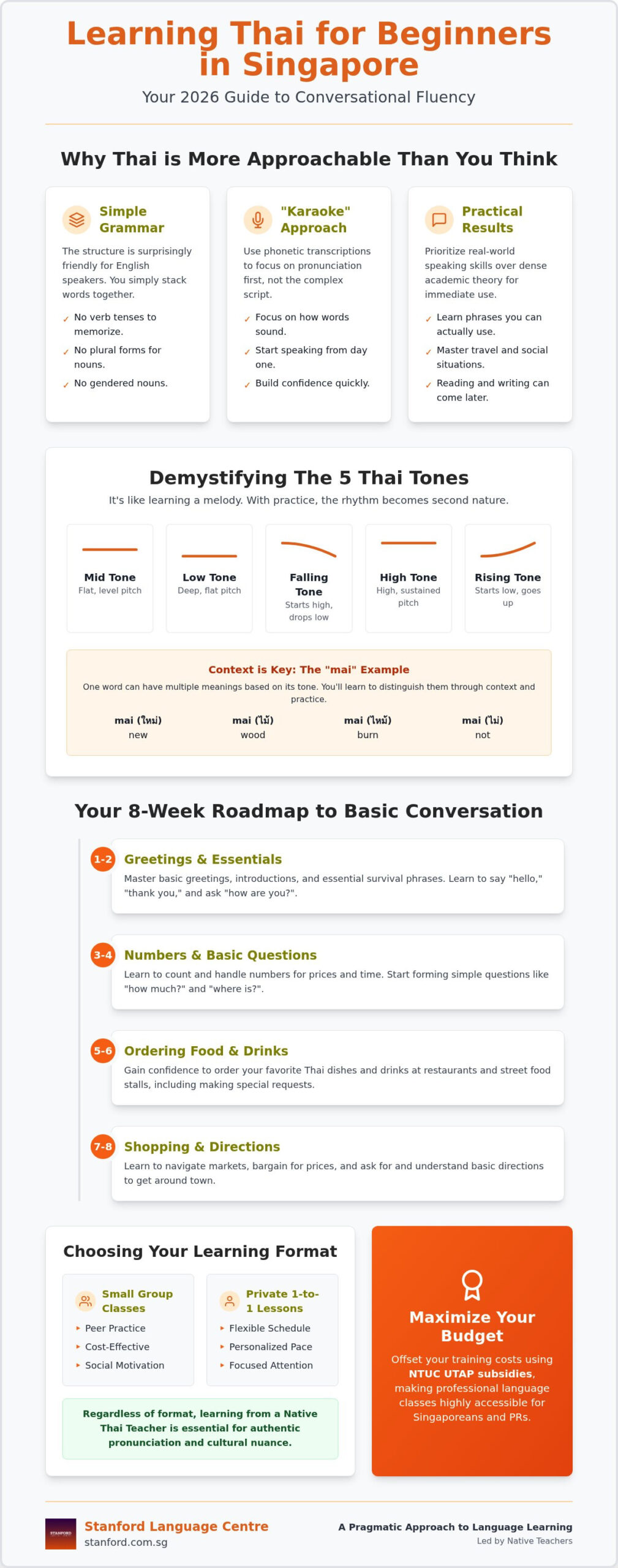
Singaporeans have a deep-rooted love for Thailand. It’s our favorite weekend getaway and a major hub for regional business. But to truly connect with the culture, you need to speak the language. If you want to learn thai for beginners singapore, the good news is that the structure of the Thai language is actually quite friendly for English speakers. While the script looks beautiful and complex, the grammar is remarkably simple. There are no verb tenses to memorize. There are no plurals or gendered nouns. You simply stack words together to build a sentence.
We recommend a “Karaoke” approach for your first few months. This means using phonetic transcriptions rather than trying to master the Thai alphabet immediately. By focusing on how words sound, you can start speaking on day one. Beginners should always prioritize conversational fluency. Reading and writing can come later once you’ve built a solid foundation of spoken words. Once you’re ready to take that next step, enrolling in a thai writing course singapore is the most effective way to transition from phonetics to full literacy. It’s about getting fast, practical results that you can use at a Bangkok night market or in a boardroom. This pragmatic focus is the best way to learn thai for beginners singapore without feeling overwhelmed by academic theory.
The Tonal System: Easier Than You Think
Thai uses five distinct tones: mid, low, falling, high, and rising. This can feel intimidating at first. A single word can have different meanings based on its pitch. For example, the word “mai” can mean “new”, “wood”, “burn”, or “not” depending on how you say it. Don’t let this scare you. Our native teachers help you “hear” these differences through repetitive, real-life dialogue. It’s like learning a melody. Once you catch the rhythm, the tones become second nature. You’ll quickly learn to distinguish between “suay” (beautiful) and “suay” (bad luck) through context and consistent practice.
Why Learn Thai in Singapore in 2026?
Choosing Your Learning Format: Group vs. Private Lessons
Deciding how to study is the first major step toward success. When you look to learn thai for beginners singapore, you’ll generally choose between social group settings or intensive private coaching. Both paths offer unique benefits. The right choice depends on your personal learning style, your budget, and how much time you can realistically commit each week.
Regardless of the format, native Thai teachers are a non-negotiable requirement. They provide the authentic accent and cultural nuance that apps or non-native speakers simply cannot replicate. Hearing the correct pitch from a local expert is the fastest way to avoid common pronunciation traps. While online classes offer unmatched convenience for a busy professional in the CBD, in-person sessions often provide better acoustic clarity for mastering those tricky five tones.
The Benefits of Small Group Thai Classes
Small group classes are the most popular choice for adults. They offer a low-pressure social environment where you can practice with peers. This peer-to-peer interaction helps reduce the initial embarrassment of making tonal mistakes. You quickly realize that everyone is facing the same challenges. A structured curriculum ensures you don’t skip essential foundational grammar while keeping the pace steady and predictable. Research shows that a small group thai language class gives you the acoustic variety of hearing multiple voices, which is scientifically proven to sharpen your ability to distinguish the five tones faster than studying alone.
- Peer Practice: Mimics real-life conversation in a safe space.
- Cost-Effectiveness: Group rates are significantly more affordable than private tutoring.
- Social Motivation: Learning with others keeps you accountable and engaged.
Many learners also search for SkillsFuture funding for Thai courses to help offset the costs of these group sessions. If you prefer a supportive community, our small group Thai class options are designed to get you speaking from day one.
When to Opt for Private Thai Tutoring
Sometimes a standard schedule just doesn’t fit a Singaporean corporate life. If you have an erratic work schedule or need specific industry vocabulary, private lessons are the superior choice. Whether you work in real estate, logistics, or regional sales, 1-1 coaching allows you to focus entirely on the words you’ll actually use in your daily professional life.
Private tutoring offers an intensive focus on your individual pronunciation hurdles. It’s a “student-first” approach that allows you to move at your own speed. You can spend more time on the five tones or rush through the basics if you’re a fast learner. If you need a tailored way to learn thai for beginners singapore, private thai lessons singapore provide that edge. Most importantly, it gives you the flexibility to reschedule around late-night meetings or last-minute business trips to Bangkok without falling behind a class.
Your 8-Week Roadmap to Basic Conversational Thai
Success in a new language isn’t about talent. It’s about having a clear, actionable plan. If you want to learn thai for beginners singapore, you need a structure that moves you from “hello” to “how much” in a matter of weeks. Most adults don’t have years to spend in a classroom. They need results they can use on their next trip to Bangkok or during a regional business meeting. This roadmap focuses on high-impact vocabulary and conversational confidence.
By following a step-by-step progression, you’ll see measurable progress every fortnight. This isn’t just about memorizing words. It’s about building the muscle memory needed to produce the right sounds. While the SkillsFuture national movement encourages lifelong learning, the key is choosing a course that respects your time. Here is how you can transform from a complete novice to a confident speaker in just two months.
Phase 1: The Foundations of Sound
The first two weeks are all about calibration. We skip the Thai alphabet entirely at this stage. Instead, we use phonetic charts that allow you to read and speak immediately. You’ll master essential greetings and introductions while learning the “politeness particles” like Khrap (for men) and Kha (for women). These small words are vital; they make you sound natural and respectful. Native teachers play a critical role here because they catch and correct your tonal slips before they become bad habits. By the end of week two, you’ll have a solid grasp of the five-tone framework.
Phase 2: Practical Daily Interaction
Weeks three and four focus on survival skills. We dive into the Thai numbering system, which is essential for handling prices, dates, and times. You’ll engage in role-playing scenarios that mimic real-life situations. One lesson might involve haggling at a Chatuchak-style market, while the next focuses on a formal business introduction. We also introduce “Question Words” like who, what, and where. These are the engines of conversation. They allow you to keep a dialogue flowing even with a limited vocabulary. This practical approach is why many choose to learn thai for beginners singapore through immersive, scenario-based training.
The final month moves into sentence construction. In weeks five and six, you’ll learn how to stack words using basic grammar rules to form complex thoughts. Finally, weeks seven and eight are dedicated to full dialogues. You’ll practice ordering specific food items, giving directions to a driver, and sharing basic personal stories. By the time you finish your eighth week, you’ll be ready to transition into Level 2 with a strong foundation of spoken Thai.
Maximizing Financial Subsidies: NTUC UTAP for Thai Courses
Learning a new language is an investment in your future. While many students immediately look for SkillsFuture credits, there is a powerful alternative that often goes overlooked. For Singaporeans and PRs who are NTUC members, the Union Training Assistance Programme (UTAP) is a game-changer. It’s a pragmatic way to learn thai for beginners singapore while keeping your out-of-pocket costs low. This subsidy is specifically designed to encourage working adults to pick up new skills without the financial stress.
The beauty of UTAP lies in its yearly refresh. Unlike SkillsFuture credits, which are a finite pool, UTAP provides an annual training allowance. This means you can fund your Level 1 course this year and still have support for advanced levels in the future. It’s about maximizing your training budget to achieve long-term fluency. By leveraging these local grants, professional language training becomes much more accessible for the average professional.
What is NTUC UTAP?
UTAP is a training benefit for NTUC members intended to defray the cost of professional development. In 2026, the funding covers up to 50% of unfunded course fees. The annual caps are generous. Members below 40 years old can claim up to S$250 per year. If you are 40 or older, your cap increases to S$500. This significantly reduces the net cost of your lessons. To qualify, you simply need to maintain an active NTUC membership and achieve at least 75% attendance during your course. The claim process is straightforward:
- Log in to the NTUC U Portal after your course ends.
- Select your approved training provider and course title.
- Submit your claim within 6 months of completing the lessons.
UTAP vs. SkillsFuture: What Beginners Should Know
Why should you prioritize UTAP? It’s all about strategy. Many learners save their SkillsFuture credits for massive career pivots or expensive certifications. Since Thai language courses are often priced at a point where UTAP can cover a large portion of the fee, it makes sense to use the union benefit first. This allows you to learn thai for beginners singapore while keeping your SkillsFuture credits intact for other needs. It’s a “student-first” way to manage your personal development fund.
We focus on providing high-impact training that qualifies for these subsidies. Our NTUC Utap claimable Thai class ensures you get native-level instruction at a fraction of the usual cost. This no-frills approach to quality means you spend less time worrying about the price and more time mastering your tones. By choosing a UTAP-approved centre, you are guaranteed a curriculum that meets professional standards while remaining affordable for the everyday learner.
Why Stanford Language Centre is the Preferred Choice for Thai
Stanford Language Centre stands out because we focus on what actually works for busy adults. We know you don’t have time for academic fluff. Our native Thai teachers are experts at identifying the common mistakes Singaporean learners make. Whether it’s the influence of Singlish or the struggle with specific tones, our team provides the tailored feedback you need to sound authentic. This is the most practical way to learn thai for beginners singapore without feeling like you’re back in a stuffy lecture hall. We bridge the gap between classroom theory and real-world application.
Efficiency is at the heart of our curriculum. We’ve condensed 12 lessons of essential content into 10 high-impact sessions. This means you reach conversational milestones faster and see immediate results. Our central location makes it easy to attend after work; we also offer flexible online options for those who prefer learning from home. We prioritize a student-first environment where your personal goals are the main focus. It’s about giving you the tools to succeed in the shortest time possible.
Our “No-Frills” Quality Approach
We believe in direct, results-oriented teaching. From your very first day, you’ll be speaking and practicing dialogue. We keep our small group Thai Class sizes limited to ensure every student receives personal pronunciation feedback from their mentor. You won’t find distant academic authorities here. Instead, you’ll find friendly, supportive mentors who view themselves as partners in your journey. Quality doesn’t have to be complicated. Our no-frills approach means we focus on the utility of the language. We teach you how to use Thai in real-world settings, from business meetings to casual travel interactions. This pragmatic focus is why we are the preferred choice for those who want to learn thai for beginners singapore effectively.
Start Your Thai Journey Today
Enrolling in our Level 1 Basic Thai course is simple. We offer regular intakes throughout the year to fit your schedule. During your first lesson at our Singapore centre, you can expect a warm, welcoming atmosphere. We’ll dive straight into the basics of the tonal system and essential greetings. You’ll leave your first session with the confidence that you can actually master this language. We promise to help you speak Thai in 2 months with our structured roadmap. Take the first step toward fluency with a team that understands your needs. View our upcoming Thai class schedule and enroll now to secure your spot in our next intake.
Start Your Thai Conversation Today
Mastering a new language doesn’t have to be a daunting academic task. By focusing on conversational fluency and following a structured 8-week roadmap, you can navigate real-world situations in Thailand with total confidence. Remember to utilize local grants like NTUC UTAP to significantly lower your out-of-pocket costs. It’s a pragmatic way to upgrade your skills while staying within your budget. Since 2004, our native Thai teachers have helped adults find their voice through a student-first approach that prioritizes practical results over dense theory.
If you’re ready to learn thai for beginners singapore, now is the perfect time to take that first step. You’ll join a supportive community of learners who value efficiency and interpersonal connection. Don’t let the complexity of tones hold you back from a skill that opens business and travel doors across the region. Join our next Basic Thai intake for only $318! Our courses are NTUC UTAP claimable, ensuring high-value training is accessible to everyone. We can’t wait to see you in class and help you start your journey toward fluency.
Frequently Asked Questions
Is Thai difficult for English speakers to learn?
Thai grammar is actually simpler than English because there are no verb conjugations or gendered nouns. While the five tones require practice, they become second nature when you learn through real-world dialogue. Our native teachers focus on helping you “hear” the pitch early on. This makes the process much less intimidating for those who want to learn thai for beginners singapore without getting bogged down in complex rules.
Can I learn Thai in Singapore using SkillsFuture credits?
You should verify eligibility with each school, as some centers offer SkillsFuture while others prioritize NTUC UTAP subsidies. For instance, NTUC members can often claim up to 50% of their course fees back through UTAP. It’s a smart way to manage your training budget while picking up a new regional language. Always check the latest government portal for the most updated list of approved courses.
How long does it take to become conversational in Thai?
Do I need to learn how to read Thai script as a beginner?
Beginners should focus on phonetics and speaking before tackling the script. Learning to read and write the Thai alphabet is a rewarding challenge, but it can slow down your initial conversational progress. We recommend mastering the sounds first. Once you have a solid foundation in spoken Thai, transitioning to the script in later levels feels much more natural and less overwhelming for adult learners. Our comprehensive Thai language course Singapore buying guide can help you choose the right program when you’re ready to move from phonetics to full script literacy.
What is the difference between Level 1 and Level 2 Thai courses?
Level 1 is all about survival skills and basic sentence construction using phonetic charts. Level 2 moves into more detailed grammar and expands your vocabulary for social and professional settings. It’s the stage where you start connecting shorter phrases into full, flowing conversations. Most students feel ready to transition to Level 2 after completing their first 10 high-impact lessons and mastering the basic tonal framework.
Are online Thai classes as effective as in-person lessons?
Online classes are highly effective if they are live and interactive. You get the same real-time pronunciation feedback from native teachers as you would in a physical classroom. Many professionals prefer this format because it saves travel time across Singapore. It’s a flexible, low-stress way to learn thai for beginners singapore without sacrificing the quality of your instruction or the social connection with your peers.
How much do Thai language lessons cost in Singapore?
Fees for Thai courses usually range from S$300 to S$450 for a standard 10-session group module. Private 1-1 lessons are priced higher because the curriculum is entirely customized to your specific pace and industry needs. Don’t forget to check if your chosen course is UTAP claimable. Utilizing these subsidies can significantly reduce your out-of-pocket expenses, making professional language training much more affordable for everyone.
What happens if I miss a Thai lesson due to work?
Most language centres provide options for make-up sessions if you have a sudden work conflict. You might be able to join another group class during the same week or access catch-up materials provided by your teacher. Since a 75% attendance rate is often required to qualify for subsidies like UTAP, it’s important to coordinate with your school early to ensure you stay on track for your claim.