You don’t need to master thousands of characters to finally feel at home in Singapore. Most expats live here for years while remaining trapped in an English-speaking bubble. It’s a common story. You want to build rapport with your team or order lunch without pointing, but the fear of complex tones feels like a wall. Finding the right mandarin course for expats singapore shouldn’t feel like another full-time job. We understand that your goal isn’t a linguistics degree; it’s practical, daily connection.
This guide helps you navigate the options to find a program tailored for professional growth and daily life. We’ll show you how to gain the confidence to chat with taxi drivers and colleagues alike. You’ll discover how a supportive, low-stress environment can turn a daunting challenge into your favorite part of the week. We’re here to help you move past academic hurdles and find a community of adult learners. Let’s look at how to find a course that respects your time and delivers real-world results.
Key Takeaways
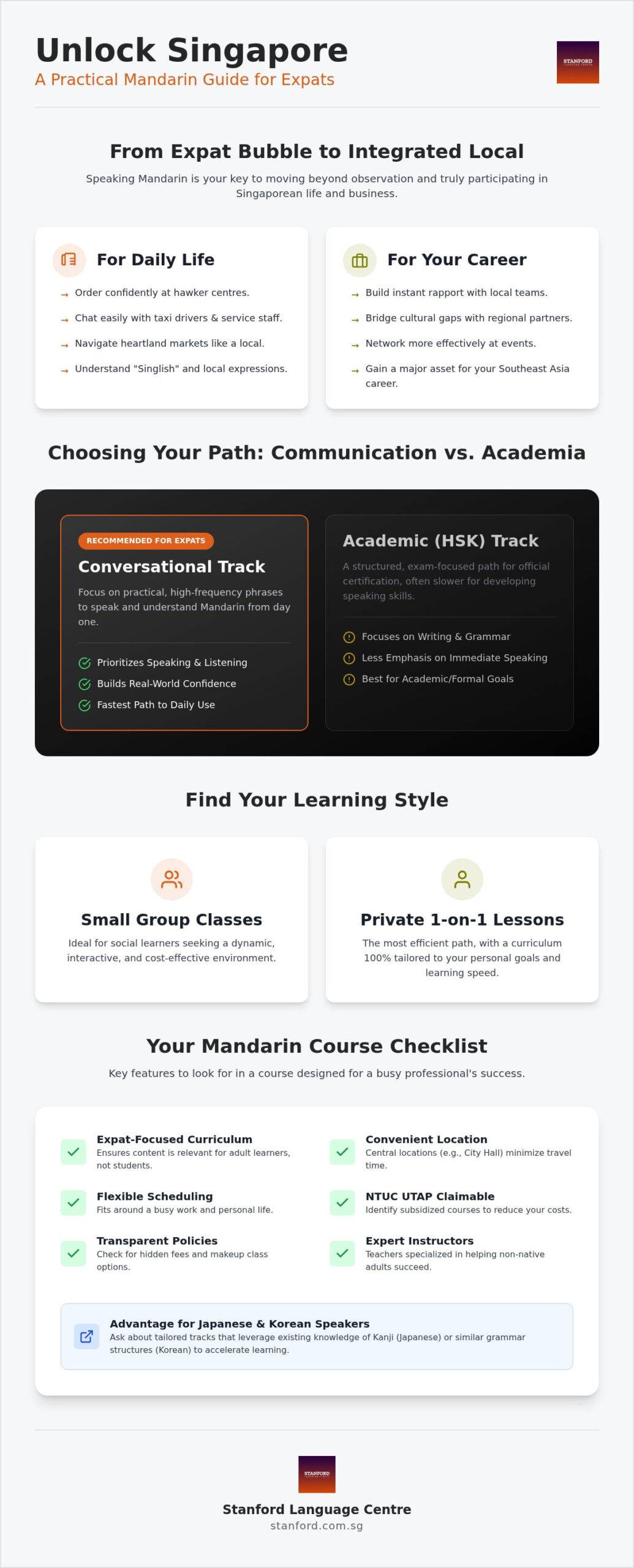
- Learn why prioritizing conversational Mandarin over academic HSK tracks helps you integrate faster into Singapore’s local and business ecosystem.
- Understand the trade-offs between social small group classes and the high-speed efficiency of private 1-1 lessons.
- Discover how to find a mandarin course for expats singapore that fits your busy schedule with convenient City Hall sessions.
- Save on your learning journey by identifying courses that are NTUC UTAP claimable to reduce your out-of-pocket costs.
- Identify the hidden fees and makeup class policies you should check before committing to any language school.
Navigating Singapore: Why Expats Are Prioritizing Mandarin in 2026
“English is enough to get by in Singapore.” You’ve likely heard this claim a dozen times. While it’s technically true, it’s also a missed opportunity. In 2026, the expat community is shifting its focus. People aren’t just looking to survive their two-year contract. They want to thrive. They want to feel connected to the heartbeat of the island. Learning Mandarin is the key to moving from an outsider to a local ally. It builds instant respect. This is why finding a mandarin course for expats singapore has become a top priority for newcomers. When you speak the language, you show that you’re here to participate, not just observe.
Mandarin for Daily Life: Beyond the Boardroom
The Professional Advantage in Southeast Asia
Singapore serves as a gateway to the rest of Asia. Professionally, this means you’re often working with diverse teams across the region. Mandarin proficiency is a major asset in corporate Singapore. It helps you bridge cultural gaps that might otherwise slow down a project. Even a Level 1 foundation allows you to participate in social mixers and networking events more effectively. You can build rapport with regional partners during those informal moments before a meeting starts. These are the moments where trust is built. Enrolling in a mandarin course for expats singapore provides a high ROI for your professional growth. It isn’t just a line on a resume; it’s a tool for building lasting career connections. You’ll find that local teams respond differently when they see you’ve taken the time to learn. It’s about partnership and mutual respect.
What to Look for in a Mandarin Course for Expats Singapore
Not all language schools are created equal. When you’re searching for a mandarin course for expats singapore, you need a curriculum that respects your time. Many programs are designed for full-time students. They move slowly and focus on academic theory. As a working professional, you need a program that prioritizes immediate, practical results. Look for adult-only environments where the content is relevant to your life and career. A good course should also offer flexibility. Life in Singapore is fast. You should have the option to attend sessions at a central, convenient location like City Hall to minimize travel time.
Instructor expertise is another critical factor. A teacher who specializes in teaching non-native adults will understand your specific hurdles. They won’t just give you a list of words to memorize. They’ll explain the “why” behind the language. This cultural context is what helps you move from robotic repetition to natural conversation. It turns a difficult task into an engaging journey. Choosing a school with a “student-first” mentality ensures you get the support you need without the stress of an intimidating academic posture.
Conversational vs. HSK: Choosing Your Path
Most schools follow the HSK (Hanyu Shuiping Kaoshi) framework. While HSK is the gold standard for academic proficiency, it’s often a trap for beginners. Exam-heavy courses spend countless hours on character stroke order and formal grammar. If your goal is to speak with colleagues or order food, this is an inefficient use of your time. Level 1 beginners should prioritize speaking and listening. Practical, modern vocabulary is far more useful than passing a written test. Look for a curriculum that focuses on high-frequency phrases you can use the moment you leave the classroom. Skip the academic jargon and focus on communication.
Specialized Tracks for Japanese and Korean Speakers
Learning Mandarin isn’t a one-size-fits-all experience. If you’re a native Japanese or Korean speaker, you have distinct advantages. Japanese learners can leverage their knowledge of Kanji to fast-track character recognition. Korean speakers often find Mandarin grammar structures more intuitive than Western learners do. A small group mandarin lessons program tailored to these native backgrounds is significantly more efficient. It allows the instructor to skip what you already know and focus on the specific phonetic challenges you face. This targeted approach saves time and keeps you motivated.
Finding a mentor who understands these nuances makes all the difference. If you’re ready to start your journey, exploring our conversational classes near City Hall is a great way to see how a pragmatic approach can speed up your progress.
Small Group vs. Private Mandarin Lessons: Which Fits Your Lifestyle?
Small group classes are the perfect antidote to the “English-speaking bubble.” They offer a built-in community of fellow adult learners who are facing the same challenges as you. Practicing dialogue becomes much less intimidating when you’re doing it with peers in a low-pressure setting. It’s a collaborative experience. You’ll find that networking happens naturally here. You aren’t just gaining a skill; you’re meeting other professionals from across the city. Choosing Professional Adult Chinese learning in Singapore through a group format is also very cost-effective. It’s a smart way to get high-quality instruction while building a local support network.
When to Invest in Private 1-1 Lessons
Private lessons are the ultimate choice for maximum efficiency. If your schedule is unpredictable, 1-1 sessions offer the flexibility you need to stay consistent. You can tailor the vocabulary to your specific industry, whether it’s Finance, Tech, or Law. This means you aren’t wasting time on words you’ll never use. Your teacher can focus entirely on your specific hurdles, like perfecting those tricky tones. It’s a fast-track approach. If you have a looming deadline for a regional project, this undivided attention is invaluable. It’s about getting the exact results you need in the shortest time possible.
For businesses, Corporate Mandarin Language Training is an excellent way to upskill an entire team at once. It builds rapport and cultural understanding across the office. If you’re a frequent traveler, look for online hybrid options. These allow you to attend your mandarin course for expats singapore from anywhere in the region. Consistency is what leads to confidence. Whether you’re in a classroom near City Hall or on a business trip, staying connected to the language is what makes the difference.
Maximizing Your Learning: Costs, Subsidies, and NTUC UTAP
Investing in your language skills shouldn’t break the bank. When you’re searching for a mandarin course for expats singapore, the sticker price is only one part of the equation. You need to look at the total value. High-end international chains often charge a premium for fancy lounges and glossy brochures. A “no-frills” local centre focuses its resources on quality teaching instead. This approach delivers a better cost-per-result ratio. You’re paying for progress, not decor. It’s a pragmatic choice for busy professionals who want results without the extra fluff.
Watch out for hidden costs that can inflate your budget. Always ask about registration fees and the cost of physical materials. Some schools have rigid makeup class policies that might cost you more if you miss a session due to work. Transparency is key. A reliable school will be upfront about these details from day one. You also need to be aware of the SkillsFuture myth. While you’ll see it mentioned everywhere, it is not available to most expats. Don’t let that discourage you. There are other ways to save on your tuition while you master a mandarin course for expats singapore.
What is NTUC UTAP and How Does it Work?
The Union Training Assistance Programme (UTAP) is a fantastic resource that many expats overlook. It’s a training benefit for NTUC union members. It aims to help workers upgrade their skills by providing a rebate on course fees. If you’re a foreigner working in Singapore, you can join the union and become eligible for these claims. It’s a simple way to reduce your out-of-pocket expenses. Once you complete your module, you can submit a claim through the NTUC portal for a rebate on the fee. It makes high-quality learning much more accessible for the international community.
Budgeting for Your Mandarin Journey
Think about your budget in terms of long-term ROI. A foundational Level 1 course is an investment in your future in Singapore. It opens doors that remain closed to English-only speakers. When comparing schools, look at the “cost per hour” but also consider the group size. A class with twenty people is far less effective than a small group of six to eight. You want more opportunities to speak. Investing in a focused, adult-oriented environment pays off because you reach proficiency faster. You’ll spend less time in the classroom and more time using your skills in the real world. That’s where the true value lies.
Ready to get started? You can check our latest intake dates for UTAP claimable classes and begin your journey today.
Start Your Journey with Stanford Language Centre’s Expat-Focused Classes
Stanford Language Centre isn’t just another school. We’ve been a local fixture since 2004. Our mission is clear. We help you talk. We designed our mandarin course for expats singapore as a bridge to the local community. There’s no intimidating academic posturing here. You’ll find a supportive team that truly understands the beginner’s struggle. We prioritize practical results over theory. Our approach is unpretentious and honest. It’s about giving you the tools to thrive in your career and daily life without the stress of a traditional classroom.
We view ourselves as your friendly guide in this journey. We offer a no-frills approach to quality instruction. This means your investment goes directly into small class sizes and expert teaching. You won’t find expensive, unnecessary extras here. Instead, you’ll find a welcoming atmosphere that aims to lower the barrier to entry for every new learner. We believe that challenging goals are attainable through a supportive and relaxed environment. It’s a student-first mentality that prioritizes your progress above all else.
The Stanford Method: Practical, Results-Oriented
Our curriculum skips the fluff. We focus on conversational foundations and high-frequency vocabulary. You learn what you’ll actually use at work or in the heartlands. We keep group sizes small. This ensures you get plenty of speaking time and direct feedback from our mentors. It’s a low-stress environment. We’ve removed the “academic” fear factor that stops many people from starting. You aren’t just a student; you’re part of a community. Our experts are passionate about helping non-native learners find their voice and build confidence quickly.
Book Your Level 1 Course Today
Location matters for a busy professional. Our centre is conveniently located at City Hall. It’s perfect for after-work sessions or a quick lunch-hour lesson. Starting your journey is simple. We have a straightforward registration process for our upcoming 2026 intakes. Are you a Japanese or Korean speaker? We offer specialized tracks that leverage your native language’s unique strengths. These tracks get you speaking even faster. Don’t let another year pass in an English-speaking bubble. Visit our City Hall centre or book your spot online. Join a mandarin course for expats singapore that respects your time. We’re ready to help you take that first step toward confidence.
Take the First Step Toward Confidence in Singapore
Living in Singapore is about more than just work. It’s about the connections you build every day. You’ve seen how a conversational approach transforms your daily life. It’s much more effective than getting bogged down in academic HSK tracks. Whether you’re ordering lunch at a hawker centre or leading a regional team, these practical skills matter. Finding a mandarin course for expats singapore that respects your schedule is the key to long-term success. Don’t forget to use subsidies like NTUC UTAP to keep your out-of-pocket costs low.
Stanford Language Centre brings over 20 years of experience to your journey. Our specialized expat conversational curriculum focuses on real-world use. We provide a supportive, low-stress environment right at City Hall. You don’t have to navigate this challenge alone. Our mentors are your partners in growth and cultural connection. Find your perfect Mandarin course at Stanford Language Centre and start thriving in your new home today. Your journey to fluency starts with a single conversation. You’ve got this!
Frequently Asked Questions
Is Mandarin really that hard for English-speaking expats to learn?
Mandarin has a reputation for being difficult, but it’s much easier when you focus on speaking. English speakers often worry about tones and characters. In a pragmatic environment, you learn to navigate these hurdles through repetition and practical use. By skipping heavy academic theory, you can start communicating much faster than you think. It’s about building confidence in daily interactions rather than achieving perfect linguistics.
How long does it take to reach basic conversational fluency in Mandarin?
Most students achieve basic conversational skills within 10 to 12 weeks of consistent study. This timeframe allows you to handle simple tasks like ordering food or giving directions to a taxi driver. Reaching this level requires attending a weekly session and practicing in real-world settings. A dedicated mandarin course for expats singapore focuses on high-frequency phrases to speed up this process. Consistency is the most important factor in your success.
Can I use my SkillsFuture credits for Mandarin courses at Stanford Language Centre?
No, we don’t accept SkillsFuture credits for our programs. We focus on providing high-quality, no-frills instruction that remains accessible through other means. Instead of SkillsFuture, our courses are NTUC UTAP claimable for eligible union members. This subsidy helps reduce your out-of-pocket expenses significantly. It’s a great alternative for expats looking to upskill while managing their budget effectively in Singapore.
What is the difference between Level 1 and Level 2 Mandarin for adults?
Level 1 is all about survival Mandarin and foundational communication. You’ll learn how to introduce yourself, count, and handle basic daily transactions. Level 2 builds on this foundation by introducing more complex sentence structures and a wider vocabulary for social interactions. While Level 1 gets you through the day, Level 2 helps you build deeper rapport with colleagues and friends. Both levels maintain a strong focus on practical, results-oriented conversation.
Are there specific Mandarin classes for Japanese or Korean speakers in Singapore?
Yes, we offer specialized tracks specifically for Japanese and Korean speakers. These classes are designed to leverage your existing linguistic advantages. Japanese learners can fast-track through character recognition due to their Kanji background. Korean speakers often find certain grammar patterns more intuitive. These tailored sessions allow the instructor to focus on your specific phonetic challenges. It’s a much more efficient way to learn compared to a general mixed-nationality class.
Do I need to learn how to write Chinese characters to be conversational?
You don’t need to master writing thousands of characters to become conversational. Our Level 1 courses prioritize Pinyin, the Romanized system for Mandarin pronunciation. This allows you to start speaking and listening immediately without the steep learning curve of traditional calligraphy. While basic character recognition is helpful for reading signs or menus, focusing on verbal communication is the fastest path to integration for busy professionals living in Singapore.
How does the NTUC UTAP claim process work for language courses?
The NTUC UTAP claim process is straightforward for union members. First, you must ensure your membership is active before and during the course. After you complete your module and receive your certificate, you log in to the NTUC portal to submit your claim. You’ll need to provide your course details and proof of payment. This rebate helps cover a portion of your tuition fees, making your mandarin course for expats singapore even more affordable.
Are online Mandarin classes as effective as in-person sessions for beginners?
Online classes are highly effective for beginners who need flexibility. They use interactive tools to mirror the classroom experience, ensuring you still get plenty of speaking practice. While in-person sessions at our City Hall centre offer more social interaction, online options are perfect for those who travel for work. Both formats follow the same pragmatic curriculum. The key to effectiveness isn’t the location; it’s the quality of the mentor and your own consistency.