Did you know that Mandarin-speaking professionals in Singapore report between 15% and 25% higher compensation than their monolingual peers in 2026? For many, the "invisible ceiling" in regional leadership isn’t about technical skill; it’s about the language of trust. Yet, finding the right mandarin course for expats singapore often feels like a chore. You’re likely tired of academic programs that force you to write characters or classes that mix you with school children. You want to speak, not just study.
We agree that learning a tonal language is intimidating, especially when you have a corporate schedule to manage. This guide will show you how to choose a Mandarin programme that prioritises practical conversational skills for your work and daily life. We’ll preview the best ways to master ordering food, taking taxis, and building rapport with local colleagues. You’ll discover how a student-first approach makes even the most challenging goals feel attainable through a supportive, adult-only environment.
Key Takeaways
- Learn how basic conversational skills can unlock professional rapport and simplify your daily life at Singapore’s hawker centres.
- Understand why selecting an adult-only mandarin course for expats singapore ensures you learn alongside peers in a professional, distraction-free environment.
- Compare the benefits of social small group settings against the high-speed customisation of private 1-1 lessons.
- Follow a practical Level 1 roadmap that prioritises the Pinyin system and essential greetings over tedious character memorisation.
- Find out how to leverage 20 years of local expertise and NTUC UTAP claims to make your language journey both effective and affordable.
Why Learning Mandarin is a Game-Changer for Expats in Singapore
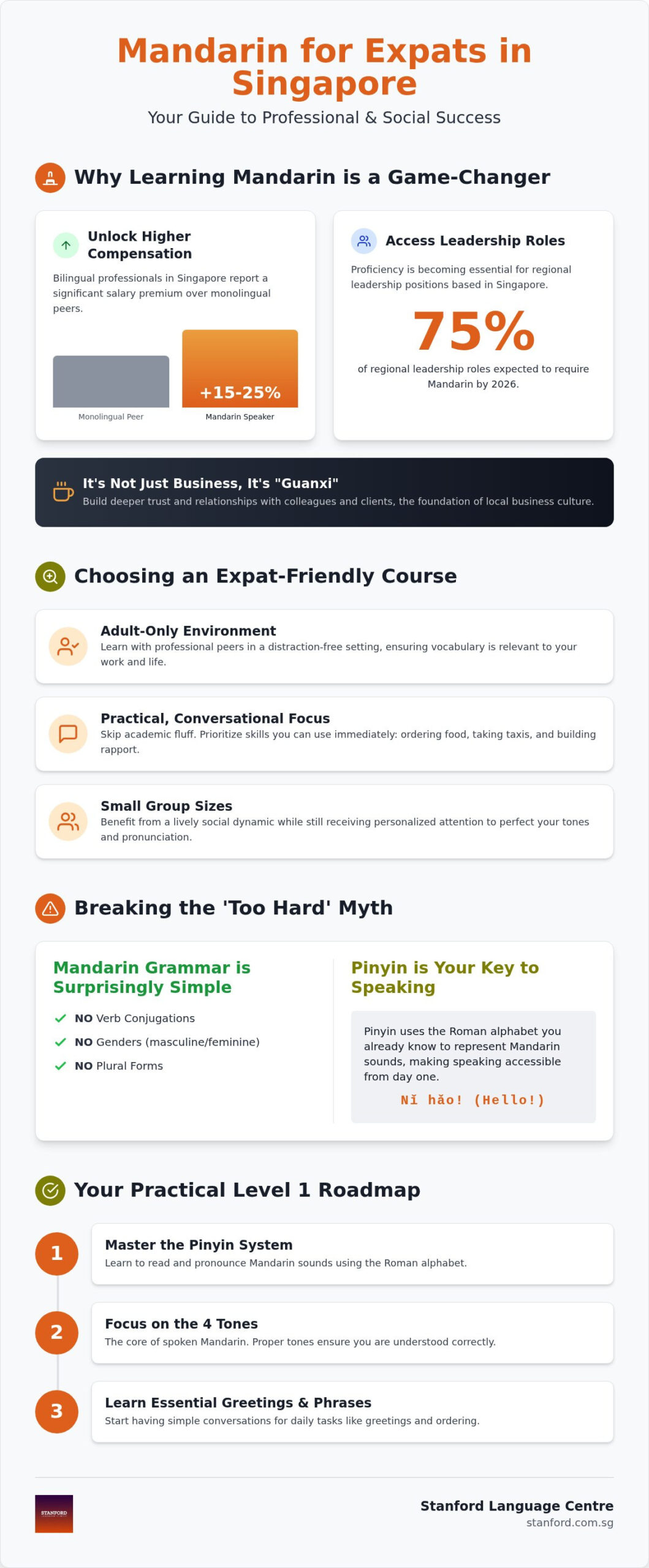
Moving to Singapore often feels like a major career leap. To truly land on your feet, you need more than just technical skills. You need "Guanxi". This traditional concept of relationship-building is the engine of local business. Mandarin proficiency is expected to be a core requirement for 75% of regional leadership roles based in Singapore by 2026. If you want to tap into the 15% to 25% salary premium reported by bilingual professionals, finding a quality mandarin course for expats singapore is the most direct path to success.
It’s not just about the boardroom. It’s about the "Uncle" at the Maxwell Food Centre or the "Aunty" in the taxi. While English is the primary administrative language, understanding Singaporean Mandarin connects you to the heart of the island. It turns a standard commute into a conversation. It makes you feel like a local rather than just a visitor. Being able to navigate heartland hawker centres with ease changes your entire experience of living here.
Learning a tonal language also keeps your brain sharp. It forces you to listen differently and improves cognitive flexibility. In 2026, new blended learning models make this process far more efficient. You can now mix in-person small groups with digital practice modules that fit into a busy corporate schedule. It’s a pragmatic way to grow your skills without burning out.
Mandarin for Business vs. Social Life
A few polite phrases go a long way in corporate meetings. It shows respect for the culture and builds immediate rapport. Start with a "Survival Mandarin" checklist: greetings, basic introductions, and numbers for prices. While many expats pick up "Singdarin" phrases for casual use, you’ll need standard Mandarin to build professional trust with regional clients. A dedicated mandarin course for expats singapore helps you distinguish between the two so you always sound appropriate for the setting.
Breaking the ‘Too Hard’ Myth
Many people quit before they start because they think Mandarin is impossible. That’s a myth. Pinyin uses the Roman alphabet to represent sounds, making speaking very accessible for English speakers. The grammar is actually simpler than many European languages. There are no verb conjugations. No genders. No plural forms. Set a realistic goal for your first six months. Focus on mastering the four tones and basic sentence structures. You’ll be surprised how quickly you can start taking taxis and ordering food confidently.
What to Look for in an Expat-Friendly Mandarin Course
Choosing a language school is about more than just finding the nearest classroom. For a busy professional, the right mandarin course for expats singapore must respect your time and your specific goals. You aren’t a university student with hours to spend on calligraphy. You’re likely here to build a life and a career. This means you need a curriculum that skips the academic fluff and gets straight to the point. Practicality should be your north star.
One non-negotiable factor is an adult-only environment. Learning a new language is a vulnerable experience. It’s much easier to practice when you’re surrounded by peers who share your professional background rather than school children. An adult-centric setting ensures the vocabulary is relevant. Instead of learning how to describe a school bag, you’ll learn how to discuss market trends or order a business lunch. It turns a simple lesson into a networking opportunity with fellow expats.
Small group sizes are equally vital for success. You need enough people for a lively social dynamic but few enough that the teacher can correct your tones. This focus on practical communication is rooted in Singapore’s bilingual policy, which has shaped a local teaching culture that values both standard proficiency and real-world application. Look for schools that employ qualified native teachers who understand the local Singaporean business context. They can help you navigate the nuances of "standard" Mandarin while explaining the local phrases you’ll hear on the street.
Flexibility is the final piece of the puzzle. Expats travel for work and meetings often run late. A school that offers clear makeup class policies or hybrid online options is essential for staying consistent. If you value a tailored approach that fits a demanding schedule, exploring professional adult Chinese learning in Singapore that offers small group or private formats can help you maintain momentum.
The Importance of an Adult-Centric Curriculum
General language schools often rely on textbooks designed for general learners or children. This often leads to ‘childish’ vocabulary that feels out of place in a corporate setting. An expat-friendly course prioritises dining, business etiquette, and travel. By focusing on these high-utility topics, you gain the confidence to use your skills immediately. Your classmates are often fellow professionals facing the same challenges, which creates a supportive, peer-to-peer learning atmosphere.
Location and Flexibility
While a central location is great for in-person rapport, online hybrid options are a lifesaver for the modern professional. Check the school’s policy on missed sessions before you enrol. Work trips shouldn’t mean falling behind your cohort. Whether you prefer the social motivation of a small group or the accelerated progress of private 1-1 lessons, the school should adapt to your life, not the other way around.
Small Group vs. Private Mandarin Lessons: Which Fits You?
Deciding between formats is the next step once you’ve committed to a mandarin course for expats singapore. Both small group and private lessons have distinct advantages. Your choice usually boils down to how quickly you need results and how much you value social interaction. Both paths lead to fluency, but the experience along the way is quite different. It’s about finding the rhythm that keeps you coming back to class week after week.
The Social Dynamics of Group Classes
In a group setting, you learn just as much from your classmates’ mistakes as you do from the teacher. It provides a natural environment for role-playing. You can practice ordering "Kopi C" or negotiating a taxi fare with multiple partners. This variety helps you adapt to different speaking styles. While academic institutions like the Confucius Institute at Nanyang Technological University offer highly structured adult programmes, many expats prefer the relaxed atmosphere of smaller centres where networking is a built-in benefit.
When to Opt for Private 1-1 Mandarin
Private 1-1 lessons are the "fast track" option. If you have a specific business presentation coming up or a move to a Mandarin-speaking region, this is your best bet. You get 100% of the teacher’s attention. This is especially helpful for addressing specific pronunciation hurdles. Some people feel self-conscious practicing tones in front of others. A private setting offers a safe space to fail and improve quickly. You also get total flexibility. Lessons can happen at your home, your office, or online, fitting perfectly around a volatile schedule.
Corporate training takes this customisation a step further. If your team works in Finance or Tech, a generic syllabus won’t cut it. You need to learn the specific terminology used in your industry. Many firms in Singapore now sponsor these sessions to help their teams build better relationships with regional stakeholders. It’s a pragmatic investment in long-term career growth. Whether you choose the social energy of a group or the precision of private tuition, the goal remains the same: practical, usable language skills.
Navigating Mandarin Level 1: A Roadmap for Beginners
Level 1 isn’t about becoming a scholar overnight. It’s about gaining the confidence to navigate your new home. A pragmatic mandarin course for expats singapore breaks this down into manageable phases. You don’t need to master thousands of characters to have a meaningful conversation at work or in the heartlands. Instead, you need a clear path that leads to functional independence. This roadmap ensures you spend your time on the skills that actually matter for your daily life.
- Phase 1: Mastering the Foundation. You’ll start with the Pinyin system and the four tones. This is your phonetic map. It’s the most critical step for being understood by locals.
- Phase 2: Social Building Blocks. This phase covers basic greetings, introductions, and numbers. These are essential for networking and simple transactions.
- Phase 3: Daily Life Essentials. Here, you’ll learn to handle real-world tasks. You’ll practice ordering food at a hawker centre or giving specific directions to a taxi driver.
- Phase 4: Survival Questions. You’ll move into simple sentence structures. This allows you to ask "where," "when," and "how much" with confidence.
- Phase 5: Cultural Nuances. Finally, you’ll explore etiquette basics. Understanding how to present a business card or the logic of Chinese-speaking contexts prevents social awkwardness.
What You Will (and Won’t) Learn in Level 1
The primary goal of Level 1 is speaking and listening comprehension. You won’t be bogged down by complex essays or academic theory. While some courses introduce high-frequency characters, it’s usually optional. The focus remains on reaching a level of "functional independence" where you can handle basic tasks without a translator. If you’re ready to start your journey with a structured, adult-only approach, explore our Mandarin classes for adults to see our upcoming intake dates.
Overcoming the Tonal Hurdle
Tones are often the biggest source of anxiety for new learners. They matter, but they shouldn’t paralyse your progress. Most people in Singapore are patient and will understand you through the context of your sentence. Practical ear-training exercises are key. You need to learn to "hear" the pitch before you can reproduce it correctly. Pinyin bridges the gap for English speakers by using the familiar Roman alphabet to represent Chinese sounds, allowing you to focus on pronunciation rather than memorising complex symbols. Don’t let the fear of a "wrong" tone stop you from speaking. The more you use the language, the more natural those sounds will become.
Stanford Language Centre: Tailored Mandarin for Singapore’s Expats
Finding a reliable mandarin course for expats singapore shouldn’t be a guessing game. Established in 2004, Stanford Language Centre has spent over 20 years refining its approach to adult language education. We don’t believe in academic filler. Instead, we focus on foundational success for busy professionals who need results. Our environment is strictly adults-only. This ensures you learn in a space designed for peer-to-peer connection and professional growth. We act as your supportive mentor throughout the journey.
Our "no-frills" philosophy prioritises student outcomes above all else. We view ourselves as partners in your progress. Whether you’re looking for a small group mandarin class for expats or private mandarin language lessons, our goal remains constant. We want you to walk out of every lesson with skills you can use immediately. It’s about practical application in real-world Singapore settings. We keep things grounded and inclusive so that challenging goals feel attainable.
Specialised tracks for East Asian Speakers
Japanese and Korean speakers often face unique challenges and advantages. We offer specialised tracks that leverage your existing knowledge of Kanji or Hanja. This comparative linguistics approach accelerates character recognition significantly. We also address specific grammatical interferences that are unique to your native tongue. It’s a tailored experience that respects your linguistic background. You’ll find yourself in a customised small group with fellow expats from similar communities.
Maximising Value with UTAP Subsidies
Quality education should be accessible and affordable. Many of our programmes are NTUC UTAP claimable mandarin courses. This allows eligible union members to claim back a portion of their course fees. The application process for our approved courses is simple and straightforward. We provide the necessary support to help you manage the paperwork. It’s a pragmatic choice for value-conscious professionals who want high-quality training. You get professional reliability without the intimidating academic posture of a traditional university.
Take the Next Step Toward Fluency in Singapore
Learning to speak Mandarin is one of the most rewarding investments you can make for your life in the Little Red Dot. It’s about building genuine rapport with colleagues and feeling truly at home in your local neighbourhood. Focus on practical conversation and choose a mandarin course for expats singapore that fits your busy schedule. You’ll find that with the right roadmap, those intimidating tones quickly become second nature.
Don’t let another year pass by without mastering the basics. Book a trial or enquire about our next intake at Stanford Language Centre today. We’re here to help you speak with confidence and succeed in every conversation.
Frequently Asked Questions
Is Mandarin really the hardest language for expats to learn?
Mandarin isn’t as impossible as it seems. While the four tones are new to English speakers, the grammar is actually much simpler than European languages. There are no verb conjugations, no genders, and no plural forms. Most students find that once they master the basic phonetic system, the logical structure of the language makes it very accessible for adults.
How long does it take to become conversational in Mandarin?
You can start handling basic daily tasks after about 15 to 20 hours of structured learning. This usually covers ordering food and giving taxi directions. To build professional rapport with colleagues, most students find that a three to six-month mandarin course for expats singapore provides a solid foundation. Practising in real-world settings like hawker centres will speed up your progress significantly.
Can I use SkillsFuture credits for Mandarin courses at Stanford?
SkillsFuture Credit is only available to Singapore Citizens aged 25 and above. It isn’t available to Permanent Residents or expats. Additionally, as of January 2025, the government ceased funding for many non-certifiable language courses.
What is the difference between HSK and a Conversational Mandarin course?
HSK is an academic proficiency exam that focuses heavily on reading and writing characters. It’s useful for university admissions but can be slow for busy professionals. A Conversational Mandarin course prioritises speaking and listening comprehension. It uses Pinyin to get you talking immediately. If your goal is to communicate at work or in daily life, the conversational track is much more efficient.
Are there specific Mandarin classes for Japanese or Korean speakers in Singapore?
Yes, we offer specialised tracks for Japanese and Korean speakers. These classes use comparative linguistics to leverage your existing knowledge of Kanji or Hanja. This allows for much faster character recognition and addresses specific grammatical differences between your native tongue and Mandarin. It’s a highly effective way for East Asian expats to accelerate their learning journey in a peer-to-peer setting.
How do I claim the NTUC UTAP subsidy for my Mandarin course?
You must be an Singaporean or PR and NTUC union member to qualify for the UTAP subsidy. Once you’ve completed your mandarin course for expats singapore with at least 75% attendance, you can submit your claim via the NTUC portal. We provide all the necessary documents and guidance to make the application process simple. It’s a pragmatic way to reinvest in your professional growth while managing costs.
Do I need to learn how to write Chinese characters to be conversational?
You don’t need to write characters to speak fluently. Our Level 1 courses focus on Pinyin, which uses the Roman alphabet to represent sounds. While recognising high-frequency characters is helpful for reading signs or menus, you can achieve functional independence through speaking and listening alone. This allows you to focus your energy on verbal communication rather than tedious memorisation.
What happens if I miss a class due to a business trip?
We understand that the expat lifestyle often involves travel and late meetings. Stanford Language Centre offers flexible makeup class policies to ensure you don’t fall behind your cohort. You can often join another group session or access digital practice materials to catch up on what you missed. We work with you to maintain your momentum despite a volatile corporate schedule.