What if the secret to finally mastering Thai tones isn’t more listening practice, but actually learning to read the script? It’s a common frustration for many learners in Singapore. You can order your favorite dish, but you feel completely illiterate the moment you look at a menu or a street sign. Joining a specialized thai reading and writing class might feel intimidating when you’re faced with unique characters and no spaces between words. You need results, but you don’t have years to spend in a stuffy classroom.
We agree that the traditional academic route is often too slow for busy professionals. That’s why we’ve designed a structured, adult-friendly curriculum that focuses on rapid literacy and practical application. You’ll learn to decode the logic of the script and finally understand the “why” behind every tone. This guide previews how our small-group sessions provide the supportive environment you need to read signs confidently and write basic messages to Thai colleagues.
Key Takeaways
- Move beyond “karaoke” phonetics to achieve true language independence by understanding how the script governs Thai tones.
- Joining a structured thai reading and writing class provides a logical roadmap for decoding complex characters through a proven, adult-friendly system.
- Professional guidance in a small group setting prevents you from forming the “fossilized” mistakes that often occur during unguided self-study.
- Gain the practical ability to read street signs, menus, and text messages through real-world exercises and mentor-led support.
- Access quality literacy training that fits your busy schedule, with courses that are NTUC UTAP claimable for eligible students.
Why Literacy is the Next Step in Your Thai Language Journey
Conversational Thai gets you through a holiday. It doesn’t get you through a career or a deep friendship. Many students find they hit a plateau after a few months of speaking only. They can’t expand their vocabulary because they don’t see how words are built. Literacy is the missing piece that turns a casual hobby into a lifelong skill. It moves you from being a passive listener to an active participant in the culture.
Breaking the Phonetic Crutch
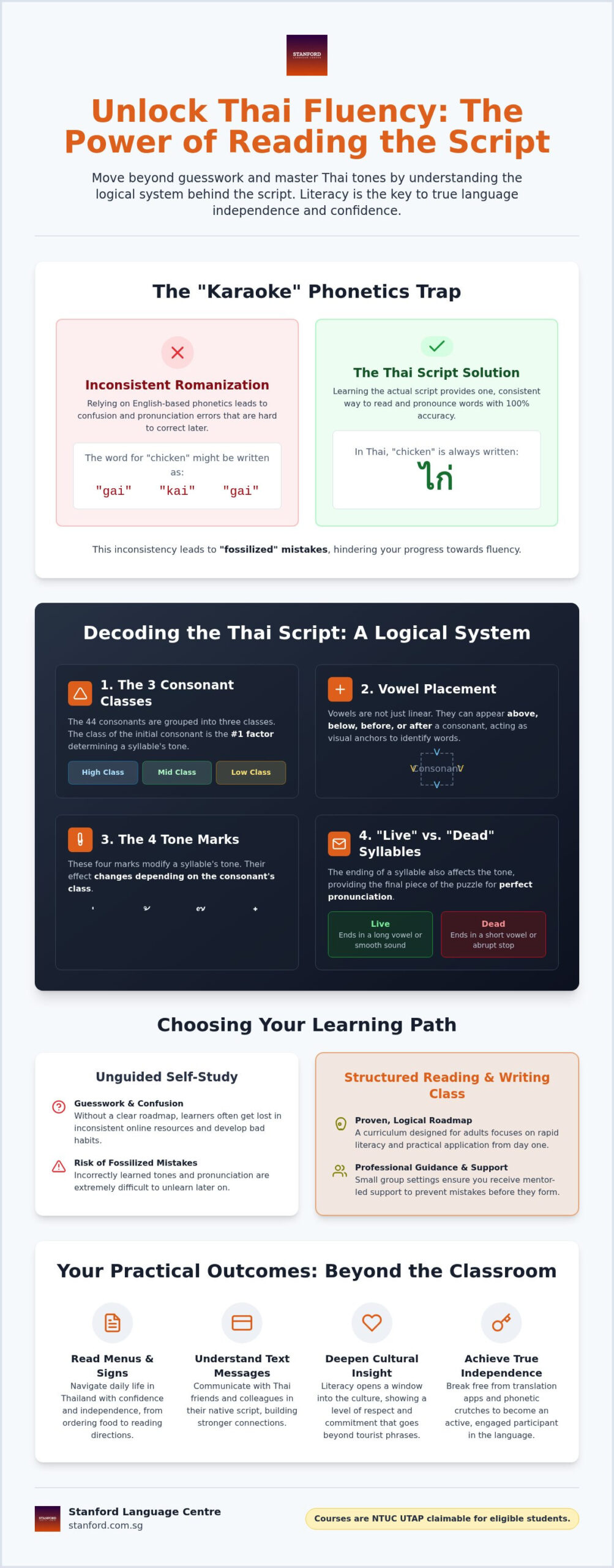
Relying on karaoke-style phonetics is a gamble. Every textbook and mobile app uses a different romanization system. One might write “gai” for chicken, while another writes “kai”. This inconsistency leads to fossilized pronunciation mistakes that are hard to fix later. By enrolling in a thai reading and writing class, you bypass this confusion entirely. You learn to see the language as it was meant to be seen. Understanding the Thai script is the only reliable way to master the five tones because the tone of a word is determined by the class of the consonant and the type of vowel used. Without the script, tones feel like random musical notes; with the script, they follow a logical, predictable system.
Cultural and Professional Integration
Literacy isn’t just about books. It’s about everyday survival and respect. Imagine navigating menus, street signs, and simple documents without reaching for a translation app. This independence is empowering. In professional settings, the ability to read basic messages or emails from Thai partners builds immediate rapport. It signals a level of commitment that conversational-only learners rarely achieve. It shows you’ve invested time into their culture, not just a few phrases for a vacation.
There’s also a significant psychological advantage. Cracking the code of a unique alphabet provides a sense of accomplishment that keeps you motivated. You stop seeing the “no spaces” rule as a barrier and start seeing it as a rhythmic flow of information. This clarity is exactly what adult learners need to stay engaged. Our thai reading and writing class focuses on these practical wins, ensuring you see the utility of your new skills from day one. When you can read the world around you, your confidence in speaking naturally follows.
Decoding the Thai Script: Consonants, Vowels, and Tones
Thai might look like a continuous stream of characters, but it’s actually a highly organized system. As a tonal and analytic language, every symbol serves a specific phonetic purpose. Once you learn the rules, the “wall of text” starts to break down into manageable pieces. It’s like learning to read music; at first, it’s just dots on a page, but soon you see the melody. You’ll find that the logic of the script actually makes speaking much easier because it removes the guesswork from your pronunciation.
The Consonant Class System
The 44 consonants are the backbone of the script. However, memorizing them in alphabetical order is a waste of time for most adults. Instead, we group them into three distinct classes: High, Mid, and Low. This grouping is vital because the class of the initial consonant determines the default tone of the word. The Thai consonant class system is a structural grouping of the 44 characters into High, Mid, and Low categories, which dictate the starting pitch and tonal behavior of every syllable. By focusing on these classes early in your thai reading and writing class, you gain a massive shortcut to correct pronunciation. It’s much more efficient than guessing the tone of every new word you encounter.
Vowels and Tone Rules
Vowels in Thai are unique because they don’t always follow the consonant. They can appear above, below, before, or even after the character they modify. Some vowels even wrap around the consonant entirely. While this sounds complex, it actually helps you identify word boundaries more easily since vowels act as visual anchors. Once you recognize the vowel shapes, you’ll start to see the individual words within a sentence quite clearly.
The four tone marks are the final layer of the puzzle. These marks don’t represent a fixed sound; their effect changes based on the consonant’s class. We also look at “Live” and “Dead” syllables. A “Live” syllable ends with a long vowel or a sonorant sound, while a “Dead” syllable ends with a short vowel or a stop sound. Understanding this distinction is the key to reading Thai with 100% accuracy. If you’re looking for a structured way to master these nuances, consider exploring the thai reading and writing class options available for beginners.
Finally, let’s talk about the lack of spaces. In Thai, spaces are used like periods to indicate the end of a sentence or a clause. You don’t need spaces between words because the rules of consonant and vowel placement naturally signal where one word ends and the next begins. It’s a rhythmic way of writing that becomes second nature once you’ve decoded the logic behind the symbols. It isn’t as scary as it looks; it’s just a different way of organizing information.
Structured Classes vs. Self-Study: Why Professional Guidance Matters
Many learners start their journey with a mobile app or a stack of flashcards. While these tools are great for building a basic vocabulary, they often fall short when it comes to the complex mechanics of the Thai script. The biggest risk of going it alone is “fossilization.” This happens when you repeat a mistake so many times that it becomes a permanent part of your language habit. Without a teacher to point out a subtle tonal error or an incorrect stroke, you might spend months practicing something that native speakers can’t understand. A professional thai reading and writing class acts as a safety net, ensuring you get the foundations right from day one.
Accountability is another major hurdle for busy adults in Singapore. It’s easy to skip a self-study session when work gets hectic. A structured weekly curriculum provides a clear roadmap and a reason to stay on track. You aren’t just learning in a vacuum; you’re moving forward with a group that shares your goals. This collective momentum makes the daunting task of learning a new alphabet feel much more manageable. You’ll also find that peer questions often highlight nuances you hadn’t considered, deepening your own understanding of the rules.
Immediate Feedback and Correction
Handwriting practice requires a trained eye. Thai characters often have small loops and specific starting points that dictate the flow of the pen. If your stroke order is off, your writing becomes illegible as you try to write faster. In a classroom setting, a mentor can correct your technique in real-time. This immediate feedback is just as vital for pronunciation. As you read aloud, your instructor can fine-tune your pitch before a bad habit takes root. For those just starting out, understanding how to learn a tonal language effectively requires this constant loop of trial and correction.
The Small Group Advantage
Learning a new script can be intimidating, but a small group setting significantly lowers the stress level. It feels less like a formal lecture and more like a workshop with a supportive guide. This environment allows for customized pacing. If the group needs more time on a specific set of vowels, the instructor can adjust the lesson accordingly. Beyond the academics, these classes are a great way to network with other professionals. You’ll meet like-minded people who are also looking for a deeper understanding of the culture through its language. This social connection turns a challenging academic task into an engaging part of your weekly routine, making it much more likely that you’ll stick with it until you’re literate.
What to Expect in a Thai Reading and Writing Curriculum
A well-designed curriculum takes the mystery out of the script by breaking it into logical, bite-sized steps. You won’t be expected to memorize all 44 consonants in one sitting. Instead, a professional thai reading and writing class focuses on a high-frequency approach. You learn the characters you’ll actually see on a daily basis first. This pragmatic method ensures you can start decoding simple signs and labels within the first few weeks. It’s about building momentum through small, consistent wins rather than getting bogged down in academic theory.
The Level 1 Literacy Roadmap
Our roadmap is divided into three clear phases to ensure no student feels overwhelmed. In Phase 1, the focus is on mastering high-frequency consonants and basic vowel signs. These are the building blocks of the language. Phase 2 introduces the tone rule matrix specifically for Mid-class consonants. This is where you begin to see how the symbols dictate the pitch of your voice. Finally, Phase 3 moves into reading and writing full sentences without any phonetic aids. By the end of this level, you’ll have the confidence to navigate basic written Thai independently.
Pragmatic Learning Tools
We use a variety of tools to help you retain what you learn. Visual aids and mnemonics are essential for remembering character shapes that might otherwise look similar. For example, associating the shape of a character with a familiar object makes recall much faster during real-world reading. Interactive dictation exercises are also a core part of the curriculum. These drills build your listening-to-writing speed, which is a vital skill for anyone looking to learn thai for beginners singapore. It’s one thing to recognize a word; it’s another to be able to write it down accurately as you hear it.
Practicality is at the heart of every lesson. You’ll engage in reading exercises using real-world materials like restaurant menus and street signs. Writing drills focus on high-frequency words and phrases that you can use immediately in social or business settings. Regular assessments are conducted to ensure you’ve truly mastered each concept before moving on to more advanced rules in our thai reading and writing class. This ensures a solid foundation that prevents the “plateau” effect mentioned earlier. Ready to start your journey? You can view our upcoming class schedules to find a session that fits your lifestyle.
Choosing Stanford Language Centre for Your Thai Literacy Goals
Since 2004, we’ve focused on helping busy professionals in Singapore reach their language goals. Our thai reading and writing class is designed with a student-first mentality. We don’t use academic jargon. We use practical results. Every lesson is built to move you closer to real-world independence. Whether you prefer a physical classroom or a hybrid model, we provide the flexibility you need. Our established reputation makes us a reliable partner for your literacy journey.
Small group sizes are a core part of our philosophy. This isn’t a lecture hall. It’s a supportive environment where you’re a partner in the learning process. You get the personalized attention required to master complex script rules. Our teachers act as friendly guides, helping you through every consonant class and vowel wrap-around. This peer-to-peer connection ensures that no student is left behind.
Financial Support with NTUC UTAP
Investing in a new skill shouldn’t be a financial burden. We’ve made our courses accessible by ensuring they are NTUC UTAP claimable. Eligible NTUC members can claim up to 50% of their course fees. This is a significant advantage for those looking to maximize their personal development budget. It lowers the barrier to entry for anyone serious about mastering the script. You get high-quality training while keeping your out-of-pocket costs manageable.
The process for claiming is straightforward. First, you register for your class and complete the training sessions. Then, you submit your claim through the NTUC portal within the required timeframe after the course ends. It’s important to clarify that SkillsFuture credits are not applicable for these specific Thai courses. We focus on UTAP to provide consistent value for our adult learners.
Start Your Journey Today
We offer national access to all residents in Singapore. Our expert teachers specialize in adult language acquisition. They understand the specific time constraints and goals of busy professionals. Joining a thai reading and writing class with us means you’re learning from down-to-earth experts. You’ll join a community of learners who are all working toward the same goal of Thai literacy in a low-stress setting.
Don’t let the script intimidate you any longer. By choosing a structured thai writing course singapore, you’re taking the most efficient path to mastery. We are here to support you at every step. Let’s unlock the ability to read and write Thai together in a relaxed and professional environment. Your journey to true language independence starts with a single character.
Take the Next Step Toward Thai Literacy
Mastering the script is the final hurdle for any serious learner. It moves you from simply memorizing phrases to understanding the logic behind every tone. You’ve seen how structured guidance prevents common mistakes and how a small-group environment makes the process feel manageable rather than intimidating. Literacy isn’t just about reading signs; it’s about gaining the independence to navigate Thai culture on your own terms.
Joining a thai reading and writing class is the most efficient way to achieve this. At Stanford Language Centre, we’ve been small group learning experts since 2004. We’re here to ensure your learning journey is both productive and affordable through our NTUC UTAP claimable programs. Our mentors are ready to help you crack the code and build lasting confidence in your skills.
Don’t let the unique characters hold you back any longer. We’re ready to guide you toward true language independence in a supportive, adult-friendly setting. View our upcoming Thai Reading and Writing Class schedule and join us today. Your path to becoming a literate Thai speaker starts here.
Frequently Asked Questions
Is the Thai reading and writing class suitable for absolute beginners?
Yes, our thai reading and writing class is specifically designed for adults with zero prior knowledge of the script. You don’t need to know the alphabet or tones before joining. We start with basic character shapes and sounds; gradually building your confidence through a logical roadmap. This approach ensures that new learners feel supported rather than overwhelmed as they begin their journey into Thai literacy from the very first session.
How long does it take to learn to read Thai fluently?
Achieving basic literacy for street signs and menus typically takes about one full course cycle of structured study. While total fluency in reading complex literature takes longer; our curriculum focuses on rapid results for everyday use. Most students find they can decode simple sentences and identify high-frequency words within the first few weeks. Consistent practice in a mentor-led environment is the fastest way to move from phonetic crutches to independent reading.
Can I use SkillsFuture credits for the Thai reading and writing class?
No, SkillsFuture credits are not applicable for our Thai language programs. We prioritize different financial support models to keep our courses accessible to all adults in Singapore. While you can’t use SkillsFuture; you can maximize your investment through other available subsidies. We encourage students to look into the NTUC UTAP claim process. It offers significant fee support for eligible members who are looking to upgrade their professional language skills.
How does the NTUC UTAP claim process work for this course?
Eligible NTUC members can claim up to 50% of their course fees through the UTAP scheme. To start the process; you first register and pay for your thai reading and writing class at our centre. Once you complete the required training hours; you submit your claim via the NTUC portal. This reimbursement model makes professional language training much more affordable for working professionals who are committed to their personal growth and career development.
What is the difference between conversational Thai and the reading/writing class?
Conversational classes focus primarily on speaking and listening using romanized phonetics. In contrast; the reading and writing class teaches you the actual script. This is the only way to truly master the five tones. Understanding the script removes the guesswork from your pronunciation and prevents the plateau effect often seen in conversational-only learners. Literacy provides a deeper logical foundation that makes your overall Thai communication much more accurate and professional.
Do I need to buy my own textbooks for the Thai writing class?
We provide all the necessary learning materials and structured drills as part of our student-first curriculum. You don’t need to worry about sourcing external textbooks before your first lesson. Our pragmatic approach focuses on high-frequency words and real-world materials like menus and signs. This ensures that every resource we use in the classroom has a direct; practical application for your daily life and social interactions with Thai speakers.
What happens if I miss a lesson in the small group program?
Our small group environment allows for a high degree of personalized attention if you happen to miss a session. Since we function as supportive mentors rather than distant lecturers; we’ll help you catch up on the specific rules or characters you missed. The structured nature of our weekly roadmap makes it easy to see exactly what was covered. You’ll always have the support of your instructor and peers to stay on track.
Is there an online option for the Thai reading and writing class?
Yes, we offer flexible online and hybrid models for students who can’t attend every session in person. These online classes maintain the same small group expert guidance as our physical classroom sessions. You’ll still receive real-time feedback on your handwriting and pronunciation from our expert teachers. This flexibility ensures that busy professionals across Singapore can achieve their literacy goals without having to worry about rigid schedules or long commutes.