Imagine spending your Tuesday evening in a crowded community centre classroom, struggling to catch the teacher’s eye while dozens of other students recite the same basic greeting. It is a common frustration for busy professionals in Singapore who want real results, not just a seat in a room. You need to speak, practice, and get immediate feedback to actually use the language at work. That is where small group mandarin lessons change the game.
We know you’re likely tired of apps that don’t talk back and private tutors that strain the budget. You want a middle ground that offers personal attention without the high price tag. This 2026 guide reveals why small group sessions are the most effective way for expats to achieve conversational fluency fast. We’ll compare the best courses that fit a professional schedule, explain how to meet like-minded learners, and show you how to maximize your NTUC UTAP claims. By the end, you’ll know exactly which structured course will help you speak Mandarin with confidence in your daily life and office environment.
Key Takeaways
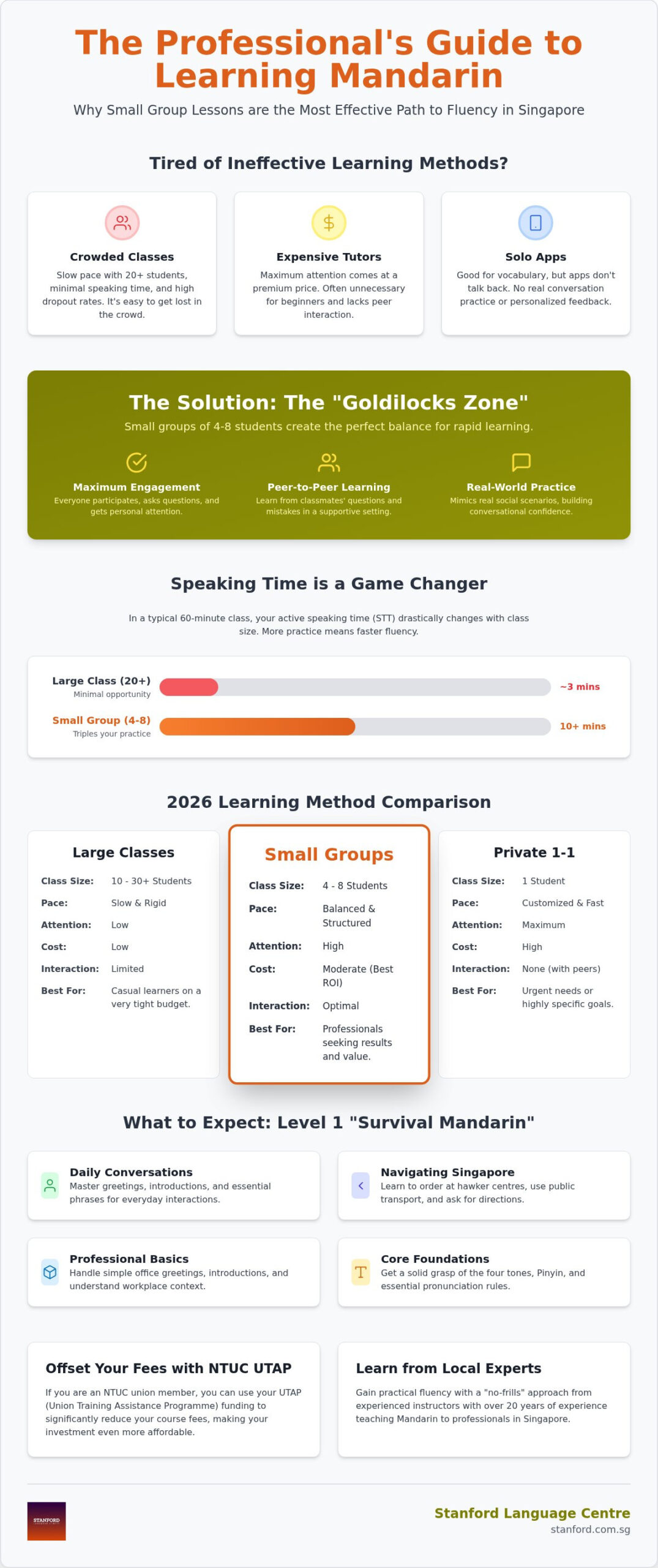
- Discover why the 4 to 8 student range is the optimal “Goldilocks” zone for faster language retention and peer interaction.
- Compare the value of small group mandarin lessons against expensive private tutors and crowded, slow-paced community classes.
- Get a clear breakdown of the Level 1 syllabus focused on “Survival Mandarin” for daily life and professional settings.
- Learn how to use NTUC UTAP funding to significantly offset your course fees if you’re a union member.
- Find out why a local expert with 20 years of experience offers the best “no-frills” path to conversational fluency.
The “Small Group” Advantage: Why Class Size Matters for Mandarin
Size isn’t just a number; it is a strategic choice for your learning. When you join small group mandarin lessons, you are entering a space designed for maximum engagement. Research into the process of second-language acquisition suggests that adult learners thrive when they can interact frequently without feeling overwhelmed. A group of 4 to 8 students is the “Goldilocks” zone. It’s large enough to provide diverse perspectives but small enough that nobody gets left behind.
Hearing a peer struggle with the four tones of Mandarin isn’t just relatable; it’s educational. When a classmate makes a mistake, your brain processes the correction alongside them. This peer-to-peer learning accelerates your own progress. It also lowers performance anxiety. You aren’t standing alone in front of a lecture hall of 30 people. You’re chatting with a few new friends in a supportive environment. This safety net allows you to take risks with your pronunciation, which is the only way to truly improve.
The math for Speaking Time (STT) is simple. In a 60-minute class with 20 people, you might speak for only a few minutes. In a small group of six, your speaking time triples. This extra practice is the difference between simply knowing a word and being able to use it in a real conversation. You get the repetitions you need to make the language stick.
Balancing Social Interaction and Personal Attention
Small groups mimic the real social scenarios you face in Singapore. Whether you’re ordering lunch at a hawker centre or greeting a colleague, these interactions happen in small circles. Our teachers act as facilitators rather than distant lecturers. They guide the conversation and provide instant feedback. This dynamic keeps you motivated. Solo study can feel lonely; a group feels like a team working toward a common goal. You aren’t just learning a language; you’re building a community of like-minded professionals.
Cost-Effectiveness for Professionals
Professionals often look at the return on investment. Private 1-1 lessons offer maximum attention but come at a premium price that isn’t always necessary for beginners. Large community classes are cheap, but they are often too slow for a professional schedule. Small group mandarin lessons offer the best ROI for foundational Level 1 courses. You get the high-quality instruction and personal corrections of a private tutor at a much more accessible rate. It’s about maximizing value. You get results without the premium brand markups found at other high-end centres.
Small Group vs. Private vs. Large Classes: A 2026 Comparison
Choosing how to learn is just as important as the language itself. In 2026, the options for learners in Singapore are broader than ever. To find your fit, think of it as a balance between budget, speed, and flexibility. Large classes are the cheapest but progress is often slow. Private lessons are the fastest but carry a premium price. For most professionals, small group mandarin lessons sit right in the middle. They offer a structured path that doesn’t break the bank or waste your time.
Many beginners fall for the “App Myth.” Duolingo or HelloChinese are fun for vocabulary, but they can’t replace human interaction. You can’t learn to swim by reading a book; you can’t learn to speak by tapping a screen. Real fluency requires a loop of speaking and receiving corrections. Similarly, large community center classes often suffer from high dropout rates. With 20 or more students, you rarely get to speak. People quit because they don’t see results. Small groups solve this by keeping everyone engaged.
The cultural context of learning here is unique. Understanding the history of Singapore’s Speak Mandarin Campaign shows how deeply the language is woven into local life. Learning in a group helps you connect with this environment much faster than solo study. If you’re ready to dive in, joining a small group course is a practical way to start.
When to Choose Private 1-1 Lessons
Private coaching is best for highly specific goals or chaotic schedules. If you need to prepare for a board meeting in Shanghai or a relocation in three weeks, you need 100% of the teacher’s focus. It’s also the right choice if your work hours change every week. For these high-stakes needs, you should consider private 1-1 mandarin singapore to get a tailored curriculum that moves at your exact pace.
Why Small Groups Are the Best Default for Beginners
Most learners thrive in a group. You start at Level 1 with others who share your frustrations and wins. This creates a weekly rhythm that keeps you accountable. You also get vital “ear training.” In the real world, people have different accents and speaking speeds. Hearing multiple classmates say the same sentence helps your brain recognize Mandarin in various voices. It’s a more realistic way to build a foundation that actually works outside the classroom.
What to Expect in a Professional Level 1 Mandarin Course
A professional Level 1 course isn’t about memorizing ancient poetry or complex calligraphy. It’s about building a functional toolkit you can use immediately. You’ll start with the essential building blocks: Pinyin, the four tones, and basic sentence patterns. Pinyin is the phonetic gateway for foreigners to read and pronounce Mandarin using the Roman alphabet. By focusing on these early, you avoid the frustration of “book learning” that doesn’t translate to real-world speech. These small group mandarin lessons prioritize “Survival Mandarin” so you can actually use what you learn the next morning at the office. If you want a broader overview of how to approach this journey, our 2026 Guide to Conversational Mandarin in Singapore is an excellent starting point for understanding the full roadmap from beginner to confident speaker.
We also recognize that not all learners start from the same place. Japanese and Korean speakers often have a head start due to shared linguistic roots or characters. That’s why we offer specialized tracks for these groups. These courses leverage your existing knowledge of kanji or hanja to move faster. This ensures the pace remains challenging and efficient for everyone in the room, regardless of their native language. It’s about working smarter, not harder.
Mastering the Four Tones in a Group Setting
Mandarin is a tonal language, which is often the biggest hurdle for English speakers. In small group mandarin lessons, you get to practice these tones through repetitive drills and immediate feedback. English speakers often struggle with the dip of the third tone or the sharp drop of the fourth. Research on the benefits of small-group instruction shows that this environment reduces stress and increases interaction. Our teachers use a supportive mentor approach. They listen to your specific pronunciation and correct you in real-time. This helps you build confidence before you step outside the classroom.
Practical Mandarin for Daily Life in Singapore
Finding the right course is only half the battle. For busy professionals, the logistics must be seamless. If a class is too far or the timing is rigid, even the best intentions fade. That is why central accessibility is a priority. Classes located near major hubs like City Hall MRT make it easy to transition from the office to the classroom. You can finish your workday and be at your desk ready to learn within minutes. This convenience ensures you stay consistent throughout the course duration.
Scheduling is equally critical. Most adult learners need options that respect their work-life balance. Small group mandarin lessons are typically offered in evening slots or on weekends to accommodate various professional demands. This flexibility allows you to build a weekly rhythm without sacrificing your career commitments. When the logistics align, the learning feels like a natural part of your routine rather than an extra chore.
Many people assume SkillsFuture is the only way to save on language learning in Singapore. However, union members have a powerful alternative in 2026. While some centers do not accept SkillsFuture credits, NTUC UTAP remains a highly effective way to offset your training costs. It’s a pragmatic solution for those looking to maximize their personal development budget while receiving high-quality instruction.
How to Claim NTUC UTAP for Your Mandarin Class
The UTAP application process is straightforward for Stanford students. First, ensure you are an active NTUC member before the course begins. After completing your lessons, you can submit your claim through the NTUC portal. For members under 40, you can claim 50 percent of unfunded course fees, capped at S$250 per year. If you are 40 or above, that annual cap increases to S$500. Just remember to submit your claim within 6 months of finishing the course to receive your reimbursement. This subsidy makes professional training much more accessible for locals and eligible expats alike.
Specialized Mandarin for Expats and Foreigners
Expat-focused schools operate differently than general tuition centers meant for children. The methodology is designed for adult brains that value logic and immediate application. For Japanese and Korean speakers, this approach is even more specialized. These tracks leverage your existing knowledge of kanji or hanja to accelerate your reading and writing progress. It’s about using what you already know to master Mandarin faster. If you want to see how these programs compare, check out our 2026 Guide: Mandarin Courses for Expats in Singapore. Ready to start? You can book your spot in our next intake today.
Why Stanford Language Centre is Singapore’s Top Choice
Experience counts. Since 2004, we have focused exclusively on adult language education. We understand the specific hurdles professionals face when learning a new language in a busy city. Our “No-Frills” philosophy keeps things simple and effective. You get high-quality instruction without the “premium brand” price tag found at other centers. We prioritize your results over fancy office lobbies or expensive marketing campaigns. It’s about value. It’s about what works for you.
The atmosphere in our classrooms is intentionally designed to be welcoming. Our teachers act as friendly guides rather than distant academics. They are approachable mentors who genuinely want to see you succeed. This supportive environment makes it much easier to take risks with your pronunciation. You’ll never feel intimidated or lost. We believe that learning should be a positive, low-stress experience that fits into your life.
We take small group mandarin lessons seriously. Our class sizes are strictly capped to ensure a high level of interaction. This isn’t just a suggestion; it’s a core rule of our methodology. We ensure every student speaks in every single lesson. You won’t just sit and listen to a lecture. You will participate, practice, and improve. This active engagement is exactly why our students achieve conversational fluency so much faster than in traditional settings.
Student-First Mentality and Practical Results
We measure our success by your actual ability to speak in real-world settings. Many of our expat students move from zero knowledge to basic conversational fluency in just one 10-lesson term. The transition from Level 1 to higher conversational levels is designed to be seamless and logical. We’ve built a curriculum that builds your confidence step-by-step. Our commitment to the Singapore professional community is unwavering. We know your time is valuable. We make every minute in the classroom count toward your fluency goals.
Ready to Start Your Mandarin Journey?
Taking the first step is easy and low-stress. You can register for our next intake of small group lessons directly through our website. If you aren’t sure where to start, our friendly staff is here to guide you. We offer quick level assessments to find the perfect fit for your current skills and goals. Join a community of motivated learners at Stanford Language Centre today. We are ready to partner with you on your journey to conversational fluency.
Start Speaking Mandarin with Confidence Today
Achieving conversational fluency doesn’t have to be a slow or lonely process. Choosing small group mandarin lessons provides the perfect balance between social interaction and the personal attention you need to progress. By focusing on practical “Survival Mandarin” and leveraging logistical advantages like our central location and NTUC UTAP funding, you can reach your goals without burning out. We’ve spent over two decades since 2004 refining a student-first approach that cuts through the fluff and focuses on what actually works for busy adults.
Our friendly mentors are ready to welcome you into a supportive environment where making mistakes is just part of the journey toward success. Whether you are looking to better connect with colleagues or navigate daily life in Singapore with ease, the right structure makes all the difference. Stop relying on apps that don’t talk back and start practicing with a community that does. For those just getting started, exploring a structured approach to conversational mandarin for beginners can help you understand exactly what to expect before your first lesson.
View Upcoming Small Group Mandarin Class Schedules
We are excited to help you start this new chapter. Your journey to fluency begins with a single conversation, and we’re here to make sure it’s a great one.
Frequently Asked Questions
How many students are typically in a small group Mandarin class?
Our small group mandarin lessons typically maintain a size of 4 to 8 students. This specific range is chosen because it creates the optimal “Goldilocks” environment for adult learners. It is large enough to allow for diverse peer-to-peer interaction and social learning but small enough to ensure the teacher can provide personalized feedback to every individual. You will never feel lost in the crowd or starved for speaking time.
Can I use SkillsFuture credits for Mandarin lessons at Stanford Language Centre?
No, we do not accept SkillsFuture credits at our centre. We choose to focus on a “no-frills” model that delivers high-quality instruction at a pragmatic, accessible price point. Instead of SkillsFuture, many of our students successfully utilize the NTUC UTAP subsidy to offset their training costs. This allows union members to claim back a significant portion of their course fees, providing a reliable alternative for professional development funding.
What is the difference between Mandarin Level 1 and HSK 1?
Mandarin Level 1 is designed for practical, real-world conversation, while HSK 1 is an academic proficiency exam focused on standardized testing. Our Level 1 curriculum prioritizes “Survival Mandarin” for daily life in Singapore, such as ordering food or introducing yourself in a business setting. While we cover the vocabulary required for HSK, our primary goal is helping you speak confidently rather than simply passing a written test.
How long does it take to become conversational in Mandarin through group lessons?
Most students achieve basic conversational fluency for daily tasks after completing a single 10-lesson term of small group mandarin lessons. In this timeframe, you’ll master Pinyin, the four tones, and essential sentence structures. While reaching professional fluency takes longer, this initial term equips you with the confidence to handle basic greetings, shopping, and navigating Singapore. It is a fast-paced, results-oriented path for busy expats and professionals.
Are these Mandarin classes suitable for Japanese or Korean speakers?
Yes, we offer specialized tracks specifically for Japanese and Korean speakers. These learners often progress faster because they can leverage their existing knowledge of kanji or hanja characters. Our teachers use specialized methods that acknowledge this linguistic proximity, allowing the group to focus more on pronunciation and conversational grammar. This tailored approach ensures that you aren’t held back by a curriculum designed only for Western learners.
Is there an online option for small group Mandarin lessons in Singapore?
Yes, we offer online classes for students who prefer the flexibility of learning from home or their office. These virtual sessions follow the same small group structure as our in-person classes to ensure interaction remains high. You will participate in real-time conversations and drills with your mentor and peers. It is an excellent solution for professionals with busy travel schedules or those who live further from our central location.
What happens if I miss a lesson in my small group course?
If you miss a session, our supportive mentors will help you stay on track by providing the relevant lesson materials and notes. While we encourage regular attendance to maintain the group’s rhythm, we understand that professional emergencies happen. You can speak with our friendly staff about the best way to catch up on the missed content. Our goal is to ensure you feel confident and prepared for the next lesson with your cohort.
How do I claim the NTUC UTAP subsidy for my Mandarin course?
To claim the UTAP subsidy, you must submit your application through the NTUC portal within 6 months of finishing your course. Ensure your membership is active throughout the training period. Members under 40 can claim 50 percent of unfunded fees capped at S$250 annually, while those 40 and above enjoy a cap of S$500. This process is a straightforward way for union members to invest in their personal growth at a lower cost.