Thai Language Course Singapore: 2026 Buying Guide

Mastering the Thai script isn’t a superpower reserved for linguists. It’s a practical skill you can pick up right here in the heart of the city. If you’ve ever stared at a Bangkok street sign in total confusion, you know the frustration of feeling like a permanent tourist. Enrolling in a thai writing course singapore is the most effective way to break that barrier. It’s about moving beyond basic greetings and actually understanding the culture on a deeper level.

You might feel intimidated by those five tricky tones or the unique, swirling alphabet. It’s also hard to imagine fitting lessons into a packed 2026 work schedule. We get it. This guide shows you how to choose the right Thai language course in Singapore without the stress. You’ll learn how to transition from basic conversational skills to full literacy. We’ll preview the best local schools, explain how to claim up to 50% of your fees via NTUC UTAP, and help you find a supportive environment that prioritizes your success.

Key Takeaways

  • Learn why native-led instruction is essential for mastering the five Thai tones and avoiding common self-study pitfalls.
  • Understand how to transition from basic conversation to reading script by choosing a structured thai writing course singapore.
  • Compare the benefits of small group classes versus private 1-1 lessons to find the best fit for your learning pace and budget.
  • Explore how to offset your learning costs in 2026 by utilizing NTUC UTAP claims for up to 50% unfunded course fee support.
  • Discover the “Speak Thai in 2 Months” methodology designed to get adult learners communicating effectively in real-world settings.

Why Enroll in a Thai Language Course in Singapore in 2026?

Singapore and Thailand share deep economic and cultural ties that only grow stronger each year. By 2026, Thailand remains a powerhouse for regional trade and a top destination for Singaporean travelers. While many people start with a few “vacation phrases,” functional literacy is what truly opens doors. Enrolling in a dedicated thai writing course singapore provides the structure needed to decode the script, helping you move past the “tourist” label and into a space of genuine understanding.

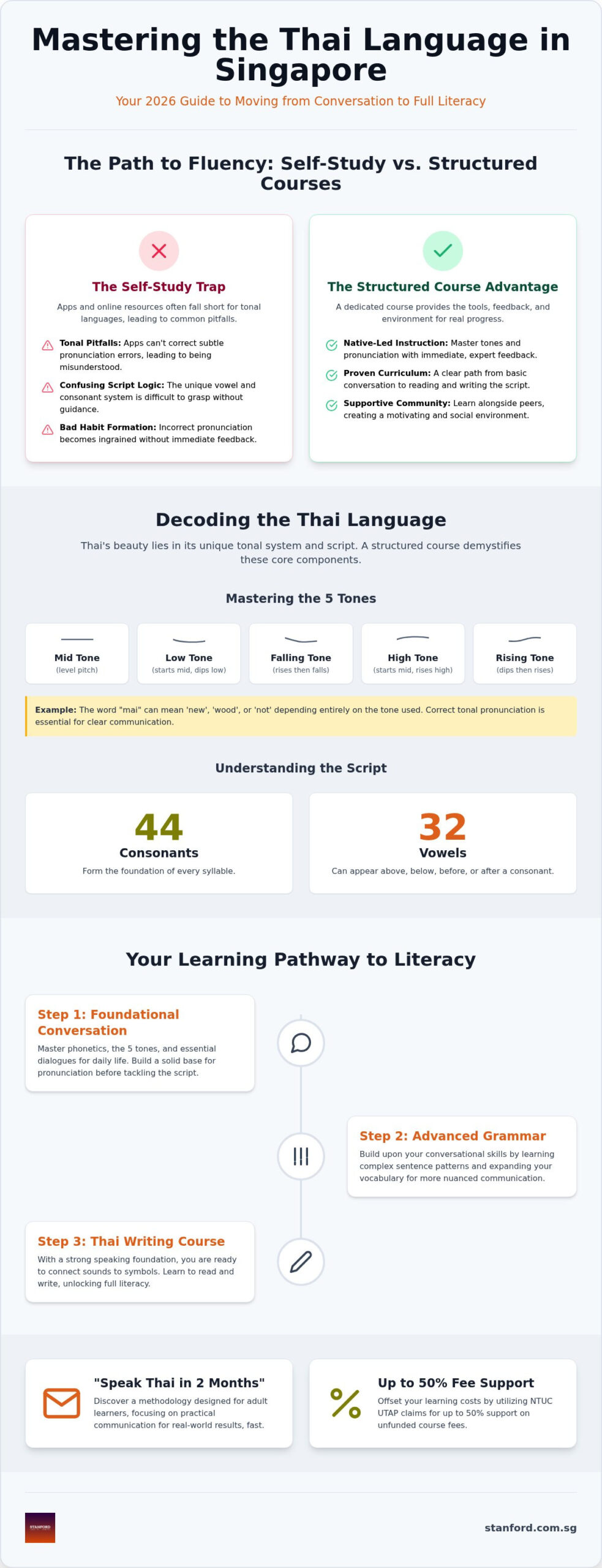
Self-study apps are popular, but they often fall short when it comes to the unique complexities of Thai. Apps can’t hear the subtle difference between a rising and a falling tone. They also struggle to explain the logic behind the script’s layout. A structured course offers a clear path. You get immediate feedback from a teacher who can correct your pronunciation before bad habits set in. Beyond the mechanics, there’s a social spark in a physical classroom. Learning alongside other Singapore-based professionals creates a supportive community, making the challenge of a new language feel much more manageable.

Thai for Professionals and Expats

For those doing business in Bangkok or EEC zones, language is a bridge to trust. Understanding cultural nuances, like the proper use of “khrap” and “ka,” shows respect for your partners. It changes the dynamic of a meeting. Basic literacy also makes a huge difference in daily life during business trips. Being able to read street signs, safety notices, or a specialized menu ensures you navigate the city with confidence. Understanding the history and structure of the Thai language helps clarify why these formal distinctions are so vital in a professional setting.

The Adult Learning Advantage

Adult-focused pedagogy is different from how we learned in school. You don’t have time for endless drills that don’t apply to real life. A good Thai course for adults focuses on high-impact vocabulary you can use immediately. Native teachers play a crucial role here. They don’t just teach grammar; they teach the “living” language used in modern Thailand. By 2026, the focus has shifted toward practical results. You’ll find that a structured thai writing course singapore emphasizes:

  • Early Tonal Correction: Getting the five tones right from day one so you’re actually understood.
  • Practical Literacy: Reading the words you see most often in shops, offices, and restaurants.
  • Efficient Progress: Using your existing knowledge of English or other languages to find shortcuts in Thai grammar.

Investing in a structured program is often more cost-effective than ad-hoc tutoring. You benefit from a proven curriculum and the motivation of a group setting. It’s about working smarter, not just harder, to reach your goals.

Understanding Course Levels: From Conversation to Writing

Learning Thai is a marathon, not a sprint. Most students in Singapore start with a foundation in speaking before tackling the script. This phased approach prevents burnout and ensures you aren’t overwhelmed. Level 1 focuses on phonetics and the five tones. You’ll learn essential dialogues for daily life, like ordering food or asking for directions. Level 2 builds on this by introducing complex grammar and sentence patterns. Once you’ve mastered basic conversation, you’re ready for a specialized thai writing course singapore to unlock full literacy.

Mastering the Five Tones

Thai is a tonal language. A single syllable can have five different meanings depending on the pitch. These include mid, low, falling, high, and rising tones. English speakers often struggle because they use tone to express emotion rather than meaning. For example, the word “mai” can mean wood, new, or “not” depending on the tone. Auditory training is vital. You must learn to hear the tones before you can hope to recognize them in the script. Native instructors help you bridge this gap by focusing on intensive ear training in those first few weeks.

Demystifying the Thai Writing Course

The Thai alphabet looks beautiful but complex. It consists of 44 consonants and 32 vowels. Unlike English, vowels can be placed above, below, or even before the consonant they follow. This can be confusing for self-taught learners. A dedicated thai writing course singapore breaks this down into manageable segments. You’ll learn the specific rules that link the script to the tones you’ve already mastered. This is where the magic happens. Suddenly, those “swirly” characters on a menu or street sign start to make sense. You move from simply memorizing sounds to reading official documents and complex signs with ease.

Most experts recommend finishing Level 1 conversation classes before starting to write. This ensures your pronunciation is solid. If you’re ready to take that first step into speaking, you can explore our structured Thai classes to build a strong foundation. Starting with the right habits makes all the difference in your long-term success. It’s a rewarding transition that transforms your experience of Thailand from that of a visitor to a knowledgeable resident.

Group vs. Private Lessons: Which Format Suits You?

Picking the right class format is a big decision. It’s the difference between a social hobby and a high-speed career tool. For most people looking into a thai writing course singapore, the choice boils down to how much time you have and how you like to interact. You need to balance your budget with your need for personal feedback. Both paths lead to fluency, but they get there in very different ways.

Cost is often the first hurdle. Small group classes are generally more affordable. They also qualify for local funding. In 2026, NTUC members can still claim up to 50% of their unfunded course fees via UTAP. This makes group learning a smart financial move. Private lessons require a larger upfront investment. However, they offer a level of flexibility that group schedules can’t match. If your work hours are erratic, private tuition ensures you never miss a beat.

The debate between online and onsite learning is also relevant. Virtual classrooms have improved significantly. They’re perfect for saving commute time across Singapore. Onsite classes, though, are still the gold standard for tonal languages. Being in the same room as your teacher makes it much easier to catch those subtle vocal shifts that define the Thai language. It’s about finding the environment where you feel most comfortable making mistakes and growing. If you’re just starting out, our beginner’s guide to learning Thai in Singapore can help you understand what to expect before you commit to a format.

The Power of Small Group Thai Classes

A class size of 8 to 12 students is often considered the “sweet spot.” It’s large enough for diverse conversation practice but small enough that you won’t get lost in the crowd. Peer learning is a secret weapon here. When you hear a classmate struggle with a rising tone, it sharpens your own ears. You learn from their mistakes as much as your own. The structured weekly schedule also provides a sense of accountability. You’re less likely to skip a lesson when your classmates are expecting you. It builds a mini-community of learners who support each other through the trickier parts of the script.

When to Opt for Private Thai Tuition

Sometimes, a standard curriculum isn’t enough. If you’re in a specialized field like legal or tech, you might need industry-specific vocabulary right away. Private lessons allow you to skip the generic “tourist” talk and dive into what matters for your job. This is also the best route for accelerated learning. If you’re moving to Thailand on short notice, a private thai writing course singapore can be compressed to fit your timeline. You get 100% of the teacher’s attention. This is perfect for smoothing out stubborn pronunciation hurdles that might be missed in a larger group setting.
Thai Language Course Singapore: 2026 Buying Guide

Key Criteria for Choosing the Best Thai Language School

Choosing the right school is about more than just finding the nearest classroom. You need a partner that understands the specific needs of adult learners. Native speakers are non-negotiable. They provide the cultural context and tonal accuracy that a textbook simply cannot capture. Beyond just basic speaking, look for a school that offers a clear progression path. A high-quality thai writing course singapore should be available once you’ve finished your introductory levels. This ensures you don’t hit a “learning ceiling” just as you’re starting to get comfortable.

Location plays a huge role in your success. A central Singapore location, like those near major MRT interchanges, helps you stay consistent. It’s much easier to attend a 7:00 pm class when it’s a short hop from your office. Consistency is what separates those who reach fluency from those who drop out after three weeks. Finally, check the funding options. While many look for SkillsFuture, savvy learners in 2026 are increasingly using NTUC UTAP to keep their out-of-pocket costs low.

Maximizing Your NTUC UTAP Benefits

If you’re an NTUC member, you can significantly reduce your tuition costs. In 2026, UTAP provides up to 50% unfunded course fee support for eligible programs. This is a powerful alternative if you’ve already used your SkillsFuture credits on other professional development. To claim your benefits, follow these steps:

  • Verify that your chosen thai writing course singapore is on the list of UTAP-supported programs.
  • Ensure your NTUC membership is active throughout the course duration.
  • Submit your claim via the NTUC portal within six months of completing the course.

Members under 40 years old can claim up to S$250 per year. If you’re 40 or above, that limit increases to S$500 per year. This makes high-quality language education much more accessible for working professionals.

Evaluating School Reputation and Reviews

Don’t just take a school’s word for it. Look at student testimonials to see how many people actually progress to higher levels. High retention rates are a sign of engaging teachers and a supportive environment. Established schools with decades of experience often have more refined curriculums than new, unproven centers. For those interested in how different languages are taught, you can see our 2026 Guide to Adult Chinese Learning in Singapore for a comparison of professional language paths.

Ready to start your journey with a proven provider? You can view our upcoming Thai course schedules to find a class that fits your busy 2026 calendar perfectly. Taking that first step with a reputable school ensures you build a solid foundation from day one.

Start Your Journey with Stanford Language Centre

At Stanford Language Centre, we believe language learning should be pragmatic, fast, and fun. Our “Speak Thai in 2 Months” methodology is specifically designed for busy adults who need immediate results. You won’t spend your evenings on abstract theory or outdated drills. Instead, you’ll dive straight into high-impact communication that you can use the very next day. Our native Thai teachers specialize in adult education, understanding the unique hurdles that expats and local professionals face in Singapore. They create a warm, low-stress environment where you can practice those tricky tones without any fear of judgment.

We provide a clear, logical roadmap for your long-term success. Most of our students begin with the Level 1 conversational program to build their oral confidence first. Once you’ve mastered the essential sounds and daily dialogues, you can seamlessly transition into our specialized thai writing course singapore. This phased progression ensures you have the solid phonetic foundation needed to tackle the script effectively. Our classrooms are conveniently located near major transport hubs, making it easy to attend a session right after your workday ends. Consistency is the key to fluency, and we make it as easy as possible to stay on track.

What’s Included in Your Course?

Our programs are built specifically for the Singaporean context. You’ll receive comprehensive materials that reflect real-world scenarios, whether you’re negotiating in a Bangkok boardroom or navigating a local market. Every lesson includes interactive dialogues, clear grammar breakdowns, and targeted vocabulary exercises. We also offer flexible hybrid learning options. If you can’t make it to the physical classroom one week, you can join via our professional online platform. This flexibility ensures your progress never stalls, even during your busiest months of 2026.

How to Enrol and Claim UTAP

Starting your journey is straightforward and stress-free. Our upcoming 2026 intakes are now open for registration. You don’t need to fill out endless forms; a simple WhatsApp message is all it takes to secure your spot. We also understand that navigating subsidies can be a bit of a headache. That’s why our administrative team provides direct assistance with all the documentation needed for your NTUC UTAP claim. We’ll help you verify your eligibility and walk you through the submission process. Whether you’re aiming for basic conversation or a full thai writing course singapore, we’re here to be your supportive partner from day one.

Register for your Thai Language Course at Stanford Language Centre today!

Take the Next Step Toward Thai Fluency

Learning a new language is a powerful investment in your professional and personal growth. We’ve explored how a phased approach, moving from basic conversation to a specialized thai writing course singapore, builds a foundation that actually lasts. By choosing native teachers and a central location, you make consistency a natural part of your weekly routine. It’s about practical results and cultural connection. You’ll find that those unique tones and “swirly” characters become familiar much faster with the right guidance.

Stanford Language Centre brings over 20 years of language teaching excellence to your journey. Our classes are designed for busy adults and are NTUC UTAP claimable, providing up to 50% unfunded course fee support. We prioritize your success through a supportive, student-first environment. Whether you’re navigating Bangkok for business or pleasure, we’re here to help you communicate with confidence. It’s time to stop feeling like a tourist and start understanding the world around you.

Start Speaking Thai in 2 Months; Enrol Now

Frequently Asked Questions

Is Thai difficult to learn for English speakers in Singapore?

Thai isn’t as hard as it looks once you get past the tones. Grammar is actually quite straightforward because there are no verb conjugations or genders. The biggest challenge for English speakers is the five tones. However, a structured thai writing course singapore helps you visualize these sounds. Most students find that they can start making basic sentences within just a few weeks of consistent practice.

How much does a Thai language course in Singapore cost in 2026?

Prices for Thai classes in Singapore vary depending on the school and the level of personalization. Most group courses for 2026 fall within a competitive range that balances quality instruction with affordability. You should also factor in materials and registration fees. To get the best value, look for programs that qualify for subsidies like NTUC UTAP. This can significantly lower your out-of-pocket expenses for high-quality language training.

Can I use SkillsFuture credits for Thai courses at Stanford Language Centre?

Our Thai programs are currently not claimable under SkillsFuture credits. Instead, we focus on providing value through the NTUC UTAP scheme. This allows eligible members to claim back a significant portion of their course fees. It’s a great alternative for professionals who want to preserve their SkillsFuture credits for other types of technical training while still improving their regional language skills at an affordable rate.

What is the difference between Level 1 Thai and the Writing Course?

Level 1 Thai is all about oral communication and listening skills. You’ll learn phonetics and essential phrases for daily life. In contrast, a thai writing course singapore focuses on the 44 consonants and 32 vowels of the script. We usually recommend that students complete Level 1 first. This ensures your ears are tuned to the tones before you start learning how to read and write them.

How long does it take to become conversational in Thai?

You can become conversational in a surprisingly short amount of time. Our specific methodology is designed to get you speaking basic Thai within just two months. This assumes you attend your weekly sessions and spend a little time practicing outside of class. While mastering the script takes longer, being able to order food and navigate Bangkok confidently is an attainable goal for most beginners in one term. For a full overview of what to expect as a new learner, our 2026 guide to learning Thai in Singapore for beginners walks you through each stage of the journey.

Are the Thai teachers at Stanford Language Centre native speakers?

Yes, all our Thai instructors are native speakers with extensive experience in adult education. This is crucial because it ensures you learn authentic pronunciation and modern slang. Native teachers can also provide cultural insights that you won’t find in a textbook. They specialize in helping expats and professionals in Singapore overcome common pronunciation hurdles, ensuring you’re understood by locals when you travel or do business.

What happens if I miss a Thai lesson due to work?

We understand that work schedules in Singapore can be unpredictable. If you miss a lesson, we offer flexibility through our hybrid learning model. You can often join a session online or access makeup materials to stay caught up with your peers. Our goal is to make learning as low-stress as possible. Just let our administrative team know in advance so we can help you find the best solution.

How do I claim the NTUC UTAP subsidy for my Thai class?

Claiming your NTUC UTAP subsidy is a simple process done through the NTUC portal. You must be an active member and submit your claim within six months of completing the course. The subsidy covers up to 50% of the unfunded course fees for eligible students. Our staff is always available to help you with the necessary documentation to ensure your claim is processed smoothly and without any delays.


Mastering the Thai script isn’t a superpower reserved for linguists. It’s a practical skill you can pick up right here in the heart of the city. If you’ve ever stared at a Bangkok street sign in total confusion, you know the frustration of feeling like a permanent tourist. Enrolling in a thai writing course singapore is the most effective way to break that barrier. It’s about moving beyond basic greetings and actually understanding the culture on a deeper level.

You might feel intimidated by those five tricky tones or the unique, swirling alphabet. It’s also hard to imagine fitting lessons into a packed 2026 work schedule. We get it. This guide shows you how to choose the right Thai language course in Singapore without the stress. You’ll learn how to transition from basic conversational skills to full literacy. We’ll preview the best local schools, explain how to claim up to 50% of your fees via NTUC UTAP, and help you find a supportive environment that prioritizes your success.

Key Takeaways

  • Learn why native-led instruction is essential for mastering the five Thai tones and avoiding common self-study pitfalls.
  • Understand how to transition from basic conversation to reading script by choosing a structured thai writing course singapore.
  • Compare the benefits of small group classes versus private 1-1 lessons to find the best fit for your learning pace and budget.
  • Explore how to offset your learning costs in 2026 by utilizing NTUC UTAP claims for up to 50% unfunded course fee support.
  • Discover the “Speak Thai in 2 Months” methodology designed to get adult learners communicating effectively in real-world settings.

Why Enroll in a Thai Language Course in Singapore in 2026?

Singapore and Thailand share deep economic and cultural ties that only grow stronger each year. By 2026, Thailand remains a powerhouse for regional trade and a top destination for Singaporean travelers. While many people start with a few “vacation phrases,” functional literacy is what truly opens doors. Enrolling in a dedicated thai writing course singapore provides the structure needed to decode the script, helping you move past the “tourist” label and into a space of genuine understanding.

Self-study apps are popular, but they often fall short when it comes to the unique complexities of Thai. Apps can’t hear the subtle difference between a rising and a falling tone. They also struggle to explain the logic behind the script’s layout. A structured course offers a clear path. You get immediate feedback from a teacher who can correct your pronunciation before bad habits set in. Beyond the mechanics, there’s a social spark in a physical classroom. Learning alongside other Singapore-based professionals creates a supportive community, making the challenge of a new language feel much more manageable.

Thai for Professionals and Expats

For those doing business in Bangkok or EEC zones, language is a bridge to trust. Understanding cultural nuances, like the proper use of “khrap” and “ka,” shows respect for your partners. It changes the dynamic of a meeting. Basic literacy also makes a huge difference in daily life during business trips. Being able to read street signs, safety notices, or a specialized menu ensures you navigate the city with confidence. Understanding the history and structure of the Thai language helps clarify why these formal distinctions are so vital in a professional setting.

The Adult Learning Advantage

Adult-focused pedagogy is different from how we learned in school. You don’t have time for endless drills that don’t apply to real life. A good Thai course for adults focuses on high-impact vocabulary you can use immediately. Native teachers play a crucial role here. They don’t just teach grammar; they teach the “living” language used in modern Thailand. By 2026, the focus has shifted toward practical results. You’ll find that a structured thai writing course singapore emphasizes:

  • Early Tonal Correction: Getting the five tones right from day one so you’re actually understood.
  • Practical Literacy: Reading the words you see most often in shops, offices, and restaurants.
  • Efficient Progress: Using your existing knowledge of English or other languages to find shortcuts in Thai grammar.

Investing in a structured program is often more cost-effective than ad-hoc tutoring. You benefit from a proven curriculum and the motivation of a group setting. It’s about working smarter, not just harder, to reach your goals.

Understanding Course Levels: From Conversation to Writing

Learning Thai is a marathon, not a sprint. Most students in Singapore start with a foundation in speaking before tackling the script. This phased approach prevents burnout and ensures you aren’t overwhelmed. Level 1 focuses on phonetics and the five tones. You’ll learn essential dialogues for daily life, like ordering food or asking for directions. Level 2 builds on this by introducing complex grammar and sentence patterns. Once you’ve mastered basic conversation, you’re ready for a specialized thai writing course singapore to unlock full literacy.

Mastering the Five Tones

Thai is a tonal language. A single syllable can have five different meanings depending on the pitch. These include mid, low, falling, high, and rising tones. English speakers often struggle because they use tone to express emotion rather than meaning. For example, the word “mai” can mean wood, new, or “not” depending on the tone. Auditory training is vital. You must learn to hear the tones before you can hope to recognize them in the script. Native instructors help you bridge this gap by focusing on intensive ear training in those first few weeks.

Demystifying the Thai Writing Course

The Thai alphabet looks beautiful but complex. It consists of 44 consonants and 32 vowels. Unlike English, vowels can be placed above, below, or even before the consonant they follow. This can be confusing for self-taught learners. A dedicated thai writing course singapore breaks this down into manageable segments. You’ll learn the specific rules that link the script to the tones you’ve already mastered. This is where the magic happens. Suddenly, those “swirly” characters on a menu or street sign start to make sense. You move from simply memorizing sounds to reading official documents and complex signs with ease.

Most experts recommend finishing Level 1 conversation classes before starting to write. This ensures your pronunciation is solid. If you’re ready to take that first step into speaking, you can explore our structured Thai classes to build a strong foundation. Starting with the right habits makes all the difference in your long-term success. It’s a rewarding transition that transforms your experience of Thailand from that of a visitor to a knowledgeable resident.

Group vs. Private Lessons: Which Format Suits You?

Picking the right class format is a big decision. It’s the difference between a social hobby and a high-speed career tool. For most people looking into a thai writing course singapore, the choice boils down to how much time you have and how you like to interact. You need to balance your budget with your need for personal feedback. Both paths lead to fluency, but they get there in very different ways.

Cost is often the first hurdle. Small group classes are generally more affordable. They also qualify for local funding. In 2026, NTUC members can still claim up to 50% of their unfunded course fees via UTAP. This makes group learning a smart financial move. Private lessons require a larger upfront investment. However, they offer a level of flexibility that group schedules can’t match. If your work hours are erratic, private tuition ensures you never miss a beat.

The debate between online and onsite learning is also relevant. Virtual classrooms have improved significantly. They’re perfect for saving commute time across Singapore. Onsite classes, though, are still the gold standard for tonal languages. Being in the same room as your teacher makes it much easier to catch those subtle vocal shifts that define the Thai language. It’s about finding the environment where you feel most comfortable making mistakes and growing. If you’re just starting out, our beginner’s guide to learning Thai in Singapore can help you understand what to expect before you commit to a format.

The Power of Small Group Thai Classes

A class size of 8 to 12 students is often considered the “sweet spot.” It’s large enough for diverse conversation practice but small enough that you won’t get lost in the crowd. Peer learning is a secret weapon here. When you hear a classmate struggle with a rising tone, it sharpens your own ears. You learn from their mistakes as much as your own. The structured weekly schedule also provides a sense of accountability. You’re less likely to skip a lesson when your classmates are expecting you. It builds a mini-community of learners who support each other through the trickier parts of the script.

When to Opt for Private Thai Tuition

Sometimes, a standard curriculum isn’t enough. If you’re in a specialized field like legal or tech, you might need industry-specific vocabulary right away. Private lessons allow you to skip the generic “tourist” talk and dive into what matters for your job. This is also the best route for accelerated learning. If you’re moving to Thailand on short notice, a private thai writing course singapore can be compressed to fit your timeline. You get 100% of the teacher’s attention. This is perfect for smoothing out stubborn pronunciation hurdles that might be missed in a larger group setting.

Thai Language Course Singapore: 2026 Buying Guide

Key Criteria for Choosing the Best Thai Language School

Choosing the right school is about more than just finding the nearest classroom. You need a partner that understands the specific needs of adult learners. Native speakers are non-negotiable. They provide the cultural context and tonal accuracy that a textbook simply cannot capture. Beyond just basic speaking, look for a school that offers a clear progression path. A high-quality thai writing course singapore should be available once you’ve finished your introductory levels. This ensures you don’t hit a “learning ceiling” just as you’re starting to get comfortable.

Location plays a huge role in your success. A central Singapore location, like those near major MRT interchanges, helps you stay consistent. It’s much easier to attend a 7:00 pm class when it’s a short hop from your office. Consistency is what separates those who reach fluency from those who drop out after three weeks. Finally, check the funding options. While many look for SkillsFuture, savvy learners in 2026 are increasingly using NTUC UTAP to keep their out-of-pocket costs low.

Maximizing Your NTUC UTAP Benefits

If you’re an NTUC member, you can significantly reduce your tuition costs. In 2026, UTAP provides up to 50% unfunded course fee support for eligible programs. This is a powerful alternative if you’ve already used your SkillsFuture credits on other professional development. To claim your benefits, follow these steps:

  • Verify that your chosen thai writing course singapore is on the list of UTAP-supported programs.
  • Ensure your NTUC membership is active throughout the course duration.
  • Submit your claim via the NTUC portal within six months of completing the course.

Members under 40 years old can claim up to S$250 per year. If you’re 40 or above, that limit increases to S$500 per year. This makes high-quality language education much more accessible for working professionals.

Evaluating School Reputation and Reviews

Don’t just take a school’s word for it. Look at student testimonials to see how many people actually progress to higher levels. High retention rates are a sign of engaging teachers and a supportive environment. Established schools with decades of experience often have more refined curriculums than new, unproven centers. For those interested in how different languages are taught, you can see our 2026 Guide to Adult Chinese Learning in Singapore for a comparison of professional language paths.

Ready to start your journey with a proven provider? You can view our upcoming Thai course schedules to find a class that fits your busy 2026 calendar perfectly. Taking that first step with a reputable school ensures you build a solid foundation from day one.

Start Your Journey with Stanford Language Centre

At Stanford Language Centre, we believe language learning should be pragmatic, fast, and fun. Our “Speak Thai in 2 Months” methodology is specifically designed for busy adults who need immediate results. You won’t spend your evenings on abstract theory or outdated drills. Instead, you’ll dive straight into high-impact communication that you can use the very next day. Our native Thai teachers specialize in adult education, understanding the unique hurdles that expats and local professionals face in Singapore. They create a warm, low-stress environment where you can practice those tricky tones without any fear of judgment.

We provide a clear, logical roadmap for your long-term success. Most of our students begin with the Level 1 conversational program to build their oral confidence first. Once you’ve mastered the essential sounds and daily dialogues, you can seamlessly transition into our specialized thai writing course singapore. This phased progression ensures you have the solid phonetic foundation needed to tackle the script effectively. Our classrooms are conveniently located near major transport hubs, making it easy to attend a session right after your workday ends. Consistency is the key to fluency, and we make it as easy as possible to stay on track.

What’s Included in Your Course?

Our programs are built specifically for the Singaporean context. You’ll receive comprehensive materials that reflect real-world scenarios, whether you’re negotiating in a Bangkok boardroom or navigating a local market. Every lesson includes interactive dialogues, clear grammar breakdowns, and targeted vocabulary exercises. We also offer flexible hybrid learning options. If you can’t make it to the physical classroom one week, you can join via our professional online platform. This flexibility ensures your progress never stalls, even during your busiest months of 2026.

How to Enrol and Claim UTAP

Starting your journey is straightforward and stress-free. Our upcoming 2026 intakes are now open for registration. You don’t need to fill out endless forms; a simple WhatsApp message is all it takes to secure your spot. We also understand that navigating subsidies can be a bit of a headache. That’s why our administrative team provides direct assistance with all the documentation needed for your NTUC UTAP claim. We’ll help you verify your eligibility and walk you through the submission process. Whether you’re aiming for basic conversation or a full thai writing course singapore, we’re here to be your supportive partner from day one.

Register for your Thai Language Course at Stanford Language Centre today!

Take the Next Step Toward Thai Fluency

Learning a new language is a powerful investment in your professional and personal growth. We’ve explored how a phased approach, moving from basic conversation to a specialized thai writing course singapore, builds a foundation that actually lasts. By choosing native teachers and a central location, you make consistency a natural part of your weekly routine. It’s about practical results and cultural connection. You’ll find that those unique tones and “swirly” characters become familiar much faster with the right guidance.

Stanford Language Centre brings over 20 years of language teaching excellence to your journey. Our classes are designed for busy adults and are NTUC UTAP claimable, providing up to 50% unfunded course fee support. We prioritize your success through a supportive, student-first environment. Whether you’re navigating Bangkok for business or pleasure, we’re here to help you communicate with confidence. It’s time to stop feeling like a tourist and start understanding the world around you.

Start Speaking Thai in 2 Months; Enrol Now

Frequently Asked Questions

Is Thai difficult to learn for English speakers in Singapore?

Thai isn’t as hard as it looks once you get past the tones. Grammar is actually quite straightforward because there are no verb conjugations or genders. The biggest challenge for English speakers is the five tones. However, a structured thai writing course singapore helps you visualize these sounds. Most students find that they can start making basic sentences within just a few weeks of consistent practice.

How much does a Thai language course in Singapore cost in 2026?

Prices for Thai classes in Singapore vary depending on the school and the level of personalization. Most group courses for 2026 fall within a competitive range that balances quality instruction with affordability. You should also factor in materials and registration fees. To get the best value, look for programs that qualify for subsidies like NTUC UTAP. This can significantly lower your out-of-pocket expenses for high-quality language training.

Can I use SkillsFuture credits for Thai courses at Stanford Language Centre?

Our Thai programs are currently not claimable under SkillsFuture credits. Instead, we focus on providing value through the NTUC UTAP scheme. This allows eligible members to claim back a significant portion of their course fees. It’s a great alternative for professionals who want to preserve their SkillsFuture credits for other types of technical training while still improving their regional language skills at an affordable rate.

What is the difference between Level 1 Thai and the Writing Course?

Level 1 Thai is all about oral communication and listening skills. You’ll learn phonetics and essential phrases for daily life. In contrast, a thai writing course singapore focuses on the 44 consonants and 32 vowels of the script. We usually recommend that students complete Level 1 first. This ensures your ears are tuned to the tones before you start learning how to read and write them.

How long does it take to become conversational in Thai?

You can become conversational in a surprisingly short amount of time. Our specific methodology is designed to get you speaking basic Thai within just two months. This assumes you attend your weekly sessions and spend a little time practicing outside of class. While mastering the script takes longer, being able to order food and navigate Bangkok confidently is an attainable goal for most beginners in one term. For a full overview of what to expect as a new learner, our 2026 guide to learning Thai in Singapore for beginners walks you through each stage of the journey.

Are the Thai teachers at Stanford Language Centre native speakers?

Yes, all our Thai instructors are native speakers with extensive experience in adult education. This is crucial because it ensures you learn authentic pronunciation and modern slang. Native teachers can also provide cultural insights that you won’t find in a textbook. They specialize in helping expats and professionals in Singapore overcome common pronunciation hurdles, ensuring you’re understood by locals when you travel or do business.

What happens if I miss a Thai lesson due to work?

We understand that work schedules in Singapore can be unpredictable. If you miss a lesson, we offer flexibility through our hybrid learning model. You can often join a session online or access makeup materials to stay caught up with your peers. Our goal is to make learning as low-stress as possible. Just let our administrative team know in advance so we can help you find the best solution.

How do I claim the NTUC UTAP subsidy for my Thai class?

Claiming your NTUC UTAP subsidy is a simple process done through the NTUC portal. You must be an active member and submit your claim within six months of completing the course. The subsidy covers up to 50% of the unfunded course fees for eligible students. Our staff is always available to help you with the necessary documentation to ensure your claim is processed smoothly and without any delays.