Vietnam has approximately 400 government-licensed industrial parks nationwide, making it a broad manufacturing network rather than a single sourcing destination. Vietnamese for supply chain managers in Singapore can help build clearer working relationships with local suppliers and teams, while understanding where Vietnam fits alongside Singapore and Indonesia supports more joined-up regional planning.
When assessing a new manufacturing base, it makes sense to focus on factory capacity, cost, and logistics. The practical picture also depends on which industries and hubs suit your products, how supplier conversations work on the ground, and how regional links affect the flow of goods.
This guide explains Vietnam’s manufacturing landscape and its role in a Singapore-Vietnam-Indonesia strategy. It also shows how Vietnamese skills can support supplier discussions and factory visits, and how work-focused language learning can help you handle these interactions with greater confidence.
Key Takeaways
- Learn how Vietnam’s manufacturing hubs and industry strengths can shape sourcing decisions across the region.
- Compare Vietnamese learning formats for individual professionals and teams, then match one to your work needs.
- Set a practical language goal based on the supplier conversations and operational tasks you handle.
- Build familiarity with business phrases that help clarify timelines, specifications and responsibilities.
- See how language skills can support supplier negotiations and make factory visits more productive.
What Vietnamese courses for business professionals are available in Singapore?
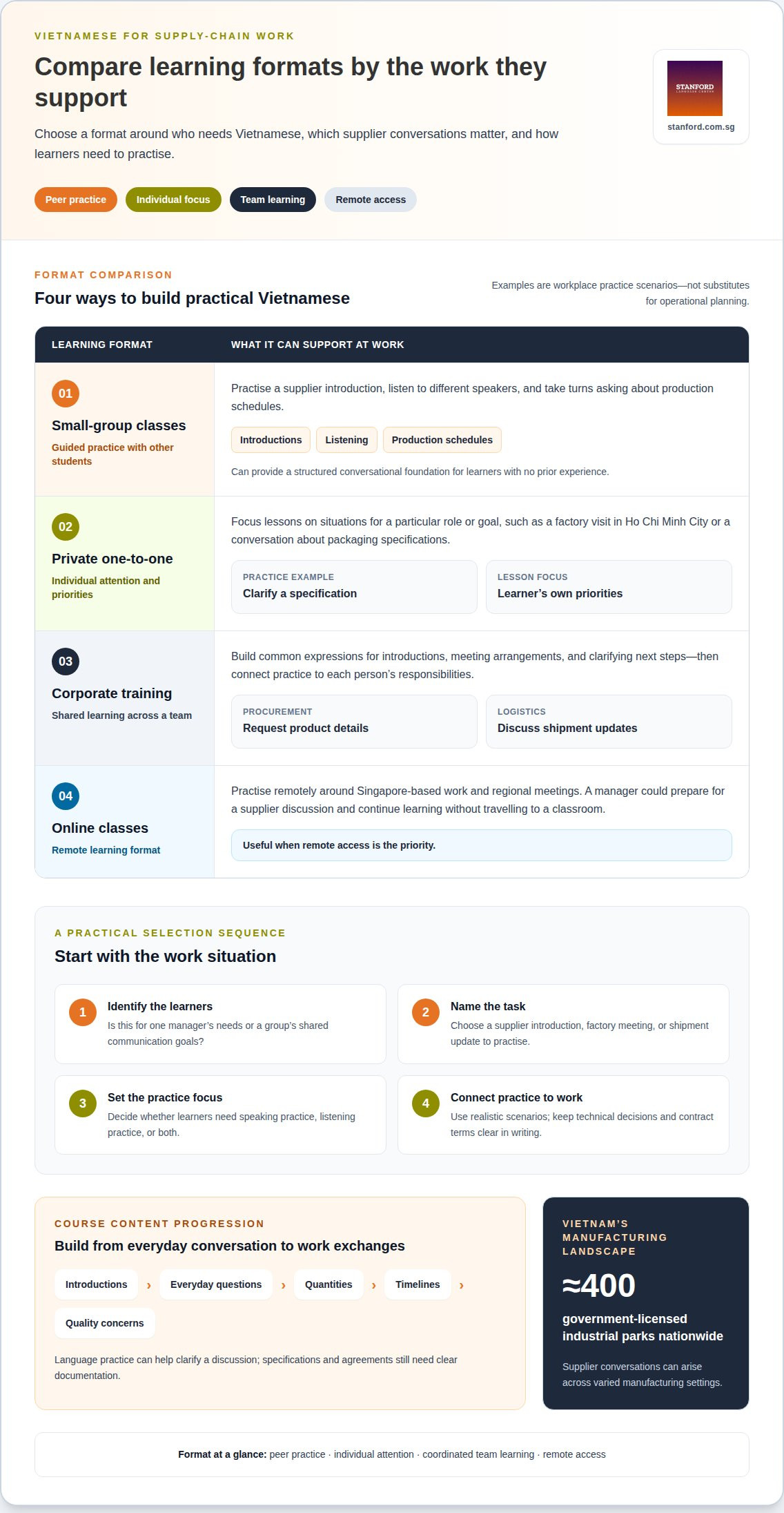
Singapore professionals can choose Vietnamese learning by format and purpose: small-group classes, private one-to-one lessons, corporate training, or online classes. Beginners can build a conversational foundation around practical situations. For a supply chain manager, that might mean introducing yourself to a factory contact, discussing delivery dates, or asking for clarification during a supplier call.
Small-group classes suit learners who want guided practice with other students. A manager might practise a brief supplier introduction, listen to different speakers, and take turns asking about production schedules. This format offers opportunities to hear and use Vietnamese in conversation, and can provide a structured foundation for learners with no prior experience before they apply the language at work.
Private one-to-one lessons offer a more individual format. A learner can focus practice on situations they expect to face, such as a factory visit in Ho Chi Minh City or a conversation about packaging specifications. This can suit a professional with a particular role or learning goal. It also allows lesson content to follow the learner’s priorities rather than a shared group sequence.
Corporate Vietnamese training supports workplace learning across a team. A Singapore business communicating with Vietnamese suppliers could focus on common exchanges, such as introductions, meeting arrangements, and clarifying next steps. Because team members have different roles, useful training can connect shared expressions with each person’s tasks. Procurement staff, for example, may practise requesting product details, while logistics colleagues practise discussing shipment updates.
Online Vietnamese classes give learners a remote format that can fit around Singapore-based work and regional meetings. A manager could practise conversation before an upcoming supplier discussion, then continue learning without travelling to a classroom. The useful format depends on whether the priority is peer practice, individual attention, coordinated team learning, or remote access. These are learning choices, not substitutes for operational planning.
Course content matters as much as format. Vietnam has approximately 400 government-licensed industrial parks nationwide, so supplier conversations can arise across varied manufacturing settings. A practical course can build from introductions and everyday questions toward workplace exchanges about quantities, timelines, and quality concerns. Learners should distinguish language practice from technical or contractual decisions: Vietnamese can help clarify a discussion, while specifications and agreements still need clear documentation.
If you are comparing options, start with an immediate work task. For supplier calls, conversational practice is a sensible foundation. If several colleagues need shared phrases, corporate training may be a better fit. For focused individual preparation, private lessons offer a direct format. This approach connects learning to your next supplier interaction and longer-term work across Vietnam, Singapore, and Indonesia.
Are there Vietnamese tutors or corporate language training providers in Singapore?
Yes. Singapore professionals can learn Vietnamese through private one-to-one lessons or corporate language training. Private lessons may suit a manager preparing for supplier calls, while a company programme can support colleagues with shared Vietnam-facing responsibilities. Choose based on who needs the language, which work conversations matter, and whether learners need individual or team-based practice.
Private lessons can focus on one role and its immediate tasks. A procurement manager might practise introducing a product requirement, asking a supplier to clarify a specification, and confirming the next discussion. A logistics manager could instead focus on shipment updates and delivery questions. These examples give lessons a clear workplace purpose, while written agreements remain important.
Corporate training can connect a team’s shared language needs with different job responsibilities. A Singapore company working with Vietnamese manufacturers might include procurement, operations, and logistics colleagues. They could practise a common meeting introduction, then rehearse role-specific exchanges about product details or delivery arrangements. A shared learning plan can help the team use familiar terms in calls, visits, and follow-up conversations.
Before choosing a format, define the work situation learners need to handle. A useful planning sequence is:
- Identify the learners: distinguish one manager’s needs from a group’s shared communication goals.
- Name the task: choose a supplier introduction, factory meeting, or shipment update as a practice example.
- Set the focus: decide whether learners need speaking practice, listening practice, or both.
- Connect practice to work: use realistic scenarios while keeping technical decisions and contract terms clear in writing.
This sequence helps match the training format to the work, rather than choosing based only on convenience. A manager preparing for a factory visit, for example, may value focused practice with introductions and questions. A team handling regular supplier discussions may benefit from shared expressions and meeting practice. In either case, start with a specific communication task.
Vietnam-facing work can also involve coordination across Singapore, Vietnam, and Indonesia. A team might use Vietnamese during a supplier conversation, then summarise decisions for regional colleagues in English. That makes clear turn-taking, confirmation questions, and accurate follow-up important learning goals. Managers can explore Vietnamese language learning when they want guided practice connected to these workplace situations, focusing on essential skills like taking turns, checking understanding, and agreeing who will relay each point.
The commercial setting can also shape what learners prepare to discuss. Vietnam’s industrial park tax incentives provide nine years at half the corporate tax rate after the tax-free period. The Singapore-Vietnam-Indonesia corridor provides access to free trade agreements covering 65 economies. Vietnam SuperPort® is an 83-hectare multimodal logistics hub in Phu Tho Province, Vietnam.
These details can guide scenario choices. A lesson might practise asking a colleague to explain a business term, discussing a cross-border meeting, or clarifying logistics questions. Whether private lessons or a company programme is preferable still depends on learners’ roles and communication tasks. Training can focus on situations the team expects to encounter, while factual commercial advice remains separate from language instruction.
What Vietnamese proficiency level is useful for managing suppliers in Vietnam?
There is no single Vietnamese proficiency level that suits every supply chain role. A manager building basic rapport has different needs from someone leading contract discussions. Set a practical target by listing the conversations you handle, such as greeting a factory team, clarifying a production issue, or summarising an agreed action. Focus on the language that helps you contribute accurately to those tasks.
Vietnamese for supply chain managers in Singapore is most useful when learning goals match real supplier interactions. For occasional visits, a conversational foundation can help with greetings, introductions, and simple questions. You could introduce your role, ask who handles quality, and request a slower explanation. These exchanges support initial contact, but do not replace technical vocabulary or written production records.
Regular supplier communication calls for stronger listening and speaking skills. When discussing a late component, a manager needs to understand the explanation, ask what happens next, and confirm who owns each action. Practising these exchanges can reveal where comprehension breaks down and when written follow-up is needed instead of relying on a brief spoken exchange.
For negotiations, assess proficiency by task rather than by a label alone. Can you follow a proposal, ask for clarification, explain your position, and identify unresolved points? Vietnamese for supply chain managers in Singapore can focus on practising these work demands. Use Vietnamese to support rapport and routine discussion, while handling complex commercial terms through clear written documentation and appropriate internal review.
These three working targets can help define a learning goal. They are practical descriptions, not formal Vietnamese qualifications:
- Foundation: introduce yourself, use polite greetings, and ask simple questions during a factory visit.
- Routine communication: discuss familiar operational topics and confirm basic actions with a supplier.
- Advanced work conversations: manage less predictable discussions, ask precise follow-up questions, and summarise proposals accurately.
Use a real work scenario to identify the next step. A procurement manager might begin with introductions, then practise asking a supplier to explain a change in material. An operations lead could focus on listening for reasons, consequences, and next actions. Each scenario reveals useful vocabulary and role-specific listening skills.
Singapore teams coordinating with Vietnam and Indonesia should decide which conversations need Vietnamese and which need a shared written record. A manager may use Vietnamese to build rapport, then record specifications, responsibilities, and dates in the team’s agreed working language. This keeps language practice grounded in the role without confusing conversational ability with technical or contractual authority.
Which Vietnamese business phrases are essential for supply chain managers
Build a phrase bank around key supplier conversations: opening a meeting, checking details, discussing delays, and agreeing on next actions. Learn each expression in Vietnamese alongside its English meaning and a work example. For instance, practise asking a supplier to repeat a production update before responding. The goal is to use clear questions in real exchanges, not just memorise isolated vocabulary.
Start with introductions and meeting control. Supply chain managers need to state their name, role, and company, then explain the purpose of a discussion. Practise a greeting, a polite request to begin, and a phrase for introducing a colleague. A clear opening sets context before the group moves to an order, quality issue, or factory schedule.
Next, practise questions that uncover operational details. A useful set covers quantity, specifications, production status, and expected completion. Rehearse asking whether a batch matches the agreed product requirements, then ask which detail needs clarification. Practise listening for the answer as well as asking the question, and use a follow-up prompt to confirm what the supplier means.
- Order details: practise asking about product type, quantity, packaging, and the relevant order reference.
- Production status: learn how to ask whether work has started and what stage it has reached.
- Quality concerns: practise describing a defect and asking what corrective action is proposed.
- Delivery timing: prepare ways to ask about dispatch, an expected arrival, and a possible delay.
- Meeting follow-up: learn to confirm the next action, the responsible person, and the timing discussed.
Keep questions precise. “Is the order ready?” may invite a broad answer; asking about the production stage or dispatch status is clearer. Practise a follow-up for each answer, such as asking what remains before shipment. When raising a quality issue, describe what you observed rather than assigning blame. This keeps the conversation focused on evidence and next steps.
Give polite clarification phrases equal attention. Practise asking someone to repeat a figure, explain a technical term, or speak more slowly. In a factory meeting, misunderstanding a quantity or date can distort the discussion. Rehearsing clarification makes it easier to pause, check meaning, and avoid pretending to understand.
Finally, practise confirmation language. Summarise the quantity discussed, the action owner, and the timing, then invite corrections. Try a short role-play: a supplier reports a production delay; the manager asks the cause, requests a revised schedule, and restates the next action. Use Vietnamese lessons to practise these expressions aloud, while recording specifications and commitments in the team’s agreed written format.
How do Vietnamese language skills help with supplier negotiations and factory visits
Vietnamese can help Singapore managers build rapport, clarify supplier responses, and follow discussions more actively. For Vietnamese for supply chain managers in Singapore, practical language skills can support negotiation preparation and factory visits. The Vietnam supply chain role described in the research includes representing a company in negotiations and contract discussions with foreign partners. Language skills can support that work, but they don’t replace commercial judgement or careful records.
Before a factory visit, practise a short introduction explaining your role and the meeting’s purpose. At the site, ask clear questions about the production process, quality checks, and who is responsible for each step. If a supplier describes an unfamiliar process, ask for another explanation. This keeps the exchange moving and helps identify what needs written follow-up.
During negotiations, listening matters as much as speaking. When discussing a proposed delivery change, identify the reason, operational effect, and next action. Ask focused follow-up questions rather than assuming a brief answer settles the issue. Then summarise the points discussed and invite corrections. This can uncover different understandings before they become operational problems.
Language practice is especially useful for the conversational parts of a visit. A manager can greet the factory team, introduce colleagues, and ask who will lead a production walkthrough. Familiarity with these exchanges can help the visitor participate rather than rely on a colleague for every interaction. A confident introduction also creates a natural opening for questions about workflow and supplier responsibilities.
Prepare by matching practice to the visit’s purpose. A focused rehearsal could cover:
- Opening the meeting: introduce your role, explain the visit’s purpose, and welcome the supplier team.
- Understanding production: ask for an explanation of a process, inspection point, or production update.
- Clarifying a concern: describe an issue and ask what action the supplier proposes.
- Closing clearly: recap the discussed actions and identify what needs written confirmation.
For contract terms, specifications, and commercial commitments, keep an accurate written record in the team’s agreed working language. Spoken Vietnamese can help managers ask questions and understand context, while written documentation supports precise review across Singapore, Vietnam, and Indonesia. Use conversation to clarify, then record the agreed details for the relevant teams.
Build negotiation confidence through guided Vietnamese practice for workplace conversations. Vietnamese for supply chain managers in Singapore can focus on scenarios such as supplier introductions, factory questions, and meeting follow-ups.
When discussing order volumes, account for the fact that Vietnamese factories may have less negotiable minimum order quantities than Chinese factories; clarify the supplier’s threshold before treating a proposed quantity as flexible. Singapore businesses should budget 6-10 weeks to identify a Vietnamese factory, complete sampling and confirm a first production order, so allow time for those steps before setting commitments.
Sembcorp’s ready-built factories in Vietnam have occupancy rates between 90-95%. The role requires experience with pharmaceutical, healthcare, or other regulated-goods supply chains and distribution.
Stanford Language Centre: Professional Adult Chinese learning in Singapore
Stanford Language Centre supports adult learners who also need Mandarin for regional business communication. Supply chain managers coordinating across Singapore, Vietnam, and Indonesia may work with Mandarin-speaking colleagues or partners as well. Mandarin learning can complement Vietnamese study, with each language serving different conversations and relationships.
For expats and foreign professionals, small-group Mandarin classes offer a shared learning setting. Stanford Language Centre also offers small-group Mandarin classes for Japanese and Korean learners. These classes suit adults who want to build practical language skills alongside their work responsibilities.
If Mandarin is another useful part of your regional communication plan, contact Stanford Language Centre to discuss your learning needs.
Make your next supplier conversation your starting point
Choose an upcoming interaction and make it your first language-learning goal. A supplier introduction, factory discussion, or follow-up call can show which Vietnamese skills would be most useful in your role. For supply chain managers in Singapore, language learning can support regional working relationships alongside clear written records and sound operational judgement.
Stanford Language Centre also supports professional adult Chinese learning in Singapore. Its small-group Mandarin classes include options for expats and foreigners, as well as Japanese learners. These may be relevant if Mandarin is another language your regional work calls for.
To discuss your Vietnamese learning needs, contact Stanford Language Centre. A clear first goal can make your next step easier to plan and help you build useful communication skills with confidence.
Frequently Asked Questions
Why should supply chain managers in Singapore learn Vietnamese?
Vietnamese can help Singapore-based managers communicate more directly with suppliers and build working rapport. During a routine check-in, for example, a manager could ask a supplier to clarify a change in material availability and explain its effect on an order. A conversational foundation can make it easier to start that exchange. Keep specifications, responsibilities, and final decisions clearly documented for colleagues across Singapore, Vietnam, and Indonesia.