What if the secret to winning your next big regional contract isn’t your pitch deck, but the way you greet your partner? Many Singaporean professionals want to tap into the booming ASEAN market but feel held back. You likely worry about the complex tones or finding a course that fits your hectic corporate schedule. It’s a common hurdle. Learning vietnamese for business singapore shouldn’t feel like a second job. It’s about building “Chân thành” or sincerity. This is the foundation of every successful partnership.
In this guide, you’ll discover how mastering business Vietnamese can unlock massive trade opportunities and how to start your journey with Stanford Language Centre today. We’ll show you exactly which linguistic skills are actually needed for trade and how to navigate cultural etiquette for high-stakes meetings. You’ll also learn how to utilize government grants like NTUC UTAP to offset your costs. Whether you need private 1-1 lessons or corporate training, we’ve got you covered. It’s time to turn that intimidation into a competitive advantage.
Key Takeaways
- Learn how to build “Chân thành” (sincerity) with partners to secure long-term trade success in the 2026 ASEAN economy.
- Understand why mastering vietnamese for business singapore requires a shift from casual conversation to professional meeting and logistics terminology.
- Discover why focusing on tone accuracy and clear pronunciation is vital for maintaining professional reliability in high-stakes negotiations.
- Follow a practical roadmap that starts with foundational Level 1 courses before advancing to industry-specific language skills.
- Maximize your professional development budget by utilizing NTUC UTAP grants to offset training costs for adult learners.
The Strategic Importance of Business Vietnamese in Singapore
Singapore’s role in the 2026 ASEAN economy is more linked to Vietnam than ever before. As a primary investor, our city-state drives massive projects in both the manufacturing and tech sectors. While English serves for basic emails, it often fails during deep-level negotiations or social dinners. Complex deals require more than just a translator; they require a direct, human connection. This is why vietnamese for business singapore has become a vital skill for local professionals. You want to be the person who understands the room, not just the person waiting for the translation.
The Vietnamese language is rich with tonal subtleties that reflect respect and hierarchy. Understanding these nuances helps you navigate the ASEAN Economic Community’s regional needs. The AEC has lowered trade barriers, but cultural barriers remain. Mastering the basics allows you to bypass these hurdles. It isn’t just about grammar. It’s about showing your partners you’re invested for the long haul.
Vietnam as a Key Market for Singaporean SMEs
Singaporean SMEs are pivoting toward Vietnam’s core growth sectors:
- High-tech manufacturing and electronics
- Digital transformation and software development
- Sustainable energy and green infrastructure
These industries rely on local supply chains and boots-on-the-ground operations. Localized communication reduces operational friction and speeds up project approvals. Having bilingual staff in regional roles isn’t a luxury anymore. It’s a necessity. It ensures your company’s values don’t get lost in translation during site visits or technical handovers. When you speak the language, you gain access to insights that aren’t available in English-only circles.
Building Trust Beyond the Contract
Vietnamese business culture prioritizes ‘Chân thành’, or sincerity. You can’t build this through a legal contract alone. Showing effort by learning basic phrases breaks the ice instantly in high-stakes meetings. It signals that you value the relationship over the simple transaction. Moving from a transactional model to a relational one is the key to longevity in the Vietnamese market. Your partners will appreciate the gesture deeply. It shows you’re a supportive ally and a reliable partner in the business journey. This effort builds a foundation of trust that survives market fluctuations and economic shifts.
Business Vietnamese vs. General Conversation
Learning a language is one thing. Learning it for the boardroom is another. Most beginner courses focus on basic survival skills like ordering food or asking for directions. While these are great for holidays, they won’t help you during a quarterly review. Choosing vietnamese for business singapore means focusing on the specific register used by professionals. It moves you from a tourist to a serious partner. You’ll shift from casual slang to formal structures that convey authority and reliability. This transition is essential for anyone looking to navigate the complex trade corridors between our two nations.
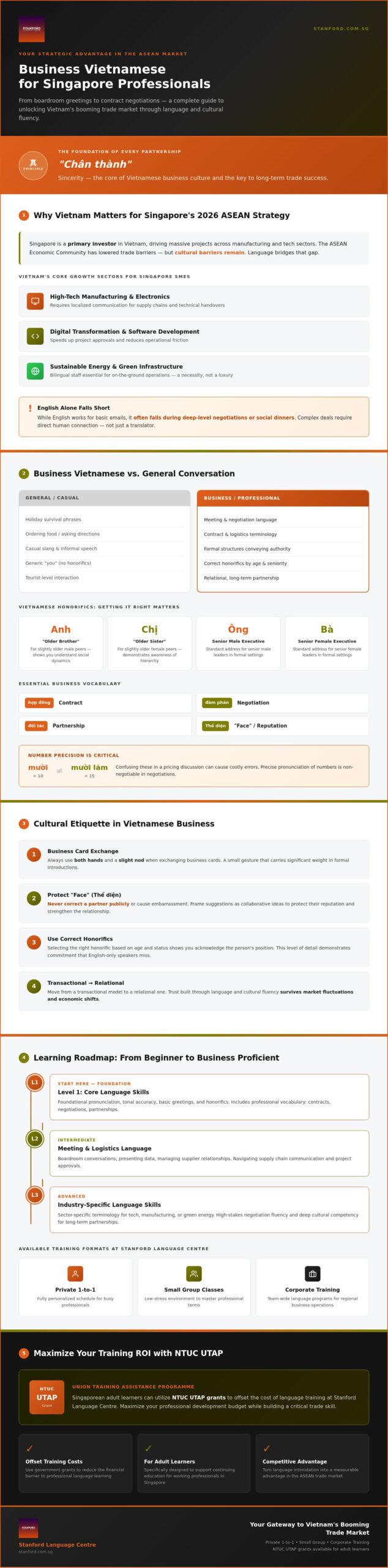
Vietnamese culture is deeply rooted in hierarchy and respect. You can’t simply use a generic “you” in a meeting. Instead, you must select the correct honorific based on age and status. Using Anh (older brother) or Chị (older sister) for slightly older peers shows you understand social dynamics. For senior executives, Ông or Bà is the standard. Using these correctly isn’t just about grammar; it’s about acknowledging the person’s position. This level of detail shows your partners that you’ve done your homework. It demonstrates a level of commitment that English-only speakers often miss.
Vocabulary for the Professional Setting
You need a specific linguistic toolkit for meetings. Words like hợp đồng (contract), đàm phán (negotiation), and đối tác (partnership) are non-negotiable. Numbers are also vital. Pricing errors often happen because people confuse mười (10) with mười lăm (15). Learning to present data clearly ensures you stay in control of the narrative. When exchanging business cards, always use both hands and a slight nod. It’s a small gesture, but it carries significant weight in a formal introduction. For those looking for structured guidance, small group Vietnamese classes offer a practical way to master these terms in a low-stress environment.
Cultural Etiquette in Vietnamese Business
The concept of ‘Face’ (Thể diện) is central to every interaction. Never correct a partner publicly or cause them embarrassment. Instead, frame your suggestions as collaborative ideas. This protects their reputation and strengthens your professional bond. Dining is where the real work happens. It’s about hospitality, not just food. Knowing the right toast or how to accept a drink gracefully can seal a deal faster than a PowerPoint presentation. As you explore Singapore-Vietnam business opportunities, remember that your language choice is your first impression. It sets the tone for a long-term, successful relationship.
Linguistic Pillars: Tones and Pronunciation for Professionals
Many professionals feel intimidated by the idea of learning a tonal language. It’s a valid concern. In Vietnamese, the pitch of your voice determines the meaning of the word. A single syllable can mean six different things depending on whether your voice rises, falls, or stays flat. For those pursuing vietnamese for business singapore, clear pronunciation is more than a linguistic goal. It’s a tool for precision. Errors in tone can lead to confusion in contract terms or pricing discussions. You don’t need to be a linguist, but you do need to be clear.
The six tones of Vietnamese are often described as musical notes. For English speakers, these can be simplified into a basic guide:
- Mid-level: Flat and steady, like a neutral statement.
- Low falling: Deep and heavy, similar to the end of a serious sentence.
- High rising: Sharp and ascending, like asking a surprised question.
- Low rising: Dipping down then back up, creating a rhythmic curve.
- High broken: A quick, glottal sound that stops abruptly.
- Low falling-rising: A questioning tone that stays lower in the throat.
Singaporean learners often face specific pitfalls. Our natural tendency to use Singlish sentence endings can sometimes interfere with the intended tone of a Vietnamese word. Focus on keeping your tones distinct and avoid the monotone trap. While it takes practice, your partners will appreciate the effort. It shows you’re a supportive ally who values their culture enough to get the sounds right.
Mastering the Tones for Clarity
Learning to distinguish between rising and falling tones is the first step. Rising tones usually sound like you’re asking a question. Falling tones sound like a firm statement. Use your hands to trace the pitch in the air as you speak; it’s a physical trick that helps your brain map the sound. Context also acts as your safety net. Even if your tone is slightly off, your partners will usually understand you based on the business topic at hand. If you’re feeling stuck, check out this guide on how to learn a tonal language for more practical beginner tips.
The Vietnamese Alphabet and Writing
One major advantage for Singaporeans is the script. Unlike Mandarin or Thai, Vietnamese uses a Latin-based alphabet called Quốc ngữ. You can read the words almost immediately. This makes starting vietnamese for business singapore much faster than other regional languages. Reading a business email is straightforward because the tones are marked with diacritics. However, speaking in person requires a focus on phonetics. While the script is familiar, the sounds are unique. We recommend focusing on phonetic building blocks early on. This builds immediate speaking confidence. You’ll move from reading a slide to engaging in a real conversation with your partners in no time.
Learning Roadmap: From Beginner to Business Proficient
Mastering vietnamese for business singapore doesn’t require you to become a linguist overnight. It’s a structured journey that aligns with your professional growth. We view language acquisition as a three stage process designed for busy adults. By breaking the content into manageable milestones, you can see immediate results in your interactions with partners. This roadmap ensures you spend your time on the skills that actually drive trade success.
- Stage 1: Foundational Vietnamese (Level 1). You’ll focus on daily survival skills. This includes formal greetings, polite introductions, and basic numbers for pricing. It’s about building comfort with the six tones.
- Stage 2: Industry-Specific Expansion. Once the basics are set, you’ll move into vocabulary that matters for your sector. You’ll learn terms for manufacturing, logistics, or tech, depending on your business needs.
- Stage 3: Complex Negotiations and Nuance. At this level, you’ll tackle high-stakes boardroom scenarios. You’ll learn to navigate subtle cultural cues and read between the lines during intense discussions.
Small group learning is particularly effective for this journey. It provides a low-pressure environment where you can practice dialogue with peers. You’ll hear different voices and accents, which prepares you for the reality of doing business in Vietnam. This peer-to-peer practice builds the muscle memory needed for spontaneous conversation.
Small Group vs. Private 1-1 Lessons
Choosing the right format depends on your specific goals. Small groups are ideal for practicing business dialogue and networking scenarios. They offer a sense of community and shared progress. However, private 1-1 lessons provide a higher degree of customization. If you need to master very specific industry jargon or have a highly irregular schedule, 1-1 training is the faster route. Many professionals also find that online options offer the flexibility needed to stay consistent without the commute. We recommend evaluating your timeline and learning style before committing.
Maintaining Progress While Working Full-Time
Consistency is more important than intensity when you’re working 40 hours a week. We suggest the ’15-minute rule’ for language retention. Spending just fifteen minutes a day on a language app or reviewing your notes keeps the sounds fresh in your mind. You can easily integrate this into your daily commute on the MRT. For companies looking to upskill entire departments, Corporate Language Training Singapore offers a methodical way to bring the classroom to your office. This ensures your whole team is aligned and ready for the next regional expansion. Ready to take the first step? You can enrol in a small group Vietnamese class today and start building your competitive advantage.
Maximizing Your Training ROI with UTAP at Stanford Language Centre
Investing in your professional development should be straightforward and rewarding. When you look for vietnamese for business singapore, you want practical results without unnecessary financial stress. Stanford Language Centre has been a supportive mentor for adult learners since 2004. We understand the unique constraints of busy professionals. Our goal is to lower the barrier to entry by providing high-value training that fits your schedule and budget. By leveraging local grants, you can focus on mastering the language while we help you manage the costs.
Understanding NTUC UTAP for Language Courses
If you’re an NTUC member, you can utilize the Union Training Assistance Programme (UTAP) to offset your course fees. This is a significant financial incentive for workers in Singapore looking to upskill. It’s designed to encourage lifelong learning and regional competitiveness. To qualify for this benefit, you generally need to meet these criteria:
- Maintain an active NTUC membership throughout the course duration and at the point of claim.
- Achieve a minimum attendance of 75% for your Vietnamese classes.
- Sit for all required examinations or assessments.
The claim process is user-friendly. You pay the course fee upfront and then submit your claim through the NTUC portal after completing the module. It’s a no-frills way to get more value from your training budget. Please note: While our Vietnamese programs are UTAP claimable, they are NOT claimable via SkillsFuture credits. We recommend checking the latest 2026 UTAP claim limits to maximize your reimbursement.
Why Stanford Language Centre for Business Vietnamese?
Our Level 1 programs are specifically designed for beginners who need to hit the ground running. We don’t focus on abstract theory. Instead, we prioritize the linguistic skills you’ll actually use in a boardroom or at a business dinner. We’ve spent years refining our curriculum to serve corporate clients and expat professionals who need efficiency. Our instructors act as friendly guides, ensuring you feel comfortable from day one.
For organizations looking to equip their entire team, we offer specialized Corporate Vietnamese Language Training. These solutions are highly flexible. We can tailor the vocabulary to your specific industry, whether you’re in green energy, tech, or logistics. This customization ensures your team builds the exact rapport needed for your trade sector. Starting your journey is simple. Enrolling in a Level 1 program is the fastest way to turn a complex challenge into a strategic advantage. We’re here to partner with you on this journey toward regional success.
Secure Your Competitive Edge in ASEAN
Mastering the nuances of trade in Vietnam starts with a single, respectful greeting. By moving beyond basic conversation and focusing on professional register and tonal clarity, you position yourself as a sincere partner rather than just another foreign investor. Whether you’re navigating complex negotiations or building rapport at a business dinner, the right linguistic skills open doors that English alone cannot.
Starting your journey into vietnamese for business singapore is now more accessible than ever. With structured Level 1 courses and flexible learning paths, you can balance professional growth with your existing corporate schedule. Don’t forget that you can also maximize your training budget through NTUC UTAP grants to offset your course fees. It’s a pragmatic way to invest in your future without overextending your budget.
Ready to unlock new trade opportunities? You can enroll in Business Vietnamese at Stanford Language Centre today. Take advantage of our expert instructors for adults and choose between small group or private 1-1 options. Your next big partnership in Hanoi or Ho Chi Minh City is waiting. Let’s get started.
Frequently Asked Questions
Is Vietnamese difficult for English speakers to learn for business?
Vietnamese is quite manageable because it uses a Latin-based script, unlike many other regional languages. The six tones are the main challenge for beginners, but we focus on practical phonetics to ensure you’re understood in a boardroom. It isn’t about achieving a perfect accent; it’s about building enough clarity to communicate with sincerity. Our instructors act as supportive mentors to help you navigate these sounds without feeling overwhelmed.
Can I use SkillsFuture credits for Vietnamese courses at Stanford Language Centre?
No, you cannot use SkillsFuture credits for Vietnamese courses at our centre. We focus on providing professional instruction that qualifies for other specific local subsidies. While SkillsFuture isn’t a payment option here, our programs are specifically designed to be claimable under the NTUC UTAP scheme. This ensures that our adult learners can still access significant financial support for their professional development and regional upskilling goals.
How much can I claim under NTUC UTAP for Vietnamese lessons?
NTUC members can generally claim up to 50% of the unfunded course fees, subject to a yearly cap. This grant is an excellent way to reduce the overall cost of vietnamese for business singapore. You’ll pay the course fee upfront and then submit your claim through the NTUC portal after completing the module. It’s a straightforward process that helps local professionals maximize their training ROI while staying competitive in ASEAN.
How long does it take to reach a basic business proficiency in Vietnamese?
Most students reach a functional business proficiency after completing our foundational Level 1 program, which typically takes ten to twelve weeks. This level allows you to handle formal introductions, basic pricing data, and polite boardroom interactions. Reaching a deeper level of negotiation skill requires further study and consistent practice. Spending just fifteen minutes a day reviewing your notes can significantly speed up your progress and retention.
Does Stanford Language Centre provide corporate training at our office?
Yes, we provide dedicated corporate training solutions that can be conducted directly at your office or via a private online platform. This is a popular choice for Singapore-based teams looking to expand into the Vietnamese market. We tailor the vocabulary to your specific industry needs, whether you’re in manufacturing, tech, or logistics. This ensures your staff learns the exact phrases required for your trade sector, making the training efficient.
What is the difference between Level 1 and Business Vietnamese?
Level 1 focuses on foundational building blocks like tones, the alphabet, and daily survival phrases. It’s the essential starting point. Business Vietnamese is a more specialized register that prioritizes formal honorifics and professional terminology. You’ll move from asking for directions to discussing contracts and logistics. Mastering vietnamese for business singapore requires this shift toward a more respectful and authoritative tone that reflects your professional reliability.
Are online Vietnamese classes as effective as in-person lessons?
Online classes are highly effective and offer the flexibility that busy professionals need to stay consistent. We use interactive platforms to ensure you get real-time feedback on your pronunciation and tones from our expert instructors. While in-person lessons offer more physical interaction, our online modules provide the same structured curriculum and expert guidance. It’s a no-frills way to maintain your learning momentum without the stress of a commute.