Vietnamese is the most accessible tonal language for English speakers because it uses a Romanized alphabet and skips complex conjugations. While most adults in Singapore feel intimidated by those six distinct tones, the reality is much more encouraging. You’ve likely felt the sting of “tone-phobia” or struggled to find a native instructor who understands the needs of a busy professional. It’s frustrating when you want to connect with business partners in Ho Chi Minh City or simply order a bowl of pho like a local, but don’t know where to start. We understand that you need practical results without the stress of a rigid classroom setting.
This guide will help you find a beginner-friendly vietnamese language class in Singapore that fits your busy schedule and your budget. You’ll discover how to master conversational basics through expert-led small groups and native instruction that prioritizes real-world utility. We’ll also show you how to maximize local training grants like NTUC UTAP to make your learning journey even more affordable. From conducting basic business introductions to navigating the streets of Hanoi with confidence, here’s how to kickstart your Vietnamese journey today.
Key Takeaways
- Learn why Vietnamese is a strategic career multiplier for Singaporeans looking to lead in the 2026 ASEAN business landscape.
- Discover how to navigate the six tones and diacritics using a pragmatic approach designed specifically for adult learners.
- Identify whether a small group vietnamese language class or private 1-1 tutoring best fits your personal learning pace and schedule.
- Unlock the steps to claiming NTUC UTAP funding to make your professional development more affordable and accessible.
- Gain insights into a curriculum that prioritizes real-world conversation and practical results from your very first lesson.
Why Join a Vietnamese Language Class in Singapore Now?
Vietnam is one of the fastest-growing economies in Southeast Asia. By 2026, its role within the ASEAN business landscape will be even more critical. For professionals in Singapore, this growth represents a massive opportunity. Learning the language isn’t just a hobby; it’s a career multiplier. It opens doors to partnerships and market insights that others often miss. Joining a vietnamese language class helps you tap into this regional momentum early.
The Business Case for Vietnamese Fluency
Vietnamese vs. Other Tonal Languages
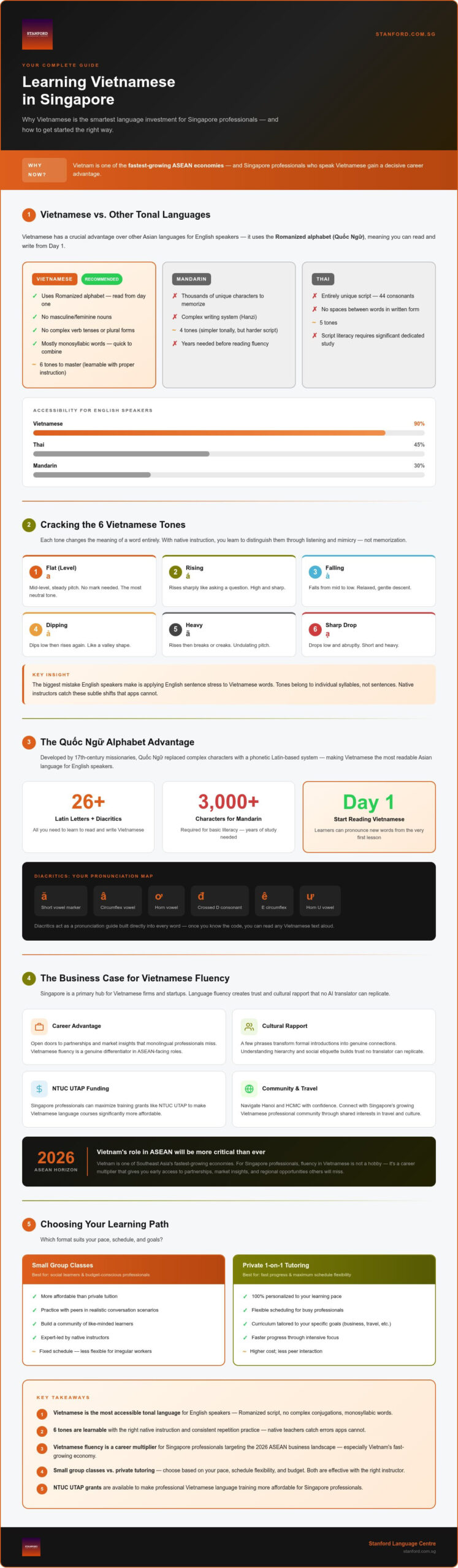
Many people fear tonal languages, but Vietnamese has a secret advantage. It uses the Romanized alphabet, known as Quốc Ngữ. Unlike Mandarin or Thai, you don’t need to memorize thousands of unique characters or complex scripts. You can start reading and writing almost immediately. The grammar is also remarkably straightforward. There are no masculine or feminine nouns. There are no complex verb tenses or plural forms to track. The “short word” advantage is real. Because most Vietnamese words are monosyllabic, you can string sentences together quickly once you know the basics. It’s a logical, efficient system that rewards consistent practice.
Beyond the boardroom, there is a vibrant social scene for learners in Singapore. When you join a local vietnamese language class, you meet peers who share your interests in travel, food, and investment. It’s a supportive environment where you can practice without judgment. You aren’t just learning a language; you’re joining a community that values growth and cultural exchange. This social connection makes the learning process feel less like a chore and more like a shared adventure. It’s about building bridges, both professional and personal, right here at home.
Mastering the Basics: Tones, Alphabet, and Conversation
Many adults hesitate to start a vietnamese language class because of the six tones. It sounds like a lot. However, once you break it down, it’s a logical system of pitch and length. Level 1 courses prioritize these phonetics because they are the foundation of everything else. You’ll learn to distinguish between the ‘flat’ tone and the ‘heavy’ tone before moving on to complex grammar. This ensures you’re understood from your very first conversation in a Hanoi coffee shop or a Singapore boardroom.
Cracking the Tonal Code
Tones can feel like a musical puzzle. In a classroom setting, you’ll practice through repetitive listening and mimicry exercises. This is where having native-speaking teachers becomes essential. They can catch the subtle shifts in your voice that an app might miss. A common pitfall for English speakers is trying to apply English sentence stress to Vietnamese words. This often changes the meaning entirely. By focusing on tonal accuracy early, you avoid developing bad habits that are hard to break later. It’s about precision, not just volume.
The Quốc Ngữ Alphabet Advantage
You can read and write Vietnamese from day one. This is because the language uses the Latin script, known as Quốc Ngữ. The Romanized script was developed by 17th-century missionaries to replace complex characters with a phonetic system that was easier for foreigners to learn and locals to read. Instead of memorizing thousands of symbols, you only need to learn a few extra marks called diacritics.
Think of diacritics as a map for your mouth. They tell you exactly how to shape your vowels and which tone to use. Once you learn the code, you can pronounce almost any word you see. This allows beginner courses to focus on high-frequency vocabulary. You’ll learn words for ‘meeting’, ‘contract’, and ‘coffee’ right away. This pragmatic approach means you can apply what you learn in a vietnamese language class to real-life situations immediately. If you’re ready to start, exploring a beginner-friendly course is the best way to build a solid foundation.
Choosing Your Path: Small Group vs. Private Vietnamese Lessons
Finding the right environment is the first step toward fluency. Some adults thrive in social settings, while others need a laser-focused approach to their specific needs. Your choice of a vietnamese language class should match your personality and your professional goals. It’s about finding a rhythm that you can maintain over several months.
The Small Group Dynamic
Small groups, typically limited to 10 or 12 students, offer a unique “sweet spot” for adult learners. You get enough personal attention from the instructor while benefiting from the collective energy of your peers. Seeing others navigate the six tones makes the process feel much less intimidating. Roleplay exercises are also more effective with partners. It’s one thing to say a phrase to yourself; it’s another to use it in a simulated market negotiation or office greeting. Peer support keeps you accountable and motivated. If you enjoy collaborative learning, a Small group Vietnamese class provides the ideal environment to build confidence.
Private 1-1 Tailored Lessons
If your schedule is unpredictable, private tutoring might be the better path. Executives in Singapore often choose this option for its sheer flexibility. You don’t have to worry about missing a session due to a last-minute flight or a late-running meeting. These lessons allow for a highly customized curriculum. You can focus specifically on business terminology relevant to your industry, whether that is logistics, finance, or manufacturing. It also provides a direct feedback loop. Your teacher can spend extra time helping you perfect the Northern or Southern accent based on where your business partners are located. This targeted approach often leads to faster conversational results.
Corporate language training is another powerful tool for Singapore-based teams. Customizing the curriculum for an entire department ensures everyone is on the same page before a major project or expansion into Vietnam. Looking ahead to 2026, the balance between online and in-person learning is also vital. Many learners prefer the physical classroom for initial phonetics but switch to online sessions for convenience. This hybrid approach ensures that your vietnamese language class fits into your life, not the other way around. It’s about making progress sustainable and results-oriented, much like how finding a transfer helper singapore can help you manage your household more efficiently to free up study time.
How to Enroll and Maximize Your Learning Grants
Starting your journey doesn’t have to be complicated. It begins with a simple assessment of your current level. Most adults start with Beginner Level 1 to build that crucial tonal foundation we discussed earlier. If you’ve learned some basics through travel or previous study, a quick consultation ensures you don’t repeat what you already know. Once you’ve picked your level, the next step is looking at your funding options. Singapore offers several ways to make professional development more affordable.
Navigating NTUC UTAP for Vietnamese Courses
The Union Training Assistance Programme (UTAP) is a fantastic resource for Singaporeans and Permanent Residents. It’s designed to encourage lifelong learning by making high-quality courses more accessible. In 2026, NTUC members can continue to claim a significant portion of their unfunded course fees. This makes joining a vietnamese language class a very cost-effective move for your career. The process is simple and transparent. You enroll and pay for your course first. Once you complete your lessons with the required attendance, you log into the NTUC portal to submit your claim. It’s a pragmatic way to upgrade your resume without a heavy financial burden.
Corporate Training Solutions
If you’re learning for work, your company might already have a training budget waiting to be used. Many Singaporean firms in the logistics, tech, and real estate sectors now prioritize regional fluency as they expand into Hanoi and Ho Chi Minh City. Language skills are a strategic asset for any team entering the Vietnamese market. Corporate modules can be customized to focus on the specific jargon used in your industry. This ensures that your team isn’t just speaking the language, but speaking the business. The ROI is clear. Better communication leads to fewer errors and stronger partnerships in the long run.
Before you commit to a full term, it’s always a good idea to check the scheduling and location. A central location in Singapore makes it easy to attend lessons after a busy workday. You can meet the instructors and get a feel for the classroom environment. This helps ensure the teaching style matches your learning preferences. If you’re ready to take the next step, you can view the upcoming enrollment dates to find a slot that fits your 2026 schedule perfectly. Taking that first step is often the hardest part, but the professional and social rewards are well worth the effort.
Start Your Journey with Stanford Language Centre
Stanford Language Centre has been a trusted partner for adult learners in Singapore since 2004. We understand that your time is valuable. Our approach is designed to be pragmatic and result-oriented. We don’t believe in overwhelming you with theoretical complexity. Instead, we offer a supportive environment where the focus remains on practical communication. Whether you are looking for a vietnamese language class to enhance your career or for personal travel, we provide the tools you need to succeed without the stress of a traditional academic setting. We strip away the academic fluff to focus on what matters most: helping you speak with confidence.
The Stanford Methodology
Our methodology centers on getting you to speak as quickly as possible. We prioritize the ‘Conversational Level 1’ curriculum because it covers the most essential real-world scenarios. You won’t just memorize word lists. You’ll learn how to navigate social and professional situations with ease. Our classroom atmosphere is friendly and unpretentious. We know that learning a tonal language can cause anxiety. Our instructors work hard to lower that barrier. Since 2004, we have helped thousands of adults gain the confidence to speak a new language. This proven track record is built on a student-first mentality that values your individual progress over rigid, intimidating academic structures.
Our native-speaking instructors bring years of experience specifically within the Singapore context. They understand the local business culture and the common pronunciation hurdles that English or Mandarin speakers might face. This local expertise allows them to provide more relevant examples and corrections. You aren’t just getting a teacher. You’re getting a mentor who understands your specific constraints as a busy professional. We prioritize a no-frills approach to quality, ensuring that every minute you spend in the classroom translates into a usable skill.
Ready to Speak Vietnamese?
We make it easy to fit learning into your life. Our school is centrally located for those who prefer the energy of in-person sessions. For those with more unpredictable schedules, our flexible online options provide the same high-quality instruction from the comfort of your home or office. We are now accepting registrations for our upcoming 2026 small group intakes. Finding the right vietnamese language class is the first step toward unlocking new opportunities across Southeast Asia.
If you aren’t sure where to start, our friendly consultants are available for a quick level assessment. They can help you decide between a group setting or private lessons based on your specific goals. You can also Learn more about our Adult Language Courses to see how our other programs compare. Every journey begins with a single step. We are here to ensure that step leads you toward real, conversational results in a relaxed and welcoming environment.
Take Your First Step Toward Regional Fluency
Vietnam’s rapid growth makes it a land of opportunity for those who can bridge the communication gap. You’ve seen how the Latin script gives you a head start and how small groups build the confidence you need for real-world interactions. Whether you’re aiming for business growth in 2026 or planning a deeper cultural immersion, the right foundation is key. Choosing a vietnamese language class that balances professional reliability with a warm, supportive atmosphere makes all the difference.
At Stanford Language Centre, we’ve been helping adults master new skills since 2004. Our native-speaking instructors provide the guidance you need to navigate those six tones with ease. Since our programs are NTUC UTAP claimable, you can invest in your professional development without overextending your budget. It’s time to stop feeling intimidated by the phonetics and start speaking. Book Your Vietnamese Level 1 Class Today and join a community of learners dedicated to practical results. We’re ready to help you succeed in a relaxed and welcoming environment.
Frequently Asked Questions
Is Vietnamese harder to learn than Mandarin for English speakers?
Vietnamese is often considered more accessible because it uses the Latin alphabet. You don’t need to memorize thousands of unique characters to start reading or writing. While the six tones require practice, the grammar is remarkably simple with no genders or complex verb conjugations. This allows you to focus your energy on speaking and listening from your very first lesson.
Can I use SkillsFuture credits for Vietnamese classes at Stanford?
No, SkillsFuture credits cannot be used for Vietnamese classes at our centre. We focus on providing high-quality instruction through other accessible avenues. Many of our students utilize the NTUC UTAP grant instead. This funding option helps eligible Singaporeans offset their course fees effectively while pursuing professional language development.
How many levels are there in the Vietnamese language program?
Our program primarily focuses on Level 1 for beginners. This level is designed to take you from zero knowledge to a functional conversational state. We prioritize the fundamentals of tones, the Romanized alphabet, and high-frequency vocabulary. This solid foundation ensures you can handle basic social and business interactions with confidence before moving toward more specialized topics.
What is the difference between Northern and Southern Vietnamese dialects?
The main differences are found in pronunciation and specific regional vocabulary. Northern Vietnamese is often seen as the standard for media and education, while the Southern dialect is widely used in business hubs like Ho Chi Minh City. Our native-speaking instructors help you understand these variations. You’ll learn to be understood across all regions of Vietnam regardless of which accent you lean toward.
How long does it take to become conversationally fluent in Vietnamese?
Most adults can handle basic social interactions after a 10 to 12 week beginner course. Real conversational confidence usually develops within six months of consistent practice. By joining a vietnamese language class regularly, you build the muscle memory needed for tonal accuracy. Consistency and peer interaction in a small group setting significantly speed up this process.
Are the Vietnamese classes at Stanford Language Centre UTAP claimable?
Yes, our Vietnamese programs are NTUC UTAP claimable for eligible members. This grant allows you to claim a portion of your unfunded course fees upon completion. It’s an excellent way for professionals in Singapore to upgrade their skills at a lower cost. We recommend checking your current membership status to maximize your available training benefits for 2026.
Do I need to learn the Vietnamese script to speak the language?
Yes, but it’s much easier than you think because it uses the Latin alphabet. Learning the script is actually the fastest way to perfect your pronunciation. The diacritics act as a map for the six tones, telling you exactly how to pitch your voice. Once you understand the script, you can read almost any word you see with the correct tone.
What happens if I miss a class in a small group setting?
We provide the necessary materials and guidance to help you catch up on missed content. While regular attendance is vital for tonal practice, we understand that busy professionals have unpredictable schedules. Our instructors are supportive and will ensure you don’t fall behind the rest of the group. You can always consult with our team regarding the best way to stay on track.