Learning a tonal language doesn’t have to feel like a second full-time job. Most professionals in Singapore want to pick up Mandarin, Thai, or Vietnamese to boost their careers. However, they’re often held back by the fear of complex tones or rigid school schedules. You want to speak with confidence. You don’t want to spend years memorizing textbooks. This Complete guide to Stanford Language Centre shows you how to reach basic conversational fluency in just two months through a relaxed, pragmatic environment.
You’ll learn how their specialized tracks for expats and foreigners simplify the learning process. We also clarify the often-confusing world of subsidies. We’ll show you how to maximize your NTUC UTAP support to significantly reduce your out-of-pocket fees. From 2026 course structures to specific financial aid steps, we’re covering everything you need to start your language journey with ease. It’s time to stop worrying about the difficulty and start focusing on the results.
Key Takeaways
- Discover how the “Fluent in 2 Months” methodology helps busy professionals achieve basic conversational skills through practical, high-speed learning.
- Explore specialized tracks for Mandarin, Thai, and Vietnamese that focus on real-world application rather than dense academic theory.
- Use this Complete guide to Stanford Language Centre to navigate 2026 course fees and maximize your savings through NTUC UTAP subsidies.
- Compare the benefits of small group interaction versus private 1-on-1 lessons to find the learning pace that suits your professional lifestyle.
- Understand the crucial distinction between available subsidies and why this centre prioritizes UTAP claims for its adult language programs.
What is Stanford Language Centre? Singapore’s Conversational Specialist
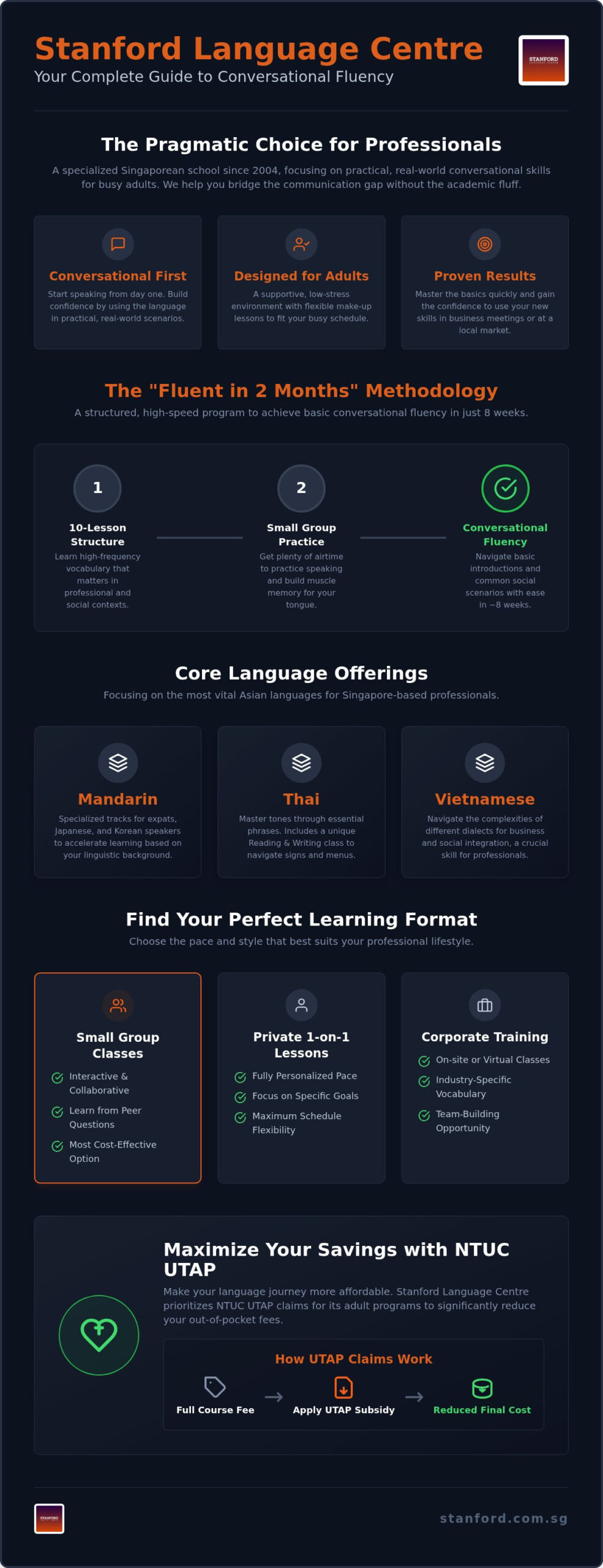
Stanford Language Centre isn’t a massive, faceless institution. It’s a specialized school that has helped adults master Asian languages since 2004. Don’t confuse it with the famous university in California. This centre is a homegrown Singaporean entity focused on professional results for the local community. It’s the pragmatic choice for anyone who needs to bridge the communication gap in our multilingual society in Singapore. They understand that for most learners, the goal isn’t to write poetry; it’s to navigate a business meeting or a local market with confidence.
Most language schools bury you in grammar books from the first day. Stanford Language Centre does the opposite. They prioritize a “Conversational First” philosophy. This means you start speaking immediately. This Complete guide to Stanford Language Centre explores why they focus so heavily on Level 1 foundational courses. By mastering the basics quickly, you gain the confidence to use your new skills in real-world settings. The school is the go-to hub for expats, foreigners, and corporate teams who need practical results without the academic fluff.
The ‘Fluent in 2 Months’ Methodology
The school uses a structured 10-lesson format designed for speed. You don’t have years to spend in a classroom. Instead, you learn high-frequency vocabulary that actually matters in a professional context. Classes are kept small. This ensures you get plenty of airtime to practice with your peers. It’s about building muscle memory for your tongue rather than just filling up a notebook. This fast-paced approach helps you move from zero knowledge to basic conversational fluency in roughly eight weeks.
A Supportive Environment for Adult Learners
Learning a tonal language like Thai or Vietnamese can feel intimidating at first. The trainers here act more like supportive mentors than distant professors. They understand the “student-first” mentality. The atmosphere is relaxed and interactive, moving away from rigid university-style lectures. If you’re a busy professional, you’ll appreciate the flexibility. They offer make-up lessons if your work schedule gets in the way. It’s a low-stress way to achieve your goals. This Complete guide to Stanford Language Centre highlights how they’ve built a community where learners feel comfortable making mistakes while they grow.
Core Course Offerings: Mandarin, Thai, and Vietnamese
Stanford Language Centre focuses on the three most vital Asian languages for Singapore-based professionals: Mandarin, Thai, and Vietnamese. Most students begin their journey with the Level 1 program. This foundational track consists of 10 lessons designed to remove the “fear factor” often associated with tonal languages. By the end of the term, you’ll handle basic introductions and navigate common social scenarios with ease. While the focus is heavily on beginners, the school provides higher-level tracks for those who want to move from basic chat to deeper fluency.
One unique feature is the Thai Reading & writing class. Many schools only teach speaking, but Stanford knows that being able to read signs and menus is a game-changer for residents and frequent travelers. This Complete guide to Stanford Language Centre wouldn’t be thorough without mentioning how these courses are structured to be NTUC UTAP claims eligible. This financial support makes the step toward multilingualism much more affordable for local professionals.
Specialized Mandarin for Expats, Japanese, and Korean Speakers
The school understands that your native language changes how you learn Mandarin. For Japanese speakers, the Small group Mandarin class for Japanese leans into your existing familiarity with Kanji. This speeds up the learning process significantly. Similarly, the Small group Mandarin class for Korean helps bridge linguistic similarities between the two languages. If you’re a Western expat, the focus shifts toward workplace communication and social integration. It’s a customized approach that respects your background. If you’re looking for a small group Mandarin class for foreigners, this tailored curriculum is a major advantage.
Thai and Vietnamese for Daily Life and Business
Mastering Thai or Vietnamese often feels like an uphill battle due to the tones. The beginner tracks here focus on mastering these tones through essential phrases for travel or relocation. In the Small group Vietnamese class, trainers help you navigate the complexities of different dialects. This is crucial if you’re doing business across different regions of Vietnam. You’ll move beyond just saying “hello” to practical applications like taking taxis, ordering food, and handling basic business introductions with local partners. This Complete guide to Stanford Language Centre highlights how these skills translate directly to better real-world connections.
Choosing Your Learning Format: Groups, Private, or Corporate
Deciding how you learn is just as important as deciding what you learn. This Complete guide to Stanford Language Centre looks at the three main ways you can study. Whether you want the energy of a classroom or the focus of a private room, there’s a setup that fits your lifestyle. Picking the right format helps you see results faster. It also ensures you actually stick with the program through to completion.
Small Group Classes: The Social Way to Learn
Small group classes are the heart of the school. They offer a balance between professional instruction and social interaction. You’ll usually find yourself in a room with a few other expats and professionals who share your goals. This creates a natural networking environment right here in Singapore. Practicing tones with a peer feels much less intimidating than doing it alone. It’s also the most cost-efficient way to learn. You get high-quality training at a lower price point than private sessions. For many, this social dynamic is what makes the “Fluent in 2 Months” goal reachable.
If you can’t make it to the physical campus, online classes provide the same digital fluency. These aren’t just recorded videos. They are live, interactive sessions that bring the classroom to your home or office. This flexibility is vital for those who want to master Professional Adult Chinese Learning in Singapore without the daily commute.
Private 1-1 and Corporate Training
Sometimes, a standard curriculum doesn’t cut it. If you need to learn specific vocabulary for the medical or hotel industry, private 1-1 lessons are the answer. You set the pace. You can accelerate through sections you find easy or spend extra time on difficult tones. The scheduling is entirely up to you. This is perfect for professionals with shifting work hours or frequent business travel. Investing in these skills often leads to significant boosts in jobs and pay as you become a more versatile asset to your company.
For businesses, corporate training solutions offer a highly customized approach. Stanford Language Centre has worked with various industries to build sector-specific programs. If your company sends Singaporean or PR staff for training, you might be eligible for additional training grants. This makes corporate language development a smart financial move for the business. It builds a more capable team while maximizing government support. This Complete guide to Stanford Language Centre emphasizes that the right format depends on your specific professional constraints.
Fees, Subsidies, and NTUC UTAP Claims
Finding an affordable way to learn shouldn’t be a headache. This Complete guide to Stanford Language Centre breaks down the financial side so you can focus on your studies. Transparency is a core value here. You’ll find that the school offers competitive rates that cater to individual learners and corporate groups alike. By choosing the right intake, you can often benefit from promotional rates that make starting your journey even easier. It’s a no-frills approach to quality education that respects your budget.
A common point of confusion for many learners in Singapore is the difference between various government subsidies. It’s vital to clarify that Stanford Language Centre does not accept SkillsFuture credits for its language programs. Instead, they focus on the Union Training Assistance Programme (UTAP). This is a significant advantage for NTUC members. While SkillsFuture is a popular topic, UTAP provides a dedicated pathway for working professionals to offset their training costs. Understanding this distinction early helps you plan your finances without any surprises.
Understanding Course Fees and Inclusions
When you look at the 2026 course fees, you’ll see two tiers: the standard rate and the promotion fee. The promotion fee is usually available for those who register before specific early-bird deadlines. This fee isn’t just for the lessons. It typically covers your registration and all necessary learning materials. You won’t have to worry about hidden costs for textbooks or hidden admin charges. To secure your spot in an upcoming intake, you can use various convenient payment methods. If your plans change, the school has clear refund and withdrawal policies designed with adult learners in mind. It’s a fair system that prioritizes your peace of mind.
Maximizing Your NTUC UTAP Benefit
If you’re an NTUC member, you can save a substantial amount on your course. The UTAP subsidy covers 50% of the unfunded course fees. For members under 40 years old, the cap is $250 per year. If you’re 40 or older, that cap increases to $500 per year as of 2026. This applies to the Level 1 conversational tracks for Mandarin, Thai, and Vietnamese. To ensure your claim is successful, you need to maintain an attendance rate of at least 75%. You should also keep your official receipt and certificate of attendance.
The claim process is straightforward. You must submit your claim online through the NTUC portal within six months of completing your course. Once approved, the funds are typically reimbursed directly to you. This makes the NTUC Utap claimable Mandarin class one of the most cost-effective ways to upskill in Singapore. This Complete guide to Stanford Language Centre confirms that by using these benefits, you can achieve your language goals while keeping your out-of-pocket expenses to a minimum.
Is Stanford Language Centre Right for You in 2026?
Choosing a language school is a big decision. You want a place that respects your time and your wallet. This Complete guide to Stanford Language Centre has shown that the school excels in three areas: speed, cost-effectiveness, and community. If you’re looking for a “no-frills” environment that delivers conversational results quickly, this is likely your best fit. You won’t find ivory towers or intimidating academic hurdles here. Instead, you’ll find a supportive group of trainers who treat you like a partner in your own growth.
Many learners try to use self-learning apps before stepping into a classroom. While apps are great for basic vocabulary, they often fail when it comes to the nuances of tonal languages like Thai or Vietnamese. You can’t get real-time feedback on your pronunciation from a screen. The “trainer-as-a-friend” model at Stanford Language Centre wins because it provides immediate correction in a low-stress setting. You get to practice with real people, which builds the social confidence apps simply can’t replicate. It’s the difference between knowing a word and actually being able to use it in a conversation.
Pros and Cons Checklist
Before you sign up, it’s helpful to see where the school fits into your specific goals. This Complete guide to Stanford Language Centre summarizes the key points to consider:
- Pros: A heavy focus on practical, real-world speaking skills. You can maximize your savings through NTUC UTAP subsidies. There are also specialized tracks specifically for Japanese and Korean speakers that leverage linguistic similarities.
- Cons: The school does not accept SkillsFuture credits. They do not offer classes for children, and their focus is strictly on Asian languages, so you won’t find European courses here.
- Who should enroll: Working professionals, expats, and foreigners who need to achieve basic conversational fluency for daily life or business in Singapore.
Getting Started with Your Enrollment
If your goal is to start chatting with locals or colleagues within two months, the next step is simple. You can use the online registration portal to browse upcoming intakes for Mandarin, Thai, or Vietnamese. If you’re unsure which level or format is right for you, contacting the school directly is the best move. Their team is most responsive during standard business hours via phone or email. They can provide personalized advice on whether a small group or private 1-1 session fits your schedule better.
Don’t let the fear of a new language hold your career back. Taking the first step is often the hardest part, but the supportive environment here makes it much easier. You can Book your Level 1 Language Class at Stanford Language Centre today! and join a community of learners who are already seeing real-world results. Whether it’s for social integration or professional growth, the ability to speak another Asian language is a tool that stays with you forever.
Unlock New Career and Social Opportunities in 2026
Mastering a new language doesn’t have to be an intimidating, years-long process. This Complete guide to Stanford Language Centre has shown that achieving basic conversational fluency is entirely possible in just two months. By focusing on practical speaking skills rather than dense theory, you’ll be ready to connect with colleagues and locals much sooner than you think. The school’s specialized expat-focused curriculum ensures that what you learn in class translates directly to your daily life in Singapore. It’s about gaining the confidence to speak, not just the ability to translate.
Since being established in 2004, the centre has remained committed to providing high-quality, accessible education for busy adults. You can significantly lower your costs by taking advantage of NTUC UTAP claimable courses; this makes professional development a smart financial choice for any worker. Whether you’re interested in Mandarin, Thai, or Vietnamese, the supportive environment here is designed to help you succeed. It’s time to stop thinking about learning and start speaking. Start Your Language Journey at Stanford Language Centre today and see how quickly you can grow. You’ve got the tools and the support; now it’s time to take that first step.
Frequently Asked Questions
Is Stanford Language Centre affiliated with Stanford University in the USA?
No, Stanford Language Centre is a local Singaporean entity and is not affiliated with Stanford University in the USA. Established in 2004, the school focuses on providing practical Asian language training for adults in a professional setting. While the name is similar, the mission is strictly about helping people in Singapore achieve conversational fluency in Mandarin, Thai, and Vietnamese.
Can I use my SkillsFuture credits for Mandarin or Thai classes here?
No, you cannot use SkillsFuture credits for classes at this centre. They focus exclusively on the NTUC UTAP subsidy to help students manage their course fees. This Complete guide to Stanford Language Centre helps clarify that while SkillsFuture is popular, the UTAP pathway is the primary financial support available here for eligible NTUC members who meet the attendance requirements.
How do I claim the NTUC UTAP subsidy for my language course?
You claim the NTUC UTAP subsidy by logging into the NTUC portal and submitting your application within six months of course completion. You’ll need to provide your official receipt and attendance certificate. Remember that a minimum attendance rate of 75% is mandatory to receive the 50% reimbursement on your unfunded course fees, subject to your annual cap.
What happens if I miss a lesson due to work commitments?
If you miss a class due to work, you can take advantage of the school’s flexible make-up lesson policy. They understand that working professionals often have unpredictable schedules. By coordinating with the administration team in advance, you can usually find a spot in another group to catch up on the material you missed without falling behind your peers.
Are the classes suitable for absolute beginners with no prior knowledge?
Yes, all Level 1 courses are built specifically for absolute beginners who have no prior experience with the language. The lessons move at a steady pace to ensure everyone feels comfortable with the new tones and vocabulary. You’ll start with basic greetings and move toward simple daily interactions in a very supportive and interactive environment.
Does the school provide certificates upon completion of Level 1?
Yes, students receive a certificate of attendance once they finish the Level 1 program. This certificate serves as proof of your new skills for your employer or your professional portfolio. Crucially, you will also need a digital copy of this certificate to successfully process your NTUC UTAP subsidy claim through the official portal after the term ends.
Are there specialized classes for Japanese or Korean speakers?
Yes, the school offers specialized Mandarin classes for Japanese and Korean speakers. These tracks are designed to leverage the linguistic connections between these languages, such as the use of Kanji in Japanese. This Complete guide to Stanford Language Centre notes that these tailored programs help students from these backgrounds progress much faster than they would in a general expat class.
Is there a difference between the online and in-person course curriculum?
No, the curriculum remains exactly the same whether you choose online or in-person learning. Both formats use the same 10-lesson structure and the same high-frequency vocabulary lists. The only difference is the delivery method; online students receive the same thorough training and conversational practice as those attending classes at the physical campus, ensuring digital fluency for all.