A deal can stall even when everyone at the table speaks English. Thai for sales and business development professionals is about more than learning phrases: it helps you communicate clearly, notice indirect feedback, and build stronger working relationships with Thai partners.
It’s natural to focus on the pitch, proposal, and numbers. But conversations also depend on how you listen, show respect, and clarify next steps. Misunderstandings about tone or expectations can make it harder to move a promising discussion forward.
This guide explains how to communicate more clearly, avoid common mistakes, interpret indirect responses with care, and approach negotiations thoughtfully. You’ll also learn where Thai language skills can support sales conversations, partner discussions, and follow-up, so you can prepare with greater confidence.
Key Takeaways
- Recognise seniority in Thai business settings and use introductions through trusted contacts to build relationships.
- Make everyday work clearer by agreeing on the output, owner, deadline, and acceptance criteria, then choosing the right channel for updates or urgent issues.
- Interpret indirect feedback with care. A private, respectful follow-up can help uncover concerns without putting someone on the spot.
- Support negotiations with patience, written recaps for important decisions, and a private conversation when disagreements are sensitive.
- Match your Thai learning goals to the role: Salesforce’s Thailand Market Business Development Representative position requires Thai fluency for client conversations.
Common mistakes in Thai business
A common mistake is assuming every meeting participant has equal authority. In Thai business interactions, recognise the most senior person first and stay attentive to status. For example, greet the senior representative before addressing the wider group. This acknowledges the meeting’s structure without assuming that the most talkative person makes the decision. Notice who leads introductions, answers detailed questions, and summarises next steps. These cues can help you direct a proposal or clarification to the right person.
Another misstep is relying on a cold approach when a trusted introduction is possible. Where appropriate, approach potential contacts through a known business or government connection. A mutual contact can provide context before a sales meeting. Prepare a concise introduction explaining your role, the value you offer, and why you want to speak. Don’t treat an introduction as a guaranteed endorsement. It opens a conversation; your follow-up and reliability still shape the relationship.
Moving too quickly to exclusivity can create avoidable risk. When entering the Thailand market, test a partner’s commitment before granting exclusivity. A controlled pilot can also be a sensible starting point for sourcing. For example, agree on a limited project with clear responsibilities before expanding the relationship. Use the pilot to observe communication, delivery, and how both sides handle problems. An enthusiastic first meeting alone doesn’t prove that a partnership is ready for a broad commitment.
These practical checks can keep early business discussions grounded:
- Identify the senior participant and address them first.
- Use a known business or government contact to make an introduction where possible.
- Agree on a controlled pilot before expanding a sourcing relationship.
- Test partner commitment before discussing exclusivity.
Each step addresses a different risk: overlooking status, entering without context, expanding before testing delivery, or committing too early. For example, a pilot can show whether a partner understands the agreed scope and responds constructively to changes. Base decisions on observed work, not just meeting impressions. That makes it easier to discuss a larger commitment using specific examples.
A practical way to learn Thai for business is to combine tutor-led practice, app-based review, and real conversations during immersion. A tutor can help you rehearse sales meetings, while an app supports vocabulary practice between sessions. Use immersion to practise greetings and everyday exchanges, then review unfamiliar expressions with your tutor.
There’s no fixed timeline for practical Thai. Progress depends on your starting point, study consistency, and the situations you need to handle. A professional preparing for introductions may need different practice from someone leading product discussions or negotiating terms. Set a practical milestone, such as delivering a concise introduction and responding to common client questions, then build from there.
Assess business proficiency through realistic tasks, not vocabulary recall alone. Role-play a client introduction, explain a proposal, answer a question about delivery, and clarify a next step. Note whether you can understand the response, ask for clarification, and summarise the agreement accurately. Repeat the task later to see what has become easier and what still needs focused practice.
Daily communication and task clarity
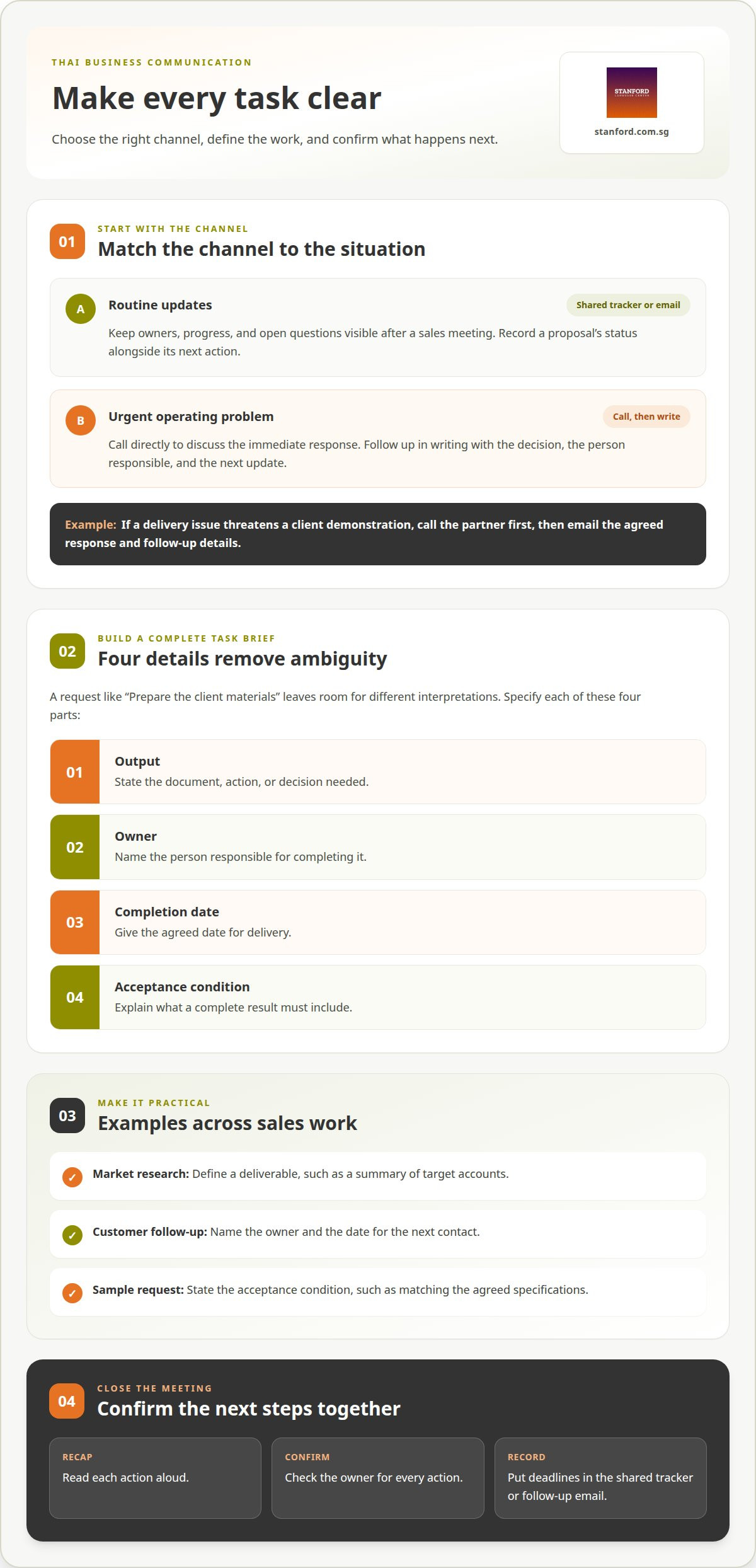
Choose a communication channel that suits the task. For routine updates with Thai partners, use a shared tracker or email. These channels keep owners, progress, and open questions visible after a sales meeting. For example, record a proposal’s status alongside its next action rather than relying on scattered chat messages. A shared record also helps both teams revisit the same details when staff change or priorities shift.
Urgent operating problems need a faster response. Call directly, then follow up in writing. If a delivery issue threatens a client demonstration, call the partner to explain the problem and agree on an immediate response. Afterward, email the decision, the person responsible, and the next update. The call supports quick discussion; the written note reduces confusion about what was agreed.
Task assignments should specify four things: the required output, the responsible person, the completion date, and the acceptance condition. “Prepare the client materials” leaves too much room for different interpretations. A clearer request identifies the materials, names the owner, gives a deadline, and says what makes them ready to share. For example, the product details and agreed prices might need to match the approved proposal.
These details matter across sales and business development. A market research request needs a defined deliverable, such as a summary of target accounts. A customer follow-up needs a named owner and a date for the next contact. A sample request needs a clear acceptance condition, such as matching the agreed specifications. Specific tasks make progress easier to track and help uncover gaps before they affect a customer discussion.
- Output: State the document, action, or decision needed.
- Owner: Name the person responsible for completing it.
- Completion date: Give the agreed date for delivery.
- Acceptance condition: Explain what a complete result must include.
Close meetings with a short task recap. Read each action aloud, confirm its owner, and record its deadline in the shared tracker or follow-up email. For example, distinguish “send product details” from “send the approved product sheet for the client proposal.” If a partner interprets the task differently, clarify the wording before work begins. This small step can prevent a missed handoff between sales and operations.
Language practice can make these exchanges easier to handle directly. Rehearse assigning a task, asking for an update, and confirming a deadline in realistic business scenarios. Practical Thai communication practice can help professionals prepare useful phrases for routine coordination and follow-up.
Kreng jai and indirect feedback
In Thai business settings, kreng jai can shape how people give and seek feedback. It reflects a balance between consideration for others and self-interest. A sales professional should remember that a partner may weigh a concern against the wish to avoid discomfort. For example, “That may be difficult” could signal a real obstacle, not a minor preference. Treat the words as something to explore, not as a firm refusal or agreement.
Indirect feedback can be easy to misread during a proposal discussion. A partner who says they will “consider it” hasn’t necessarily approved the offer. They may need time, have a concern, or want input from others. Rather than pressing for an immediate yes, ask a specific, neutral follow-up: “Which part would you like us to clarify?” This invites a useful response without demanding a public rejection.
The way you ask matters. A broad question such as “Is everything fine?” can make it difficult to raise a specific issue. Ask about a concrete decision instead: “Does the delivery schedule work for your team?” Then pause, listen, and allow time for a considered answer. If the response sounds uncertain, offer options, such as adjusting the timing or reviewing the scope. This can make feedback easier to give.
- Notice the signal: A hesitant response to a proposed launch date may indicate a scheduling concern.
- Ask about one point: Invite comments on delivery, scope, or support separately.
- Offer a low-pressure route: Ask whether a private follow-up would make discussion easier.
- Summarise carefully: Restate the concern and invite corrections before changing the proposal.
Feedback also depends on who is present. A junior contact may avoid openly disagreeing with a senior colleague in a group meeting. If a proposal receives little discussion, don’t assume the room has approved it. Ask whether anyone wants to add a point, then offer a private way to share concerns. For example, follow up individually after presenting a new service plan.
Respond to concerns without making the other person defend their position. If a partner questions a proposed sales target, ask which assumption feels unrealistic. They might point to customer demand, internal capacity, or timing. Acknowledging the specific issue helps distinguish practical feedback from general politeness. Confirm what you understood, then discuss possible adjustments. For Thai for sales and business development professionals, this listening skill supports clearer conversations and more grounded commitments.
Kreng jai doesn’t mean every indirect answer hides disagreement. Context matters. Consider the response alongside the discussion, the question asked, and any practical details offered. If a partner says the schedule is difficult and mentions a staffing gap, address that gap directly. If they give no detail, gently ask what would make the plan workable. The aim is mutual understanding, not interpreting every pause as a hidden message.
Negotiating with Thai business partners
In Thailand, business relationships can begin through personal contacts from family, friendship, education, and professional circles. A mutual connection can introduce your role and provide context before a meeting. Treat that introduction as the start of building trust, not a substitute for clear discussions. For example, explain why your company wants to meet and what kind of partnership you hope to explore.
Respect for elders and superiors, including patrons, is deeply rooted in Thailand. In a negotiation, notice who has decision-making authority and give senior participants space to contribute. A junior contact may coordinate details without approving commercial terms. Ask who should join discussions about scope, timing, or commitments. This helps you direct proposals to the people who can consider them.
Negotiations work better when both sides can discuss a proposal’s practical value. Instead of insisting that a price or deadline is final, explain the reasoning behind it. For example, connect a proposed delivery date to production planning, then ask which timing works for the partner. If they raise a concern, explore the specific issue before offering alternatives. This keeps the discussion focused on workable terms.
Ask questions that invite detail without forcing an immediate yes or no. Ask which part of the offer needs more discussion, or what would make the proposed scope a better fit. If a partner hesitates over a launch plan, clarify whether the concern relates to timing, resources, or customer demand. Keep your tone calm. A negotiation is also an opportunity to learn how each side defines a successful agreement.
For sales meetings, networking, and negotiations, prioritise Thai expressions for greeting people, introducing your role, asking about priorities, clarifying terms, and confirming next steps. Practise the Thai equivalents of “Could you explain your priorities?” and “Let me confirm what we’ve agreed.” These phrases can open a discussion and check understanding without relying only on English.
After an important decision, send a written meeting recap. Record the agreed scope, responsibilities, open questions, and next actions. For example, distinguish a proposed delivery date from one both parties have accepted. A recap gives each side a clear record and an opportunity to correct misunderstandings before work proceeds.
Discuss sensitive disagreements privately. Raising a difficult point in front of a larger group can make it harder to discuss options openly. Arrange a one-to-one conversation, describe the issue with a concrete example, and invite the partner’s view. If a delivery commitment differs from the recap, focus on the wording and impact, then agree on a practical correction. Clear records and respectful discussion support better negotiations.
What Thai language level is needed for sales and business development jobs in Thailand?
The level of Thai required depends on the role’s daily communication needs. Salesforce’s Business Development Representative role for the Thailand market requires candidates to be fluent in Thai so they can converse with clients there. This gives applicants a clear example: client-facing roles may require more than greetings or prepared introductions.
Fluency matters when conversations move beyond a script. A sales representative may need to understand a client’s needs, explain a product, respond to concerns, and clarify the next step. If you can deliver a pitch but struggle to follow questions, you may not be ready for independent client discussions. Practise listening and responding, not just presenting.
Other business development positions may use Thai differently. A role focused on researching prospects may involve less live negotiation than one managing client relationships. Read each job description for specific communication tasks, such as presenting proposals, building local relationships, or handling client calls. Match your practice to those tasks rather than aiming for a vague idea of “business Thai.”
Assess your working ability through realistic role-plays. Practise introducing your company, asking about a client’s priorities, describing a service, and answering follow-up questions. Add a change in direction, such as a client questioning the proposed timeline. Can you understand the concern, respond clearly, and confirm what both sides will do next? That is more useful than recalling a long vocabulary list.
Check four skills separately:
- Listening: Follow a client’s questions and identify their main concern.
- Speaking: Explain an offer without relying entirely on memorised lines.
- Clarifying: Ask for details when a request or response is unclear.
- Follow-up: Summarise the discussion and confirm the next action.
For an interview, prepare examples based on the job’s actual duties. If it includes client calls, practise a short discovery conversation. If it involves presenting proposals, rehearse explaining value and responding to questions. A language assessment should reflect those tasks, making strengths and areas for practice easier to identify.
Set a learning target around a real work situation. For instance, aim to complete a mock sales call from greeting through follow-up, then note where you needed help. Repeat that task with new questions and customer needs. Focused Thai language practice can help you build skills for the client conversations your target role requires.
Stanford Language Centre: Professional Adult Chinese learning in Singapore
Stanford Language Centre offers professional adult Chinese learning in Singapore for adults who also want to develop Mandarin skills. This is a separate learning goal from Thai for business conversations, but it may suit professionals whose work includes Mandarin-speaking clients or colleagues.
Small group Mandarin classes are available for expats and foreigners, as well as Japanese and Korean learners. These classes support learners who want to build practical Mandarin skills in a group setting. Choose this pathway when Mandarin is relevant to your work or learning plans, rather than as a substitute for Thai practice.
If you’d like to explore Mandarin learning for your professional goals, contact Stanford Language Centre.
Turn your next client conversation into a learning goal
Choose an upcoming business interaction as your next language milestone. It could be opening a first meeting, explaining your company’s role, or responding when a client changes direction. Build your practice around the vocabulary and replies that matter in that situation. Afterward, note which expressions were useful and what you want to handle more confidently next time.
This keeps learning connected to your actual sales work rather than an abstract study target. For Thai for sales and business development professionals, regular practice can help you prepare for client conversations and build stronger working relationships. Focus on the language that serves your next real business need.
Stanford Language Centre offers Thai language learning, including corporate and private classes. Explore Thai language learning for your professional goals and take the next step at a pace that works for you.
Frequently Asked Questions
Why should sales and business development professionals learn Thai?
Learning Thai can help professionals take part more directly in conversations with Thai clients and business contacts. For example, recognising product terms, customer needs, and follow-up requests can help you contribute beyond a prepared English pitch. Thai for sales and business development professionals is especially relevant when a role involves regular client conversations in Thailand. It also gives you a practical way to prepare before relying on spontaneous language skills.
How do Thai business etiquette and communication styles affect sales conversations?
These factors shape how you open a discussion, direct questions, and interpret responses. For example, if a meeting includes people with different levels of seniority, consider who should receive a proposal question or respond to a decision point. A calm pace gives participants room to explain their views. Don’t treat a polite response as final approval; confirm what it means for the next business step.
What are common mistakes foreigners make when selling or negotiating in Thai?
A frequent mistake is relying on a memorised pitch without adapting to the customer’s questions. If a prospect asks about after-sales support, repeating product benefits won’t address the concern. Pause, identify the question, and respond to it before returning to your presentation. Another mistake is using unfamiliar technical terms without checking understanding. Rephrase the idea in plain language and invite the prospect to explain what matters most.
Are Thai language skills required for sales and business development roles in Thailand or Singapore?
Requirements depend on the specific role and market. Salesforce’s Thailand Market Business Development Representative position requires fluency in Thai for conversations with clients in that market. For roles based in Singapore, read the job description carefully: it may identify Thai as essential, useful, or unnecessary. Compare the stated duties with your ability to handle the actual client interactions, such as calls, presentations, or follow-up discussions.
What are the best Thai courses for sales and business professionals in Singapore?
Combine tutor-led practice, app-based review, and real conversations during immersion. Rehearse sales meetings with a tutor, practise vocabulary between sessions, and use immersion to practise greetings and everyday exchanges.