What if the five tones of the Thai language weren’t a barrier, but actually the secret to unlocking a whole new culture without breaking your budget? Many learners in Singapore feel intimidated by the idea of starting from scratch. You might worry that the script is too complex or that tuition costs will spiral out of control. It’s a common concern. Finding structured Thai lessons that balance professional quality with a welcoming, relaxed atmosphere shouldn’t be a struggle.
This guide simplifies your search for the right programme. We’ll show you how to choose between small group classes and private sessions while ensuring you gain the practical skills needed for travel or work. You’ll discover how to master basic conversational fluency and navigate the Thai script with confidence. We also provide a clear breakdown of how to use NTUC UTAP subsidies to claim 50% of your course fees, including how to maximize the annual caps of up to $500 for members aged 40 and above. Whether you’re a busy professional or a casual learner, here is your roadmap to starting a successful language journey today.
Key Takeaways
- Learn why Thai is a vital tool for business expansion in 2026 and how it transforms your regional travel experiences.
- Evaluate whether small group classes or private Thai lessons better suit your personal learning style and professional schedule.
- Get a clear roadmap for mastering the five tones and essential conversational phrases through a structured Level 1 curriculum.
- Discover how to reduce your out-of-pocket costs by claiming 50% of your course fees using the NTUC UTAP subsidy.
- Find a supportive, “no-frills” learning environment that prioritizes practical results and real-world application for busy adults.
Why Learn Thai in Singapore? Benefits for 2026
Singapore’s relationship with Thailand has never been stronger. As we move through 2026, the economic ties between our two nations continue to deepen. Choosing to take Thai lessons isn’t just a hobby; it’s a strategic move for your career and personal life. While digital tools are everywhere, they often fail to capture the soul of the Thai language. A local classroom setting provides the immediate feedback and cultural context that an algorithm simply can’t match. Learning in a local Singapore centre means you get to hear the specific ways Thai is used in a regional context. It’s about more than just vocabulary; it’s about the rhythm of conversation. Physical classes at a school like Stanford Language Centre keep you accountable in a way that a notification on your phone never will.
Learning a tonal language also offers surprising cognitive benefits. It trains your brain to hear pitches and nuances you might otherwise miss. For adults in Singapore, this mental exercise is a great way to stay sharp while gaining a practical skill. Plus, being in a physical centre allows you to practice with peers who share your goals. You aren’t just memorizing words; you’re building a foundation for real-world interaction.
Thai for Business and Networking
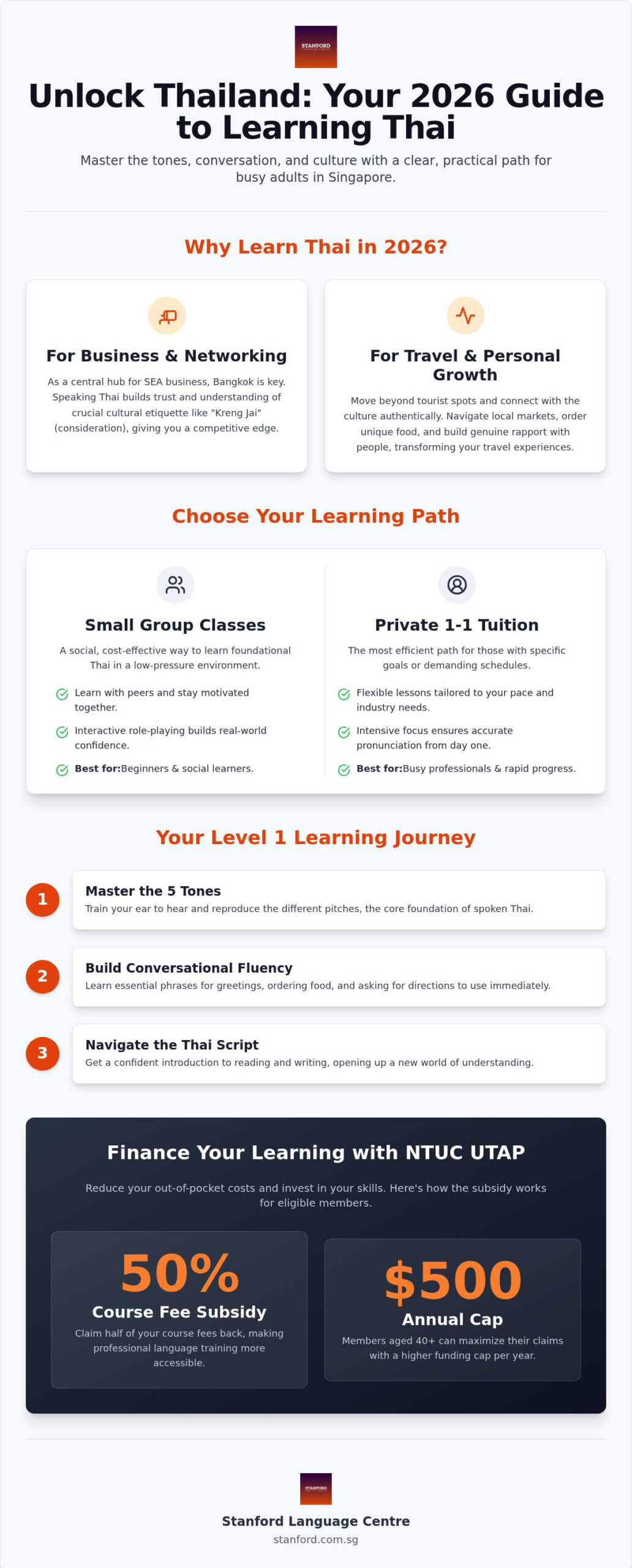
Bangkok remains a central pillar for Southeast Asian business expansion in 2026. Many Singaporean firms are setting up regional offices there, making Corporate Thai Language Training a high-demand asset. Understanding the language allows you to grasp subtle cultural nuances in business etiquette. You’ll learn how to build “Kreng Jai” (consideration for others), which is vital for long-term partnerships. Being able to exchange more than just basic greetings shows your Thai counterparts that you’re truly invested in the relationship. It builds a level of trust that English alone cannot achieve. These skills are essential for anyone looking to lead teams or manage projects across the border.
Thai for Personal Growth and Travel
Most visitors to Thailand stay within the comfort of tourist hotspots. When you speak the language, the country opens up in a completely different way. You can navigate local markets, order off-menu delicacies, and build genuine rapport with people outside the main cities. Taking Thai lessons helps you move beyond being a spectator. You become a participant in the culture. In Singapore, joining a class also means joining a community. You’ll meet fellow travelers and professionals, creating a network of support that makes the learning process much more enjoyable and less intimidating. It’s about building confidence that carries over into every part of your life.
Choosing the Right Format: Group vs. Private Thai Lessons
Deciding how to learn a new language is just as important as the language itself. In Singapore, you have options that range from social classrooms to intensive solo sessions. Your choice depends on your schedule, your budget, and how quickly you need to start speaking. Most beginners find that structured Thai lessons in a physical school provide the best balance of theory and practice. While apps offer convenience, they can’t correct your tone in real-time or simulate the nuance of a real conversation. Selecting the right format ensures you don’t lose momentum after the first few weeks.
The Benefits of Small Group Classes
Small group classes are the most popular entry point for adult learners in Singapore. These sessions, particularly for Level 1, focus on foundational conversational Thai in a low-pressure environment. You aren’t just learning from a teacher; you’re learning from the mistakes and successes of your peers. This social environment provides a unique kind of motivation. If you see a classmate master a difficult tone, you know you can do it too. Interactive role-playing is a core part of this format. You’ll practice ordering food or asking for directions with other students, which builds the confidence you need before you step off a plane in Bangkok. It’s a cost-effective way to test the waters and see if the language is right for you.
When to Opt for Private 1-1 Tuition
Private lessons are the gold standard for those with specific goals or erratic schedules. If you’re a busy professional in the CBD, finding a fixed time every week might be difficult. Private 1-1 Thai lessons allow you to set the pace. You can spend more time on the five tones if you’re struggling, or fly through basic greetings if you’ve already picked them up. This intensive focus ensures that your pronunciation is accurate from day one. For those looking for instruction tailored to a specific industry, private tuition is the most efficient path. It allows the trainer to focus on the vocabulary you actually need for your job, whether that’s in real estate, finance, or retail.
For those who can’t make it to a physical campus, online Thai language classes offer a flexible middle ground. You get the benefit of a live native trainer without the commute. However, many local learners still prefer the onsite experience for its total immersion. Being in a dedicated space helps you switch your brain into “Thai mode” more effectively. If your company is planning a move to Bangkok, Corporate Thai Language Training can be delivered at your office for maximum convenience. This ensures your team is ready to handle regional networking with confidence.
The Thai Learning Journey: From Level 1 to Literacy
Starting a language journey feels like stepping into a new world. Many adult learners worry they’ll get stuck at the “hello” and “thank you” stage forever. However, a structured approach makes the transition from a total beginner to a confident speaker much smoother. Your progress is built in stages. You begin with the sounds, move to the structure, and eventually unlock the written word. This logical flow ensures you don’t feel overwhelmed by the complexity of the language all at once.
Mastering the five tones is usually the biggest hurdle. It’s the key to being understood by native speakers. Without the right pitch, a word for “near” can easily become the word for “far.” Professional Thai lessons focus heavily on these nuances early on. Trainers use practical drills to help your ears distinguish between high, low, rising, falling, and mid tones. Once you get the hang of it, you’ll find that Thai grammar is actually quite straightforward. There are no complex verb conjugations or gendered nouns to memorize. Enrolling in structured Thai lessons ensures you don’t pick up bad habits that are hard to break later.
Foundational Conversational Thai
Your first few weeks are all about immediate utility. You’ll learn how to navigate a menu, haggle at a market, and give directions to a taxi driver. We focus on the sentence structures you’ll use every day. For example, learning how to use “khrap” and “ka” correctly adds an instant layer of politeness to your speech. You’ll practice common phrases until they feel natural. The primary goal of Level 1 is achieving basic daily survival Thai.
Mastering the Thai Script
Once you’ve found your voice, the next step is the Thai Reading & writing class. Some people think they can skip the script, but reading actually improves your spoken accuracy. The Thai alphabet and its vowel markers act as a visual guide for tones. When you can read the tone rules on paper, your pronunciation becomes much more consistent. Practical exercises in these classes often involve writing basic messages or reading street signs. It transforms the way you see the world around you. Instead of seeing decorative squiggles, you start to see clear instructions and stories. This literacy is what truly bridges the gap between being a visitor and being a part of the community.
Financing Your Thai Lessons: NTUC UTAP and Claims
Budgeting for a new skill is a practical concern for most adult learners in Singapore. You might be looking for ways to offset the cost of professional tuition. While some schools focus on SkillsFuture, it’s important to know that the Union Training Assistance Programme (UTAP) is a highly effective alternative for NTUC members. It provides a direct way to reduce your out-of-pocket expenses while maintaining high standards of instruction. Choosing Thai lessons that are UTAP-supported ensures you get the best value for your time and money. It’s a “student-first” approach that makes personal growth attainable for everyone.
In 2026, the eligibility criteria for UTAP remain clear and beneficial for local workers. You can claim 50% of the unfunded course fees, which is a significant saving. For members under 40 years old, the annual claim cap is S$250. If you’re 40 or older, this cap increases to S$500 per year. This higher cap is designed to encourage mid-career professionals to stay competitive in the regional market. To qualify, you must be an active NTUC member before the course starts and throughout its duration. You also need to maintain at least 75% attendance, which helps keep you accountable and ensures you’re actually gaining the skills you’re paying for.
How to Maximise Your UTAP Benefit
Claiming your subsidy is a straightforward process, but timing is everything. You must submit your claim through the NTUC portal within six months of completing your course. Always keep your original receipts and attendance records as these are required for verification. Stanford Thai lessons are UTAP claimable for eligible members. This funding makes it much easier to commit to a full Level 1 programme or even transition into more advanced reading and writing classes. By using your annual cap effectively, you can essentially halve the cost of your language journey every year.
Corporate Training Subsidies
For businesses, the financial incentives are even more robust. Companies looking to expand into the Thai market can leverage various training grants to upskill their staff. We provide customised billing and reporting for Corporate Thai Language Training, making it easy for HR departments to manage claims. The ROI on language training is often seen in smoother negotiations and stronger regional partnerships. It’s a low-stress way for firms to build a more versatile, culturally aware workforce. Whether you’re an individual or a business owner, these financial supports ensure that high-quality Thai lessons remain a smart, affordable investment.
Start Your Thai Journey with Stanford Language Centre
Since 2004, we’ve helped thousands of adults in Singapore master new languages. Our approach isn’t about rigid academic drills or intimidating lectures. We focus on creating a supportive space where you feel comfortable making mistakes. Our native-speaking teachers understand the specific challenges that local learners face. They act as mentors who guide you through the intricacies of tones and culture. When you sign up for Thai lessons with us, you’re joining a community of like-minded professionals and enthusiasts. We believe that challenging goals are attainable through a relaxed and encouraging environment.
Our school is located in a centralized area, providing a convenient hub for learners from all over the island. We aren’t a distant corporate franchise. We’re a local, relatable entity that’s been part of the Singaporean educational landscape for over two decades. This local expertise means we know how to explain Thai concepts using examples that resonate with people living and working here. It’s this peer-to-peer connection that makes our school a preferred choice for those who want quality without the pretension. We emphasize a “no-frills” approach that prioritizes your personal growth and success above all else.
The Stanford Method: Practical and Accessible
We value your time and your commitment. Our curriculum prioritizes results that you can use immediately in the real world. Whether you’re ordering street food in Bangkok or negotiating a business deal, we give you the tools to succeed. This pragmatic focus is consistent across all our programs. For instance, we apply the same “student-first” mentality to our Professional Adult Chinese learning in Singapore. You’ll find a low-stress environment that strips away theoretical complexity to focus on what actually works. Our goal is to lower the barrier to entry for every new learner who walks through our doors.
Enrolment and Next Steps
Getting started is simple and straightforward. We run regular intake cycles for our Level 1 classes throughout the year. You can check our latest dates online to find a schedule that fits your professional life. If you need a more customized approach, we encourage booking a private 1-1 consultation to discuss your specific needs. Our friendly staff are always ready to provide honest advice on course selection or corporate training solutions. They can also help you understand the UTAP claim process we discussed earlier. Taking the first step toward fluency in Thai lessons has never been more accessible. Reach out to us today to secure your spot in our next intake and start your journey with a partner you can trust.
Taking the First Step Toward Thai Fluency
Mastering a new language is a rewarding investment that opens doors to deeper cultural connections and regional business opportunities. You’ve seen how structured Level 1 courses provide survival skills for daily life. NTUC UTAP claimable courses make professional tuition affordable for Singaporean workers. Choosing the right format, whether it’s a social group setting or flexible private sessions, ensures your learning journey fits your lifestyle.
Stanford Language Centre has been a trusted partner for adult learners since 2004. With over 20 years of experience, we specialize in delivering practical results in a low-stress, encouraging environment. Our Thai lessons are designed to get you speaking with confidence quickly. You don’t have to navigate the complexities of tones alone when you have expert native trainers as your guides.
Ready to begin? Book Your Thai Lesson at Stanford Language Centre Today and join a community dedicated to your success. It’s time to turn your interest into a valuable skill.
Frequently Asked Questions
Are Thai lessons in Singapore SkillsFuture claimable at Stanford?
No, Thai lessons at Stanford Language Centre are not SkillsFuture claimable. We focus on providing NTUC UTAP claimable programs instead. This subsidy allows eligible NTUC members to claim 50% of their unfunded course fees, up to an annual cap of $250 or $500 depending on your age. It’s a practical alternative that helps many of our students manage their learning costs effectively.
How long does it take for a beginner to speak basic Thai?
You can expect to speak basic phrases after just a few sessions. Most students achieve “survival Thai” fluency for travel and daily interactions by the end of our 10-lesson Basic Conversational course. While total mastery takes time, our pragmatic approach ensures you can order food, ask for directions, and handle simple greetings with confidence within a few weeks of starting.
Do I need to learn the Thai script to speak the language?
No, you don’t need to learn the script to start speaking. Our Level 1 classes use phonetic transcriptions to help you focus entirely on pronunciation and tones first. However, we do recommend our Thai Reading & writing class once you have the basics down. Learning the script acts as a visual guide for tones and significantly improves your long-term spoken accuracy.
Is Thai really that hard for English speakers to learn?
Thai is often perceived as difficult because of its five tones, but the grammar is actually very straightforward. There are no complex verb conjugations, plurals, or gendered nouns to memorize. Our trainers act as supportive mentors, breaking down the tonal system into digestible steps. With the right guidance, most English speakers find the language accessible and quite logical once they start.
What is the difference between Level 1 and the Reading/Writing class?
The Level 1 course focuses purely on oral communication and essential conversational phrases for immediate real-world use. In contrast, the Thai Reading & writing class introduces you to the alphabet, vowel markers, and the rules of the script. Most students complete the conversational foundation before transitioning to literacy to ensure they have a solid vocal base and understand the sounds first.
Can I take Thai lessons online with Stanford Language Centre?
Yes, we offer Online Thai Language Classes for those who prefer the convenience of learning from home or the office. These sessions maintain the same interactive, small-group format as our physical classes in Singapore. You’ll still receive real-time feedback from our native trainers, ensuring you don’t miss out on the nuances of pronunciation while enjoying the flexibility of a digital classroom.
How do I claim the NTUC UTAP subsidy for my Thai course?
You claim the subsidy by logging into the NTUC portal after your course is finished. You must be an active member before the course starts and maintain at least 75% attendance to qualify. You’ll need to submit your claim within six months of completion. Our staff will provide the necessary receipts and attendance records to make the process straightforward and stress-free for you.
Does Stanford offer Thai lessons for children?
No, we specialize exclusively in adult language education. Our curriculum and teaching methods are tailored to the specific needs of busy professionals and expats in Singapore. By focusing on adult learners, we create a peer-to-peer environment that is both mature and results-oriented. This allows us to maintain a high standard of practical instruction for those using Thai for work or travel.