Imagine standing at a busy Maxwell Food Centre stall while the lunch crowd swells around you. You want to order a specific dish, but the pressure of the fast-moving queue makes you point silently instead of speaking. It’s a small moment, but it reinforces that nagging feeling of being an outsider in your own neighborhood. Many expats find that traditional language schools focus too much on complex grammar or writing characters. This makes learning conversational Mandarin chinese singapore feel like an impossible mountain to climb.
We understand that frustration. You need practical skills for real life, not an academic degree. This guide reveals how you can go from zero to holding confident daily conversations in just two months. By using a structured, local approach, you’ll skip the fluff and focus on what actually matters. We’ll show you how to order food with total confidence, exchange pleasantries with colleagues, and grasp the basic context of office meetings. It’s time to stop feeling like a spectator and start participating in the vibrant culture of Singapore.
Key Takeaways
- Master conversational Mandarin chinese singapore by focusing on Hanyu Pinyin and verbal communication instead of memorizing thousands of characters.
- Follow a clear 8-week roadmap that builds your confidence for real-world scenarios like ordering food or exchanging pleasantries with colleagues.
- Understand the benefits of small group classes that offer a social, low-pressure environment perfect for busy professionals.
- Learn how to navigate local language nuances and “Singdarin” to better integrate into Singapore’s social and professional circles.
- Find out how a pragmatic, results-oriented approach can help you achieve fluency without the frustration of traditional academic courses.
Why Conversational Mandarin is Essential in Singapore
Living in Singapore, it’s easy to believe that English is enough. After all, it’s the primary language for business and administration. However, relying solely on English often keeps you on the surface of local life. Learning conversational Mandarin chinese singapore allows you to move beyond the “tourist” experience. It isn’t about passing a rigorous exam or writing thousands of characters. Instead, it’s about functional fluency. You want to understand the rhythm of the city. While Standard Chinese is the basis, you’ll often encounter Singaporean Mandarin in daily life. This local variant includes unique loanwords and nuances that reflect the city’s multicultural heritage. Mastering these basics makes the difference between feeling like a guest and feeling like a local.
The Difference Between Academic and Conversational Chinese
Traditional courses often bury students under the weight of 5,000+ characters. For most adults, this is an immediate deal-breaker. Mastering conversational Mandarin chinese singapore means skipping the fluff. It prioritizes Hanyu Pinyin, the phonetic system that lets you speak and listen without worrying about complex brush strokes. We focus on high-frequency vocabulary used in Singaporean workplaces and hawker centres. Think of it as a “need to know” basis. Level 1 is the most critical stage for adult learners. It’s where you build the confidence to open your mouth and make sounds. By focusing on phonetics rather than symbols, you progress much faster. You’ll spend your time practicing tones and sentence structures that actually come up in your daily routine.
Social Integration for Expats and Foreigners
Many expats live in a “foreigner bubble” for years. They shop at the same places and talk to the same circles. Learning to speak Mandarin is the quickest way to pop that bubble. It helps you understand local banter and build genuine rapport with colleagues. Simple greetings or a few words of cultural etiquette go a long way in a professional setting. Beyond the office, it simplifies your life. Navigating a wet market, explaining a symptom at a local clinic, or giving specific directions to a taxi driver becomes stress-free. You’ll find that locals appreciate the effort. It shows respect for the culture and opens doors to friendships that English simply can’t reach.
The Foundation: How Adults Learn Mandarin Successfully
Adults process information through logical patterns. Unlike children who absorb language through passive exposure, adult learners thrive on structured frameworks. You want to know why a sentence is built a certain way before you try to use it. This is why mastering conversational Mandarin chinese singapore requires an approach that emphasizes immediate application. If you can’t use what you learned in the classroom at the office the next morning, the lesson hasn’t served its purpose. We focus on building a foundation that respects your time and your cognitive strengths.
Hanyu Pinyin is the secret weapon for any adult learner. It’s the phonetic system that uses the Roman alphabet to represent Mandarin sounds. By mastering Pinyin, you bypass the immediate need to memorize thousands of characters. This allows you to focus entirely on speaking and listening from day one. Understanding the history of Singapore’s language policies helps explain why this phonetic clarity is so vital in a city with various dialects and accents. It gives you the “ear training” needed to navigate a multicultural environment.
Language apps are popular, but they often fail at real-time correction. You need a human guide to catch subtle mistakes in your intonation. Small group classes provide the necessary feedback loop that an algorithm just can’t replicate. They also allow for interactive role-playing. Practicing a real-world scenario with a peer builds muscle memory. It prepares you for the fast-paced social interactions you’ll face every day. If you’re ready to build these skills, a small group Mandarin class offers the perfect balance of professional structure and social interaction.
Mastering the Four Tones
Mandarin is a tonal language. This means the pitch of your voice changes the word’s meaning entirely. For example, the sound “ma” can mean mother, hemp, horse, or a scolding depending on the tone you use. It’s often the biggest hurdle for English speakers. Practical exercises, like the “staircase” visualization for the four tones, help you distinguish these sounds. However, nothing beats consistent practice with a native-speaking teacher. They can hear the slight flatnesses or incorrect rises that you might miss. Getting the tones right is the key to being understood by locals at the wet market or in the boardroom.
Practical Vocabulary for the Singapore Context
Success in conversational Mandarin chinese singapore comes from learning words you actually hear on the street. We prioritize high-frequency vocabulary that makes an immediate impact on your quality of life. Start with the basics of local life:
- Ordering Kopi: Learn how to ask for your coffee with less sugar (shao dai) or no milk (o) like a pro.
- Business Etiquette: Practice the correct way to present your business card with both hands while offering a polite greeting.
- Numbers and Dates: Master the building blocks of scheduling and shopping to handle transactions with total confidence.
By focusing on these practical areas, you turn every daily errand into a mini-practice session. You aren’t just learning a language; you’re gaining the tools to navigate your environment with ease.
Choosing the Right Mandarin Course: Small Groups vs. Private Tuition
Selecting the right format for your conversational Mandarin chinese singapore journey is a strategic decision. You need a setup that fits your schedule without sacrificing results. While self-study apps offer convenience, they lack the cultural context and real-time correction required for true fluency. In Singapore, where Mandarin is one of the four official languages of Singapore, the choice usually falls between small group classes and private tuition. Each path serves a different purpose depending on your career goals and learning style.
Private 1-1 lessons are the gold standard for those with highly specific needs. If you’re a surgeon needing medical terminology or a lawyer reviewing contracts, the customized pace is invaluable. However, for most adults seeking general social and professional integration, small groups often provide a more dynamic and cost-effective environment. The balance between in-person immersion and the convenience of a central location, like City Hall, often trumps the isolation of online-only learning. It’s about finding a rhythm that you can actually sustain over two months. For professionals who need faster results, an intensive Mandarin course in Singapore can help you reach conversational fluency in a compressed timeframe without sacrificing quality.
The Power of Small Group Dynamics
Many expats hesitate to speak because of “performance anxiety.” It’s a common hurdle. Learning alongside peers who are at the same Level 1 starting point removes that pressure. You aren’t just a student; you’re part of a cohort. These structured programs keep everyone on the same roadmap, ensuring no one gets left behind. Beyond the language, these classes double as networking hubs. You’ll meet like-minded professionals from various industries, turning your Tuesday evening lesson into a social highlight. It’s much easier to practice ordering a drink when you’re doing it with a new friend.
Funding Your Education: NTUC UTAP Explained
A common misconception is that language subsidies are only for local citizens. While it’s true that SkillsFuture credits are restricted, foreigners and expats have another powerful option. The NTUC Union Training Assistance Programme (UTAP) offers significant support for eligible union members. This can make a high-quality course even more accessible. For instance, a foundational course might cost $385 for 10 lessons. By utilizing UTAP, cost-conscious learners can significantly reduce their out-of-pocket expenses. It’s a pragmatic way to invest in your skills without breaking the bank. This “no-frills” approach to quality is why many professionals choose established centres with over 20 years of experience. You get professional reliability without the intimidating academic price tag.
Your 8-Week Roadmap to Conversational Mandarin
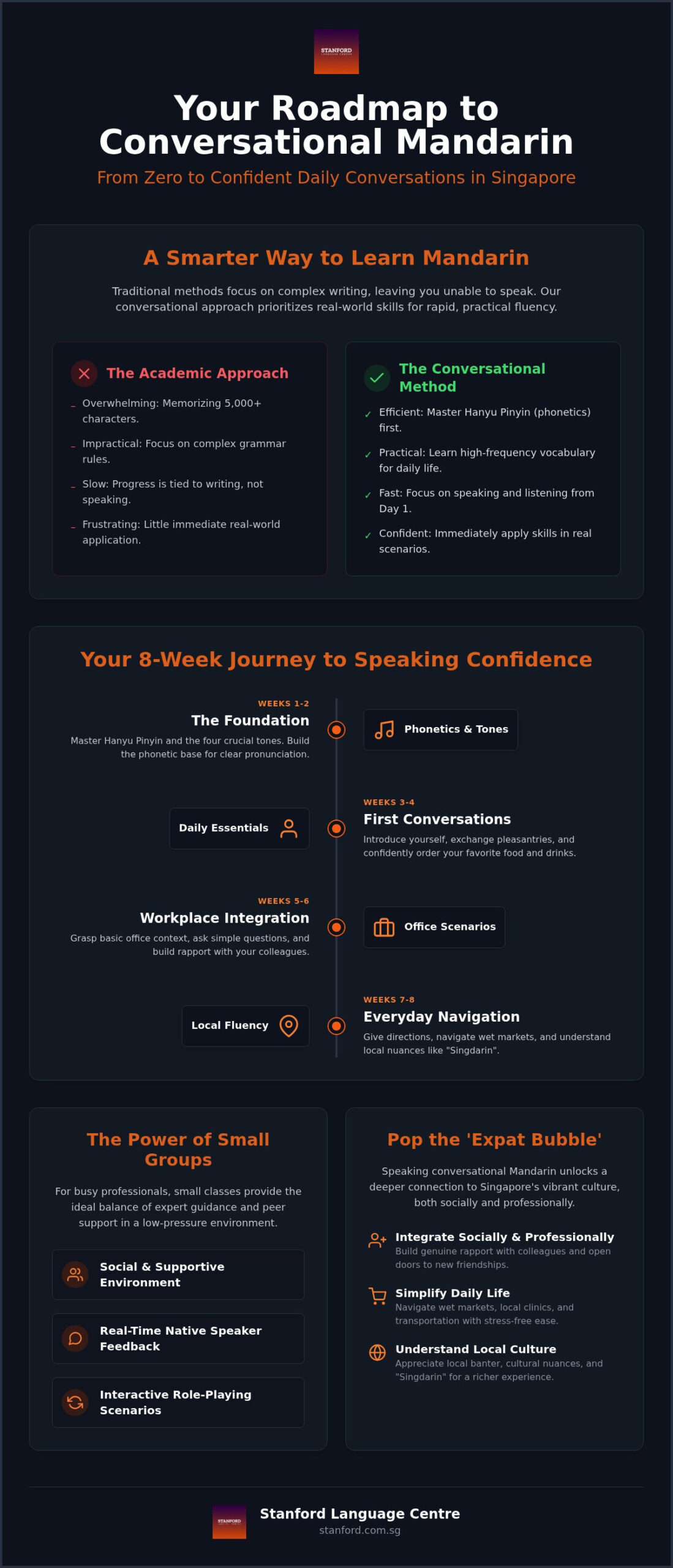
Mastering a new language shouldn’t feel like an endless trek without a map. Most adults struggle because they can’t see the finish line. A clear, week-by-week timeline turns a daunting task into a series of achievable wins. This 8-week structure is specifically designed for mastering conversational Mandarin chinese singapore in a way that fits a busy professional’s life. You won’t be fluent overnight, but you’ll be functional in record time.
The journey starts with the mechanics of sound. In Weeks 1 and 2, the focus is entirely on Hanyu Pinyin and basic greetings. This is your foundation. You’ll practice the four tones until they feel natural. By Week 4, the curriculum shifts toward survival skills. You’ll learn numbers, shopping phrases, and the essential vocabulary needed for the local food scene. This phase is about high-frequency words that you can use the moment you step out of the classroom.
Week 1-4: The Survival Phase
The first month centers on the “Who, What, and Where” of daily life. It’s often the most challenging period because you’re overcoming the initial fear of speaking out loud in public. We prioritize building the courage to make mistakes and keep going. Every trip to the mall or the wet market becomes a low-stakes practice session. By the end of Week 3, you will be able to order a full meal and handle basic payment transactions entirely in Mandarin.
Week 5-8: The Connection Phase
Once you’ve mastered the basics, it’s time to add depth. Weeks 5 and 6 focus on your personal life. You’ll learn to describe your daily routine, talk about your family, and share your hobbies. This moves you beyond simple transactions and into actual social interaction. You’ll start to feel more like a participant in Singaporean culture rather than just an observer.
The final two weeks bridge the gap between social life and the office. We cover workplace communication and fundamental sentence structures. You’ll learn how to exchange pleasantries with colleagues and grasp the general context of business discussions. We strip away the complex linguistic jargon to focus on patterns that work. By the end of the eighth week, you’ll be ready for Level 1 completion and have the confidence to use your skills daily. If you’re ready to start this journey, you can enroll in a Mandarin class for adult and see real results in just two months.
Why Stanford Language Centre is Singapore’s Top Choice for Adults
Stanford Language Centre has spent over two decades refining how adults find their voice in a new language. Since 2004, we’ve focused on providing a pragmatic, no-frills environment that respects your time and your budget. We know you’re busy. That’s why our centre is centrally located at City Hall. It’s the ideal spot for easy after-work access, allowing you to transition from the office to the classroom in minutes. Mastering conversational Mandarin chinese singapore doesn’t have to be an intimidating academic pursuit. It should be a practical journey that fits into your lifestyle.
Our track record speaks for itself. With over 20 years of experience in adult language training, we’ve helped thousands of foreigners and expats integrate into local life. We also recognize that every learner is different. We offer specialized tracks for Japanese and Korean speakers, using tailored teaching methods that address their specific linguistic backgrounds. This level of customization ensures that you aren’t just another student in a crowded room. You’re a partner in a journey toward confident communication.
Expert Tutors for Non-Native Speakers
Our teachers are more than just native speakers. They’re experts who understand the specific linguistic hurdles that English speakers face. They create a welcoming, student-first atmosphere that prioritizes practical results over theoretical complexity. We don’t want you to just memorize words; we want you to use them. To support your busy schedule, we offer access to online resources and makeup lessons. This flexibility ensures that you stay on track even when work gets demanding. It’s about providing a supportive environment where you feel comfortable making mistakes and growing.
Value-Driven Learning at $385
We believe in transparent pricing. Our foundational Level 1 course is priced at $385 for a 10-lesson module. There are no hidden registration fees to catch you off guard. This 10-lesson structure is specifically designed to maximize your retention of conversational Mandarin chinese singapore without causing burnout. It provides a steady, reassuring pace that keeps you engaged from the first greeting to the final workplace scenario. If you’re ready to break out of the “foreigner bubble,” now is the time. Join our next intake at City Hall or enroll in our Mandarin class for adult to start your two-month transformation.
Take the First Step Toward Local Fluency
Mastering conversational Mandarin chinese singapore isn’t about passing a rigid academic exam. It’s about gaining the confidence to order your favorite dish, joke with colleagues, and navigate the city with ease. By focusing on a “speaking-first” approach and a clear eight-week roadmap, you bypass the frustration of complex characters and dive straight into useful communication. You’ve seen how logical structures and small group dynamics can turn a daunting challenge into a rewarding social experience.
We provide a supportive environment that respects your time and career goals. With over 20 years of experience and a convenient City Hall location, our classes fit seamlessly into a busy professional’s schedule. Our “no-frills” approach ensures you get high-quality training without unnecessary complexity. Plus, our courses are NTUC UTAP claimable, making professional development more accessible for everyone in the community.
Start your Mandarin journey for just $385; View 2026 Class Schedules
You don’t have to feel like an outsider anymore. Start your journey today and experience the difference that a local, pragmatic approach can make. We look forward to seeing you in class.
Frequently Asked Questions
Is Mandarin really that hard for English speakers to learn?
Mandarin is often perceived as difficult, but it’s much more accessible when you prioritize speaking over writing. For English speakers, the lack of verb conjugations and plural forms makes the grammar surprisingly straightforward. The main challenge lies in mastering the four tones. By using Hanyu Pinyin as a phonetic guide, you can start communicating effectively without the need to memorize thousands of complex characters right away.
Can I use SkillsFuture credits for Mandarin courses at Stanford Language Centre?
Our courses at Stanford Language Centre are not claimable via SkillsFuture credits. We focus on providing high-quality, practical training through other accessible means. Instead of those credits, eligible union members can utilize the NTUC UTAP scheme to offset their course fees. This ensures that our conversational Mandarin chinese singapore programs remain affordable for professionals who want results without the administrative hurdles often found in larger government-funded institutions.
How much does a basic conversational Mandarin course cost in Singapore?
A foundational Level 1 Mandarin course at our centre costs $385 for a module of 10 lessons. This price point is designed to be transparent and accessible for adults and expats. There are no hidden registration fees to worry about. This fee covers a structured two-month program that focuses on high-frequency vocabulary and essential daily interactions. It’s a pragmatic investment for anyone looking to integrate into Singapore’s social and professional circles.
Will I learn how to write Chinese characters in a conversational course?
A conversational course focuses primarily on speaking and listening skills rather than writing characters. We believe that for most adults, the goal is functional fluency in daily life. Memorizing 5,000 characters can be a major barrier to progress. Instead, we use Hanyu Pinyin to help you master pronunciation. This allows you to spend your time practicing real-world scenarios like ordering food or introducing yourself to local colleagues with total confidence.
What is the difference between Hanyu Pinyin and Mandarin?
Mandarin is the spoken language itself, while Hanyu Pinyin is the phonetic system used to write Mandarin sounds using the Roman alphabet. Think of Pinyin as a bridge that helps you pronounce words correctly before you learn any characters. It’s an essential tool for English speakers because it provides a familiar way to visualize tones and sounds. Mastering Pinyin is the first step in our conversational Mandarin chinese singapore roadmap.
Is NTUC UTAP claimable for foreigners taking Mandarin classes?
Yes, the NTUC UTAP scheme is available for eligible union members, including foreigners and expats. This is a significant benefit for cost-conscious learners who want to offset their education expenses. While citizens often look for other credits, UTAP provides a reliable way for all union members to invest in their personal growth. You can check your eligibility through the NTUC website to see how much you can claim for our foundational courses.
How long does it take to become fluent in basic conversational Chinese?
You can achieve basic conversational fluency in just two months with our structured Level 1 program. This timeframe is designed for busy professionals who need immediate results. By the end of these eight weeks, you’ll be able to handle daily errands, exchange pleasantries, and understand the general context of meetings. True fluency takes longer, but this initial phase provides the critical foundation you need to stop feeling like an outsider in Singapore.
Do you offer private 1-1 Mandarin lessons for busy executives?
We offer private Mandarin language lessons specifically for foreigners and expats who require a more customized pace. These 1-1 sessions are ideal for busy executives who need to focus on specific industry vocabulary or have unpredictable schedules. While small groups offer great networking, private tuition allows the teacher to tailor every minute of the lesson to your personal goals. It’s a highly efficient way to reach your desired level of proficiency.