The easiest way to learn Chinese online is to combine structured beginner study with regular listening and speaking practice. A well-chosen mandarin lesson can help you build pronunciation and Pinyin skills while practising useful words and phrases. With consistent study, simple everyday conversations can become an achievable early goal.
Getting started can feel overwhelming: tones, unfamiliar sounds, characters and sentence patterns all compete for attention. You do not need to master everything at once. Begin with the basics, then practise using them in short, real-life exchanges.
This guide covers beginner resources for pronunciation, Pinyin, grammar, reading, writing and everyday conversation. You will also learn how to combine online study with speaking practice, helping you choose a manageable routine and make each study session count.
Key Takeaways
- Start with pronunciation and Pinyin, then build a steady routine that includes listening and speaking.
- Use beginner resources to practise reading and writing alongside essential vocabulary and sentence patterns.
- Learn grammar through simple examples, then turn each pattern into a sentence you can use in conversation.
- Prepare useful phrases for introductions, meeting people and ordering food in everyday situations.
- Choose a learning format that suits your needs, including adult classes for expats and foreign learners or groups tailored for Japanese and Korean speakers.
Beginner Mandarin pronunciation, Pinyin, reading, writing and conversation
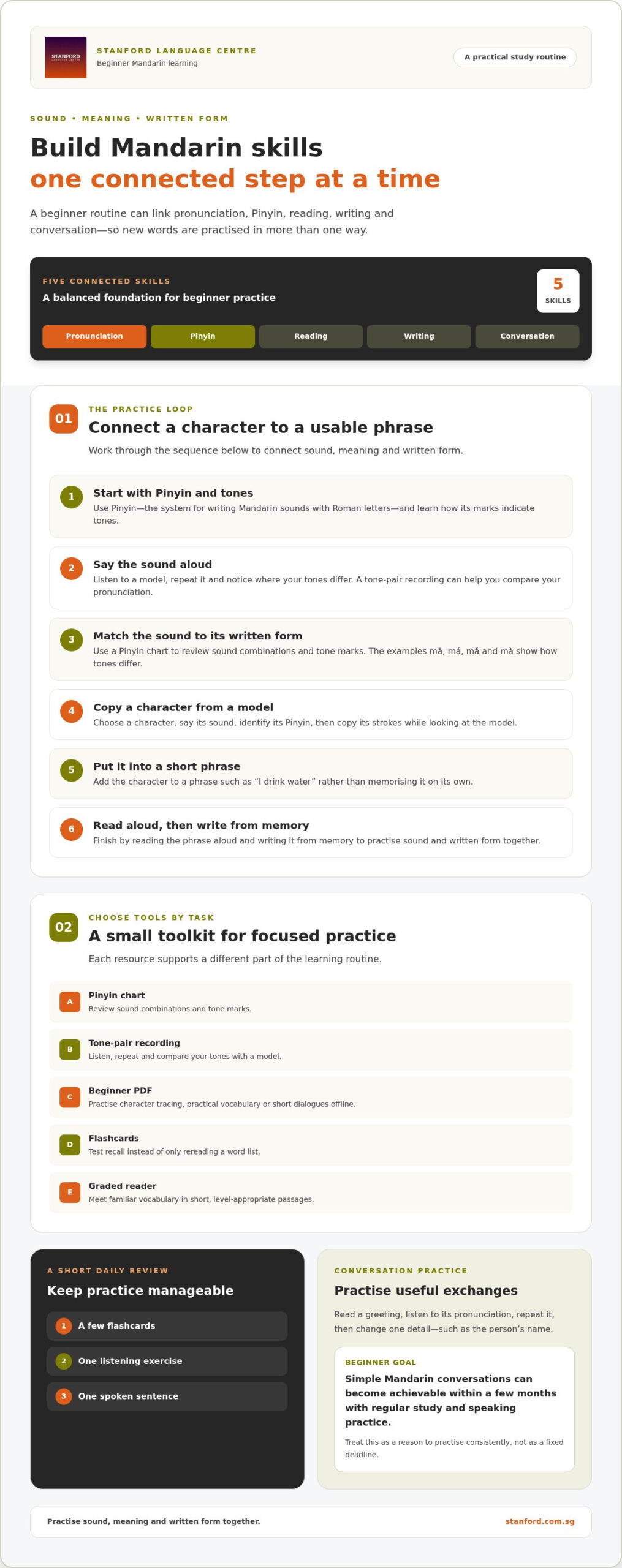
Build your first study routine around five connected skills: pronunciation, Pinyin, reading, writing and conversation. Start with Pinyin, the system for writing Mandarin sounds with Roman letters, and learn how its marks indicate tones. For example, mā, má, mǎ and mà have different tones and meanings. Say each sound aloud, then match it to its written form. This gives new words a clear sound and a useful memory cue.
Use a small set of beginner tools, each for a specific task. A Pinyin chart helps you connect initials and finals, while a tone-pair recording lets you compare your pronunciation with a model. Free beginner Mandarin PDFs can provide printable vocabulary lists, character tracing sheets and short dialogues. Choose pages that show Pinyin alongside characters and English meanings. After downloading a PDF, select a few words, cover the English translations, recall their meanings, then check your answers. A spaced-repetition flashcard tool helps you review those words later. A graded reader supports reading with short, level-appropriate passages and familiar vocabulary.
- Pinyin chart: Use it to review sound combinations and tone marks.
- Tone-pair recording: Listen, repeat and notice where your tones differ.
- Beginner PDF: Practise tracing characters or reviewing practical vocabulary offline.
- Flashcards: Test recall instead of only rereading a word list.
- Graded reader: Meet known words in short sentences and simple stories.
Reading and writing work best in small, connected steps. Choose a character from a PDF, say its sound, identify its Pinyin, then copy its strokes while looking at the model. Add the character to a short phrase, such as “I drink water,” rather than memorising it on its own. Next, read the phrase aloud and write it from memory. This sequence connects sound, meaning and written form. A beginner course can provide a structured path through these steps, particularly when listening and speaking practice accompany written exercises.
For conversation, practise a useful exchange rather than isolated vocabulary. Read a greeting, listen to its pronunciation, repeat it, then change one detail, such as the person’s name. Regular study and speaking practice can help beginners start having simple Mandarin conversations within a few months. Treat that timeline as a reason to practise consistently, not as a fixed deadline. A short daily review can combine a few flashcards, one listening exercise and one spoken sentence. Note phrases you can already use, such as introducing yourself or asking someone’s name. This makes your progress visible and helps you choose a practical focus for your next study session.
Pronunciation, pinyin, and essential vocabulary
Once you can read a Pinyin spelling, practise hearing and producing its sounds accurately. Listen to one short word in a recording, pause, then repeat it aloud. Record your attempt and compare the two. Focus on what changes: the opening sound, vowel or tone. This listen-and-repeat cycle turns pronunciation into an active skill rather than a page of marks. Note words that sound alike to you, then revisit them in your next practice session.
A pronunciation dictionary with audio is useful when a new word appears in a reading or conversation. Look up the word, listen before reading the Pinyin, then say it without copying the audio. This order tests whether your ear recognises the sound. A voice recorder helps you notice patterns in your speech, while a simple notebook lets you write a word, its Pinyin, its meaning and a short example sentence together. For instance, put each new food word into a phrase about what you like to eat.
Build essential vocabulary around situations you expect to meet, not unrelated word lists. A flashcard app can prompt active recall: see the English meaning, try to remember the Mandarin word, and reveal the answer only afterward. Group cards by purpose, such as greetings, food, travel, or work. Add a short phrase to each card, so you practise how the word behaves in context. Review difficult words more often, and retire familiar ones from intensive practice.
Sound-alike words can still differ in meaning or use, so practise them in pairs. Quick Chinese Lessons: Lesson 3 covers distinctions including 还是 versus 或者, 和 versus 又, 合适 versus 适合, and 见 versus 见面. After reviewing a pair, write one example for each word and read both aloud. This makes a useful self-check: can you explain why one choice fits the sentence better? If not, return to the example and listen again before adding the words to your active vocabulary.
Keep each practice round focused. Choose a small vocabulary set, listen to its audio, say each word, and use it in a sentence. Then test yourself without looking at the Pinyin or translation. A tutor-led Mandarin course for adults can add guided pronunciation practice and help connect vocabulary to spoken use.
Basic Mandarin grammar and sentence construction
Start with short statements that follow a clear subject, time, place, and action pattern. For example, build a sentence around “I drink tea,” then swap the drink or time. This helps you see how word order carries meaning. Quick Chinese Lessons: Lesson 2 covers basic Chinese sentence order, question patterns, using 吗, and the difference between 不 and 没有. Turn each pattern into a spoken example before adding another rule. A sentence-pattern table is useful for arranging words and comparing your version with a model.
Questions give you an immediate way to practise sentence structure. Add 吗 to a statement to make a yes-or-no question, then answer it with a short reply. For example, turn “You like tea” into “Do you like tea?” and practise both parts aloud. A grammar workbook can provide sentence prompts, while a voice recorder helps you hear whether your question sounds clear. Compare 不 and 没有 in context rather than treating them as interchangeable. Write one sentence with each, then explain how the meaning changes.
Descriptions are another useful starting point. Quick Chinese Lessons: Lesson 1 teaches the use of 是, the difference between 很 and 非常, how adjectives work in Chinese, and how to use 的 in descriptions. Practise with a simple introduction, such as identifying your job or describing a place. Then make a second version using a different adjective. A sentence-building worksheet can help you spot where each word belongs. Read both versions aloud, and check that the description still matches what you mean.
- Sentence-pattern table: Arrange a subject, time, place, and action in a clear order.
- Grammar workbook: Practise questions, descriptions, and short written answers.
- Voice recorder: Listen for missing words or unclear phrasing in your spoken examples.
- Flashcards: Review a grammar pattern on one side and a sample sentence on the other.
Use a repeatable practice cycle to make grammar active. Choose one pattern, read a model sentence, then write a new version with different details. Say it aloud, then turn it into a question or a negative sentence. For example, take a statement about liking a dish and practise asking someone the same thing. A correction notebook can hold the original sentence, your revision and a brief note about the change. Review those notes before writing a new set. This gives each grammar point a practical purpose instead of leaving it as a rule to memorise. In an adult course, look for practice that connects sentence construction with speaking and listening.
Mandarin lessons for practical everyday conversations
For business Chinese, choose structured practice based on workplace tasks. For everyday conversation, prioritise realistic dialogue and listening. Small-group classes give you opportunities to practise with a partner, while private lessons can focus on your individual communication goals.
Useful conversation practice starts with a clear situation. Choose a familiar setting, such as introducing yourself at a meeting, asking for directions or arranging lunch. Set a goal, then practise a short exchange from greeting to response. A role-play prompt card can keep the dialogue focused without requiring a full script. Once the exchange feels familiar, change one detail, such as the person, place or meeting time. This encourages flexible speaking rather than memorising a fixed conversation.
For workplace use, build practice around tasks you actually need to handle. A learner preparing for a meeting can rehearse a greeting, a simple opinion and a follow-up question. Someone speaking with customers can practise welcoming a visitor and clarifying a request. Work-focused training should connect phrases to these situations and include opportunities to respond aloud. Private lessons or corporate training may suit learners with specific workplace goals, while a small group adds partner practice and turn-taking.
Everyday conversation calls for a different mix of skills. Practise listening for the main point, asking someone to repeat a phrase and giving a short answer. A conversation worksheet can show both sides of a dialogue, while an AI language tutor such as MakesYouFluent or a voice recorder lets you practise speaking and replay your responses. Keep each round practical: listen to a short prompt, answer without reading, then review the recording. Note one phrase that came easily and one that needs another attempt.
Try this repeatable sequence:
- Set a scene: Choose a specific task, such as asking for a dish at lunch.
- Prepare key phrases: Write a greeting, a request, and a polite response.
- Practise both roles: Take the speaker’s part, then answer as the other person.
- Change one detail: Swap the dish or request, keeping the conversation moving.
- Review aloud: Record the exchange and repeat any phrase that feels difficult.
In Singapore, an NTUC UTAP claimable Mandarin class is one option for learners exploring funding support. A course’s claimability and the applicable process depend on the scheme’s conditions, so distinguish funding eligibility from the learning format that best fits your goals.
Choose a course by matching its practice to the conversation you want to have next. For workplace communication, look for role-plays based on meetings or customer interactions. For everyday conversation, prioritise dialogue, listening and responsive speaking practice.
Mandarin phrases for making friends, ordering food and introductions
Useful phrases work best as short exchanges, not isolated lines. In a beginner Mandarin lesson, practise a greeting, your name and a simple question about the other person. Then add a follow-up, such as asking what they do or whether they live nearby. This gives the conversation a natural next step. Make a small prompt card with the English meaning on one side and the Mandarin phrase on the other. Say the phrase before turning the card over.
To make friends, prepare language for opening, responding and continuing a conversation. A greeting can lead to asking someone’s name; their answer gives you a chance to introduce yourself. Practise a polite response when you meet someone, then add a question about their interests. A dialogue notebook helps you keep these turns together. Write a short exchange for two speakers, mark where each person responds, and practise both roles aloud. Swap one detail, such as a hobby, to make the exchange feel less memorised.
Ordering food involves more than naming a dish. Practise getting a server’s attention, asking for a recommendation, stating what you would like and responding to a follow-up question. Include a polite way to ask for the bill. A menu image or blank menu worksheet makes role-play more concrete. Point to an item, place your order, then switch roles and act as the server. Adapt the practice to a café, hawker centre or restaurant instead of relying on one fixed script.
Use a phrase bank to sort expressions by purpose:
- Introductions: Greeting someone, giving your name, and asking theirs.
- Friendly conversation: Asking about interests and responding with a related detail.
- Food orders: Choosing an item, asking about a dish, and making a request.
- Polite exchanges: Saying thank you, asking for clarification, and closing the interaction.
Practise each set with a simple routine. First, listen to an audio model and repeat the phrase. Next, cover the written prompt and recall the phrase from its English meaning. Finally, use it in a role-play with one detail changed. A voice recorder can help you review whether your words sound clear, and a flashcard app can prompt recall between sessions. In another Mandarin lesson, practise switching roles and adapting a phrase to a new situation. Note phrases that need another attempt instead of restarting the whole set.
If you want guided practice with introductions, food orders, and friendly exchanges, explore Mandarin speaking classes and choose a learning format that suits your goals.
Stanford Language Centre: Professional Adult Chinese learning in Singapore
Stanford Language Centre offers professional adult Chinese classes in Singapore and nationwide online options, featuring small-group Mandarin classes for expats, foreign learners, Japanese speakers, and Korean speakers. These options give adult learners a structured place to practise speaking and build practical skills with others learning Mandarin.
Choose a group suited to your background and learning goals. A class for expats and foreign learners may suit someone starting out, while Japanese- and Korean-focused groups provide a learning setting tailored to those audiences. Consider which environment will help you take part in conversation and keep practising between lessons.
If you’re ready to learn Mandarin with guidance and peer practice, contact Stanford Language Centre to explore its adult classes.
Make your next conversation your learning goal
Choose one real situation you want to handle in Mandarin, such as chatting with a neighbour or making a simple request. Let that goal shape what you practise next. A clear purpose can help you stay focused and connect learning with daily life.
Set a routine that fits your week. Choose a regular time to practise and decide what you will work on before you begin. For example, use one session to prepare a short introduction, then practise delivering it naturally. Keep your next step small and specific.
The right mandarin lesson should help you move from studying phrases to using them with another person. If you’re ready to explore adult learning options in Singapore, contact Stanford Language Centre to take the next step. Start with the conversation you want to have, and build from there.
Frequently Asked Questions
Why is it important to use real-life content when learning Chinese?
Real-life content shows how language works beyond textbook exercises. A café menu, event notice or workplace message gives you a clear purpose for reading and responding. For example, use a menu to identify dish names and decide what you might order. Then practise explaining your choice in a short exchange. This material helps you notice which words and expressions fit your daily routines.
Where can I take a mandarin lesson in Singapore?
You can take adult Mandarin classes in Singapore through a language centre offering structured courses. Stanford Language Centre provides adult Chinese learning, including small-group classes for expats and foreign learners, Japanese speakers, and Korean speakers. Private lessons and online classes are also available through its Mandarin offerings. Consider whether you prefer learning with a group or focusing on individual goals with a teacher.
What types of Mandarin classes are available in Singapore, such as group, private, and online classes?
Common formats include small-group classes, private one-to-one lessons and online classes. A group suits learners who want to practise with classmates, while private lessons can focus on individual goals. Online study may suit someone who prefers to join remotely. A mandarin lesson can take any of these formats, so compare them with your routine and preferred way of practising speaking.
Which Mandarin courses in Singapore are best for adults, children, and beginners?
The best course depends on the learner’s age, starting level and reason for studying. Adults may prefer practical content for social or workplace communication. Beginners benefit from a clear starting level and lessons that build skills progressively. Children need a course designed for their age and learning needs, rather than an adult class. Identify what the learner wants to do in Mandarin, then choose a course built around that goal.
How do I choose a Mandarin tutor or language school in Singapore?
Start by defining your goal, such as speaking with colleagues, handling everyday errands or learning as a beginner. Then compare course format, level and lesson focus. Look for a clear path from foundational material to practical use, and consider whether you learn best independently or with classmates. For workplace needs, choose training shaped around business communication. These criteria help you compare options by how well they fit your needs.
What is the typical duration and schedule of Mandarin courses in Singapore?
Course duration and meeting schedules vary by programme and format. Stanford Language Centre’s basic Mandarin package consists of 10 lessons over 2 months. Before planning your study routine, consider how lesson timing will fit around work and how much time you can set aside for review. The course period gives you a planning frame, while the timetable depends on the class arrangement.
Do Singapore Mandarin classes teach simplified Chinese characters and Hanyu Pinyin?
Course content varies, so look for a syllabus that covers the writing system and pronunciation support you need. Hanyu Pinyin represents Mandarin sounds using Roman letters, while Chinese characters appear in written text. If reading and writing matter to you, look for lessons that include character practice. If speaking is your priority, choose a course with listening and speaking exercises alongside written material.
How do I book a trial lesson or enroll in a Mandarin course in Singapore?
To enroll with Stanford Language Centre, contact the centre at info@stanford.com.sg or 97379914 / 96562095. Share your current level, learning goals, and preferred class format so your enquiry is clear. If you’re interested in a trial lesson, mention that separately from course enrolment. Before signing up with any school, review the course details and its stated enrolment process.