Did you know that professionals with Mandarin skills in Singapore can earn between 10% and 40% more than their peers? It’s a massive career advantage that often feels out of reach when you’re worried about tonal mistakes or a packed schedule. You want to sound professional, not like you’re reciting a textbook. When you choose to learn mandarin for work singapore, the focus should be on practical results that help you build trust in the boardroom.
We know you’re busy and perhaps a bit confused by the difference between SkillsFuture credits and NTUC UTAP subsidies. This guide will help you master the practical Mandarin skills you need to navigate Singapore’s business landscape with confidence and efficiency. You’ll learn how to handle basic introductions, join in on office banter, and build stronger rapport with your Chinese-speaking clients. We make the process simple; our approach prioritizes your career growth over academic theory so you can start communicating from day one.
Key Takeaways
- Understand why Mandarin acts as a bridge to regional markets and how it builds essential professional relationships.
- Discover how to learn mandarin for work singapore by focusing on high-frequency workplace vocabulary instead of academic theory.
- Compare the benefits of small group networking against the speed of customized private 1-1 lessons. This helps you choose the right path for your specific career goals.
- Learn how to use government subsidies like NTUC UTAP to make your professional development more affordable.
- Master simple strategies like setting micro-goals. It’s a great way to build your confidence through real-world practice every day.
Why Learning Mandarin is a Career Game-Changer in Singapore
Singapore’s business world moves at a relentless pace. While English is the primary medium for trade, Mandarin remains one of the four official languages in Singapore. It acts as the secret sauce for professionals looking to climb the corporate ladder. When you choose to learn mandarin for work singapore, you aren’t just memorizing vocabulary. You’re building a bridge to massive regional markets in China, Taiwan, and across Southeast Asia. This skill turns you into a versatile asset for any firm with regional ambitions.
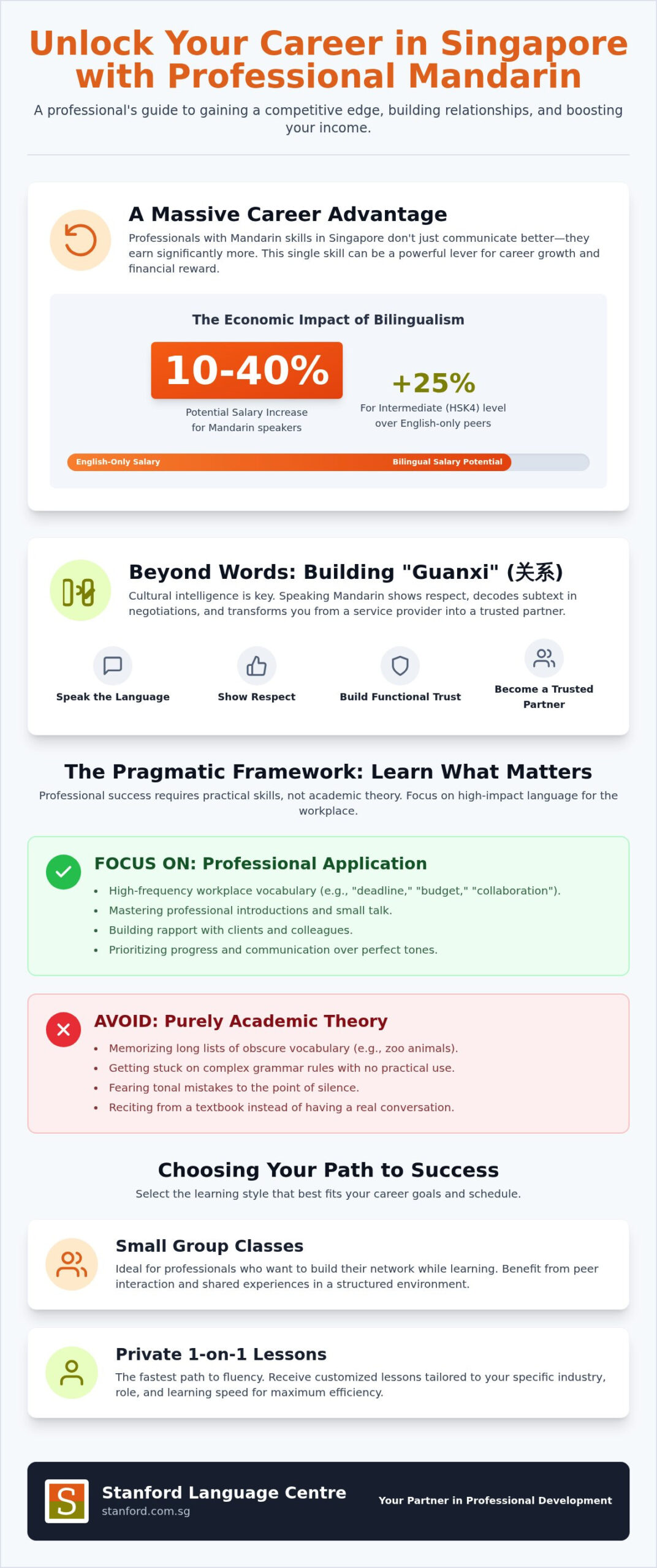
In the heart of the CBD, relationships drive results. We often call this “Guanxi.” It’s the art of building deep, functional trust that goes far beyond a signed contract. Speaking the language shows a level of respect that English alone cannot convey. It moves you from being a service provider to a trusted partner. However, don’t confuse “Singlish” Mandarin with what’s required in a boardroom. Professional Business Mandarin focuses on precision and etiquette. It ensures you sound like the expert you are, helping you avoid the casual pitfalls of local slang during high-stakes meetings.
In Singapore’s competitive job market, where standing out is crucial, a standard degree often isn’t enough. Now is the time to finally bridge the communication gap. The opportunities are expanding; you just need the right linguistic tools to seize them.
The Economic Advantage of Bilingualism
Bilingualism pays off in very literal terms. Research shows that professionals with Chinese language skills in Singapore can earn 10% to 40% higher salaries than their peers. If you reach an intermediate level, such as HSK4, you could earn up to 25% more than English-only graduates in similar roles. Multinational corporations (MNCs) specifically hunt for talent that can coordinate between Singaporean hubs and regional headquarters. The “Mandarin Advantage” today is the strategic ability to use language as a lever for higher salary brackets and exclusive, high-tier project assignments.
Cultural Intelligence in the Workplace
It’s about more than words; it’s about the “Chinese mindset.” Understanding the nuances of language helps you decode the subtext in business negotiations. This cultural intelligence prevents costly misunderstandings that can stall a deal for months. Beyond the boardroom, it transforms your daily office life. Building genuine rapport with Chinese-speaking colleagues improves overall morale. You’ll find yourself included in the office banter and informal networking that often happens over lunch. You won’t just be nodding along anymore. You’ll be an active, confident participant in every conversation.
The Pragmatic Framework: What Professional Mandarin Really Looks Like
Professional success doesn’t require you to be a poet. It requires you to be effective. When you learn mandarin for work singapore, you should ditch the long lists of obscure animals or colors found in basic textbooks. Instead, focus on high-frequency workplace vocabulary. You need words for “deadline,” “budget,” and “collaboration.” Mastery starts with the business introduction. It’s the first sixty seconds of a meeting that sets the tone. Small talk about the weather or the commute builds the “Guanxi” we mentioned earlier. It shows you’re invested in the person, not just the transaction.
Many professionals freeze because they fear tonal mistakes. Here’s a secret: “close enough” is often better than staying silent. Context usually carries the meaning in a business setting. If you’re discussing a “contract,” your colleagues will likely understand you even if your tone isn’t perfect. Don’t let the fear of sounding unprofessional stop you from trying. It’s about progress, not perfection. In a fast-paced environment like Singapore, the effort to speak is often more respected than the accuracy of the pitch.
Tailored Learning for Japanese and Korean Speakers
Japanese and Korean expats have a unique head start. If you’re a Japanese speaker, your knowledge of Kanji gives you an immediate advantage in character recognition. Similarly, Korean speakers can leverage Hanja roots to guess the meaning of complex business terms. Grammatical overlaps in sentence structure also mean you can often pick up the rhythm faster than Western learners. While pronunciation hurdles like the “r” and “sh” sounds exist, focusing on these specific areas saves time. You’ll find that choosing a small group Mandarin class tailored to these backgrounds can cut your learning time significantly.
Business Etiquette and Language
Etiquette is the framework that holds the language together. Using “Nin” instead of “Ni” shows a high level of respect for seniority. It’s a small change that makes a big impact during a first meeting. When exchanging business cards, always use two hands and take a moment to read the card before putting it away. Even your digital presence matters. On platforms like WeChat, keep your messages concise. Understand when to use a voice note and when a professional text is more appropriate. These small details prove you’ve done more than just study a textbook; they show you are serious when you learn mandarin for work singapore.
Choosing Your Path: Group Classes vs. Private Lessons
Deciding how to study is a strategic business decision. Your learning style should match your professional goals and your daily schedule. Most people think about cost first, but you should also consider the speed of your progress. If you’re looking for a cost-effective way to upskill, look for an NTUC UTAP claimable Mandarin class. This specific subsidy can cover up to S$250 per year for union members. It makes professional development accessible without draining your personal budget. Whether you choose a small group Mandarin class or private Mandarin language lessons depends on how quickly you need to see results in the office.
When you choose to learn mandarin for work singapore, you must decide between the energy of a group and the precision of a private tutor. Both paths lead to success, but they serve different needs. Online Mandarin language classes are another flexible option for those who travel frequently. However, many professionals find that in-person sessions at a central location provide the focus they need to truly disconnect from their emails and engage with the language. If you want a broader overview of your options, our 2026 guide to professional adult Chinese learning in Singapore covers the full range of formats available to busy expats.
The Benefits of Small Group Dynamics
Small groups are the sweet spot for adult learners. We keep our classes under 10 pax to ensure everyone gets maximum speaking time. You won’t just be a face in a crowd; you’ll be an active participant. These classes often become a secondary networking hub. You’ll meet other expats and professionals who are also trying to learn mandarin for work singapore. Peer feedback is a powerful tool here. Hearing a classmate navigate the same tones helps you recognize your own mistakes faster. It’s an encouraging, “no-frills” environment where you learn from each other’s questions as much as the teacher’s answers.
When to Invest in Private 1-1 Coaching
Sometimes, a group pace doesn’t fit your specific career trajectory. If you have a major presentation in Beijing or a business trip coming up, private Mandarin language lessons are the way to go. This format allows for a 100% customized industry focus. You can practice your specific pitch or learn the technical jargon relevant to your field, such as finance, tech, or logistics. For C-suite professionals, the biggest benefit is flexibility. Private coaching works around your board meetings and travel schedule, ensuring you never miss a lesson due to a late-running conference call. If your entire department needs to upskill, corporate Mandarin language training can even bring the classroom directly to your office.
Success Strategies for Busy Professionals
Consistency beats intensity every single time. If you try to learn mandarin for work singapore by cramming for three hours on a Sunday, you’ll likely forget most of it by Tuesday. Your brain needs regular, short bursts of exposure to move new vocabulary into long-term memory. Aim for just 15 minutes a day. Set realistic micro-goals, such as mastering five new work-related phrases each week. Use the “Coffee Shop” method for low-stakes practice. Order your morning kopi or lunch in Mandarin. These small wins build the confidence you need before you step into a boardroom or a networking event.
Technology is a helpful ally, but don’t let it become a crutch. Apps are excellent for vocabulary drills during your commute, but they can’t replace the real-time correction of a professional instructor. Use them to supplement your formal classes rather than relying on them as your sole source of learning. This balanced approach ensures you get both the repetitive practice and the nuanced feedback required for a professional environment. It keeps your progress steady without the frustration of hitting a plateau on your own.
Integrating Mandarin into Your Workday
You don’t need to clear your schedule to practice. Look for small gaps in your day where you can weave the language in naturally. Listen to business-focused Mandarin podcasts while you’re on the MRT. If you’re feeling particularly bold, switch your phone or email interface to Chinese. You already know where the buttons are, so this forces you to recognize characters through sheer repetition. Volunteer for simple tasks at work that require basic interaction. Offer to greet a visiting client or help a colleague with a short Chinese message. These real-world applications make the language feel less like a chore and more like a tool you use every day.
Overcoming the “Fear of Face”
The “Fear of Face” is the biggest hurdle for most adult learners. You don’t want to sound unprofessional or make a tonal mistake in front of your peers. However, mistakes are a necessary part of the learning curve. The good news is that Singaporeans are generally very positive and encouraging when they hear a foreigner trying to speak Mandarin. They appreciate the effort and the respect it shows for the local culture. Don’t worry about being perfect; focus on being understood. When the grammar gets tough, stay motivated by looking at your progress rather than the mountain ahead. To get started with a structured plan that fits your schedule, sign up for a private Mandarin class for foreigners and expat professionals today.
Why Stanford Language Centre is the Professional Choice
Stanford Language Centre has been a staple in the local community since 2004. We don’t believe in academic fluff or intimidating lectures. Our courses are built for people who need to use the language immediately. When you choose to learn mandarin for work singapore with us, you get a curriculum that values your time. Our expert teachers understand the specific pressures of the expat and professional experience. They don’t just teach grammar; they teach you how to survive and thrive in a Singaporean office environment. With central locations and flexible online Mandarin language classes, we make it easy to fit learning into your week.
We prioritize practical results over theoretical complexity. This “student-first” mentality ensures you walk away from every lesson with something you can use the next morning. Our classes provide a supportive and relaxed environment that lowers the barrier to entry for new learners. You won’t feel like you’re back in school; you’ll feel like you’re in a workshop designed for your career success. We focus on the utility of the language, using everyday terms that resonate with busy professionals.
Maximizing Your NTUC UTAP Claims
While many people look at SkillsFuture, NTUC UTAP is a fantastic alternative for union members. You can claim up to S$250 back on your course fees every year. This makes our NTUC UTAP claimable Mandarin class an incredibly high-value investment for any professional. To qualify, you simply need to be an NTUC member and ensure your membership is active throughout the course duration. The process is straightforward. First, register for your class. Second, complete the course with at least 75% attendance. Finally, submit your claim via the NTUC portal within six months of the course end date. It’s a pragmatic way to learn mandarin for work singapore without the heavy price tag.
A Legacy of Professional Success since 2004
Our philosophy has remained the same for over two decades: provide high-quality, no-frills language training that works. We’ve helped thousands of expats, including specialized programs for Japanese and Korean speakers, find their voice in Singapore’s competitive market. Our success stories come from corporate clients and individual professionals who now navigate their workplaces with ease. We view ourselves as your partners in this journey, not just distant authorities. You’ll join a community of peers who are all striving for the same professional growth in a friendly, unpretentious setting. Ready to take the next step? View our upcoming Mandarin class schedule and start your journey today.
Take the Next Step in Your Professional Journey
Professional Mandarin is more than just a skill on your resume; it’s a tool for building real connections in Singapore’s diverse business landscape. You don’t need to master every character to be effective. By focusing on high-frequency workplace vocabulary and leveraging small group dynamics, you can see results quickly. It’s about building rapport and showing respect to your regional partners. We’ve been serving Singapore professionals since 2004 with a student-first approach that prioritizes your practical success.
Choosing to learn mandarin for work singapore is a strategic investment that pays dividends through higher rapport and expanded career opportunities. Our courses are NTUC UTAP claimable, helping you manage costs while you upskill in a supportive, low-stress environment. Don’t let the fear of making tonal mistakes hold you back any longer. You have the strategies, the resources, and the subsidies ready. It’s time to start communicating with confidence and efficiency.
Boost your career-Enrol in a Professional Mandarin Course today
Frequently Asked Questions
Is Mandarin really necessary for work in Singapore if everyone speaks English?
Mandarin is essential for building deep professional trust and accessing regional markets across Asia. While English is the primary language for trade, Mandarin allows you to connect with clients and colleagues on a cultural level. It moves you from being just another vendor to a trusted partner who respects the local context. Speaking the language helps you navigate the subtext of negotiations that English alone might miss.
How long does it take to reach a conversational level for business?
Most professionals reach a basic conversational level within three to six months of consistent, weekly study. This timeframe assumes you’re attending a structured class and spending about 15 minutes a day on self-practice. By focusing on high-frequency workplace vocabulary rather than academic lists, you’ll be able to handle introductions and office banter much sooner than you expect. Consistency is the key to seeing real results.
Can I use SkillsFuture credits at Stanford Language Centre?
Yes, you can use your SkillsFuture credits for our “Basic Conversational Mandarin for Beginner 1” course. This is a practical way for Singapore Citizens to offset their expenses while they learn mandarin for work singapore. We recommend checking your available credit balance on the MySkillsFuture portal before you register. This ensures a smooth payment process and helps you maximize your available government subsidies.
How do I claim NTUC UTAP for my Mandarin course?
You claim your NTUC UTAP subsidy by submitting an application through the NTUC portal after your course ends. To be eligible, you must maintain at least 75% attendance and submit your claim within six months of the course completion date. This subsidy provides up to S$250 per year back on your course fees for union members. It’s a straightforward process designed to support your professional development.
Are there specific classes for Japanese or Korean speakers?
We offer specialized programs specifically designed for Japanese and Korean speakers to leverage their linguistic backgrounds. These classes use your existing knowledge of Kanji or Hanja to accelerate character recognition and grammar understanding. Our instructors are experts at addressing the specific pronunciation hurdles that North Asian expats face. This tailored approach helps you learn mandarin for work singapore much faster than a generic course would allow.
What happens if I miss a class due to a work commitment?
We offer flexibility for busy professionals because we know your schedule can change at the last minute. If you miss a small group session, you can often check with your instructor for catch-up materials or join a different session if space is available. For those with very unpredictable calendars, our private Mandarin language lessons offer the most flexibility. You can reschedule these sessions with advance notice to fit your work life.
Do you offer trial lessons for professional Mandarin courses?
We focus on delivering high-value, results-oriented training from your very first session. While we don’t typically offer standalone trial lessons, our small group focus and supportive environment ensure you feel comfortable and engaged immediately. Our “student-first” mentality means we prioritize your practical progress over academic theory. You can always contact us to discuss your specific career goals and find the most suitable class for your level.
Is it better to learn Simplified or Traditional characters for business?
Simplified characters are the standard choice for business in Singapore and Mainland China. They are used in almost all corporate documents, professional emails, and digital messaging platforms like WeChat. While Traditional characters are used in Taiwan and Hong Kong, mastering Simplified characters first provides the broadest utility. This choice ensures your reading and writing skills are immediately applicable in the majority of regional business settings.