A convenient class isn’t enough if it doesn’t fit your routine. Adults can learn the Thai language in Singapore through small-group, private one-to-one or online lessons. The right format depends on whether you value practice with classmates, individual focus or the flexibility to study remotely.
Want to try a class before committing? A trial can help you get a feel for the teaching style and your comfort speaking aloud. This guide explains what to look for, including what you can practise and how to assess a trial-class offer.
You’ll also get a practical view of course fees, the Thai skills you can develop, and how to fit lessons into your schedule. Fees depend on the lesson format, frequency and learning arrangement, and are provided after a quote request. You’ll learn how to compare class schedules and locations with MRT access, so you can choose an option that works for your goals and your week.
Key Takeaways
- Use a trial class, when available, to experience the teaching style and see whether beginner lessons suit your learning goals.
- Compare course fees by lesson format, frequency and learning arrangement so you can understand what shapes the overall cost.
- Decide whether you want to focus first on everyday conversation, grammar or reading, then look for lessons that match those priorities.
- Consider class schedules alongside travel time and MRT access to find an option that fits comfortably into your week.
- Compare group, private and online learning formats to choose the setting that best supports your routine and preferred way of practising.
Do you have free trial classes?
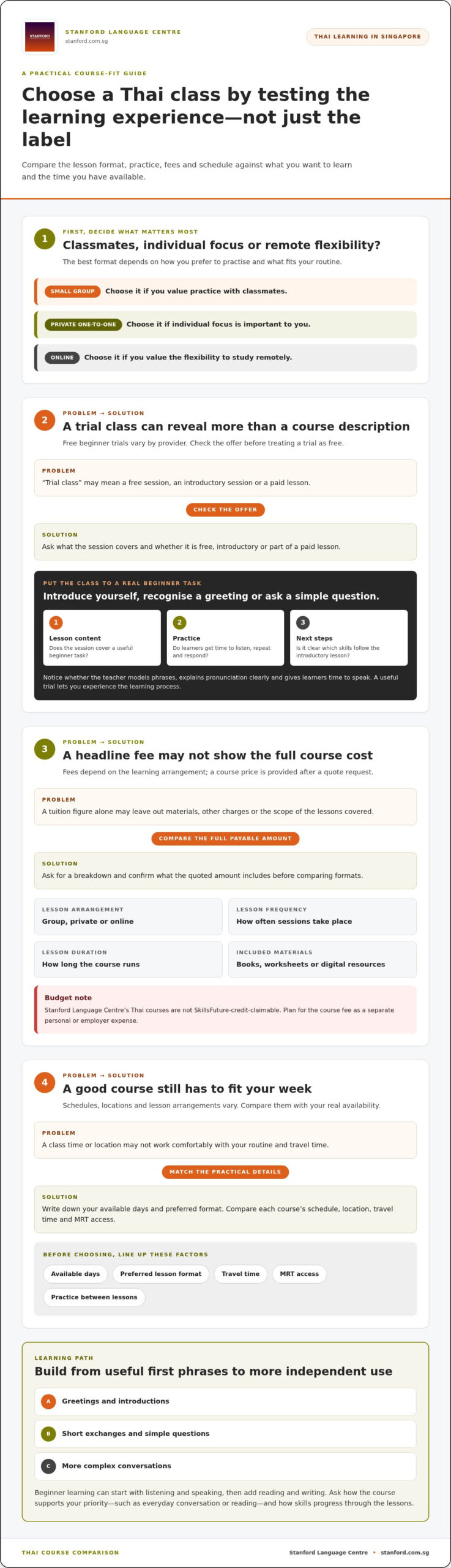
Free beginner trial classes vary by provider in Singapore, so don’t assume every Thai course includes one. A trial can help you judge the lesson pace, teaching approach and speaking practice before choosing a course. Ask what the session covers and whether it is free, introductory or part of a paid lesson. Those details shape what you can fairly assess.
Use a trial to test a specific beginner task. For example, practise introducing yourself, recognising a greeting or asking a simple question. Notice whether the teacher models each phrase, explains pronunciation clearly and gives learners time to respond. A useful session lets you experience the learning process, not just hear a course description.
Before attending, write down one goal, such as greeting a Thai-speaking colleague or ordering a drink. During class, observe how the teacher breaks that task into manageable steps. Do you hear a phrase, practise it aloud, then use it in a short exchange? That sequence gives you a clearer picture of how the course builds practical speaking skills.
Language schools, community-centre classes and private tutors differ in lesson structure, group interaction and personalisation. A school may follow a planned beginner curriculum, a community-centre class may bring learners together for scheduled sessions, and a private tutor can focus on individual goals. Compare the actual format, practice time and learning materials rather than relying on the provider label.
To choose a qualified Thai teacher or language school in Singapore, assess the course plan and teaching approach directly. Look for clear beginner outcomes, practice with listening and speaking, and explanations that help you correct pronunciation. Ask how lessons build from greetings to short exchanges, and whether learners receive feedback. A sample activity should show how beginners participate, not only how the teacher presents information.
For a first comparison, use these three checks:
- Lesson content: Does a beginner session cover a useful task, such as introducing yourself?
- Practice: Do learners get time to listen, repeat and respond?
- Next steps: Is it clear what skills follow the introductory lesson?
Beginner Thai learning can start with listening and speaking before adding reading and writing. A learner might first practise common greetings, then build a short introduction and respond to a simple question. Reading can help connect written forms with words heard in class, while writing supports recall. Ask how these skills fit into the course, especially if your immediate goal is everyday conversation.
After a trial, compare what you experienced with your original goal. If you want conversation, consider whether you spoke during the session. If reading matters, look for a clear place for written practice. After class, note one useful phrase, one question and one skill you want to develop next. That makes choosing a beginner course more practical.
Course fees and estimated payable fees
Thai course fees in Singapore depend on the learning format and what tuition includes. A private lesson and a group course involve different teaching arrangements, while online study may have different materials or delivery costs. For any course, the price depends on the case and is given after a quote request; factors include lesson format, frequency, duration and included materials. Compare the full payable amount, not just a headline tuition fee.
Ask for a fee breakdown that separates tuition from any required materials or other charges. For example, if a course requires a textbook, clarify whether it is included or bought separately. Also establish whether the stated amount covers the full course or a particular block of lessons. These details make comparisons between group, private and online formats more useful, without relying on an unsupported market average.
Stanford Language Centre’s Thai courses are not SkillsFuture-credit-claimable. Plan for the course fee as a separate personal or employer expense.
Course levels usually build from beginner foundations towards more independent use. A beginner may start with greetings and introductions, then practise short exchanges before moving into more complex conversations. Ask how a course describes progression and what learners are expected to do at each stage. A clear sequence helps you choose a suitable starting point, especially if you already know some spoken Thai but have not studied reading.
Course schedules, lengths and formats vary. Lessons may be group classes, private tuition or online sessions, with start dates and session frequency affecting the overall duration. Before comparing options, write down your available days and preferred format. Then compare those with each course’s schedule and the amount of practice offered between lessons.
Attendance and certificates are separate considerations. Ask what attendance record the course keeps and whether completing it leads to a certificate. If you need evidence for a workplace or personal record, clarify what the document represents: attendance, completion or an assessed result. A certificate’s practical value depends on its stated purpose, so do not assume it proves a particular level of Thai ability.
Textbooks and course materials can shape both the learning experience and total cost. Find out whether lessons use printed books, teacher-prepared worksheets or digital materials. For example, a beginner course might pair vocabulary practice with short dialogues and reading exercises. Check how materials support your goal, such as speaking with Thai colleagues or learning to read common signs. Consistent resources can also help you review between lessons.
To compare a course efficiently, list tuition, materials, schedule, course duration and any certificate details in one place. Then consider which format matches your routine and learning priorities. A structured Thai language course is one option to consider when planning your next learning step.
Thai grammar, reading and conversation skills
Adults who want to learn the Thai language in Singapore can combine speaking practice with grammar and script study. The balance depends on whether their goal is everyday conversation, literacy, or both.
Grammar and Conversation Skills
Start with useful sentence patterns, then change one detail at a time. For example, use a greeting, add your name and follow with a simple question. This helps you notice word order while building a short exchange, rather than memorising isolated phrases.
Thai verbs do not change form to show tense in the same way English verbs do. Words indicating time can clarify meaning, so learners can compare a present activity with a past one. A course may introduce polite particles and question forms through examples, such as asking someone’s name or where they are going.
For conversation practice, check whether activities include listening, responding and taking turns. A role-play about meeting a colleague gives you a reason to use greetings, introductions and questions together. Feedback on tone and pronunciation matters because a familiar word can sound different when spoken with another tone.
Notice how a teacher connects each grammar point to real communication. For instance, after practising a question pattern, learners might use it to ask about someone’s plans. This gives grammar a practical purpose and helps you recall the structure during conversation. Look for chances to answer without reading from a script.
Speaking, Reading, and Writing Curriculum
A speaking, reading and writing curriculum connects spoken phrases with Thai script. Learners can practise hearing a word, saying it, recognising its written form, then copying it. This step-by-step approach helps show whether literacy is part of the course or whether lessons focus mainly on conversation.
Thai writing uses consonant characters and vowel signs, which can appear before, after, above or below a consonant. For example, learners need to notice where a vowel sign sits, not just copy a word’s left-to-right shape. Reading exercises can build recognition, while writing practice helps reinforce character forms and spelling.
Speaking practice should include listening for tones and repeating short phrases. Try a simple cycle: listen to a model, repeat it, then use the phrase in a new response. This connects pronunciation practice with communication, rather than treating speaking as repetition alone.
Reading and writing goals differ from conversation goals. Someone preparing for travel may prioritise spoken requests, while a learner reading menus or signs needs script recognition. Ask how lessons divide time across these skills and whether written exercises support vocabulary used in speaking activities.
A person learning the Thai language in Singapore can compare course content by looking for progression from sounds and basic phrases to connected tasks. A beginner might move from introducing themselves to reading a short dialogue and writing familiar words. Choose a curriculum that matches your purpose, then track what you can understand, say and read without prompts.
Class location and MRT access
When choosing an in-person Thai class, consider the full journey, not only the nearest transport stop. Compare the classroom address with your usual starting point, route and final walk. A short walk from one station may suit you better than a longer journey with transfers. The easiest route depends on where you travel from and when lessons finish.
Start by mapping the trip from home or work. For example, compare travelling from your office on a weekday with leaving home for a weekend class. Look at the MRT route, transfers and walking directions for the time you expect to attend. This gives you a clearer view of the journey than relying on a district name or a station’s distance alone.
Use this practical location check:
- Starting point: Choose where you’ll usually travel from, such as your workplace.
- Station route: Note the nearest MRT station and any transfers along the way.
- Last stretch: Check the walk from the station to the building entrance.
- Return trip: Consider how you’ll travel home after the lesson.
Singapore’s MRT network connects different parts of the island, but the most suitable route depends on your starting station and destination. A class near Paya Lebar, for example, may be convenient for one learner and less practical for someone travelling from elsewhere. Compare your actual trip instead of assuming a central location will work best for everyone.
Check the classroom building and entrance as well. A map pin may show the building without identifying the entrance or room. Match the address to the building name and follow the directions for reaching the classroom. If the venue is inside a large complex, allow time to find the room before the lesson starts.
For recurring classes, consider the route at your likely travel time. A journey that works from home may feel different after a full workday. Think through the complete routine: finishing work, travelling, attending class and getting home. If you rely on public transport, choose a journey you can fit into your regular week.
Online lessons remove the commute, while in-person classes provide a dedicated place to practise with others. If you want to learn the Thai language in Singapore, weigh your preferred learning setting against the time and effort involved in travelling. Write down your starting point, MRT route, walk to the venue and return plan before deciding which class location suits your routine.
Thai group class schedules and fees
For a Thai group class in Singapore, schedule fit and total cost matter together. A convenient lesson time is easier to keep than one that clashes with work or family plans. Compare the class timetable, course duration and complete fee details before choosing. Treat each as part of the same decision, not separate details to review later.
Start by listing the times you can attend consistently, such as weekday evenings or a weekend slot. Then compare each available class schedule against that list. Consider the full routine: leaving work, travelling to class, attending the lesson and getting home. A time that looks open on your calendar may be harder to manage if travel makes the evening too tight.
Review these schedule details together:
- Lesson day and time: Match the stated session time to your regular commitments.
- Course duration: Understand how long the class runs and how lessons progress.
- Attendance pattern: Consider whether you can attend each scheduled session consistently.
- Learning format: Compare in-person group learning with an online class if travel affects your routine.
Group lessons provide a shared setting for practising Thai with other learners. That can create opportunities to listen to different responses and take turns in conversation. A private lesson offers a different arrangement, while online learning removes the commute. Choose the format that gives you a workable balance between speaking practice, schedule and travel demands.
Thai course fees depend on the learning arrangement and what the course includes. The price depends on the case and is given after a quote request; factors include lesson format, frequency, course duration and materials. No reliable comparison comes from tuition alone if one course includes learning materials and another lists them separately.
For a clear comparison, write down the quoted tuition, any material charges, session frequency and total course duration. For example, compare a weekly group class with an online option by recording the complete payable amount and schedule commitment for each. This makes the trade-offs visible without relying on generic market estimates or assuming every provider calculates fees alike.
Before committing, check that the published timetable and fee arrangement suit your actual week. If your work calendar changes, an online format may reduce travel pressure. If you prefer practising with classmates, prioritise a group schedule you can attend regularly. Explore Thai class options as you compare formats and plan your learning routine.
Stanford Language Centre: Professional Adult Chinese learning in Singapore
Stanford Language Centre provides Professional Adult Chinese learning in Singapore, with small-group Mandarin classes for expats and foreigners, Japanese learners, and Korean learners. These options suit adults who want structured Chinese study and a group setting tailored to their language background.
If your next language goal is Mandarin, consider which class group best matches your needs. For example, an expat or foreign learner may prefer a group designed for that audience, while Japanese or Korean learners can choose a class tailored to their background. This is a separate learning path from the Thai course considerations covered above.
To explore adult Mandarin learning, contact Stanford Language Centre or visit stanford.com.sg.
Turn your Thai goal into a practical next step
Choose one reason to study Thai, such as connecting with friends, travelling with more confidence, or communicating at work. Let that goal guide what you practise first. A short routine built around real situations can make learning feel more purposeful than collecting phrases without context. As you learn Thai in Singapore, focus on the moments when you want to understand or respond more naturally.
Make your next step simple: decide what you want to say, then choose a learning format that fits your routine. Stanford Language Centre offers Thai learning options for adults. If you’re ready to explore a class, contact Stanford Language Centre and discuss your learning goals. Every useful phrase begins with a first attempt. Keep going, and let each new conversation build your confidence.
Frequently Asked Questions
How much does it cost?
The cost depends on the lesson format and course arrangement. Group, private and online lessons have different teaching setups, so compare what each option includes before deciding. Stanford describes its rates as reasonable and does not publish a single fee that applies to every learner. Consider your preferred format and learning goals when reviewing the payable amount for a Thai course.
What is the schedule like?
Thai class schedules depend on the selected format and course timetable. Stanford’s basic Thai package consists of 10 lessons over 2 months, giving learners a defined course period. Group classes follow scheduled sessions, while private lessons can be customised to a student’s time. Online lessons provide another way to fit study around work or personal commitments. Review the timetable against your regular weekly routine.
Where can I learn Thai in Singapore?
You can study Thai through in-person or online classes in Singapore. Stanford Language Centre offers small-group Thai classes, private Thai lessons and online Thai classes for adult learners. Choose an in-person format if you want a classroom setting, or online lessons if remote study suits your routine better. The best fit depends on how you prefer to practise and where lessons fit into your week.
What are the best Thai language schools and courses in Singapore?
The best course is the one that matches your learning goal, preferred format and starting level. Compare whether lessons focus on practical conversation, offer a clear beginner pathway and suit your schedule. Stanford Language Centre provides basic Thai lessons for adults, with group, private and online learning options. For example, a learner preparing for everyday conversations may prefer a conversational course over study focused mainly on written exercises.
How much do Thai lessons cost in Singapore?
Thai lesson fees vary with the course format and learning arrangement, so there is no single price for every lesson type. Stanford describes its rates as reasonable, and its basic Thai package includes instructional time, practice materials and access to native trainers. When comparing costs, consider the complete course and included resources rather than calculating tuition alone. This helps you assess what the fee covers alongside the learning format.
Are there beginner, intermediate, and advanced Thai courses in Singapore?
Yes, Thai learning options can suit different stages. Stanford offers structured beginner programs, and intensive Thai lessons cover basic through advanced levels. If you are new to the language, start with foundational phrases and conversation practice. Learners with prior experience can look for lessons that build on existing skills. Choosing by your current ability helps keep class content relevant instead of revisiting familiar material or skipping key foundations.
Can I learn Thai online or through private tutors in Singapore?
Yes, Thai study is available online and through private one-to-one lessons. Stanford provides online Thai classes and private Thai lessons, giving learners a choice between remote study and individual tuition. Private lessons can be customised to the student’s time and location. For example, choose online lessons if travel is inconvenient, or private tuition if you want the teaching arranged around your individual learning needs.
Do Singapore Thai language courses teach reading and writing as well as speaking?
Some Thai courses focus on practical conversation, while reading and writing may be taught through a dedicated class. Stanford offers a Thai reading and writing class alongside conversational Thai learning. If literacy matters to your goal, such as reading menus or writing familiar words, choose a course that includes script practice. Learners focused on speaking can prioritise lessons built around listening, pronunciation and everyday exchanges.