You don’t need a musical ear to master the five tones of the Thai language. Most adults in Singapore give up before they start because they’re intimidated by the script and the pitch. However, the real secret to fluency isn’t innate talent; it’s a structured roadmap built for a busy professional’s brain. It’s about practical application over theoretical complexity.
We understand the frustration of wasting hours on apps that don’t lead to real conversations. You want to order food confidently and navigate Thailand without a translator. You need a class that respects your work schedule and provides a supportive, low-stress environment. It’s common to feel overwhelmed by the unique script, but with the right guidance, those symbols become clear instructions.
You can learn Thai language essentials through a proven system designed specifically for expats and professionals. This article explores the best adult courses in Singapore, including how to maximize your NTUC UTAP funding. We’ll preview the journey from basic phonetics to reading menus, ensuring you gain the skills needed for both social and business settings. Let’s turn that intimidation into confidence.
Key Takeaways
- Discover why Thai is a vital gateway for business expansion in Southeast Asia and how it transforms your travel experiences beyond typical tourist paths.
- Master the five tones and unique script using a phonetic-first approach designed for adults who want to learn Thai language skills quickly and effectively.
- Choose between interactive small group classes for peer support or private 1-1 lessons for a faster, more customized learning path.
- Follow a clear, two-phase roadmap that moves you from basic survival greetings to handling complex daily interactions with confidence.
- Reduce your out-of-pocket costs by claiming up to 50% of your course fees through NTUC UTAP funding for eligible programs.
Why Learn Thai Language in Singapore in 2026?
Singapore and Thailand share more than just a short flight path. In 2026, the economic and cultural ties between these two nations are tighter than ever. Many professionals now choose to learn Thai language skills to transform their relationship with the Land of Smiles. It is not just about being a better tourist; whether you are exploring Bangkok’s business districts or diving into the marine beauty with Scubadeep in Phuket, speaking the language enhances every interaction. It is about becoming a participant in a vibrant, growing region. Learning Thai opens doors that stay closed to those who only speak English.
The Business Case for Thai Fluency
Singapore remains a vital regional hub for Thai trade. If you’re working in logistics, digital finance, or regional tourism, Thai fluency is a massive asset. Business partners in Bangkok value the effort of local communication. When you speak their language, you build immediate rapport. It shows a level of respect that a translator simply cannot provide. In the 2026 job market, localized skills are in high demand. Companies want employees who can navigate cultural nuances without a middleman. You don’t need to be perfect to see results. Even basic conversational skills can smooth over a difficult negotiation or help you close a deal during a business dinner. It’s about being approachable and reliable.
Personal Growth and Social Integration
Most learners start with ‘tourist Thai’ but quickly want more. Genuine conversational ability allows you to move beyond the typical paths in Phuket or Sukhumvit. You can read menus, understand street signs, and talk to locals in rural provinces where English is rare. For a deeper look at the linguistic roots, this Thai language overview provides details on its history, script, and phonology. Understanding the language helps you understand the “Jai” (heart) of Thai culture. It explains why certain etiquettes matter and how to navigate social settings with grace.
There are also significant cognitive benefits for adult learners. Thai is a tonal language. Learning it is like training your ear for music. It challenges your brain to process sounds in a new way, which keeps your mind sharp and flexible. In Singapore, we have a large and welcoming Thai community. Speaking the language helps you connect with neighbors and colleagues on a sincere, peer-to-peer level. We take a ‘friendly guide’ approach to help you overcome any initial anxiety about the five tones. We focus on practical, real-world application so you can start using your new skills immediately. It’s a low-stress way to achieve a high-impact goal.
Mastering the Essentials: Tones, Script, and Vocabulary
Mastering the basics is the first hurdle when you decide to learn Thai language skills. Many adults fear the five tones or the complex script. It’s a common concern. We use a results-oriented method that breaks these down into manageable pieces. We don’t start with dry grammar. We start with sounds you can actually use. Our goal is to lower the barrier to entry by focusing on practical results over theoretical complexity.
Demystifying the Five Tones
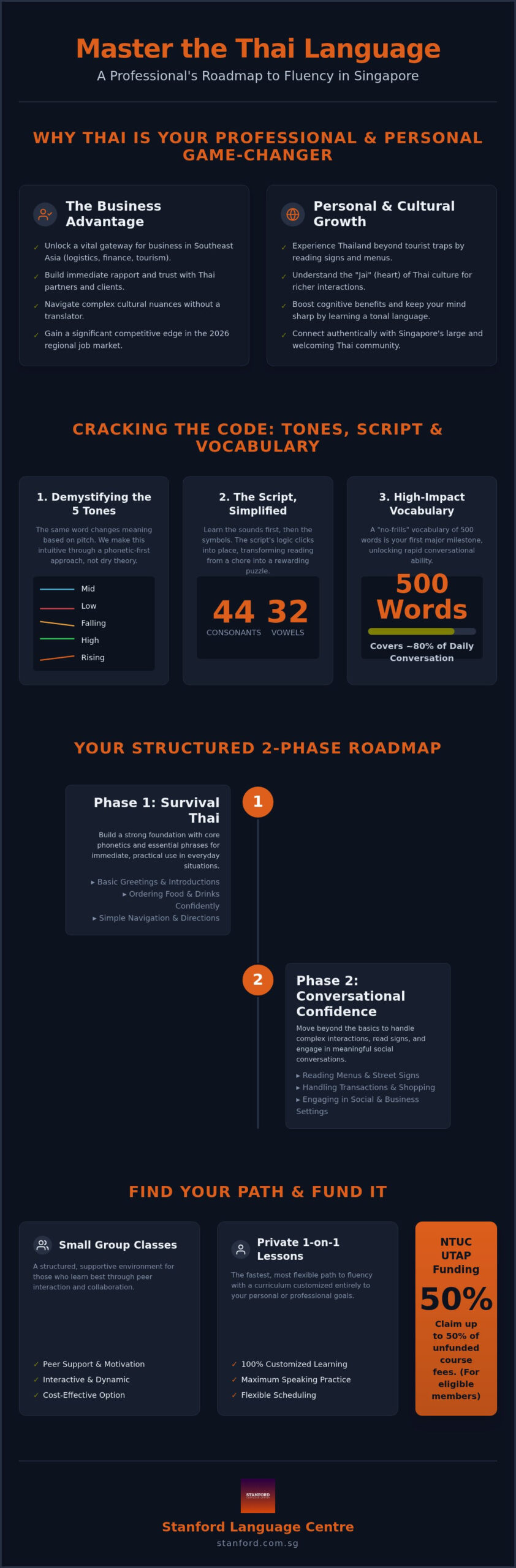
Thai is a tonal language. This means a single word can have different meanings depending on your pitch. You’ll encounter mid, low, falling, high, and rising tones. It sounds like music. Visualizing these as physical movements helps. For instance, a falling tone starts high and drops. Research in the Journal of the Southeast Asian Linguistics Society highlights how these phonological structures define the language’s unique identity. While it seems daunting, how to learn a tonal language is actually quite straightforward with the right drills. In our small group classes, we practice these sounds until they become muscle memory. We focus on accuracy without the academic pressure.
Transitioning to Thai Reading and Writing
Don’t try to learn the alphabet on your first day. That’s a recipe for burnout. We recommend a phonetics-first approach. Once your ears are tuned to the sounds, the script makes much more sense. The Thai alphabet has 44 consonants and 32 vowels. It’s logical but different from English. Vowels can be placed above, below, or even before the consonant. Our specialized thai writing course singapore guides you through this transition when you’re ready. Reading signs and menus becomes a rewarding puzzle rather than a source of stress. It adds a layer of confidence to your travel and business interactions.
A “no-frills” vocabulary of 500 words is your first major milestone. This covers about 80% of daily interactions. Focus on high-utility words first. A common pitfall is over-emphasizing the wrong syllable. Thai is often syllable-timed, unlike the stress-timed rhythm of English. Another error is mixing up the ‘k’ and ‘kh’ sounds; this can change the meaning entirely. We help you catch these errors early. If you’re ready to start your journey, our small group Thai classes are the perfect place to build these foundational skills in a supportive environment.
Choosing the Right Thai Course: Small Groups vs. Private 1-1
Choosing the right environment to learn Thai language skills depends entirely on your personal goals and daily schedule. Adults need efficiency. You don’t have time for academic fluff. You need a setup that yields real-world results quickly. Whether you thrive in a social setting or require the laser focus of a one-on-one session, the structure of the course matters more than you might think. Finding a class that fits a busy work schedule is often the biggest hurdle for professionals in Singapore.
The Power of Small Group Thai Classes
Small group Thai classes are a favorite for many. They offer a balance of social interaction and structured learning. You get maximum interaction time with native-speaking instructors who understand the local context. Learning alongside peers means you hear different voices and common mistakes. This actually speeds up your own progress. Our Level 1 curriculum is built for foundational success. It’s not just about grammar; it’s about building a community of learners right here in Singapore. While some learners explore general SkillsFuture-approved Thai courses, our specialized programs are tailored for those seeking a more personal, mentor-led experience that prioritizes conversational confidence.
Tailored Private and Online Solutions
Sometimes a standard schedule doesn’t fit. If you’re a busy professional with an unpredictable calendar, online Thai language classes offer the ultimate flexibility. You can learn from your office or home without the commute. For those with specific business or travel needs, a private Thai language class is the fastest path. We customize the lesson pace to your ability. This ‘fast-track’ approach allows us to address your specific linguistic blind spots immediately. You won’t spend time on topics you’ve already mastered. It’s a high-impact way to get ready for a big move or a regional project. These sessions are designed to be self-contained and informative, moving at a pace that respects your time.
Structured adult-only environments outperform general language schools. We don’t mix children and adults because the learning objectives are completely different. The teaching style is pragmatic and grounded. We focus on the utility of the service, ensuring you learn the practical application of skills in real-world settings. This student-first mentality ensures you get the most value for your time and money. We view ourselves as partners in your journey rather than distant authorities. It’s about being a supportive ally in your quest for fluency.
Your 2026 Thai Learning Roadmap: From Beginner to Fluent
Success doesn’t happen by accident. It requires a structured path that respects your time as a busy professional. When you decide to learn Thai language skills, having a clear roadmap ensures you don’t waste effort on irrelevant vocabulary. You wouldn’t hike a mountain without a map, and language learning is no different. We’ve designed a four-phase journey that moves you from absolute beginner to a confident communicator.
What to Expect in Conversational Level 1
Phase 1 is your foundation. This is where you master greetings, introductions, and survival phrases. Your first milestones are practical: ordering your favorite street food without pointing or telling a taxi driver exactly where to go in Bangkok. Much like our conversational mandarin level 1 course, the focus here is on immediate utility. We use encouraging classroom drills to help you overcome the ‘silent period.’ This is the phase where you understand more than you can say. We’ll get you talking from day one in a low-stress environment.
Phase 2 moves you into Intermediate Conversation. At this stage, you’ll start handling complex daily interactions. You might find yourself negotiating at a local market or explaining a specific need to a service provider. You’re no longer just reciting memorized phrases; you’re building your own sentences and expressing personal opinions. It’s about finding your own voice in a new language.
Advancing to Literacy and Beyond
Phase 3 is where the written world opens up. You’ll transition from karaoke-style phonetics to the real Thai script. This is a rewarding milestone. Suddenly, street signs, menus, and basic messages from colleagues become clear. Reading and writing aren’t just academic exercises; they are tools for independence. You’ll also refine your tones to achieve near-native professional communication. This level of detail is what separates a casual learner from a true enthusiast.
Finally, Phase 4 reaches Advanced Fluency. This is the level required for high-stakes business negotiations and understanding deep cultural nuance. You’ll learn to navigate formal settings with the same ease as a casual chat over coffee. It’s a journey that takes commitment, but each phase offers its own set of rewards and breakthroughs. We view ourselves as your supportive mentors throughout this entire process. Ready to take the first step on your path? Check out our small group Thai Class to begin your roadmap today.
Funding Your Thai Lessons: NTUC UTAP and Corporate Training
Quality education shouldn’t be a financial burden. Many adults in Singapore hesitate to start a new course because of the perceived cost. We believe that professional training should be accessible and affordable for everyone. If you’re looking to learn Thai language skills, there are several ways to reduce your out-of-pocket expenses. By leveraging available grants and corporate programs, you can focus on your progress rather than your budget.
Maximizing Your NTUC UTAP Benefits
The Union Training Assistance Programme (UTAP) is a fantastic resource for NTUC members. It’s designed to encourage lifelong learning by subsidizing course fees. You can claim up to 50% of the unfunded course fees for eligible programs. For members below 40 years old, the funding cap is $250 per year. If you’re 40 or above, that cap increases to $500 per year. This financial advantage makes high-quality Thai lessons significantly more reachable for Singaporeans and PRs alike.
Applying for UTAP is a straightforward process. First, ensure you’re an active NTUC member before the course starts. Second, register for an eligible Thai language program. Third, complete the course with at least 75% attendance. Finally, submit your claim through the NTUC portal within six months of your course completion date. It’s a no-frills system that rewards your commitment to personal growth. We’re here to help you navigate these requirements so you can get the most value from your membership.
Corporate Thai Training for Teams
Organizations often need more than just general conversation. Our corporate Thai language training is built for teams that require specific, industry-related terminology. We don’t believe in one-size-fits-all solutions. Instead, we tailor the syllabus to match your business goals. Whether your team is in logistics, finance, or retail, we provide the linguistic tools needed for regional success. Building a culturally competent workforce is a smart investment in the 2026 global market.
We prioritize flexibility to minimize disruption to your business operations. Lessons can be scheduled during lunch hours, after work, or even online to fit your team’s busy calendar. This customized approach ensures that your employees gain practical skills they can use immediately in business meetings or negotiations. Stanford Language Centre has been a supportive mentor for professionals since 2004. We focus on interaction and real-world results. Our student-first mentality ensures your team feels confident and capable from the very first session. Let’s work together to bridge the communication gap with your Thai partners.
Unlock New Opportunities with Thai Fluency
Mastering a new language is a powerful way to expand your horizons in Southeast Asia. Whether you’re aiming for business growth or more authentic travel experiences, the ability to communicate in Thai sets you apart. We’ve seen how a structured roadmap and specialized adult learning methodology turn a daunting challenge into an achievable goal. You don’t have to tackle the five tones alone. With the right support, you can move from basic greetings to reading menus and signs with confidence.
It’s time to learn Thai language skills in a way that respects your schedule and your goals. Our programs are designed for busy professionals who need practical results. You can benefit from small group sizes for personalized attention and even reduce your costs through NTUC UTAP claimable courses. We are here to act as your supportive mentors every step of the way. Start your Thai language journey with Stanford Language Centre today! You’ll be surprised at how quickly you can start making real connections.
Frequently Asked Questions
Is it hard for English speakers to learn Thai?
Thai has unique challenges like the five tones and a non-Roman script, but it isn’t impossible for English speakers. Our methodology focuses on phonetics first to help you learn Thai language basics without feeling overwhelmed. We prioritize conversational skills so you can see immediate results in daily life. Most students find that once they understand the logic of the tones, the language becomes much more approachable and logical.
How long does it take to become conversational in Thai?
Most adults reach a basic conversational level after completing our Level 1 program. This foundational phase typically covers survival Thai like ordering food, taking taxis, and simple introductions. While true fluency takes longer, you’ll gain the confidence to navigate social settings in Thailand within a few months of consistent practice. Our small group focus ensures you get enough interaction time to lock in these essential skills quickly and effectively.
Can I use SkillsFuture credits for Thai classes at Stanford Language Centre?
No, our Thai language courses are not SkillsFuture credit claimable. Instead, we focus on providing high-quality, NTUC UTAP claimable programs for our students. This allows eligible NTUC members to claim back up to 50% of their course fees. We’ve found this funding model provides significant value for professionals and expats looking for specialized adult training. It is a great alternative for those who have already exhausted their other government credits.
What is the difference between conversational Thai and Thai reading/writing classes?
Conversational Thai classes focus on speaking and listening skills using phonetic systems to get you talking immediately. These are ideal for travelers and business professionals who need to communicate. In contrast, our Thai reading and writing classes dive into the unique script and alphabet. We usually recommend mastering basic conversation first before tackling the written word. This two-phase approach ensures you don’t feel overwhelmed by the complex script on day one.
How do I claim the NTUC UTAP subsidy for my Thai course?
To claim the NTUC UTAP subsidy, you must be an active NTUC member before and during the course. You need to maintain at least 75% attendance and complete the program successfully. Once the course ends, you can submit your claim through the NTUC portal within six months. This scheme can cover up to 50% of your fees, making it an affordable way to learn Thai language skills while working in Singapore.
Are native Thai speakers teaching the classes?
Yes, all our Thai language classes are taught by experienced, native-speaking instructors. We believe that learning from a native speaker is essential for mastering the correct pronunciation and nuances of the five tones. Our teachers act as supportive mentors, guiding you through the cultural etiquette that accompanies the language. This ensures you’re not just learning words, but also how to use them respectfully in real-world business or social settings.
Do you offer online Thai lessons for busy professionals?
We offer flexible online Thai language classes designed specifically for busy professionals. These sessions provide the same structured curriculum as our onsite classes but with the convenience of learning from your office or home. If your schedule is particularly unpredictable, our private 1-1 lessons might be the best fit. This allows you to customize the pace and timing of your lessons to suit your specific business or travel needs perfectly.
What happens if I miss a lesson in a small group class?
If you miss a lesson, we provide the course materials and notes so you can keep up with the curriculum. While we don’t offer makeup sessions for missed group classes, our instructors are approachable allies who can answer quick questions during the next session. We encourage consistent attendance to get the most out of the peer interaction, but we understand that work commitments sometimes arise. Our goal is to keep your progress on track.