Learn Mandarin Language: A Professional Guide for Expats

What if the biggest barrier to your career growth in Singapore isn’t your technical skill, but your inability to connect over a working lunch? For many expats, the decision to learn mandarin language feels like trying to climb a mountain without a map. The four tones seem intimidating. Those complex characters look like art rather than an alphabet. You’re busy. You don’t have years to spend in a stuffy classroom studying theory when you just need to close a deal or chat with your neighbors.

We understand the frustration of generic apps that don’t help in a real-world Singapore setting. This guide offers a practical, result-oriented roadmap designed specifically for busy adults. It’s about efficiency and comfort. We’ll show you how to master the essentials of your Mandarin journey right here in the city. You’ll gain the conversational fluency needed for daily life and the professional edge required in the workplace. From ordering your favorite local dish to interacting with colleagues, we’ll help you build the confidence to thrive in your new home.

Key Takeaways

  • Prioritize practical conversational skills. It’s the fastest way to integrate into Singapore’s social and professional circles.
  • Choose structured classes to learn mandarin language. Real-time feedback is the only way to master the four tones without frustration.
  • Follow a simplified roadmap for Pinyin. We break down complex foundations into digestible steps for busy adults.
  • Customise your learning for the workplace. Specialized corporate training gives you a distinct edge in your specific industry.
  • Maximise your budget with NTUC UTAP claims. Access premium small group lessons while keeping your costs low.

Understanding the Mandarin Landscape in Singapore

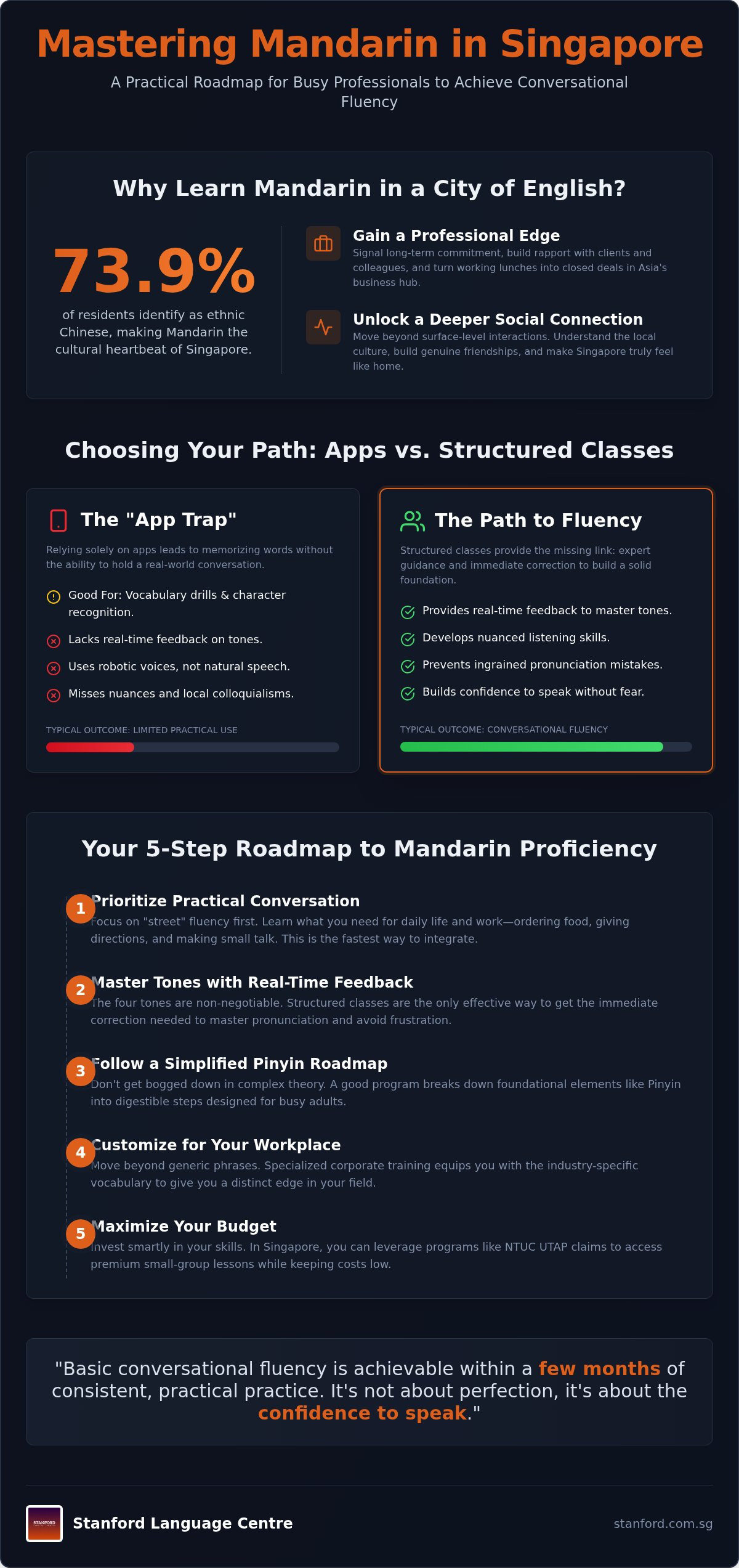
Singapore is a unique gateway where East meets West. While English is the primary language for business and government, Mandarin remains the cultural heartbeat for much of the population. To learn mandarin language in this city is to unlock a deeper level of integration. You aren’t just memorizing words. You’re building a bridge to the 73.9% of residents who identify as ethnic Chinese. For those interested in the formal structures of the tongue, this Standard Chinese overview provides a look at the phonology and grammar that define the language globally.

The biggest mistake expats make is choosing an academic path over a practical one. You don’t need to study ancient literature to be successful here. You need “street” fluency. This means being able to order food, give directions, or exchange pleasantries with a neighbor. For a busy professional, fluency isn’t about perfection. It’s about the confidence to speak without fear. Singapore is the perfect immersion hub because you see the language every day on signs, in menus, and in the MRT. Choosing to learn mandarin language through a practical lens ensures you get results you can use immediately.

Setting a goal of basic conversational fluency is achievable within a few months of consistent practice. You don’t need to be a linguist to see the benefits. Even a basic grasp of the language changes how people perceive you in a professional setting. It shows respect for the local culture. It proves you’re here to stay and contribute. Most importantly, it makes your stay in Singapore feel less like a temporary assignment and more like a home.

Why Learn Mandarin for Work in Singapore?

Social Benefits for Expats and Foreigners

Daily life becomes much richer when the “wall of sound” around you starts to make sense. You’ll move through the city with a new sense of ease. Ordering at a hawker centre becomes a highlight rather than a stressful task. You’ll find that locals appreciate the effort, even if your tones aren’t perfect yet. This linguistic understanding significantly lowers culture shock. It turns Singapore into a place where you truly belong. It’s about feeling at home in your community and making lasting friendships with people from all walks of life.

Comparing Learning Methods: Apps vs. Structured Classes

Many expats begin their journey to learn mandarin language by downloading a popular app. It feels easy. It’s gamified. It fits into a commute. However, relying solely on software often leads to the “App Trap.” This is where you memorize hundreds of words but can’t hold a two-minute conversation with a colleague. Apps are fantastic for vocabulary drills. They aren’t great for the nuances of speech. Mandarin is a tonal language. Without real-time feedback, you might be practicing the wrong pronunciation for months without knowing it. Self-study is a great supplement, but it shouldn’t be your only strategy.

The global demand for these skills is undeniable. Organizations like the Critical Language Scholarship Program highlight Mandarin as a vital tool for professional and economic success. In Singapore, this is even more apparent. Professional instruction provides the missing link: nuanced listening. A teacher can see your facial expressions. They can hear the slight dip in your third tone. This immediate correction prevents bad habits from taking root. It’s about building a solid foundation from day one. A professional guide helps you bridge the gap between knowing a word and knowing how to use it in a high-stakes meeting.

When Language Apps Are (and Aren’t) Enough

Apps like HelloChinese or Duolingo are helpful for character recognition. They turn learning into a game. But they miss the human element. They can’t explain why a certain phrase feels “off” in a Singaporean boardroom. They also struggle with local colloquialisms. If you want to learn mandarin language for the real world, you need to hear how locals actually speak. Apps often use robotic voices. These don’t prepare you for the fast-paced, rhythmic flow of a conversation at a Maxwell Food Centre stall. Use them for 10 minutes a day to keep your vocabulary fresh, but don’t expect them to make you fluent.

The Advantages of Small Group Mandarin Lessons

Small groups offer a low-stress environment. You aren’t alone in your struggle with tones. Seeing peers make similar mistakes reduces performance anxiety. It makes the classroom feel like a community. You get personalized attention without the intensity of a 1-on-1 session. A structured progression ensures you don’t skip the boring but essential foundations. Instructors at a local centre understand the specific needs of expats living in the Lion City. If you’re looking for a supportive environment, exploring a small group mandarin class for expat and foreigner can provide the accountability you need to stay on track. This face-to-face interaction is where the real progress happens.

The Essential Roadmap for Beginner Mandarin Learners

Starting to learn mandarin language doesn’t have to be overwhelming. Success comes from a structured approach that prioritizes speaking over theory. The first step is mastering Pinyin. This is the phonetic system that uses the Roman alphabet to represent Chinese sounds. It’s your secret weapon. It allows you to start speaking immediately without waiting to memorize thousands of complex characters. Think of it as the training wheels for your linguistic journey.

Once you have a handle on Pinyin, you’ll tackle the four tones. These often scare beginners, but they don’t have to be a source of frustration. It’s helpful to think of tones as a musical rhythm rather than a rigid rule. Consistent practice with a guide helps you develop muscle memory in your throat and tongue. You’ll move from Pinyin to basic character recognition naturally. Focus on high-frequency characters first. You’ll see them on menus and street signs every day in the Lion City.

Mandarin Level 1 for Adults: The Core Curriculum

Practical Mandarin for Daily Life in Singapore

Living in Singapore requires specific linguistic skills. You need to understand local address formats and give directions to taxi drivers. You might also encounter “Singdarin,” which is the local blend of Mandarin and other languages. Terms like “makan” (eat) or “tapao” (takeaway) are part of the local fabric. Understanding these nuances helps you feel like a local rather than a visitor. Stanford Language Centre focuses on these practicalities to ensure you can use your skills the moment you step out of the classroom. This approach turns every interaction into a learning opportunity.
Learn Mandarin Language: A Professional Guide for Expats

Finding Your Niche: Specialized Mandarin for Professionals

A generic approach rarely works for a high-performing professional. If you want to learn mandarin language effectively, you need a path that aligns with your specific career goals. A banker in the CBD needs a different vocabulary than a software engineer in One-North. Tailoring your learning ensures you aren’t wasting time on irrelevant phrases. You focus on the jargon and social etiquette that actually matters in your boardroom. This targeted method speeds up your progress. It provides immediate ROI for your limited time.

Many organizations now recognize the value of linguistic agility. We see a significant rise in Corporate Mandarin Language Training for entire teams. Learning as a group builds a shared culture within the office. It turns a challenging task into a team-building exercise. For senior executives with unpredictable schedules, private 1-1 lessons are the ultimate fast track. You get 100% of the instructor’s attention. You can pivot the lesson to prepare for an upcoming presentation or a regional client visit at a moment’s notice. It’s about flexibility and results.

Expats often require a different pedagogical approach than heritage learners. While a heritage learner might have some childhood exposure, an expat is often starting from a completely different cultural context. This requires a “no-assumptions” teaching style. It’s about building the logic of the language from the ground up. We keep the content grounded in the Singaporean business environment so you can use it the same day.

Mandarin for Japanese and Korean Speakers

Japanese and Korean speakers have a unique advantage. You can leverage your existing knowledge of Kanji or Hanja to master reading much faster than Western learners. The “bridge” between these scripts and Mandarin characters is a massive shortcut. However, the pronunciation challenges are specific. We focus on the distinct sounds that East Asian learners often find tricky. A small group Mandarin class for Japanese or Korean speakers uses a customized curriculum. It respects your linguistic background while correcting common tonal errors efficiently.

Private Mandarin Class for Foreigners and Expats

A private Mandarin class for foreigners and expat learners offers total flexibility. You set the pace. If you need to spend three weeks mastering the specific terms for “supply chain management,” you can. If you have a busy travel schedule, you can adjust your sessions accordingly. This bespoke approach allows you to address the professional jargon relevant to your specific role. It’s the most efficient way to gain the confidence needed to lead a meeting or negotiate a contract in your new language.

Starting Your Journey at Stanford Language Centre

Stanford Language Centre has spent over two decades refining a student-first approach. We know that adults learn differently. You don’t need academic pressure. You need a supportive space where mistakes are part of the process. Our small group mandarin class for expat and foreigner is designed to lower the barrier to entry. We keep the atmosphere relaxed and the results practical. Whether you visit our central location or join our online Mandarin Language Classes, the focus remains on your personal success.

Choosing to learn mandarin language with us is about joining a partnership. Our instructors aren’t just teachers. They are allies in your journey. They understand the specific hurdles expats face in the Lion City. We’ve built our curriculum to be modular and digestible. This ensures you can balance your studies with a demanding career without feeling overwhelmed. We prioritize the skills you’ll use the moment you leave the classroom.

Maximizing Your NTUC UTAP Claimable Mandarin Class

Professional development shouldn’t be a financial burden. For Singaporeans and PRs who are NTUC members, our NTUC Utap claimable Mandarin class is a game-changer. This subsidy helps cover a portion of your course fees, making high-quality instruction accessible. To be eligible, you simply need to be an NTUC member before and during the course. You also need to maintain a minimum attendance of 75%.

The claim process is straightforward. Once you complete your training, you submit your claim through the NTUC portal within the required timeframe. This makes professional learning highly affordable. It’s a practical way to invest in your future without a massive upfront cost. Our team is happy to guide you through the eligibility details to ensure you get the most out of your training benefits.

Next Steps: Enroll in a Level 1 Program

If you’re a total beginner, our Level 1 program is the perfect starting point. If you’ve studied before, we’ll help you determine your current level through a quick assessment. This ensures you’re placed in a group that matches your pace. For your first class, just bring a notebook, a pen, and an open mind. You can expect a warm welcome and an immediate dive into useful phrases. For a deeper look at what to expect this year, read our 2026 Guide: Adult Chinese Learning in Singapore. We look forward to helping you reach your goals.

Unlock Your New Life in Singapore

Mastering a new tongue is a strategic career move. It’s also the fastest way to feel truly at home in the Lion City. You now understand that focusing on practical, real-world skills beats passive app usage every time. By prioritizing Pinyin and conversational basics, you’ve already simplified the path ahead. The right environment turns the fear of tones into a rewarding daily habit. You don’t need years of academic study; you just need a roadmap designed for your busy lifestyle.

The decision to learn mandarin language is an investment in your future. We provide the support you need through small group sizes for maximum interaction and expert instructors specializing in adult learners. Our programs are grounded in the local context to ensure you gain immediate value. We even offer NTUC UTAP claimable courses available to make your professional development more affordable. You’re closer to fluency than you think.

Start your Mandarin journey with a professional course today and see how quickly you can bridge the gap between being a visitor and becoming a local leader. We’re here to guide you every step of the way.

Frequently Asked Questions

Is Mandarin really the hardest language for adults to learn?

Mandarin isn’t necessarily the hardest language, but it is certainly different. The grammar is actually simpler than many European languages since there are no verb conjugations or gendered nouns to worry about. The main challenge lies in mastering the tones and characters. If you focus on practical conversational skills first, you’ll find the structure quite logical. It’s all about breaking the learning process into manageable, bite-sized steps.

How long does it take to become conversationally fluent in Mandarin?

Most adults achieve basic conversational fluency within three to six months of consistent study. This allows you to handle daily interactions like ordering food or introducing yourself with confidence. To learn mandarin language at a professional level, you might need a year of structured practice. Your progress depends on immersion. Using your new skills at a local hawker centre daily will speed up your results significantly.

Do I need to learn Chinese characters to speak Mandarin?

You don’t need to master characters to start speaking. Pinyin allows you to communicate using the Roman alphabet, which is much faster for beginners to grasp. While reading characters is helpful for long-term integration, it shouldn’t stop you from starting your journey. Many of our students focus purely on speaking and listening in the first few levels. This keeps the learning process low-stress and highly practical for your daily life.

Can I use SkillsFuture credits for Mandarin classes at Stanford?

Our Mandarin courses are not claimable under SkillsFuture credits. However, we offer NTUC UTAP claimable Mandarin class options for eligible NTUC members. This subsidy is a fantastic way for Singaporeans and PRs to reduce their out-of-pocket costs for professional development. It makes high-quality language training much more accessible for busy adults. Always check your membership status and the latest eligibility criteria on the NTUC portal before you enroll.

What is the difference between Mandarin and Cantonese?

Mandarin and Cantonese share the same writing system but sound completely different. Think of them as being as distinct as Spanish and Italian. Mandarin is the official language in Singapore and the primary medium for business across Asia. While Cantonese is widely spoken in some social circles, Mandarin provides a much broader professional edge. If your goal is regional trade or local integration, Mandarin is the most practical choice.

How many hours a week should I dedicate to learning Mandarin?

Consistency is more important than the total number of hours. We recommend dedicating three to five hours a week to see steady progress. This includes your structured class time and short, daily review sessions. Even 15 minutes of practice a day keeps the sounds fresh in your mind. This manageable pace prevents burnout and ensures you retain what you learn. It’s a marathon, not a sprint, so find a rhythm that fits your schedule.

Are online Mandarin classes as effective as in-person lessons?

Online classes are highly effective when they involve real-time interaction with a live teacher. Our digital sessions use the same student-first approach as our physical classrooms. You still get immediate feedback on your tones and pronunciation from expert instructors. This flexibility is perfect for professionals who travel or have unpredictable work hours. You get the same quality of instruction without the need to commute across the city after a long day.

What happens if I miss a small group class session?

We understand that work or family commitments can sometimes get in the way of your studies. If you miss a session, we provide the lesson materials so you can catch up before the next class. Our instructors are supportive and will help you stay on track with the rest of the group. For those with very volatile schedules, our private 1-1 lessons offer even more flexibility. We want your learning journey to be as stress-free as possible.


What if the biggest barrier to your career growth in Singapore isn’t your technical skill, but your inability to connect over a working lunch? For many expats, the decision to learn mandarin language feels like trying to climb a mountain without a map. The four tones seem intimidating. Those complex characters look like art rather than an alphabet. You’re busy. You don’t have years to spend in a stuffy classroom studying theory when you just need to close a deal or chat with your neighbors.

We understand the frustration of generic apps that don’t help in a real-world Singapore setting. This guide offers a practical, result-oriented roadmap designed specifically for busy adults. It’s about efficiency and comfort. We’ll show you how to master the essentials of your Mandarin journey right here in the city. You’ll gain the conversational fluency needed for daily life and the professional edge required in the workplace. From ordering your favorite local dish to interacting with colleagues, we’ll help you build the confidence to thrive in your new home.

Key Takeaways

  • Prioritize practical conversational skills. It’s the fastest way to integrate into Singapore’s social and professional circles.
  • Choose structured classes to learn mandarin language. Real-time feedback is the only way to master the four tones without frustration.
  • Follow a simplified roadmap for Pinyin. We break down complex foundations into digestible steps for busy adults.
  • Customise your learning for the workplace. Specialized corporate training gives you a distinct edge in your specific industry.
  • Maximise your budget with NTUC UTAP claims. Access premium small group lessons while keeping your costs low.

Understanding the Mandarin Landscape in Singapore

Singapore is a unique gateway where East meets West. While English is the primary language for business and government, Mandarin remains the cultural heartbeat for much of the population. To learn mandarin language in this city is to unlock a deeper level of integration. You aren’t just memorizing words. You’re building a bridge to the 73.9% of residents who identify as ethnic Chinese. For those interested in the formal structures of the tongue, this Standard Chinese overview provides a look at the phonology and grammar that define the language globally.

The biggest mistake expats make is choosing an academic path over a practical one. You don’t need to study ancient literature to be successful here. You need “street” fluency. This means being able to order food, give directions, or exchange pleasantries with a neighbor. For a busy professional, fluency isn’t about perfection. It’s about the confidence to speak without fear. Singapore is the perfect immersion hub because you see the language every day on signs, in menus, and in the MRT. Choosing to learn mandarin language through a practical lens ensures you get results you can use immediately.

Setting a goal of basic conversational fluency is achievable within a few months of consistent practice. You don’t need to be a linguist to see the benefits. Even a basic grasp of the language changes how people perceive you in a professional setting. It shows respect for the local culture. It proves you’re here to stay and contribute. Most importantly, it makes your stay in Singapore feel less like a temporary assignment and more like a home.

Why Learn Mandarin for Work in Singapore?

Social Benefits for Expats and Foreigners

Daily life becomes much richer when the “wall of sound” around you starts to make sense. You’ll move through the city with a new sense of ease. Ordering at a hawker centre becomes a highlight rather than a stressful task. You’ll find that locals appreciate the effort, even if your tones aren’t perfect yet. This linguistic understanding significantly lowers culture shock. It turns Singapore into a place where you truly belong. It’s about feeling at home in your community and making lasting friendships with people from all walks of life.

Comparing Learning Methods: Apps vs. Structured Classes

Many expats begin their journey to learn mandarin language by downloading a popular app. It feels easy. It’s gamified. It fits into a commute. However, relying solely on software often leads to the “App Trap.” This is where you memorize hundreds of words but can’t hold a two-minute conversation with a colleague. Apps are fantastic for vocabulary drills. They aren’t great for the nuances of speech. Mandarin is a tonal language. Without real-time feedback, you might be practicing the wrong pronunciation for months without knowing it. Self-study is a great supplement, but it shouldn’t be your only strategy.

The global demand for these skills is undeniable. Organizations like the Critical Language Scholarship Program highlight Mandarin as a vital tool for professional and economic success. In Singapore, this is even more apparent. Professional instruction provides the missing link: nuanced listening. A teacher can see your facial expressions. They can hear the slight dip in your third tone. This immediate correction prevents bad habits from taking root. It’s about building a solid foundation from day one. A professional guide helps you bridge the gap between knowing a word and knowing how to use it in a high-stakes meeting.

When Language Apps Are (and Aren’t) Enough

Apps like HelloChinese or Duolingo are helpful for character recognition. They turn learning into a game. But they miss the human element. They can’t explain why a certain phrase feels “off” in a Singaporean boardroom. They also struggle with local colloquialisms. If you want to learn mandarin language for the real world, you need to hear how locals actually speak. Apps often use robotic voices. These don’t prepare you for the fast-paced, rhythmic flow of a conversation at a Maxwell Food Centre stall. Use them for 10 minutes a day to keep your vocabulary fresh, but don’t expect them to make you fluent.

The Advantages of Small Group Mandarin Lessons

Small groups offer a low-stress environment. You aren’t alone in your struggle with tones. Seeing peers make similar mistakes reduces performance anxiety. It makes the classroom feel like a community. You get personalized attention without the intensity of a 1-on-1 session. A structured progression ensures you don’t skip the boring but essential foundations. Instructors at a local centre understand the specific needs of expats living in the Lion City. If you’re looking for a supportive environment, exploring a small group mandarin class for expat and foreigner can provide the accountability you need to stay on track. This face-to-face interaction is where the real progress happens.

The Essential Roadmap for Beginner Mandarin Learners

Starting to learn mandarin language doesn’t have to be overwhelming. Success comes from a structured approach that prioritizes speaking over theory. The first step is mastering Pinyin. This is the phonetic system that uses the Roman alphabet to represent Chinese sounds. It’s your secret weapon. It allows you to start speaking immediately without waiting to memorize thousands of complex characters. Think of it as the training wheels for your linguistic journey.

Once you have a handle on Pinyin, you’ll tackle the four tones. These often scare beginners, but they don’t have to be a source of frustration. It’s helpful to think of tones as a musical rhythm rather than a rigid rule. Consistent practice with a guide helps you develop muscle memory in your throat and tongue. You’ll move from Pinyin to basic character recognition naturally. Focus on high-frequency characters first. You’ll see them on menus and street signs every day in the Lion City.

Mandarin Level 1 for Adults: The Core Curriculum

Practical Mandarin for Daily Life in Singapore

Living in Singapore requires specific linguistic skills. You need to understand local address formats and give directions to taxi drivers. You might also encounter “Singdarin,” which is the local blend of Mandarin and other languages. Terms like “makan” (eat) or “tapao” (takeaway) are part of the local fabric. Understanding these nuances helps you feel like a local rather than a visitor. Stanford Language Centre focuses on these practicalities to ensure you can use your skills the moment you step out of the classroom. This approach turns every interaction into a learning opportunity.

Learn Mandarin Language: A Professional Guide for Expats

Finding Your Niche: Specialized Mandarin for Professionals

A generic approach rarely works for a high-performing professional. If you want to learn mandarin language effectively, you need a path that aligns with your specific career goals. A banker in the CBD needs a different vocabulary than a software engineer in One-North. Tailoring your learning ensures you aren’t wasting time on irrelevant phrases. You focus on the jargon and social etiquette that actually matters in your boardroom. This targeted method speeds up your progress. It provides immediate ROI for your limited time.

Many organizations now recognize the value of linguistic agility. We see a significant rise in Corporate Mandarin Language Training for entire teams. Learning as a group builds a shared culture within the office. It turns a challenging task into a team-building exercise. For senior executives with unpredictable schedules, private 1-1 lessons are the ultimate fast track. You get 100% of the instructor’s attention. You can pivot the lesson to prepare for an upcoming presentation or a regional client visit at a moment’s notice. It’s about flexibility and results.

Expats often require a different pedagogical approach than heritage learners. While a heritage learner might have some childhood exposure, an expat is often starting from a completely different cultural context. This requires a “no-assumptions” teaching style. It’s about building the logic of the language from the ground up. We keep the content grounded in the Singaporean business environment so you can use it the same day.

Mandarin for Japanese and Korean Speakers

Japanese and Korean speakers have a unique advantage. You can leverage your existing knowledge of Kanji or Hanja to master reading much faster than Western learners. The “bridge” between these scripts and Mandarin characters is a massive shortcut. However, the pronunciation challenges are specific. We focus on the distinct sounds that East Asian learners often find tricky. A small group Mandarin class for Japanese or Korean speakers uses a customized curriculum. It respects your linguistic background while correcting common tonal errors efficiently.

Private Mandarin Class for Foreigners and Expats

A private Mandarin class for foreigners and expat learners offers total flexibility. You set the pace. If you need to spend three weeks mastering the specific terms for “supply chain management,” you can. If you have a busy travel schedule, you can adjust your sessions accordingly. This bespoke approach allows you to address the professional jargon relevant to your specific role. It’s the most efficient way to gain the confidence needed to lead a meeting or negotiate a contract in your new language.

Starting Your Journey at Stanford Language Centre

Stanford Language Centre has spent over two decades refining a student-first approach. We know that adults learn differently. You don’t need academic pressure. You need a supportive space where mistakes are part of the process. Our small group mandarin class for expat and foreigner is designed to lower the barrier to entry. We keep the atmosphere relaxed and the results practical. Whether you visit our central location or join our online Mandarin Language Classes, the focus remains on your personal success.

Choosing to learn mandarin language with us is about joining a partnership. Our instructors aren’t just teachers. They are allies in your journey. They understand the specific hurdles expats face in the Lion City. We’ve built our curriculum to be modular and digestible. This ensures you can balance your studies with a demanding career without feeling overwhelmed. We prioritize the skills you’ll use the moment you leave the classroom.

Maximizing Your NTUC UTAP Claimable Mandarin Class

Professional development shouldn’t be a financial burden. For Singaporeans and PRs who are NTUC members, our NTUC Utap claimable Mandarin class is a game-changer. This subsidy helps cover a portion of your course fees, making high-quality instruction accessible. To be eligible, you simply need to be an NTUC member before and during the course. You also need to maintain a minimum attendance of 75%.

The claim process is straightforward. Once you complete your training, you submit your claim through the NTUC portal within the required timeframe. This makes professional learning highly affordable. It’s a practical way to invest in your future without a massive upfront cost. Our team is happy to guide you through the eligibility details to ensure you get the most out of your training benefits.

Next Steps: Enroll in a Level 1 Program

If you’re a total beginner, our Level 1 program is the perfect starting point. If you’ve studied before, we’ll help you determine your current level through a quick assessment. This ensures you’re placed in a group that matches your pace. For your first class, just bring a notebook, a pen, and an open mind. You can expect a warm welcome and an immediate dive into useful phrases. For a deeper look at what to expect this year, read our 2026 Guide: Adult Chinese Learning in Singapore. We look forward to helping you reach your goals.

Unlock Your New Life in Singapore

Mastering a new tongue is a strategic career move. It’s also the fastest way to feel truly at home in the Lion City. You now understand that focusing on practical, real-world skills beats passive app usage every time. By prioritizing Pinyin and conversational basics, you’ve already simplified the path ahead. The right environment turns the fear of tones into a rewarding daily habit. You don’t need years of academic study; you just need a roadmap designed for your busy lifestyle.

The decision to learn mandarin language is an investment in your future. We provide the support you need through small group sizes for maximum interaction and expert instructors specializing in adult learners. Our programs are grounded in the local context to ensure you gain immediate value. We even offer NTUC UTAP claimable courses available to make your professional development more affordable. You’re closer to fluency than you think.

Start your Mandarin journey with a professional course today and see how quickly you can bridge the gap between being a visitor and becoming a local leader. We’re here to guide you every step of the way.

Frequently Asked Questions

Is Mandarin really the hardest language for adults to learn?

Mandarin isn’t necessarily the hardest language, but it is certainly different. The grammar is actually simpler than many European languages since there are no verb conjugations or gendered nouns to worry about. The main challenge lies in mastering the tones and characters. If you focus on practical conversational skills first, you’ll find the structure quite logical. It’s all about breaking the learning process into manageable, bite-sized steps.

How long does it take to become conversationally fluent in Mandarin?

Most adults achieve basic conversational fluency within three to six months of consistent study. This allows you to handle daily interactions like ordering food or introducing yourself with confidence. To learn mandarin language at a professional level, you might need a year of structured practice. Your progress depends on immersion. Using your new skills at a local hawker centre daily will speed up your results significantly.

Do I need to learn Chinese characters to speak Mandarin?

You don’t need to master characters to start speaking. Pinyin allows you to communicate using the Roman alphabet, which is much faster for beginners to grasp. While reading characters is helpful for long-term integration, it shouldn’t stop you from starting your journey. Many of our students focus purely on speaking and listening in the first few levels. This keeps the learning process low-stress and highly practical for your daily life.

Can I use SkillsFuture credits for Mandarin classes at Stanford?

Our Mandarin courses are not claimable under SkillsFuture credits. However, we offer NTUC UTAP claimable Mandarin class options for eligible NTUC members. This subsidy is a fantastic way for Singaporeans and PRs to reduce their out-of-pocket costs for professional development. It makes high-quality language training much more accessible for busy adults. Always check your membership status and the latest eligibility criteria on the NTUC portal before you enroll.

What is the difference between Mandarin and Cantonese?

Mandarin and Cantonese share the same writing system but sound completely different. Think of them as being as distinct as Spanish and Italian. Mandarin is the official language in Singapore and the primary medium for business across Asia. While Cantonese is widely spoken in some social circles, Mandarin provides a much broader professional edge. If your goal is regional trade or local integration, Mandarin is the most practical choice.

How many hours a week should I dedicate to learning Mandarin?

Consistency is more important than the total number of hours. We recommend dedicating three to five hours a week to see steady progress. This includes your structured class time and short, daily review sessions. Even 15 minutes of practice a day keeps the sounds fresh in your mind. This manageable pace prevents burnout and ensures you retain what you learn. It’s a marathon, not a sprint, so find a rhythm that fits your schedule.

Are online Mandarin classes as effective as in-person lessons?

Online classes are highly effective when they involve real-time interaction with a live teacher. Our digital sessions use the same student-first approach as our physical classrooms. You still get immediate feedback on your tones and pronunciation from expert instructors. This flexibility is perfect for professionals who travel or have unpredictable work hours. You get the same quality of instruction without the need to commute across the city after a long day.

What happens if I miss a small group class session?

We understand that work or family commitments can sometimes get in the way of your studies. If you miss a session, we provide the lesson materials so you can catch up before the next class. Our instructors are supportive and will help you stay on track with the rest of the group. For those with very volatile schedules, our private 1-1 lessons offer even more flexibility. We want your learning journey to be as stress-free as possible.