Choosing how to learn Chinese in Singapore starts with a practical question: what would you like to be able to say, and what kind of lesson can you attend consistently?
Searching for “learn chinese singapore” brings up group, private and online options, but it can be hard to compare them. As an adult, you may want useful spoken Mandarin that fits around work and daily life, without making study feel like a second job.
This guide explains how to choose a manageable starting goal, compare lesson formats and build a simple practice routine between classes. Use the checklists and examples to identify what matters most to you before choosing a course.
At Stanford Language Centre, adults can study Mandarin in person or online with native trainers. The 10-Lesson Basic Mandarin Course runs over 2 months and gives beginners a defined structure for practising conversational Mandarin. Choose a format that fits your schedule, then make time to use what you learn between lessons.
Key Takeaways
- For adults searching “learn chinese singapore,” this guide focuses on Mandarin and shows how to set a useful first goal, such as managing a simple conversation.
- Assess a course by its goals, opportunities to speak and listen, interaction, and whether the schedule works for you.
- Compare group, private and online lessons by the type of interaction and flexibility each offers.
- Build a repeatable practice habit by reviewing phrases, listening, speaking aloud and revisiting difficult language.
- Explore Stanford Language Centre’s adult Mandarin options, including the 10-Lesson Basic Mandarin Course, which runs over 2 months.
What Does Learning Chinese in Singapore Mean for Adult Beginners?
If you’re looking to learn chinese singapore, it helps to know that the adult courses in this guide teach Mandarin. “Chinese” can refer to different languages and varieties, while Mandarin is the focus here. In Singapore, Mandarin has a distinct place alongside the country’s other languages, shaped in part by initiatives such as the Speak Mandarin Campaign.
You don’t need to master every aspect of Mandarin at once. Speaking, reading and writing are related but distinct learning goals. You might begin with greeting a neighbour, making small talk with colleagues or handling a simple exchange in a shop. Reading characters or writing messages can come later, or you can work on those skills alongside speaking if they matter to you.
For an adult beginner, conversational Mandarin means understanding and using simple spoken phrases in familiar situations, even if you still need time, repetition or help to respond. This is a practical starting point, not a promise of fluency. Defining what you want to do helps you focus on useful language instead of trying to learn everything at once.
What should a beginner expect from practical Mandarin learning?
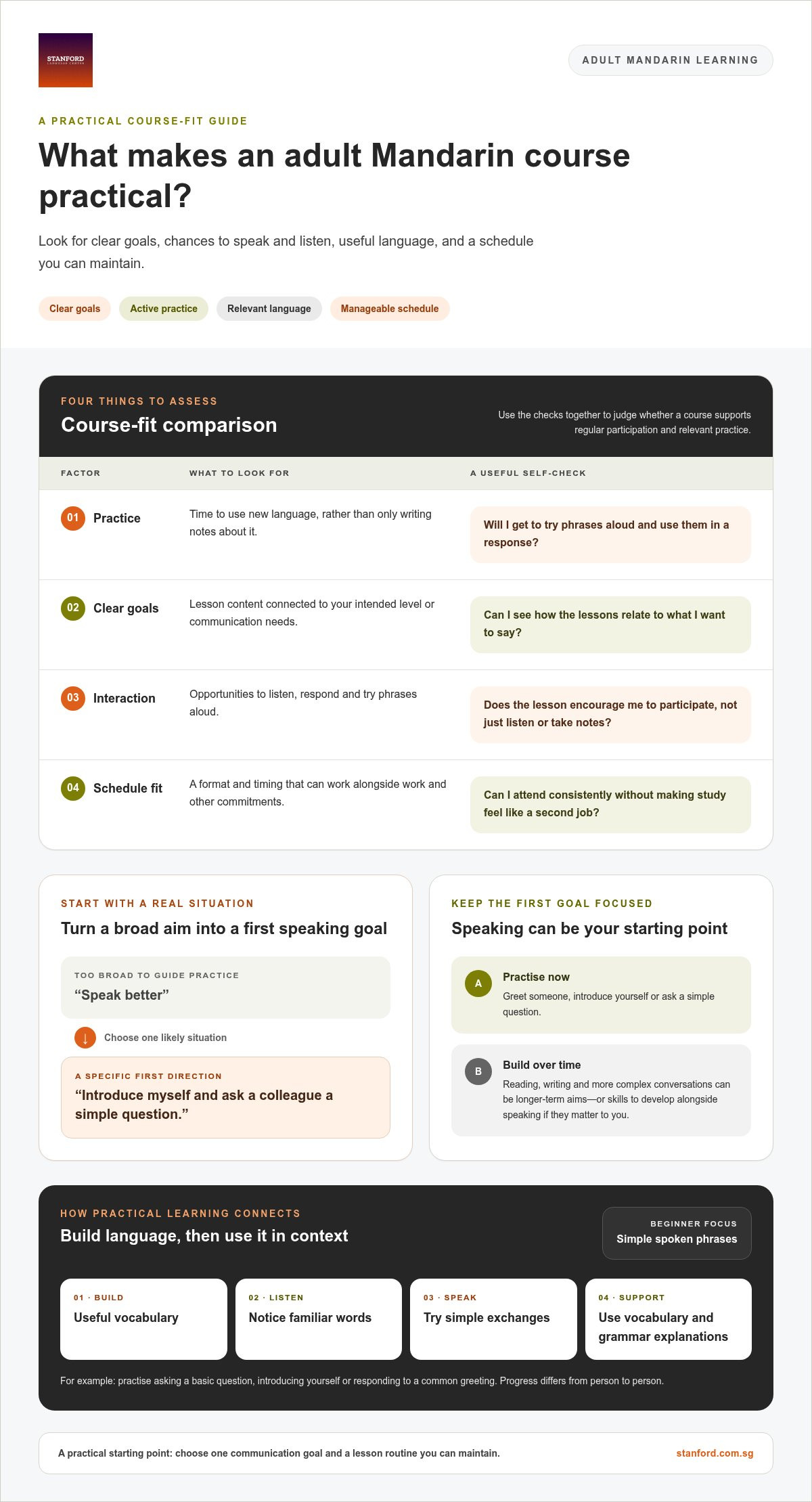
Practical learning builds step by step. You develop useful vocabulary, practise listening for familiar words and try simple spoken exchanges. You might work on asking a basic question, introducing yourself or responding to a common greeting. Vocabulary and grammar explanations support these exchanges, while using phrases in context helps you practise communicating. Regular attendance and practice keep learning active, though progress differs from person to person.
Before comparing classes, choose one realistic communication goal. It gives you a concrete way to judge whether a course’s lesson focus and format suit what you want to practise.
How can you set a useful first learning goal?
Think of situations where you want to use Mandarin, then describe one task you could practise. “Speak better” is difficult to measure. “Introduce myself and ask a colleague a simple question” gives you a clear first direction. Your goal could relate to daily life or a work interaction. It doesn’t need to cover every situation you might encounter.
- Choose an immediate speaking aim: for example, greet someone, introduce yourself or ask a simple question.
- Keep broader ambitions separate: reading, writing and handling more complex conversations can be longer-term aims.
- Make it personal: choose a situation you’re likely to encounter, so new phrases have a clear use.
A specific first goal gives you a starting point without limiting what you can learn later. For more ideas on everyday speaking situations and building conversational skills, explore this conversational Mandarin guide. Once you know what you want to say first, you’ll have a clearer basis for comparing learning approaches.
What Makes an Adult Mandarin Course Practical and Effective?
A practical adult Mandarin course helps you use what you’re learning, not just recognise it on a page. Vocabulary and grammar explanations provide building blocks. Listening and speaking activities help you put them together, notice what you understand and identify where you need more practice. That balance matters if your reason to learn chinese singapore is to communicate in everyday situations.
A practical adult Mandarin course combines clear goals, active speaking and listening practice, useful language, and a schedule you can maintain.
Use this checklist to assess whether a course could fit:
- Practice: Lessons give you time to use new language, not only write notes about it.
- Clear goals: You can see how lesson content relates to your intended level or communication needs.
- Interaction: Learners have opportunities to listen, respond and try phrases aloud.
- Schedule fit: The format and timing are manageable alongside work and other commitments.
No single checklist item guarantees a particular result. Taken together, they help you judge whether the course supports regular participation and relevant practice.
Does the course give learners opportunities to speak?
Speaking practice gives you a chance to recall new words and phrases and use them in a response. For example, a guided exchange might involve listening to a short prompt, choosing a suitable phrase and saying it aloud. Activities vary, so look for a lesson environment that encourages participation instead of relying only on listening or note-taking. Explanations matter too, but practice helps connect them with communication.
Consider how you prefer to take part. Some learners feel comfortable trying phrases in a group; others prefer more individual speaking time. In either format, look for opportunities to engage with the language, listen closely and try a response without expecting every sentence to be perfect.
How should lesson goals connect with everyday use?
Before choosing a course, write down a few situations that matter to you. These might include making a straightforward request, understanding a familiar question or sharing basic information at work. Choose a small number to start. Specific situations help you identify relevant words and responses, and give practice a clear purpose.
Keep near-term communication needs distinct from wider ambitions, such as reading more comfortably or speaking about a broader range of topics. You can build towards those over time. A Mandarin Level 1 adult guide can help you think about a beginner’s starting point and how foundational learning relates to practical use.
When a course’s goals connect with situations you recognise, practice has a clear purpose and can be easier to sustain. Stanford Language Centre offers adult Mandarin lessons in group, private and online formats. Explore the adult Mandarin learning options and compare them with your goals and routine.
Group, Private, or Online: Which Mandarin Learning Format Fits?
The right format is one you can attend, participate in and practise with regularly. Group lessons offer a shared learning rhythm, private lessons focus on one learner, and online lessons let you join remotely. Each supports adult Mandarin learning in a different way. Compare the trade-offs below against your schedule, preferred level of interaction and study habits. For a broader comparison, see this guide to the best Mandarin classes for adults in Singapore.
Small group
Interaction: Shared activities and peer practice.
Flexibility: Follow a group schedule.
Routine: A regular class rhythm can help you stay engaged.
May suit you if: You enjoy learning alongside others.
Private, one-to-one
Interaction: Direct attention from the trainer.
Flexibility: Choose a suitable time and location.
Routine: Arrange learning around your individual needs.
May suit you if: You prefer a more individual setting.
Online
Interaction: Learn remotely with a trainer.
Flexibility: Join online rather than attending in person.
Routine: Consider whether remote lessons fit your usual study habits.
May suit you if: You prefer learning from home or another suitable location.
When might a small group suit an adult learner?
A small group can make learning social and interactive. Shared activities give you opportunities to listen to other learners and practise taking turns in a conversation. This can suit you if you like a shared pace and the experience of learning alongside others. Stanford Language Centre’s group classes are relaxed and interactive, with Free make-up when available. Group lessons may be less suitable if you want the session to focus entirely on your individual questions.
When might private or online lessons be a better fit?
Private lessons may suit you if you value individual attention or prefer a format shaped around your learning needs. Stanford Language Centre’s private Mandarin lessons are one-to-one, with flexible timing and a location chosen by you. Online Mandarin lessons are another option if remote learning fits your routine. Consider whether you focus well through a screen and feel comfortable practising speaking online.
Think beyond the lesson itself. A class that fits your calendar is easier to attend consistently, while a comfortable format can make it easier to participate. If you want to learn chinese singapore, compare options against your real constraints: how you prefer to interact, where you can learn and what routine you can maintain.
Stanford Language Centre offers adult Mandarin lessons in group, private and online formats, with in-person learning also available. For more guidance on getting started as an adult, the Mandarin school Singapore guide for adult learners can help you consider which approach fits your needs.
How to Build Steady Mandarin Progress Between Lessons
Lessons introduce language and give you a place to practise it. A simple routine between classes helps keep new words and phrases familiar, so you can return to them rather than starting from scratch each time. Practice doesn’t need to take over your week. Short, regular sessions can be easier to maintain around work and personal commitments than an ambitious plan that is hard to follow.
Consistent practice complements structured lessons by helping useful language stay familiar and easier to revisit.
Try this repeatable sequence after a lesson:
- Review: Look back at a few new words or phrases and recall the situation in which you used them.
- Listen: Revisit lesson material and listen for language you recognise.
- Speak aloud: Repeat useful phrases, then try saying them without looking at your notes.
- Revisit: Mark any phrase that still feels difficult and bring it back into your next practice session or class.
Keep the routine manageable. The aim is to engage with Mandarin again, not to test yourself until every phrase feels perfect.
What can you practise after each Mandarin lesson?
Review new words while the lesson context is still fresh. Instead of copying a long vocabulary list, choose a few phrases you can imagine using. Say them aloud and notice what you remember and where you hesitate. Listening again can help you recognise familiar words in context. Make a brief note of questions, difficult phrases or situations you want to practise in your next class.
For example, write down a phrase you understood but couldn’t recall quickly, then note a conversation where it could be useful. That gives your next review a clear focus and turns “I need more practice” into a manageable next step.
How can busy adults keep learning manageable?
Attach practice to a routine that already exists, such as reviewing a phrase after class or listening during a regular break. Choose a small step you can repeat instead of relying on motivation to find a large block of study time. If a busy week interrupts your routine, restart with one familiar phrase rather than treating the gap as a failure.
Track progress against your own communication goals. You might notice that you recognise a familiar question more easily, say a phrase with less hesitation or feel more comfortable attempting a simple exchange. These are useful signs to reflect on, not deadlines or guarantees of fluency.
If you’re searching for “learn chinese singapore,” a manageable practice habit can connect course learning with your personal goals. Explore adult Mandarin learning options at Stanford Language Centre and choose a format that supports regular participation.
Learn Chinese with Stanford: Find an Adult Mandarin Course That Fits
Once you have a learning goal and an idea of how you prefer to study, choose a format that fits your routine. Stanford Language Centre offers adult Mandarin learning through group, private, intensive and online lessons. Lessons are available in person or online, so you can consider both the learning style and where you prefer to take part.
Which Stanford Mandarin course format may suit your goals?
Each option provides a different way to structure your learning. A group class may suit you if you enjoy a relaxed, interactive setting and learning alongside others. Group classes include Free make-up when available. Stanford also offers specialised small-group Mandarin classes for Japanese and Korean speakers.
Private Mandarin lessons are one-to-one, with flexible timing and a location chosen by you. They may suit you if you want individual attention. Online lessons let you learn remotely, while in-person lessons offer a classroom setting. Intensive lessons provide a more concentrated course format. Choose according to the routine you can maintain and the type of interaction that helps you participate.
For a defined starting structure, Stanford Language Centre’s 10-Lesson Basic Mandarin Course consists of 10 lessons over 2 months. The course is designed for conversational Mandarin and gives you a clear timeframe to consider as you plan around other commitments. A course structure provides a starting point for learning, while your progress depends on your participation and practice.
If you’re exploring ways to learn chinese singapore, focus on the support and schedule that feel workable now. You can refine your goals as you gain experience with the language.
What is the next step for joining a course?
Start with the adult Mandarin course overview and compare the options with your preferred way to learn. If you’re still weighing formats, list what matters most: a shared class environment, one-to-one attention, remote learning or a more concentrated schedule. That short list can make your decision clearer.
Pricing is available on request. For current pricing and course details, contact Stanford Language Centre at 9737 9914 or 9656 2095, or email info@stanford.com.sg. You don’t need to have every long-term goal mapped out before you begin. A suitable first course gives you a practical place to start and room to build on your learning.
Take Your First Mandarin Step
You don’t need to map out every stage of learning before you begin. Choose one conversation you’d like to feel more comfortable having, then consider what would help you practise regularly. That gives you a personal starting point, not a deadline.
A search for “learn chinese singapore” can bring up many possibilities, but your next step can stay simple: explore the learning approach that feels manageable now. Your aims may grow as you gain experience, and you can adjust your practice along the way.
Stanford Language Centre’s adult Mandarin options support different goals and preferences, with native trainers and a focus on effective practice. Review the course details, consider what fits your routine and request current pricing if you’d like to know more.
Explore adult Mandarin courses with Stanford Language Centre. Choose a format that fits your schedule and take the first step towards practising Mandarin.
Frequently Asked Questions
How much does it cost to learn Chinese with Stanford Language Centre?
Course pricing is available on request. Compare the formats that fit your learning goals, then contact Stanford Language Centre for current details. If you’re planning to learn chinese singapore, call 9737 9914 or 9656 2095, or email info@stanford.com.sg.
Can eligible corporate groups receive an SSG Training Grant for Mandarin training?
Eligible corporate groups may qualify for an additional Training Grant from Singapore SkillsFuture (SSG) for Mandarin training. Eligibility applies, so the grant is not automatic for every company or course. Corporate training is tailored to business communication needs, and eligible groups may receive the grant in addition to a special corporate rate.
Is Stanford’s Mandarin course NTUC UTAP claimable?
Stanford offers NTUC UTAP-claimable Mandarin classes. Claims are subject to the current UTAP eligibility rules and conditions, which may apply to both the learner and the course. Review the current requirements to understand your eligibility and any steps involved in making a claim.
What happens if I miss a Stanford group Mandarin class?
Group classes include Free make-up when available. A make-up session depends on availability, so it isn’t guaranteed for every missed class. Keep track of the lesson topic and new phrases so you can review them and stay connected to the course.
Can I take Stanford Mandarin lessons if I do not live in Singapore?
Yes. Stanford Mandarin lessons are available online as well as in person, so you can join remotely if you live elsewhere. Consider whether online learning suits your routine and preferred way to practise, then choose the course format that aligns with your goals.
Does Stanford Language Centre offer Chinese lessons for children?
Stanford Language Centre’s Mandarin learning options are for adults. This guide covers adult courses, including group, private and online learning. If you’re an adult starting Mandarin, think about the situations you want to handle and the kind of practice that would help. A clear personal goal can make it easier to choose a suitable learning format.