What if learning Mandarin for healthcare workers in Singapore could fit around your shifts, rather than forcing your schedule to fit a class? Private lessons offer a flexible way for doctors and other healthcare professionals to build practical language skills. Most practitioners reach functional proficiency for basic medical interactions within 30 to 40 hours of structured learning.
It’s understandable to want more than textbook phrases. At work, you may need to greet patients, ask about symptoms and understand everyday health concerns, while fitting study around demanding shifts.
This guide explains how private classes can suit changing schedules, what course hours involve and what basic progress may look like. You’ll also find examples of conversational Mandarin and specialty vocabulary, plus ways to focus learning on the situations you encounter in healthcare. The aim is a clear, practical picture of how to get started and what you can work towards.
Key Takeaways
- Plan a realistic learning path around your current Mandarin level and the patient interactions you handle most often.
- See how course structure and private lesson formats can help make learning workable alongside changing shifts.
- Prioritize clear, everyday questions and responses before adding vocabulary for specific health concerns.
- Use focused practice to build confidence with greetings, symptom questions, and the language needed in your clinical setting.
- Explore small-group Mandarin options designed for adult learners, including expats and Japanese or Korean speakers.
How long does it take to become proficient in basic medical Mandarin?
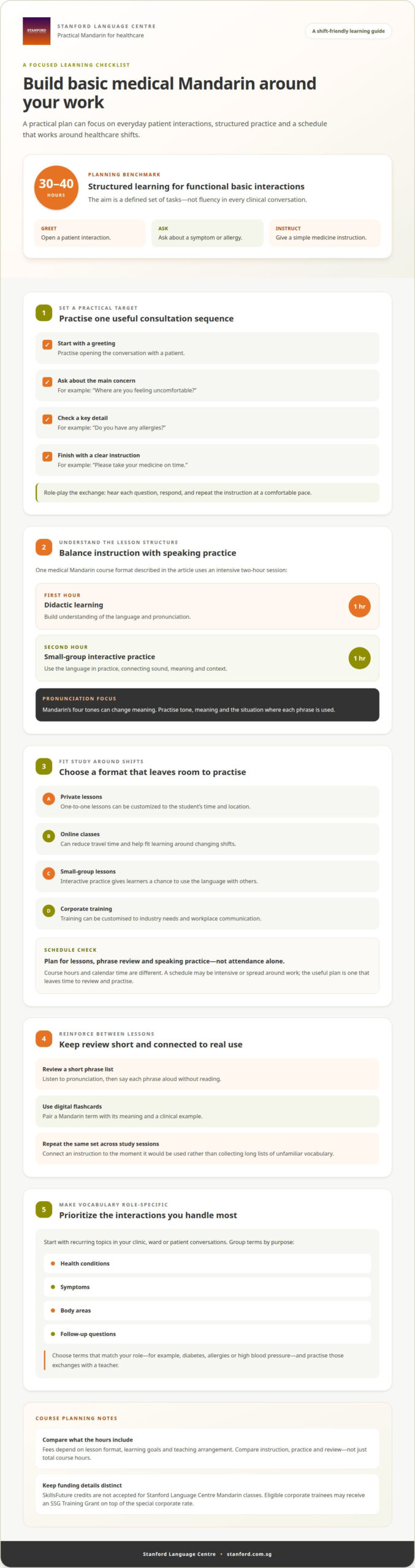
A practical benchmark is 30 to 40 hours of structured learning for functional proficiency in basic medical Mandarin interactions. That means practising a defined set of tasks, not becoming fluent in every clinical conversation. For example, a learner may work towards greeting a patient, asking about a symptom, and giving a simple medicine instruction. This timeframe gives healthcare workers a planning guide, while the learning focus determines what they can do at the end.
Consultation language connects short questions with clear responses. Practise a sequence that starts with a greeting, moves to the patient’s main concern and checks a key detail. For example, ask “Where are you feeling uncomfortable?” followed by “Do you have any allergies?” Then practise an instruction such as “Please take your medicine on time.” Role-play lets you hear each question, respond and repeat the instruction at a comfortable pace.
Structured training can make those exchanges easier to recall under pressure. A medical Mandarin course described in the research uses an intensive 2-hour format: the first hour focuses on didactic learning, and the second hour uses small-group interactive practice. It also emphasizes Mandarin’s four tones, which can change meaning. For healthcare providers, practice should connect sound, meaning, and the context in which a phrase is used.
Self-directed study can reinforce classwork between lessons. Review a short phrase list, listen to the pronunciation, then say each phrase aloud without reading. Digital flashcards can pair a Mandarin term with its meaning and a clinical example. Connect an instruction to the moment it would be used, then review the same set across several study sessions. This makes practice more focused than collecting long lists of unfamiliar vocabulary.
Workplace training can make language learning relevant to a team’s daily communication. A session might use a sample consultation, practise questions about symptoms and rehearse clear instructions. Stanford Language Centre provides corporate Mandarin training that can be customised to industry needs. Private lessons offer focused one-to-one practice. In either format, realistic scenarios give learners time to repeat and refine their wording.
Focused vocabulary practice can connect learning to a healthcare worker’s role. Someone who often discusses diabetes may prioritize that term, while another learner may focus on allergies or high blood pressure. List common patient questions and instructions for your role, then practise those exchanges with a teacher. This keeps basic Mandarin learning connected to workplace interactions.
Medical Chinese course hours and scheduling
Course hours and calendar time are different things. A medical Chinese course may concentrate teaching into an intensive session, while shift workers may prefer lessons spread around work. For example, a nurse on rotating shifts could plan practice between sessions, while a doctor with a fixed clinic roster might choose a recurring time. The useful schedule is the one that leaves room to review phrases and practise speaking, not just attend class.
Before choosing a format, match your learning goal to the time you can study. List the communication tasks that matter, such as asking about symptoms or giving a simple instruction. Then consider whether private lessons, a small group, online classes or corporate training best suits your circumstances. Structured lessons introduce language and pronunciation, while interactive practice gives you a chance to use them. Leave time for review too.
Online lessons can reduce travel time and make it easier to fit learning around changing shifts. A learner can join from home after work, then review the class material before the next session. Online Mandarin classes provide one format to consider when scheduling matters. For a useful online session, set a specific goal beforehand, such as practising a patient greeting or rehearsing a symptom question, and keep notes for later review.
Course fees depend on the lesson format, learning goals, and teaching arrangement; pricing is provided after a quote request. Compare the structure of each course, not just its total hours. An intensive course and a longer learning plan may allocate time differently between instruction, practice, and review. For healthcare workers, the relevant consideration is whether the scheduled lessons give enough attention to the medical situations they need to discuss.
SkillsFuture credits are not accepted for Stanford Language Centre’s Mandarin classes. For budgeting, keep individual course fees separate from corporate funding: eligible corporate trainees may receive an SSG Training Grant on top of the special corporate rate. Do not assume that a course qualifies for funding simply because it is taught in Mandarin or relates to workplace skills.
Private Mandarin lessons are one-to-one and customized to the student’s time and location. Identify work commitments that regularly change, then discuss a lesson arrangement that leaves space for practice. Online Mandarin classes are also available. A workable timetable makes steady learning possible without turning each lesson into a rushed add-on.
Specialty-specific vocabulary
Specialty vocabulary is most useful when it connects a patient’s concern with a clear, relevant question. A healthcare worker in Singapore might prioritize terms used in their clinic, ward, or patient conversations. Start with recurring topics, then group words by purpose: health conditions, symptoms, body areas, and follow-up questions. This makes the vocabulary easier to retrieve during speaking than a long, mixed list of Chinese language terms.
Four useful condition terms are 糖尿病 (táng niào bìng), meaning “diabetes”; 过敏 (guò mǐn), meaning “allergies”; 中暑 (zhòng shǔ), meaning “heatstroke”; and 高血压 (gāo xuè yā), meaning “high blood pressure.” These examples cover distinct health topics, so learners can practise recognizing each term in context. Pairing a term with a short question or patient response helps connect vocabulary knowledge to a real exchange.
Build a small vocabulary set around one consultation task. For example, if you need to discuss allergies, practise 过敏 (guò mǐn) alongside the question “Do you have any allergies?” For stomach-related concerns, connect 胃 (wèi), meaning “stomach,” with a question about discomfort. The aim is to recognize terms when listening and use them accurately when speaking, not merely memorize isolated words.
Organize specialty vocabulary in three columns: Mandarin term, English meaning and a short example. Keep related terms together. A set about health conditions could include diabetes, high blood pressure and heatstroke. Another might focus on body areas, such as 胃 (wèi), or familiar symptoms. Reviewing one category at a time makes gaps in your vocabulary easier to spot.
Practise each term with a short routine. First, read the Mandarin term and its pinyin aloud. Next, cover the English meaning and recall it. Then use the word in a complete question or response. For example, move from recognizing 高血压 (gāo xuè yā) to asking a relevant question in a role-play. Include listening practice so you can recognize the term when someone else says it, not only when reading.
Specialty coaching can adapt practice to the learner’s role and common patient interactions. A clinician can bring a set of recurring topics, then practise a focused exchange with a language teacher. One session might centre on condition terms; another might work on linking those terms to questions and instructions. Keep the practice within the learner’s language goals, and use clinical judgment for diagnosis, treatment, and patient-care decisions. A focused vocabulary plan helps make each learning session purposeful.
Basic conversational Mandarin for healthcare professionals
For healthcare workers in Singapore, practice can start with a greeting and a clear introduction in Mandarin. Learn how to say “Hello” and “I am the doctor,” then practise both aloud. Pay attention to Mandarin’s four tones, as clear pronunciation helps patients follow the conversation. Use a calm pace and familiar wording to explain the purpose of an exchange before asking for information. This is a practical starting point for Mandarin for healthcare workers Singapore.
Next, practise opening a conversation about a patient’s main concern. Learn the Mandarin question meaning “Where are you feeling uncomfortable?” It gives the patient a simple way to describe a problem. Take turns as clinician and patient, then repeat the exchange with different responses. This builds listening and speaking skills around a consultation step, rather than relying on memorized lines alone.
Questions about allergies and medication call for careful listening. Practise asking “Do you have any allergies?” and “What medications are you taking?” separately, then use them in a short role-play. Pause after each question, listen to the answer, and repeat or clarify key information in simple language. This helps you focus on understanding a response, not just delivering a question.
Symptom vocabulary can help you follow familiar answers. Learn the Mandarin words for fever, cough, dizziness and the common cold. Add terms for body and head, then practise recognizing each one when spoken before using it in a question. Grouping words by the kind of answer they may help identify makes them easier to use in conversation.
Use a simple practice sequence: listen to a phrase, repeat it aloud, then use it in a brief exchange. For example, introduce yourself and follow with a symptom question. A teacher can model pronunciation and point out tone differences. Short, repeated exchanges help you retrieve phrases in conversation, while reading a list alone provides less speaking practice.
Keep a practice sheet organized around tasks in the learner’s work setting. The article recommends listing the 50 most common phrases used in a ward. Sort them by purpose, such as greeting, asking about symptoms, or discussing medication history. Review one category at a time and practise it aloud through role-play. This makes Mandarin for healthcare workers in Singapore more focused on useful conversations. These phrases support basic exchanges, but they don’t replace professional interpretation when communication becomes more complex.
Mandarin for healthcare workers and trainees in Singapore
Mandarin can support patient communication, but it serves a different purpose from clinical training. There is no single Mandarin proficiency threshold that applies to every healthcare role in Singapore. The useful level depends on the conversations you need to manage, such as greetings, symptom questions or basic care instructions.
Singapore’s population makes this skill relevant in patient-facing settings. By June 2025, residents aged 65 and over represented 18.78% of the population. Mandarin is also described as the heart language for nearly 30% of Singapore’s population. These figures offer context, not a measure of any individual patient’s language preference. Workers should establish which language a patient understands rather than assume from age or background.
For trainees, a practical learning plan starts with common communication tasks. Practise a greeting, an introduction and a question about a patient’s concern. Then add terms relevant to your placement, such as allergies or medication. A trainee in a ward could rehearse how to ask about family history: “家族有遗传病吗?(jiā zú yǒu yí chuán bìng ma?)” means “Is there any family history of hereditary diseases?” Pair each phrase with a realistic scenario to practise listening and speaking together.
Are there Mandarin proficiency requirements for healthcare workers in Singapore? Mandarin is a practical communication skill, and the level needed depends on the role and patient interactions. It does not replace clinical qualifications or professional judgment.
Which Mandarin qualifications or certificates are useful for healthcare workers in Singapore? A course completion certificate can document language study, while a practical demonstration can show how well someone handles relevant conversations. Choose learning that includes speaking and listening practice, not only written vocabulary or grammar exercises.
Workplace learning can connect language practice to a team’s routines. A session might use a sample patient interaction, then let staff practise asking and responding in Mandarin. Trainees can focus on communication expected during placement, while experienced workers can prioritize recurring conversations. Mandarin’s four tones matter too: practise pronunciation so spoken words are clear and distinguishable.
The main takeaway is to match learning goals to patient-facing tasks. Start with basic exchanges, then build vocabulary around your workplace and responsibilities. Mandarin can help open a conversation, but understanding each patient’s needs still requires attentive listening and appropriate clinical care.
Stanford Language Centre: Professional Adult Chinese learning in Singapore
Stanford Language Centre offers adult Chinese learning in Singapore for people building practical Mandarin skills. Healthcare workers can strengthen everyday conversation through structured language learning and focus their practice on workplace situations.
Small-group options include Mandarin classes for expats and foreigners, Japanese speakers, and Korean speakers. These classes offer a shared learning setting for adults to build foundational skills and practise speaking Mandarin.
If you’re ready to explore adult Mandarin learning in Singapore, contact Stanford Language Centre.
Choose a Practical Next Step
Turn your interest in Mandarin for healthcare workers Singapore into a learning goal that fits your role. Choose one communication need to focus on first, such as welcoming patients, asking a clear question or understanding a familiar response. A defined starting point directs practice towards conversations that matter in your work, instead of trying to learn everything at once.
As you consider your next step, think about how you learn best and what you want to practise. You might prefer a structured class or a setting where you can speak with other learners. Bring your preference and learning goal to a conversation about adult Mandarin learning.
For a friendly discussion about learning options, contact Stanford Language Centre. Start with one useful goal, then build your Mandarin skills steadily from there.
Frequently Asked Questions
Are there private classes available for doctors with unpredictable shift patterns?
Yes. Private Mandarin lessons are one-to-one and customized to the student’s time and location. This can suit doctors with changing work schedules, because lessons are arranged individually rather than around a fixed group timetable. Share your learning goals and preferred study arrangements when discussing lessons, and focus practice on patient-facing conversations relevant to your role.
Will I learn how to write Chinese characters, or is the focus on speaking?
Adult Mandarin courses focus on foundational conversational skills, with speaking and listening as central priorities. For a healthcare goal, practise saying questions clearly, recognizing spoken responses and using relevant phrases in role-play. Character writing is a separate focus from conversational practice. Set spoken communication as your priority when choosing learning activities and reviewing course materials.
What Mandarin courses for healthcare workers are available in Singapore?
Options include private Mandarin lessons, small-group adult classes, online Mandarin classes and corporate Mandarin training. Choose based on whether you want individual practice, a group learning environment or workplace training. Corporate programs can be customized to industry needs. These are Mandarin learning formats, not a claim that every class follows a dedicated medical syllabus.
Which Singapore providers offer medical Mandarin training for healthcare staff?
Stanford Language Centre offers adult Mandarin learning and corporate Mandarin training that can be customized to industry needs. Corporate training can suit organizations seeking language learning for staff in medical settings. The centre also provides private and group Mandarin lessons. These options support practical language development, but they are not clinical training or a professional interpreting service.
What Mandarin vocabulary and patient-care scenarios do healthcare courses cover?
Useful practice can connect health terms with realistic conversations. For example, practise recognizing vocabulary related to food poisoning or dehydration, then use role-play to ask about a patient’s concern and understand a response. A course plan can reflect your department and common interactions. Language practice supports communication, while clinical assessment and care remain part of the healthcare professional’s role.
How much do medical Mandarin courses in Singapore cost, and are subsidies available?
Course fees depend on the learning arrangement, and pricing is provided after a quote request. Stanford Language Centre’s Mandarin classes are NTUC UTAP claimable; SkillsFuture credits are not accepted. Eligible corporate trainees may receive an SSG Training Grant on top of the special corporate rate. These funding routes differ, so distinguish an individual course claim from workplace training support when planning.
How long are healthcare Mandarin courses, and what are the class schedules and formats?
Basic Mandarin packages consist of 10 lessons over 2 months, with in-person and online learning formats available. Private lessons are one-to-one and customized to the student’s time and location, which can help fit study around changing shifts. A specific medical course may use a different structure, so distinguish the general adult Mandarin package from a healthcare workplace training plan when considering schedules.