Tone pairs make Mandarin pitch easier to hear than practising isolated tones alone. To learn how to differentiate Chinese tones for Korean ears, listen for the pitch movement across two syllables, then identify and compare the pair. Mandarin has four main tones and a neutral tone, so focus on each tone’s direction and how it sounds beside another.
It’s understandable if the tones are hard to separate at first. Korean pitch and intonation work differently from Mandarin tones, and simply hearing Chinese in the background may not make the contrasts clear. Focused listening gives your ear a specific task: identify the pitch pattern instead of letting the sound pass by.
This guide explains how active listening, simple hand gestures, and tone-pair practice can help you recognise Mandarin pitch patterns and follow spoken Chinese with more confidence. You’ll also learn how Korean pitch habits can affect what you hear, why tones matter in real words, and how structured practice can build clearer listening skills.
Key Takeaways
- Train your ear with focused listening and clear choices between pitch patterns, rather than relying on background exposure alone.
- Recognise how Mandarin’s tones can change a syllable’s meaning, making pitch an important clue when you listen to spoken Chinese.
- Use simple hand movements to make each tone’s pitch direction easier to notice and remember.
- Practise tone pairs to hear how two syllables work together, including patterns that may sound different from isolated tones.
- Compare Mandarin’s tone contours with Korean pitch habits to spot which listening patterns may need extra attention.
Why active ear training helps learners distinguish Mandarin tones
Korean speakers may confuse Mandarin tones because Korean pitch and intonation patterns don’t mark words in the same way. Learning how to differentiate Chinese tones for Korean ears means listening for the pitch movement on each syllable, not just the overall melody of a phrase.
Pitch Differences That Distinguish Words
In Mandarin, a tone is the pitch pattern attached to a syllable, and changing it can change the word’s meaning. Mandarin has four main tones, high, rising, low, and falling, plus a neutral tone.
The same consonant and vowel can represent different words when pronounced with different tones. Listen to the syllable itself, then notice whether its pitch stays level, rises, stays low, or falls. This distinction helps you identify words more accurately in a sentence, even when the surrounding vocabulary is unfamiliar.
Active Listening and Tone References
Active listening gives your ear a clear task: hear a sound, choose its tone, then compare your choice with a reliable audio reference. This is more focused than playing Mandarin recordings passively while doing something else.
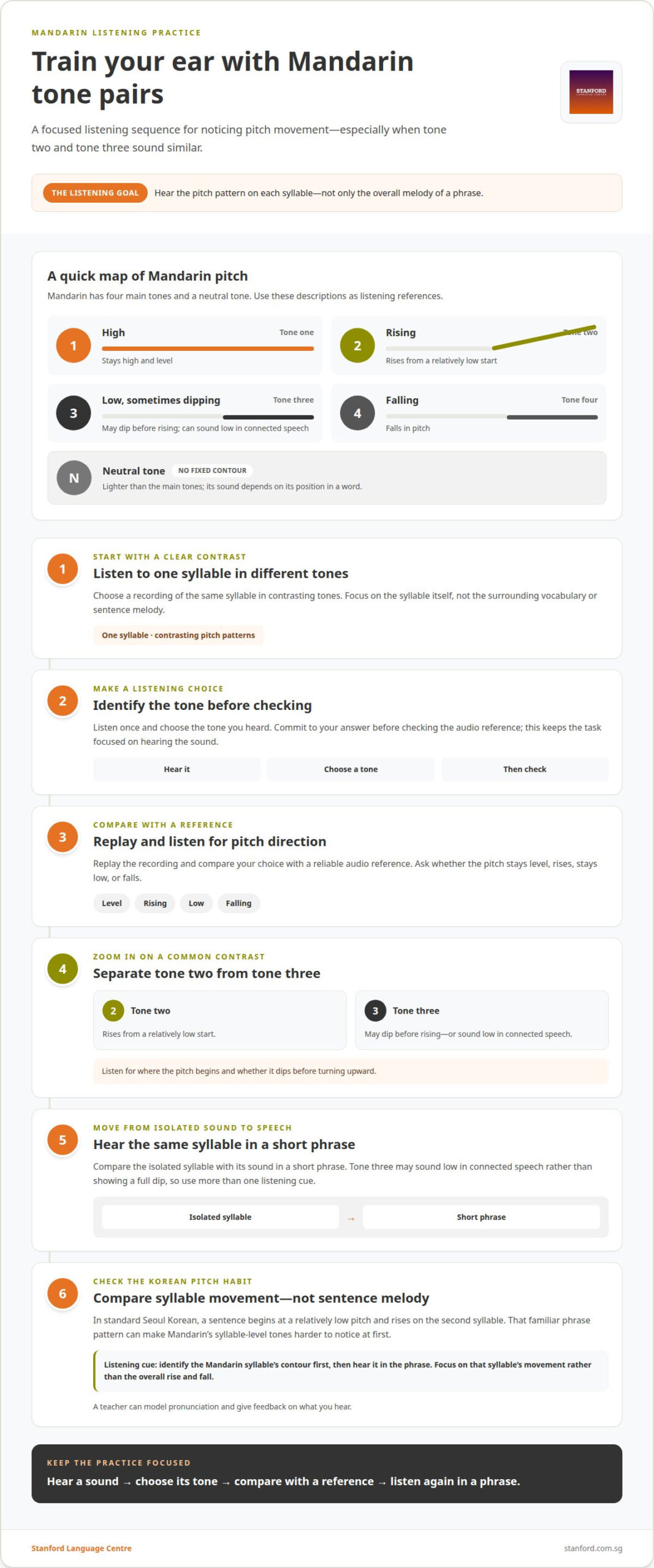
Start with a recording of one syllable in contrasting tones. Choose the tone before checking the answer, then replay the audio and listen for the pitch direction. Next, hear the same syllable in a short phrase. A teacher can model the pronunciation and give feedback on what you hear. This routine helps you connect a sound with its tone instead of guessing from the word’s meaning.
Tone Two and Tone Three
Tone two rises, while tone three is low and may dip before rising. Because both can include an upward movement, learners may miss where the pitch begins and how it changes.
Compare recordings of the same syllable in tone two and tone three. Ask whether the pitch rises from a relatively low start or dips before turning upward. Tone three may also sound low in connected speech rather than show a full dip. Comparing isolated syllables with short phrases gives you more than one cue for distinguishing the pair.
Mandarin Contours and Korean Intonation
In standard Seoul Korean, the first syllable of a sentence begins at a relatively low pitch, and the voice rises on the second syllable. That familiar phrase pattern can make Mandarin’s syllable-level tones harder to notice at first.
Korean vowels after tensed and aspirated stops also tend to have higher pitch than they otherwise would. Separate these pitch effects from the Mandarin tone by focusing on one syllable at a time. To practise how to differentiate Chinese tones for Korean ears, listen to a Mandarin syllable alone, identify its contour, then hear it in a phrase. Compare the syllable’s movement, not just the sentence’s overall rise and fall.
Why tone accuracy matters for understanding
In Mandarin, pitch is part of the information carried by a syllable, not just a feature of a speaker’s voice. Hearing the tone more accurately makes it easier to connect spoken words with their meaning and pronounce them clearly.
Mandarin has four main tones, high, rising, low, and falling, plus a neutral tone. A syllable can sound different when its tone changes, even if its consonant and vowel remain the same. Tone accuracy matters in sentences because listeners use the pitch pattern alongside surrounding words to understand meaning. The syllable inventory with tones is about three times larger than without them, showing how much distinction pitch adds.
Tone notation makes pitch differences visible. In Pinyin, marks appear above vowels: a macron represents tone one, an acute accent tone two, a caron tone three, and a grave accent tone four. The neutral tone is usually unmarked. Numbers can also indicate tone: a syllable may be written with a numeral from one to five, using a five-point scale where one is lowest and five is highest. Marks and numbers are references, not substitutes for hearing the sound.
Recognizing and Correcting Tone Problems
To identify a tone problem, compare the tone you hear or pronounce with a clear reference, then pinpoint the difference. This matters because a learner may know a word’s spelling but still mishear or produce its pitch.
Work with one syllable at a time. Listen to a recording, select the tone you heard, then replay it and compare your choice with the reference. For pronunciation practice, record yourself saying the same syllable and compare its pitch direction with the model. Feedback from a teacher or proficient speaker can point out whether the issue is the starting pitch, rise, or fall. Correct one feature, then practise the syllable consistently in a short phrase.
The Main Tones and Neutral Tone
The four main Mandarin tones follow distinct pitch patterns, while the neutral tone is lighter and depends on its position in a word. Learning to tell them apart matters because a correct consonant and vowel alone may not identify the intended word.
Use the tone mark or numeral as a reminder before listening, then focus on the sound itself. A tone one reference stays high; tone two rises; tone three is low; tone four falls. The neutral tone has no fixed contour like the other four. In a listening exercise, first identify the syllable, then decide which pitch pattern you hear. This separates sound recognition from guessing based on vocabulary.
For a practical check, keep a short record of the syllables that cause mistakes. Note the tone mark, your first listening choice, and any correction after replaying the reference. Reviewing your notes shows which contrasts need more attention and helps connect tone perception with clearer pronunciation. Immediate feedback is useful because it lets you correct a mistaken pitch pattern before repeating it across several words or sentences.
Hand gestures for practising pitch patterns
A hand gesture gives each Mandarin tone a visible path, helping you connect pitch movement with speech. Trace the sound as you listen, then repeat it aloud; the movement gives your attention a clear target beyond the written tone mark.
Keep the gesture simple and consistent. Hold your hand in front of you and move it with the pitch, not with the word’s meaning or volume. Represent the four main tones with four paths: level, rising, low, and falling. These movements are memory cues, not precise measurements of a speaker’s voice. Use the same direction each time so the patterns stay easy to distinguish.
- Tone one: move your hand horizontally to show a steady, high pitch.
- Tone two: sweep your hand upward to match the rising contour.
- Tone three: lower your hand to show the low part of its contour, adding a small upward turn when you hear one.
- Tone four: move your hand sharply downward to follow the falling pitch.
Practise with one recorded syllable at a time. First, listen without moving; on the second play, trace the contour; on the third, say the syllable while repeating the gesture. This three-pass routine separates listening from speaking, then connects them. If your hand rises during a tone-four recording, replay the audio and adjust the direction before repeating the word.
Gestures can also help with tone pairs. Draw the first tone, then continue directly into the second tone’s path without pausing between syllables. For example, a level movement followed by a downward movement gives your hand two distinct jobs. This visual sequence can make it easier to hear where one pitch pattern ends and the next begins in a short phrase.
Use the movement alongside audio references, not instead of them. A hand can show the direction you intend, but the recording lets you compare that intention with native pronunciation. After listening, check whether the spoken pattern and gesture match. If they differ, slow the audio and isolate the syllable that caused the mismatch.
Hand-gesture practice is estimated to take 2 to 3 weeks to show results. Treat that as a practice window, not a deadline. During each session, choose a small set of vocabulary, use the same gestures, and return to the audio after speaking. The goal is to connect pitch patterns with what you hear and say, rather than relying on an English spelling or meaning to guess the tone.
Learning tones through tone pairs
Tone pairs let you hear how pitch patterns connect across two syllables in Mandarin speech. Tone two versus tone three, and tone one versus tone four, are useful contrasts to practise when the sounds feel confusing.
Practising Mandarin Tone Pairs
A tone pair is a sequence of two syllables, each carrying a tone, such as first tone followed by fourth tone. Practising pairs matters because words and phrases rarely appear as isolated syllables in conversation.
Mandarin has 20 possible tone-pair combinations when the neutral tone is included, since the neutral tone can occur only on the second syllable. Use audio with the same syllables spoken in different pairs. First, listen and choose which pair you heard. Then check the answer and replay the recording, focusing on the pitch change between syllables.
Keep Pinyin or characters visible only after your first listening choice. That order helps separate what you hear from what you expect the word to mean. Run 20 forced-choice trials for one tone minimal pair, such as tone one versus tone four. Record each answer, then repeat the contrast if the pitch direction still feels unclear.
Challenging Tone Pairs for Korean Learners
Tone two and tone three can be difficult to distinguish because both may include an upward movement, while tone one and tone four require you to hear level versus falling pitch. These contrasts matter because a quick first impression can miss the contour that identifies the intended word.
For tone two and tone three, compare where the pitch begins and how it moves through the syllable. Tone two rises; tone three is low and may dip before rising. For tone one and tone four, listen for a steady high sound versus a sharp fall. Avoid judging only by how high the final pitch sounds.
Two third tones in sequence create another important pattern: the first is pronounced as a second tone. Practise that pair in a short phrase, then compare it with two separate third-tone references. This change shows why tone pairs need to be heard as connected speech, not just as written tone labels.
A compact practice routine keeps the listening task clear:
- Choose one contrast, such as tone two against tone three.
- Complete 20 forced-choice trials using recorded sounds.
- Review missed answers, then listen again before checking Pinyin or characters.
- Repeat the pair in a word or short phrase to hear it in speech.
Track the contrast that causes the most mistakes and return to it in later practice. This makes tone-pair work a focused way to learn Chinese listening patterns, rather than a matter of guessing from vocabulary alone.
How do Mandarin tone contours compare with Korean pitch and intonation?
Mandarin uses pitch contours to distinguish syllables, while Korean pitch patterns also shape how speech sounds. For Korean speakers, the key is noticing whether pitch belongs to a Mandarin syllable’s tone or to a Korean sentence pattern.
In standard Seoul Korean, a sentence begins with a relatively low first syllable, then the voice rises on the second. That familiar movement can influence what a Korean listener expects to hear. In Mandarin, by contrast, tone can distinguish one word from another, so the pitch movement on an individual syllable matters even as the sentence continues.
Listen for the size and location of the pitch change. In a Korean sentence, the rise from the first syllable to the second can create a phrase-level pattern. In Mandarin, focus on the contour within the syllable itself: does it stay high, rise, remain low, or fall? Separating these listening tasks helps prevent a sentence-wide rise from being mistaken for a rising Mandarin tone.
Consonants can also affect the pitch Korean speakers hear. In Korean, vowels following tensed and aspirated stops tend to be pronounced at a higher pitch than they otherwise would. This pitch shift is tied to the sound context, rather than serving as a Mandarin-style tone contrast. Compare syllables with different initial consonants carefully, so consonant effects don’t distract from the Mandarin contour.
Use this listening comparison with a recording that contains short syllables and sentences:
- Listen to a Mandarin syllable alone and mark whether its pitch stays level, rises, stays low, or falls.
- Replay the syllable inside a phrase and follow the same contour, rather than judging the whole sentence’s melody.
- Listen to a Korean sentence and notice the lower first syllable and rising second syllable.
- Compare the two recordings, asking whether the pitch movement belongs to one syllable or spans the phrase.
The distinction matters in conversation. If you treat every pitch change as sentence intonation, you may overlook a Mandarin tone; if you interpret every rise as a word tone, Korean sentence patterns may seem more tone-like than they are. Use the Mandarin syllable as your listening unit first, then widen your attention to the surrounding words. This helps you hear both the tone contour and the larger speech pattern without confusing their roles.
For extra practice, alternate a Mandarin syllable recording with a short Seoul Korean sentence. Describe the pitch direction in each before replaying them. This simple contrast helps make the two systems easier to distinguish while keeping your attention on what you actually hear.
Stanford Language Centre: Professional Adult Chinese learning in Singapore
Stanford Language Centre offers professional adult Chinese learning in Singapore, including a small group Mandarin class for Korean learners. If you want guided practice hearing tone pairs, pitch contours and spoken Mandarin, a class can help you work on these skills alongside other parts of the language.
The Korean-focused class is a natural next step if self-practice leaves you unsure whether you heard a rising tone, a low tone or a change across two syllables. Explore the Mandarin course options to see how structured learning can support your goals.
Contact Stanford Language Centre to discuss learning Mandarin as a Korean speaker.
Make Your Next Listening Session Count
Make tone practice a small, focused part of your Mandarin routine. Choose a short audio clip, listen for one contrast, and note what you hear before checking the reference. This habit can help you learn how to differentiate Chinese tones for Korean ears in real speech, not only in isolated drills. Keep the goal practical: understand the words around you and feel more prepared to join a conversation.
If structured learning would help you keep building those skills, Stanford Language Centre provides professional adult Chinese learning in Singapore, including small group Mandarin classes for expats and foreigners and for Japanese learners. These options support learners who want guided progress in a group setting.
Contact Stanford Language Centre to discuss your Mandarin learning goals. Keep listening, stay curious, and let each practice session bring you closer to confident communication.
Frequently Asked Questions
What are the four Mandarin tones and the neutral tone?
Mandarin’s four main tones are high-level, rising, low, and falling; a neutral tone is also used. In Pinyin, tone marks show these patterns above a vowel, while tone numbers offer another shorthand. For example, your notes might pair a written syllable with its tone mark and a short audio sample. This makes it easier to connect spelling with pronunciation during review.
What listening exercises help Korean speakers recognize Mandarin tones?
Use short, shuffled audio clips and choose the tone before looking at the answer. Include isolated syllables and familiar words, so you practise hearing pitch without relying only on memory. After each choice, replay the sound and note what helped you decide, such as a level start or a clear rise. Later, listen to the same words in short exchanges to practise recognising them in speech.
How can Korean learners practice producing Mandarin tones accurately?
Begin with a clear recording and copy one syllable at a time, matching its pitch movement rather than making the sound louder. Record your attempt, listen back, and compare the direction and shape with the model. Then say the syllable in a short phrase without stopping between every sound. Feedback from a teacher or proficient Mandarin speaker can help identify a specific adjustment, such as beginning higher or completing a fall.
What tone-pair drills and minimal-pair examples are useful for Korean speakers?
Use the same syllable recorded in two tones, then shuffle the clips and identify each one without seeing its label. Start with tone one versus tone four, then practise tone two versus tone three. For a focused drill, complete 20 listening choices for one contrast and review only the missed items. Keep the syllable constant where possible, so the changing pitch, rather than a different consonant or vowel, guides your answer.
How can Korean speakers use pitch graphs or tone marks to learn Mandarin tones?
A pitch graph gives a visual trace of how a voice moves during a syllable; tone marks provide a compact written reminder. Use both after listening: sketch or view the contour, then match it with the Pinyin mark. A numbered reference can also show relative pitch on a scale from 1 to 5. Treat the graph and mark as memory aids, and return to audio to hear the actual pronunciation.
What pronunciation mistakes do Korean learners make with Mandarin tones?
One common challenge is treating pitch mainly as sentence intonation, which can make a syllable’s tone less noticeable. Learners may also flatten a rising contour, let a falling tone rise at the end, or use a familiar Korean pitch pattern in place of the Mandarin one. Work on one contrast at a time. A recording of your own speech can reveal whether the pitch changes where you intended.
How long does it take Korean speakers to improve Mandarin tone recognition?
Two to four weeks of focused daily practice is a useful estimate for beginning to identify all four tones more reliably. It is not a deadline or a guarantee; familiarity with Mandarin, consistency, and the contrasts you practise all affect progress. Keep a simple record of your listening choices and review difficult pairs. Recognition can continue to improve as you hear tones in words, phrases, and natural conversation.