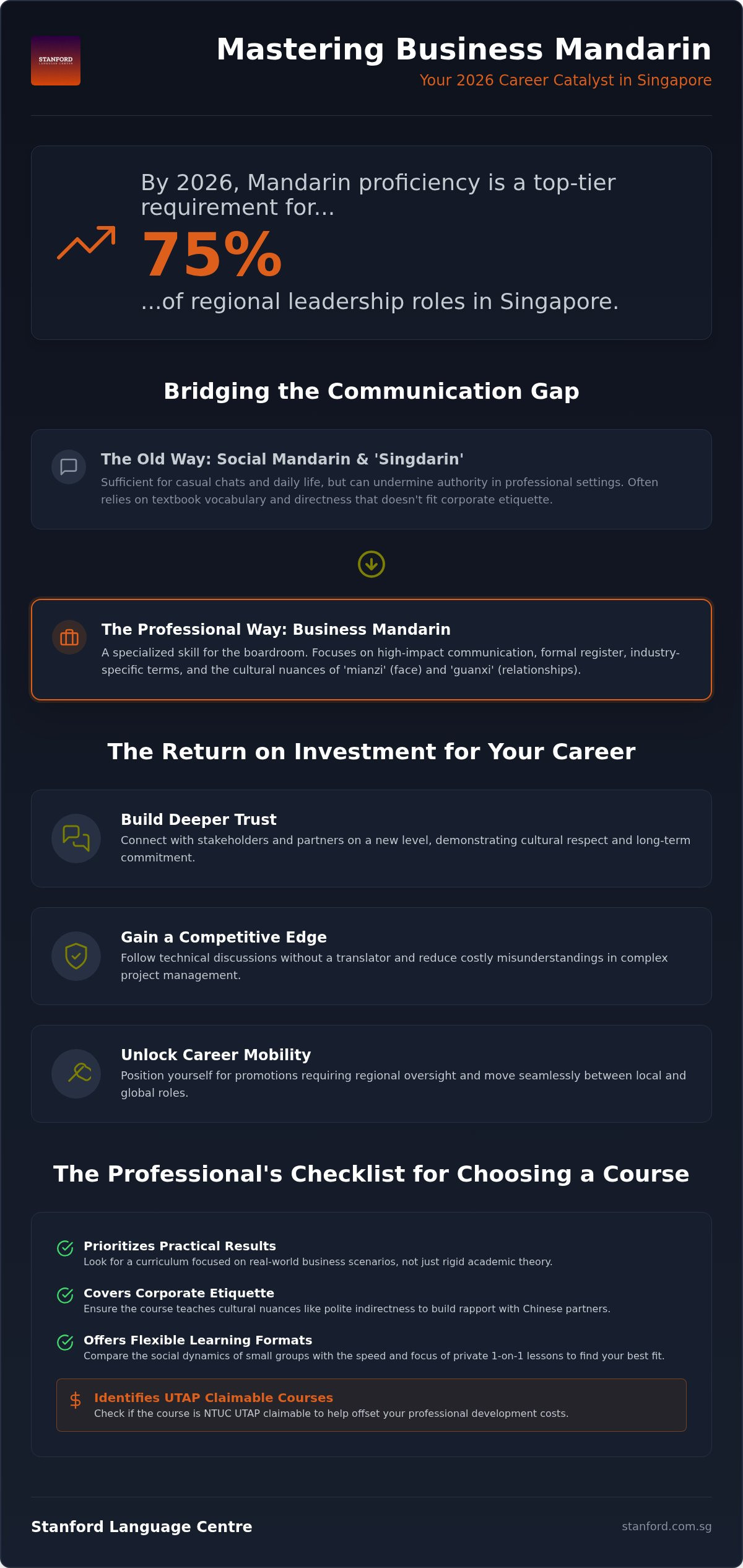
Did you know that by 2026, Mandarin proficiency is a top-tier requirement for 75% of regional leadership roles in Singapore? It’s a staggering figure that highlights a growing reality in our local market. You’ve likely felt that awkward gap yourself during a high-stakes meeting when the conversation shifts and you’re left relying on a translator. Most professionals want to connect more deeply with their partners, but they’re often held back by textbook vocabulary that just doesn’t work in a fast-paced boardroom. We know you’re busy. You need practical results, not a linguistics degree.
Finding the right Business Mandarin course Singapore has to offer means choosing a path that prioritizes high-impact communication over rigid academic theory. This guide is your roadmap to mastering professional Chinese with a pragmatic approach tailored specifically for Singapore’s corporate landscape. We’ll show you how to nail your first business introduction, navigate complex corporate etiquette, and even claim UTAP subsidies to keep your training costs low. It’s time to stop feeling left out and start leading the conversation with confidence.
Key Takeaways
- Transition from casual conversation to the formal, high-stakes communication style required for Singapore’s 2026 trade landscape.
- Understand the nuances of professional etiquette, including when to use polite indirectness to build rapport with Chinese partners.
- Choose the most effective learning format by comparing the social dynamics of small groups with the speed of private 1-1 lessons.
- Learn how to identify a Business Mandarin course Singapore that is NTUC UTAP claimable to help offset your professional development costs.
- Use our professional checklist to find schools that prioritize practical, real-world results over intimidating academic theory.
Why a Business Mandarin Course in Singapore is Your 2026 Career Catalyst
Singapore’s economy is more intertwined with regional trade than ever before. By 2026, the city-state has solidified its position as the primary hub for Greater China trade, making effective communication a non-negotiable skill. Mandarin is one of the four official languages of Singapore, but there is a wide gulf between daily conversation and professional excellence. Many of us rely on ‘Singdarin’ for casual chats. While that works at a coffee shop, it can undermine your authority in a high-stakes meeting. Professionalism requires a shift in tone, vocabulary, and delivery.
Proficiency in Mandarin acts as a powerful soft power tool. It isn’t just about translating words. It’s about demonstrating cultural respect and a deep commitment to your business partners. When you can follow a technical discussion without a translator, you gain an immediate competitive advantage. In the 2026 job market, bilingualism isn’t just a “nice-to-have” on a resume. It’s a core requirement for anyone aiming for regional leadership roles.
The ROI of Language Skills for Professionals
Investing your time in a Business Mandarin course Singapore provides a clear return on investment. You’ll notice the difference during client dinners or late-night negotiations. These are the moments where trust is built and deals are sealed. When you speak the language of your partners, you integrate into regional teams faster. You’re no longer the outsider waiting for a summary. You become the person driving the project forward. This skill set ensures long-term career mobility, allowing you to move seamlessly between local firms and global MNCs that prioritize regional expertise.
- Build deeper trust with stakeholders during informal networking.
- Reduce misunderstandings in complex project management.
- Position yourself for promotions that require regional oversight.
Singapore’s Unique Business Mandarin Landscape
Our workplace culture is unique. We often navigate a fluid mix of English and Mandarin throughout the day. However, standard conversational skills aren’t enough for the boardroom. In 2026, sectors like finance, green tech, and legal services require specific terminology that you won’t find in a general textbook. Using the wrong term for “liquidity” or “compliance” can be a costly mistake. A targeted Business Mandarin course Singapore focuses on these nuances. It helps you master the formal register needed for presentations while keeping you comfortable in our local bilingual environment. You’ll learn to switch from casual office banter to precise professional Chinese with ease.
Bridging the Gap: Social Mandarin vs. Professional Business Chinese
Business Mandarin is a specialized subset of Chinese focusing on workplace etiquette, formal register, and industry-specific vocabulary. It’s the difference between ordering a meal and closing a deal. While social Mandarin helps you survive daily life, a Business Mandarin course Singapore helps you thrive in the boardroom. Business Mandarin serves as a vital tool for professional credibility by signaling your competence and respect for the regional corporate environment.
One of the biggest hurdles for learners is the shift in sentence structure. In casual settings, directness is often accepted. In a professional context, you’ll need to master polite indirectness. This isn’t about being vague; it’s about protecting ‘mianzi’, or face. In Chinese business culture, giving and saving face is essential for maintaining ‘guanxi’, the deep-rooted relationships that drive commerce. Singapore’s long history of trade, supported by our comprehensive bilateral Free Trade Agreement (FTA) with China, means these cultural nuances are deeply embedded in our local corporate DNA.
Essential Vocabulary for the Singapore Workplace
Mastering the right words makes you sound like an insider. You need terms specifically for meetings, presentations, and email correspondence. For example, knowing how to open a formal email differs significantly from a quick WeChat message. You should also be aware of the difference between mainland China terminology and local usage. While we use Standard Chinese, certain business idioms vary across the region. Avoiding common ‘Singlish’ habits is also key. Dropping sentence-ending particles like ‘lah’ or ‘lor’ instantly elevates your professional profile. It shows you can adapt to a more formal register when the situation demands it.
Corporate Etiquette and Nuance
How you say something is often as important as what you say. Addressing superiors and clients correctly is the first step. Using proper titles and honorifics shows you understand the hierarchy. The art of the business card exchange is another critical skill. Always use two hands. It’s a simple gesture that signals immense respect. Even seating arrangements in a meeting room carry weight. Subtle linguistic cues, such as using ‘nín’ instead of ‘nǐ’, signal authority and deference simultaneously. These small details build the trust necessary for long-term partnerships. If you’re looking to practice these scenarios in a low-pressure environment, a small group Mandarin class can provide the perfect setting to refine your technique.
Finding Your Fit: Comparing Small Group, Private, and Corporate Training
Choosing the right Business Mandarin course Singapore isn’t just about picking a school. It’s about picking the right environment for your specific goals. Learning speed and retention vary wildly between formats. Small groups offer social reinforcement and networking opportunities. Private lessons provide surgical precision for specific career needs. Corporate training ensures your entire team is on the same page for regional projects. Understanding the Importance of Chinese Language Skills helps you realize why a tailored approach is necessary for your career growth in 2026.
Every professional has a different learning curve. Some thrive on peer interaction, while others need a curriculum that moves at their own pace. Small groups (usually under 10 students) are ideal for those who want to practice dialogue in a safe, social setting. If you’re an executive with a packed schedule, the focus of a private session is often more effective. Regardless of the format, the goal is the same. You want to move from being a passive listener to an active participant in professional conversations.
Small Group Mandarin Lessons for Foreigners
Learning in a small group is often the “sweet spot” for many expats. It provides enough peers to practice dialogue but still allows for plenty of individual attention from the teacher. You’ll build a community of fellow professionals facing the same linguistic challenges. This peer-to-peer interaction is invaluable for building confidence. You can explore our Small Group Mandarin Lessons for Foreigners to see how we structure these interactive sessions. It’s a low-stress way to gain fluency before heading into a high-pressure boardroom.
Private 1-1 Mandarin in Singapore for Fast Progress
If you need to see results quickly, 1-1 lessons are the fastest route. You don’t have to wait for other students to catch up. We can tailor the curriculum entirely to your specific industry. If you work in Real Estate or IT, we focus on the terminology you actually use every day. These sessions are incredibly flexible. They fit around your business trips and last-minute meetings. We can focus on your personal weaknesses, whether it’s mastering tones or refining your professional writing for email correspondence. It’s high-efficiency learning designed for busy professionals who need to see immediate progress.
For organizations, Corporate Mandarin Language Training is the best way to upskill entire departments. It ensures everyone uses the same professional terminology and understands corporate etiquette consistently. This creates a unified front for your brand when dealing with regional partners. Whether it’s a small group or a private lesson, the right Business Mandarin course Singapore will provide the practical tools you need to succeed.
The Professional’s Checklist for Choosing a Language School in Singapore
Choosing a Business Mandarin course Singapore shouldn’t feel like a gamble. Many high-level institutions focus exclusively on advanced learners, often requiring HSK 5 proficiency before you even step into a classroom. This leaves a massive gap for the 90% of the expat market who are starting from scratch. You need a school that understands your specific starting point. Look for native teachers who have actual business experience rather than just academic credentials. They should be able to explain the “why” behind corporate etiquette, helping you understand the logic of the boardroom, not just the grammar of a textbook.
Experience with non-native speakers is critical. A school that specializes in teaching expats will have a curriculum designed for those who didn’t grow up with Chinese characters. Assess the curriculum carefully. Is it strictly for advanced speakers, or does it offer a clear foundational Level 1 track? A professional course should bridge the gap between basic phonetics and corporate terminology, ensuring you aren’t thrown into the deep end without the right tools. We believe in a “no-frills” approach to quality, prioritizing practical results and student comfort over the size of the campus.
Maximizing Your NTUC UTAP Benefits
Training budgets can be tight, especially in a competitive market like 2026. Checking for NTUC UTAP claimable status is a smart way to maximize your resources. This subsidy helps union members offset their course fees, making professional development much more accessible. It’s a vital alternative for those who may not have access to SkillsFuture credits. To claim, you typically enroll in a supported program, maintain the required attendance, and submit your claim through the NTUC portal after the course ends. You can find a step-by-step guide on Maximizing Your NTUC UTAP Claimable Mandarin Class to ensure you get the most out of your training budget.
Specialized Mandarin Classes for Expats
Different backgrounds require different pedagogical approaches. Japanese and Korean speakers often recognize many characters but face unique challenges with grammar and specific pronunciations. Western expats, on the other hand, might find tones and character memorization more hurdlesome. A good school doesn’t use a “one size fits all” method. It adapts its teaching style to your linguistic background, helping you master tones quickly through targeted practice. This personalized attention ensures you make steady progress without feeling overwhelmed. If you’re ready to start your journey with a supportive and friendly guide, explore our NTUC Utap claimable Mandarin class options today.
Pragmatic Business Mandarin Training at Stanford Language Centre
Stanford Language Centre has been a trusted name in adult education since 2004. We bring over two decades of experience to every Business Mandarin course Singapore we offer. Our approach isn’t about rigid testing or academic pressure. We follow a ‘Student-First’ philosophy that prioritizes your comfort and practical results. We want to lower the barrier to entry. Learning a new language is challenging enough. Your environment should be welcoming and supportive. Our native-speaking teachers are more than just instructors. They are guides who understand the Singaporean corporate context deeply. They help you navigate the nuances of local business culture while mastering the language. We offer both online and physical classroom options to suit your busy schedule.
We know that professionals have limited time. You need to see the utility of what you’re learning immediately. That’s why our curriculum is grounded in real-world application. We avoid high-brow linguistic terminology. Instead, we focus on the words and phrases that help you build interpersonal connections. Whether you’re an expat looking to integrate or a local professional aiming for a regional role, our courses provide a low-stress path to success. We’ve built a community of learners who support each other, making the journey as enjoyable as the result.
Our Level 1 Foundations for Professionals
Many professionals worry about starting from zero. We specialize in taking you from silence to basic, confident conversation. Our Level 1 foundations are designed specifically for the workplace. We don’t waste time on irrelevant phrases. Instead, we focus on practical modules. You’ll learn how to nail professional introductions. You’ll master numbers for budget discussions. You’ll even learn how to make basic workplace requests without hesitation. It’s about giving you the tools to participate in office culture immediately. For a full breakdown of what to expect, explore our Professional Adult Chinese Learning in Singapore roadmap. It provides the clear path you need to succeed.
Corporate Mandarin Language Training Solutions
Building a bilingual team is a strategic move for any 2026 business. We offer Corporate Mandarin Language Training solutions that are as flexible as you are. We provide on-site training at your office or interactive online sessions for remote teams. Every program is tailored to your company’s specific industry and goals. We have a long history of working with major MNCs and local SMEs in Singapore. We know that a finance team needs different vocabulary than a tech startup. Our assessments ensure we hit the mark every time. Contact us today for a corporate assessment and a customized quote so we can build a training plan that delivers real value to your organization.
Take Control of Your Professional Future Today
Mastering professional communication is one of the smartest moves you can make for your career in 2026. We’ve explored how the right Business Mandarin course Singapore can bridge the gap between casual ‘Singdarin’ and the high-stakes language of the boardroom. You now know that building ‘guanxi’ and protecting ‘mianzi’ are just as important as the specific vocabulary you use. Whether you choose the social energy of a small group or the speed of private lessons, the key is to start with a pragmatic, results-oriented approach.
Stanford Language Centre has been a friendly guide for professionals since 2004. We specialize in making language learning accessible and low-stress for expats and locals alike. With our specialized training tracks for Japanese, Korean, and Western learners, we ensure your path to fluency is as efficient as possible. Plus, our NTUC UTAP claimable courses help you maximize your training budget. Don’t let another meeting go by where you feel left out of the conversation.
Start Your Business Mandarin Journey at Stanford Language Centre Today. You’ve got the drive to succeed, and we’re here to help you reach your goals with confidence.
Frequently Asked Questions
Is a Business Mandarin course suitable for a complete beginner?
Yes, our courses are designed to be accessible for those starting from zero. Our foundational Level 1 modules focus on high-impact basics like professional introductions and numbers. You don’t need any prior knowledge to begin. We take you from silence to basic workplace conversation in a supportive, low-pressure environment that prioritizes practical results over academic theory.
How many hours does it take to become proficient in Business Mandarin?
Proficiency depends on your specific goals, but most professionals achieve basic conversational confidence within 40 to 60 hours of structured learning. This timeframe allows you to handle introductions, follow meeting agendas, and make basic workplace requests. For those needing to master technical jargon or complex negotiations, we recommend continuing through our intermediate and private 1-1 tracks.
Can I use SkillsFuture credits for courses at Stanford Language Centre?
No, we do not currently offer SkillsFuture credit claimable courses for Mandarin. We focus on providing high-quality, pragmatic training that is NTUC UTAP claimable instead. This subsidy is an excellent alternative for union members looking to offset their professional development costs while receiving instruction that is specifically tailored for Singapore’s corporate landscape.
What is the difference between General Mandarin and Business Mandarin?
General Mandarin covers daily survival tasks like ordering food or asking for directions. A Business Mandarin course Singapore focuses on the formal register and etiquette required in a professional setting. You’ll learn how to navigate ‘mianzi’ (face) and ‘guanxi’ (relationships) while mastering the specific terminology used in finance, tech, or real estate meetings.
How do I claim the NTUC UTAP subsidy for my Chinese class?
You can claim the NTUC UTAP subsidy by ensuring you are a union member before your course begins. First, enroll in one of our supported programs and maintain at least 75% attendance. After you finish the course, log in to the NTUC uPortal to submit your claim. It’s a simple process that helps you maximize your training budget effectively.
Are there specialized classes for Japanese or Korean speakers?
Yes, we offer specialized tracks for Japanese and Korean speakers to address their unique linguistic needs. These learners often recognize many characters but face specific challenges with Mandarin tones and grammar. Our teachers use custom pedagogical approaches that leverage your existing knowledge while helping you master the nuances of professional Chinese communication more quickly.
What happens if I miss a lesson due to a business trip?
We know that professional schedules can be unpredictable. If you miss a small group lesson, we provide all the necessary course materials and summaries so you can catch up on your own time. For those with very frequent travel, our private 1-1 lessons offer the ultimate flexibility, allowing you to reschedule sessions around your business trips and meetings.
Do you provide business Mandarin certification upon completion?
Yes, we issue a certificate of completion for our Business Mandarin course Singapore once you finish your modules. This certificate serves as a valuable addition to your professional profile and resume. It demonstrates your commitment to personal growth and your ability to navigate high-stakes, Mandarin-speaking business environments with the confidence and credibility your role demands.