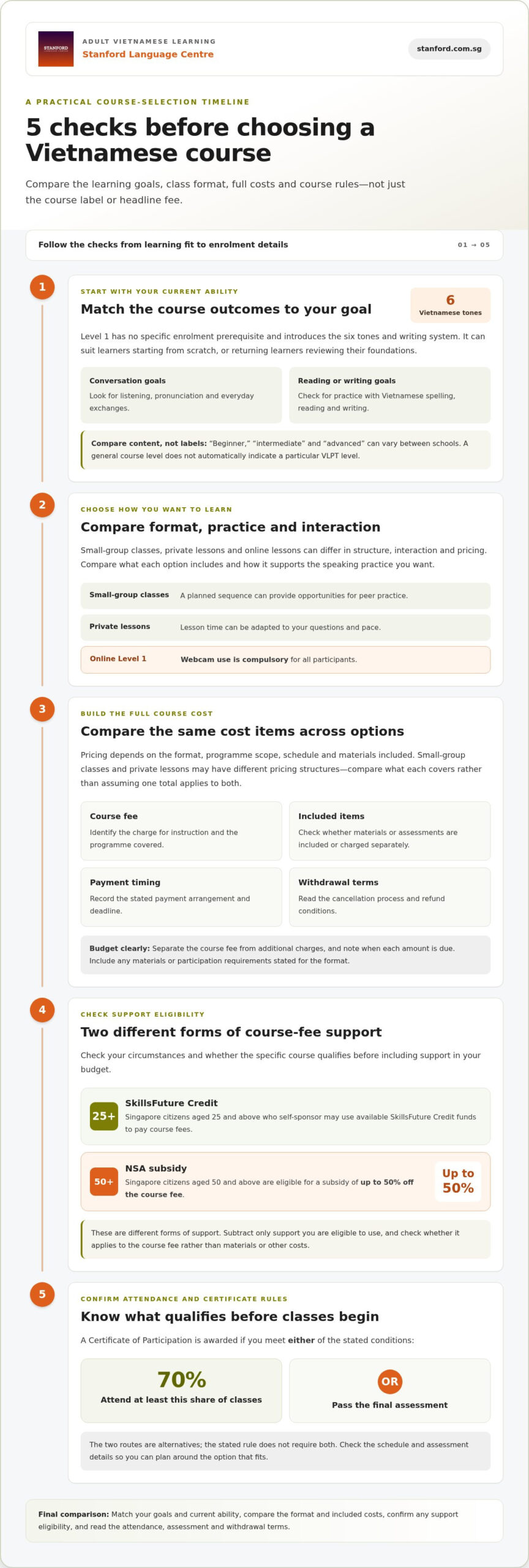
The best Vietnamese language course in Singapore for an adult is one that fits your starting level, learning goals and schedule. Level 1 has no specific enrolment prerequisite and introduces the six tones and writing system. For the online Level 1 class, webcam use is compulsory for all participants.
Learning Vietnamese can make conversations with Vietnamese-speaking friends, family, and colleagues feel more natural. It also offers a practical way to build cultural understanding, one useful phrase at a time. Starting from scratch is manageable when lessons are structured and give you opportunities to practise speaking.
This guide explains what can affect course fees without quoting a provider’s price, what beginner and higher-level study can involve, and how to compare attendance expectations, certificates and class interaction. You’ll also find out what to consider when choosing between online, small-group and private lessons, so you can find a learning format that works for you.
Key Takeaways
- Compare course costs by looking at the learning format and what the programme includes, rather than relying on a headline fee alone.
- Beginner study introduces Vietnamese’s six tones and writing system, with no specific prerequisite for Level 1.
- Check attendance and assessment rules: a Certificate of Participation is awarded for attending at least 70% of classes or passing the final assessment.
- Choose a class format that gives you the kind of speaking practice and teacher interaction you need; webcam use is compulsory in the online Level 1 class.
- Use your goals and current ability to decide what to look for in course listings, then compare the practical details before enrolling.
Course fees and total programme costs
Budget for the whole course, not just its advertised fee. Check what the course fee includes, such as learning materials, and whether any additional charges apply. Compare the same items across programmes before deciding. For example, a fee that includes materials is easier to compare with one that lists them separately.
Course pricing depends on the format, programme scope, schedule, and materials included. Small-group classes and private lessons can have different pricing structures, so compare what each option covers rather than assuming one total applies to both. Stanford Language Centre provides Vietnamese learning in small groups, through private lessons, and online. Contact the centre for pricing details.
For a realistic estimate, write down each cost shown during enrolment. Separate the course fee from any additional charges, then note when each amount is due. If you are comparing online and in-person options, include any materials or participation requirements stated for each format. This gives you a clearer total before committing.
- Course fee: Identify the amount charged for instruction and the programme covered.
- Included items: Note whether course materials or assessments are included or charged separately.
- Payment timing: Record the stated deadline and payment arrangement.
- Withdrawal terms: Read the cancellation process and refund conditions before enrolling.
Some Singapore citizens may have support for course fees. Singapore citizens aged 25 and above who self-sponsor may use available SkillsFuture Credit funds to pay course fees. Singapore citizens aged 50 and above are eligible for an NSA subsidy of up to 50% off the course fee. These are different forms of support, so check which eligibility criteria apply to your circumstances before building them into your budget.
When estimating your payable fees, begin with the full course fee and subtract only support you are eligible to use. Do not assume every course qualifies for the same funding or that support covers additional charges. Check whether the support applies to the course fee, rather than materials or other costs.
To enrol, choose a level and class format, then follow the course provider’s registration and payment steps. Before paying, read the stated payment schedule, cancellation process, and refund conditions so you understand what happens if your plans change. A Vietnamese language class can be compared using these same cost and policy checks.
Vietnamese course levels from beginner to advanced
Start with what you can already do in Vietnamese, not just a course label. Level 1 has no specific enrolment prerequisite. It introduces learners to the language’s six tones and writing system. That makes it a clear starting point for adults without prior study. Returning learners can also use it to review their foundations before progressing.
Choose a course by matching its stated outcomes to the skills you want to develop. A conversation-focused learner may prioritise listening, pronunciation, and everyday exchanges. If you want to read messages or write notes, look for practice with Vietnamese spelling too. Course labels such as beginner, intermediate, and advanced can vary, so compare lesson content rather than relying on the label alone.
- Starting point: Choose Level 1 if you’re new to Vietnamese or need structured foundations.
- Next step: Look for outcomes that build on familiar vocabulary, listening, and spoken responses.
- Broader use: Include reading and writing goals if you need more than spoken conversation.
- Personal fit: Match the course focus to situations such as family conversations, travel, or workplace exchanges.
Preparing for the VLPT is a separate goal from completing a course level. Identify the proficiency level you’re aiming for and the skills its assessment requires, then compare those requirements with the course outcomes. A class may build general Vietnamese ability without being designed specifically for VLPT practice. For focused preparation, organise your study around the assessment skills and practise the relevant task types. Don’t assume that an “intermediate” label equals a particular VLPT level.
Course levels can differ in sequence and content between schools. Compare entry expectations, learning outcomes, and progression routes. For example, check whether the next course builds on the vocabulary and speaking practice you’ve already covered. A shared label such as “beginner” doesn’t guarantee that two courses cover the same topics or develop the same skills.
Language schools, private tutors, and online lessons differ mainly in structure and interaction. A school course can provide a planned sequence and peer practice. A private tutor can adapt lesson time to your questions and pace. Online lessons avoid travelling to class, while the amount of speaking practice depends on how lessons are run. Compare the format with your goals, then check that its level and outcomes fit your next step.
Attendance requirements and certificates
For a Vietnamese course with a Certificate of Participation, the stated rule is clear: participants receive one if they attend at least 70% of classes or pass the final assessment. The two routes are alternatives. Meeting either condition qualifies under this rule, so learners can plan around attendance and assessment rather than assuming both are compulsory.
Attendance matters from the start. Before enrolling, read the course schedule and compare each session with your work, family, and travel commitments. If you expect to miss a class, note which sessions may be affected and how that could change your attendance. Keep your own record alongside any attendance information provided during the course. This makes it easier to spot a potential shortfall before the final session.
The 70% threshold gives you a practical benchmark, but the exact attendance calculation depends on the course’s class schedule. Don’t translate the percentage into a fixed number of missed lessons without knowing how the course counts sessions. A cancelled class, a late arrival, or an online connection issue may be treated differently under individual attendance procedures. Read the stated attendance terms and use the course’s official record as your reference.
The final assessment offers another route to the Certificate of Participation. Treat it as a course requirement, not an automatic formality. Review the course topics, practise the skills covered in class, and understand the assessment format before the course ends. If your attendance falls below 70%, passing the final assessment is the alternative stated route. The rule doesn’t say that every learner must pass the assessment when they already meet the attendance threshold.
- Before enrolling: Save the schedule and read the certificate conditions.
- During the course: Track attended sessions against the 70% requirement.
- Before assessment: Review lesson content and the stated assessment instructions.
- After completion: Keep the certificate and course records with your learning documents.
Distinguish a Certificate of Participation from a proficiency result. A participation certificate recognises that a learner met an attendance or assessment condition. It doesn’t, by itself, describe a particular Vietnamese proficiency level or prove fluency. If your goal is to show language ability for work or further study, compare the certificate with the evidence that goal requires. For example, consider whether a participation certificate meets your needs if you’re seeking structured proof of proficiency.
For an online Vietnamese class, plan attendance around the format as well as the calendar. Level 1 requires webcam use for all participants, so prepare the necessary setup before class. Reliable participation helps you follow lessons and maintain a clear record of attendance. Keep the 70% route and final-assessment alternative in view throughout the course, not just when certificates are issued.
Class sizes and student-teacher interaction
Class size shapes how often you can speak, listen, and receive feedback. Don’t judge a Vietnamese class by enrolment numbers alone. Check how lesson time is shared between teacher explanations, individual practice, and learner conversations. For example, a class may include pair activities, but you’ll also want opportunities to ask questions directly.
Look for clear opportunities to practise speaking during each lesson. A useful activity might involve introducing yourself, asking a follow-up question, and then switching roles. This gives learners a reason to listen as well as speak. Find out whether feedback includes individual pronunciation corrections, group feedback, or both. That helps you understand how interaction works in practice.
Teacher access matters when you get stuck. Consider a tone exercise: can you repeat a sound and receive a correction before moving to another phrase? For writing practice, find out whether the teacher reviews individual examples or demonstrates common corrections for everyone. These details show whether feedback is built into lessons rather than left until the end.
- Speaking turns: Find out how learners practise dialogue, not only repeat vocabulary.
- Corrections: Ask how pronunciation and sentence errors are addressed during class.
- Questions: Check how learners raise questions during activities and explanations.
- Peer practice: Look for structured exchanges, such as taking turns asking and answering.
- Teacher feedback: Understand whether comments are individual, shared with the class, or both.
Private lessons and group learning offer different kinds of interaction. One-to-one teaching centres the lesson on your questions and pace. Group lessons can add conversation practice with other learners, such as role-playing a greeting or ordering a meal. Neither format is automatically better. Choose based on whether individual feedback or peer conversation better supports your current goal.
For online classes, interaction depends on more than seeing the teacher on screen. Check how learners take turns, practise dialogue, and signal questions during a lesson. A webcam requirement, where applicable, also makes it important to prepare a quiet space and working camera. For in-person learning, consider whether the room setup lets you hear classmates and join pair activities comfortably.
Before enrolling, use a simple three-step comparison. First, identify your priority, such as pronunciation or spontaneous conversation. Next, consider how a typical lesson supports that skill. Finally, compare teacher feedback and peer practice in each format. If your goal is conversational confidence, choose a class with clear opportunities to speak, not just time spent listening.
Choose an interaction style that fits your learning goal. A learner preparing for family conversations may value repeated dialogue practice. Someone focused on accurate pronunciation may prefer frequent, specific corrections. Write down the format, practice activities, and feedback method for each option. This makes it easier to see which learning environment offers the participation you need.
Vietnamese course search results
Search listings are a starting point, not a complete course comparison. A result may show a course title without explaining its level, class format, or intended learners. Read the relevant course details and note those points before deciding. For example, distinguish an adult beginner class from a workplace programme, even when both teach Vietnamese.
Are there Vietnamese courses in Singapore for children, adults, or business learners? Adult learners can look for structured beginner classes, while businesses can consider training designed for workplace needs. For children, select a course that clearly states its age suitability and learning approach.
Search wording can blur important differences. “Vietnamese lessons” may describe group learning, private lessons, or online classes. Check the course details for the format, level, and intended learner rather than relying on the result title. A practical shortlist could include a structured group option and an individual or online format.
Are there Vietnamese language courses near MRT stations or in specific areas of Singapore? Compare the stated venue and travel requirements with your routine. Online lessons provide another option when travelling to a classroom doesn’t suit your schedule.
Schedules and duration need the same careful comparison. Are there published schedules, course durations, and formats for Vietnamese courses in Singapore? Class times and programme length depend on the course; compare the timetable and lesson format shown for each option. A listing might describe classroom, private, or online learning, so match its schedule with your weekly availability.
A short course description may not tell you everything you need to know. Use these steps to assess what each listing actually says:
- Read the course page: Note the level, target learner, format, and stated outcomes.
- Compare schedules: Record lesson days and times alongside your own commitments.
- Check venue details: Look for a Singapore address or nearest MRT station when in-person study matters.
- Identify the teaching format: Separate small-group, private, and online options.
- Review enrolment details: Keep the fee, payment terms, attendance rules, and certificate conditions together.
For adults starting from scratch, a Level 1 course with no specific enrolment prerequisite is one useful search criterion. The course should explain its learning focus, such as spoken practice or Vietnamese writing. For workplace learning, look for content connected to the needs of employees, rather than assuming a general course will match every business goal.
Use a comparison table or notes app to shortlist options by level, format, schedule, venue, and course outcomes. Then revisit the strongest match and read its enrolment information before taking the next step. To compare Vietnamese class formats, review the course details against the goals and practical checks in your shortlist.
Stanford Language Centre: Professional Adult Chinese learning in Singapore
Stanford Language Centre offers Professional Adult Chinese learning in Singapore, including small-group Mandarin classes for expats and foreigners, Japanese speakers, and Korean speakers. These options suit adults who want guided Mandarin study in a group setting, with class choices shaped for different learner backgrounds.
If you’re comparing adult language programmes after reviewing Vietnamese course formats, consider whether Mandarin is another useful goal for you or your workplace. A small-group class can provide structured learning alongside practice with fellow students. Explore adult Mandarin classes to see whether that learning path fits your needs.
For details about adult Chinese learning, visit stanford.com.sg.
Turn your learning goal into a first step
Choosing a Vietnamese language course in Singapore is only the start. Set a clear purpose, such as speaking more comfortably with relatives or joining everyday conversations. Then choose a small action to repeat between lessons, like practising a greeting aloud or reviewing useful phrases before a conversation. A steady routine helps bring learning into real life.
As you begin, notice which situations feel easier and which still take effort. This can help you focus your practice and make future learning decisions with more confidence. Progress doesn’t need to be dramatic to be useful. Each new phrase gives you another way to connect.
Ready to take the next step with Vietnamese? Contact Stanford Language Centre to ask about small-group classes, private one-to-one lessons, or online learning. Share your learning goal to get started.
Frequently Asked Questions
Why learn the Vietnamese language?
Vietnamese can help you connect more naturally with Vietnamese-speaking friends, relatives, and colleagues. Even simple phrases can make everyday interactions warmer, from greeting someone to asking about their day. Learning also offers a practical way to explore Vietnamese culture through conversation, food, and family traditions. Choose a personal reason to begin, then focus your practice on the situations where you want to communicate.
Where can I take Vietnamese language courses in Singapore?
You can take Vietnamese classes in Singapore through group, private, or online lessons. Stanford Language Centre offers small-group Vietnamese classes, private one-to-one lessons, and online learning. If you prefer individual attention, consider private lessons; if you enjoy practising with peers, a group class may suit you better. Compare each format with your learning preferences and daily routine.
Which Vietnamese courses in Singapore are available for beginners and advanced learners?
Beginners can start with Level 1, which has no specific enrolment prerequisite. If you’ve studied Vietnamese before, compare course outcomes with what you can already understand and say. Look for advanced study that develops the skills you need, such as more fluent conversation or stronger reading and writing. Course labels vary, so use the stated learning outcomes to judge whether a class suits your current ability.
How much do Vietnamese language courses in Singapore cost?
The cost depends on the course format, programme scope, schedule, and included materials. A group course and private lessons may have different pricing, so compare what each fee covers. Contact Stanford Language Centre for pricing details and review any separate charges before enrolling. Budget for the complete programme cost rather than comparing headline fees alone.
Which Vietnamese course providers in Singapore offer small-group or private lessons?
Stanford Language Centre offers small-group Vietnamese classes, private one-to-one Vietnamese lessons, and online language classes. Group learning gives you opportunities to practise with other students, while private lessons focus on your questions and pace. Choose the format that supports your main goal, whether you want to practise dialogue with peers or focus on specific learning needs.
Do Vietnamese language courses in Singapore include placement tests or certificates?
Placement tests and certificates depend on the course. A placement test can help match prior learning with a suitable starting level, while some programmes may have no specific entry prerequisite. Participants receive a Certificate of Participation if they attend at least 70% of classes or pass the final assessment. This certificate recognises participation or assessment completion; it isn’t the same as a formal proficiency result.