The best Thai course isn’t necessarily the most intensive. It’s one that gives you useful conversation practice in a format that fits your routine. When comparing a thai language course singapore learners can fit around work, start with what matters most: practising with a group, having one-to-one lessons, or learning online.
If you’re unsure which option suits you, begin with your goal. You may want to handle everyday exchanges, feel more comfortable speaking with colleagues, or make time for a new language alongside other commitments. Stanford Language Centre’s 10-Lesson Basic Thai Course is designed for adults who aren’t Thai speakers. It focuses on conversation and runs over 2 months.
This guide compares group, private and online learning, explains the basic course structure, and helps you match a format to your goals and schedule. You’ll also find practical ways to make lesson time count and understand the available funding options.
Key Takeaways
- A practical thai language course singapore adults can stick with should build useful listening and speaking skills through conversation practice.
- Compare group, private and online lessons by the interaction and flexibility you prefer. Group classes are relaxed and interactive, with Free make-up when available.
- The 10-Lesson Basic Thai Course has a defined structure: 10 conversation-focused lessons spread over 2 months.
- Use a quick checklist to weigh your conversation goals, preferred format, schedule, online preference and budget.
- Course fees are available on request. NTUC UTAP claimability and corporate training grants may also be relevant, subject to eligibility.
What should a Thai language course in Singapore help you learn?
You can learn useful Thai speaking skills without choosing an academic-style course. Look for lessons that help you understand everyday exchanges and practise responding aloud. A conversational course puts useful phrases, listening and speaking at the centre, so you can connect what you learn with real interactions.
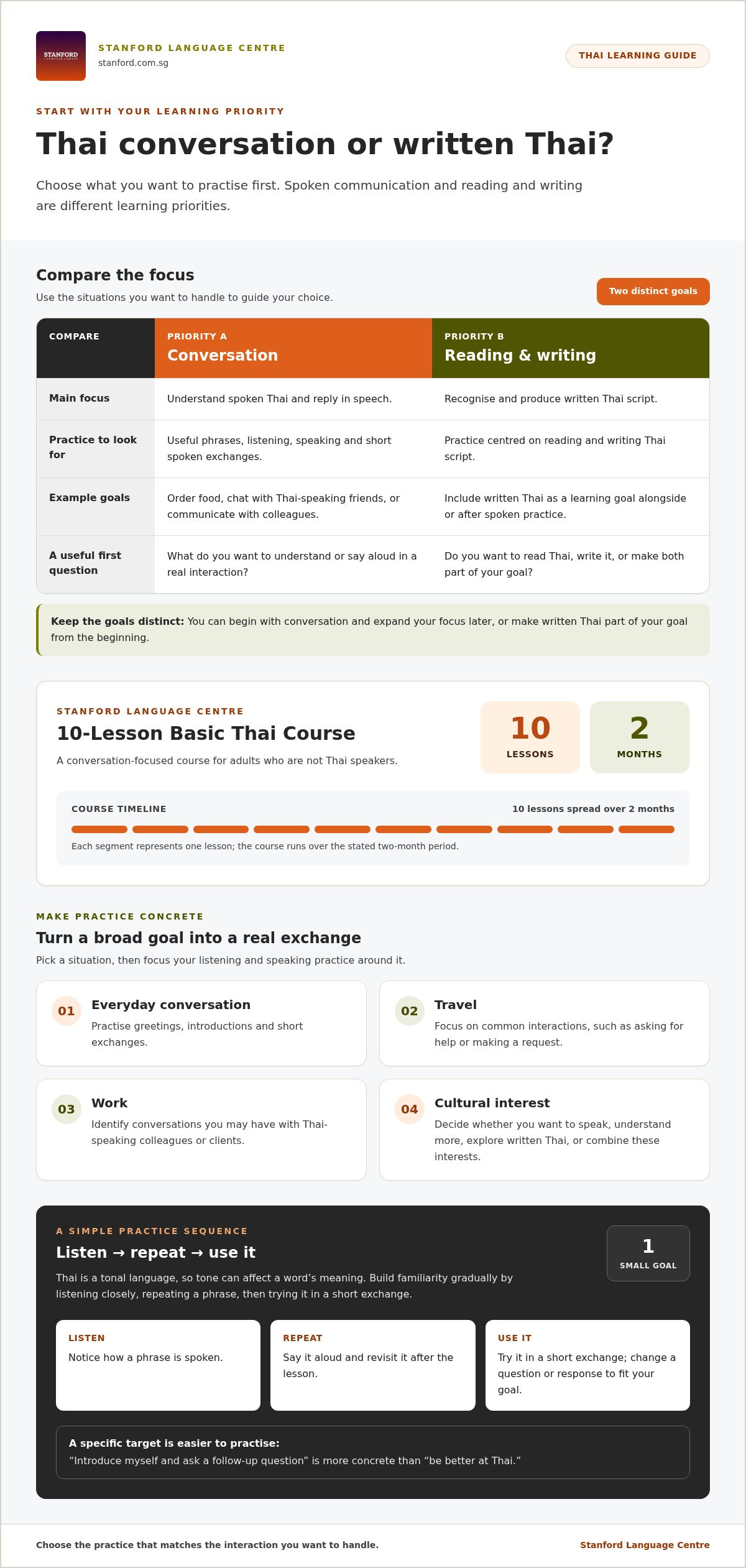
“Conversational” and “reading and writing” describe different learning priorities. A conversational course centres on understanding spoken Thai and replying in speech. A course focused on reading and writing centres on recognising and producing written Thai script. If your immediate goal is to communicate aloud, prioritise conversation practice. If you also want to read Thai, treat that as a separate learning goal.
Your goals might include ordering food while travelling, chatting with Thai-speaking friends, communicating with colleagues, or learning more about Thai culture. Make the goal specific enough to guide your practice. For example, “introduce myself and ask a follow-up question” is easier to work towards than “be better at Thai.”
Set a clear goal before comparing Thai classes
Before comparing lesson formats, name one situation where you want to understand or use Thai. This makes it easier to decide what kind of practice should come first and whether you want to focus on spoken language or include literacy skills too.
- Everyday conversation: Practise greetings, introductions and short exchanges.
- Travel: Focus on common interactions, such as asking for help or making a request.
- Work: Identify the conversations you’re likely to have with Thai-speaking colleagues or clients.
- Cultural interest: Decide whether you mainly want to speak, understand more, or explore written Thai as well.
It’s useful to separate immediate speaking goals from longer-term reading and writing interests. You can start with conversation and expand your focus later, or make written Thai part of your learning goal from the beginning. As you practise, note which situations feel easier and which phrases you still need to work on. That gives you a concrete way to reflect on your progress.
What does a beginner Thai course usually focus on?
Foundational lessons can introduce useful phrases and give you guided opportunities to listen and respond. Practising a short exchange helps connect a phrase to an interaction instead of leaving it as a line to memorise. Repeating a conversation and adapting it with a different question or response can also help you become more comfortable speaking aloud.
Pronunciation matters because Thai is a tonal language: tone can affect a word’s meaning. The Thai language has features worth understanding as you learn, but you can build familiarity gradually. Listen closely to how a phrase is spoken, repeat it, then try using it in a short exchange. Stanford Language Centre’s guide to how to learn a tonal language offers more practical context for this part of learning.
When comparing a thai language course singapore option, look beyond the word “beginner.” Consider whether the course is conversation-focused, whether you’ll have opportunities to speak, and whether its format fits the way you prefer to learn.
How Stanford’s 10-Lesson Basic Thai Course is structured
A clear course outline makes it easier to plan language learning around work, family and other commitments. Stanford Language Centre’s 10-Lesson Basic Thai Course is for adults who aren’t Thai speakers and focuses on conversation. The course is presented as a route to conversational fluency within 2 months, with a defined lesson count and duration to help you plan your learning.
Here are the course details:
- Course: 10-Lesson Basic Thai Course.
- Length: 10 lessons spread over 2 months.
- Focus: Conversation for adults who are not Thai speakers.
The set lesson count and two-month timeframe give you a clear planning framework. Think about how the course period fits your calendar and how you’ll make time to attend lessons and revisit what you’ve learned. The course has a conversation focus, so consider the everyday or work-related exchanges you want to practise as you progress through the lessons.
What to expect from the basic Thai course format
The course provides a structured way to work towards conversational Thai over 2 months. Its focus is on conversation, giving you a defined period of guided learning rather than an open-ended commitment. As you take part, connect the phrases and practice to the situations you want to handle, such as introductions, requests or short exchanges.
A fixed course structure can help turn a broad intention into a manageable commitment. Choose a practical goal to keep in mind, such as feeling more prepared for a basic conversation. After each lesson, take note of one phrase you can recall and one you want to practise again. That simple review helps you stay connected to the course between lessons.
How to prepare for useful progress between lessons
Keep practice connected to real situations. Choose one small personal goal, such as introducing yourself, asking a simple question or following a short exchange. After a lesson, revisit the material and notice which phrases feel familiar and which still need attention. You can practise aloud, repeat an exchange, or try changing one part of a dialogue to make it more relevant to your goal.
Keep a short list of questions that come up as you practise. For example, note a phrase you’d like to use in a conversation or a sound you want to listen for more carefully. Bring those points into your learning so you can connect course material to the conversations you want to have.
If you’re comparing a thai language course singapore option, the Basic Thai Course offers a defined duration and a conversation focus. Explore Stanford’s adult Thai learning options to see how a structured course could fit your goals.
Group, private or online Thai lessons: which format fits you?
The right lesson format depends on how you prefer to practise and what your schedule can support. Some learners enjoy trying phrases with classmates, while others prefer individual attention or the convenience of learning remotely. Stanford Language Centre offers Thai lessons in person or online. Compare the options by interaction, scheduling and learning preference.
| Format | Interaction | Scheduling | May suit you if… |
|---|---|---|---|
| Group | Relaxed, interactive practice alongside other learners | Attend according to the group class schedule | You enjoy learning with others and want a cost-efficient option |
| Private | One-to-one lessons | Flexible timing at a student-chosen time and location | You prefer individual attention or need a tailored routine |
| Online | Learn remotely with a teacher | Online lesson format; timing depends on the arrangement | You prefer remote study or want to learn without travelling to a lesson |
When might group Thai classes suit a learner?
Group classes can make practice feel social and relaxed. Hearing classmates try phrases, taking turns and responding in short exchanges gives you opportunities to speak as well as listen. Stanford’s group classes are relaxed, interactive and cost-efficient. Free make-up when available is offered for missed group sessions.
This format may suit you if you enjoy shared learning and can follow a group timetable. Practising alongside other learners gives you a chance to listen to different attempts and take part in exchanges. If you’re new to speaking Thai, focus on joining in with short phrases first, then build towards longer responses as you become more comfortable.
When might private or online Thai lessons suit a learner?
Private lessons are one-to-one, with flexible timing and a location chosen by the student. This format can suit you if you want individual attention or need to fit lessons around other commitments. Online lessons offer a remote way to study Thai, whether you prefer learning from home or want to avoid travelling to class.
Think about the practical difference: private describes the one-to-one lesson format, while online describes how a lesson is delivered. These options can overlap. The best fit depends on whether individual attention, remote access or learning alongside classmates matters most to you.
As you compare a thai language course singapore option, picture a lesson in your regular routine: how you’ll take part, where you’ll learn and what kind of interaction helps you speak up. Explore Thai lesson options to find a format that feels practical for your goals and schedule.
How to choose a Thai course around your schedule, goals and budget
A suitable course should work in real life, not just look appealing on paper. Before choosing a thai language course singapore option, compare its learning focus, lesson format and timing. Use a short checklist to keep your decision centred on what you need, rather than on course names alone.
- Conversations: What do you want to understand or say in Thai, such as everyday phrases, travel requests or work-related exchanges?
- Interaction: Would you rather practise with a group or learn one-to-one?
- Schedule: Which days and times can you keep free consistently?
- Online preference: Do you prefer joining lessons remotely or learning in person?
- Budget: What can you set aside, and could UTAP or workplace funding be relevant to your circumstances?
Match the course format to your weekly routine
Be practical about time and location. Consider when you can attend regularly and whether travelling to a lesson fits your week. Private Thai lessons are one-to-one, with flexible timing and a location chosen by the student. This can suit learners whose commitments make a fixed routine harder to manage.
Thai lessons are also available online. If remote learning is a better fit, Stanford’s online Mandarin, Thai and Vietnamese classes page outlines online learning options. Choose the format you’re most likely to sustain, rather than one that only works during an unusually quiet week. If you’re deciding between online and in-person lessons, consider where you can focus and which option makes it easier to take part consistently.
Understand course fees and funding without assumptions
Course fees are available on request. For a useful budget comparison, consider the total course fee alongside the number of lessons, format and schedule. Compare the specific options you’re considering rather than relying on another learner’s price or an assumed market average.
NTUC UTAP claimability is a separate consideration for individual learners. Stanford offers NTUC UTAP claimable Thai classes. Claimability is subject to eligibility, so include it in your budget only if you meet the scheme requirements. UTAP is distinct from SkillsFuture credits, which Stanford does not accept for these Thai courses.
Corporate funding is a different route. Eligible corporate groups may qualify for an additional Training Grant from SkillsFuture Singapore (SSG) on top of a special corporate rate. The grant is not automatic for every company or group. If you’re planning workplace training, consider the team’s communication needs and the languages employees need to use. Keep corporate funding separate from individual learner claimability when comparing costs.
Once you’ve weighed your goals, routine and budget, you can make a more confident choice. Explore Thai course options and find a learning format that fits your plans.
Start learning Thai with Stanford Language Centre
Choosing a course is easier when you know what you want to practise and how you prefer to learn. Stanford Language Centre offers adult Thai learning options with a practical, conversation-focused approach. The 10-Lesson Basic Thai Course runs over 2 months, while group, private and online lessons provide different ways to fit learning into your routine. Stanford presents its basic course as a route to conversational fluency within 2 months.
Which Stanford Thai learning option should you enquire about?
If you’re new to Thai and want a defined starting point, consider the 10-Lesson Basic Thai Course. It focuses on conversation for adults who aren’t Thai speakers. Group classes offer relaxed, interactive learning alongside others, with Free make-up when available. Private Thai lessons are one-to-one, with flexible timing and a location chosen by the student. Online lessons are another option if you prefer to study remotely.
For workplace learning needs, Stanford also offers corporate Thai training. Think about who will be learning and what kinds of conversations they need to handle. Sharing those details helps shape a discussion about a suitable learning format and the communication needs of the group.
- Beginner with a clear starting goal: Consider the 10-Lesson Basic Thai Course.
- Learner who prefers individual attention: Explore private one-to-one lessons.
- Learner who values shared practice or remote access: Consider group or online lessons.
- Workplace requirement: Enquire about corporate Thai training.
Take the next step with clear expectations
A helpful enquiry can be simple. Share what you hope to do in Thai, whether you prefer group, private or online learning, and the kind of schedule that could work for you. You can also ask about the course structure that best matches your goals. Course pricing is available on request. Stanford is the “most affordable language provider in Singapore.”
NTUC UTAP claimable Thai classes are offered, subject to individual eligibility. SkillsFuture credits are not accepted for these courses. Corporate training is separate: eligible corporate groups may qualify for an additional SSG Training Grant on top of a special corporate rate.
Ready to explore a thai language course singapore adults can match to their goals? Contact Stanford Language Centre to enquire about schedules and pricing. Call 9737 9914 or 9656 2095, or email info@stanford.com.sg. You’re also welcome to Contact Stanford about Thai lessons and share your preferred format and learning goal.
Turn your Thai goal into a first step
Choose one real conversation you’d like to feel more prepared for, then use it as a guide as you begin. It could be a greeting, a question at work or a friendly exchange while travelling. Keeping that intention in mind gives your learning a personal purpose and helps you choose which phrases to practise first.
As you consider a thai language course singapore option, think about the learning environment that will help you stay engaged. A first milestone can be modest: recognise a phrase, respond with a short answer or feel more comfortable trying aloud. Returning to familiar phrases and using them in different exchanges can help you make practice more relevant to your own goals.
Ready to take that first step? Share your learning goal and preferred lesson format with Stanford Language Centre. Enquire about Thai lessons with Stanford. Start with one conversation in mind, and let your learning grow from there.
Frequently Asked Questions
Is a Thai language course suitable for complete beginners?
Yes. Stanford’s 10-Lesson Basic Thai Course is for adults who aren’t Thai speakers and focuses on conversation. It consists of 10 lessons spread over 2 months. You can also choose private or online lessons if another format better fits your routine. Before starting, think of one real situation you’d like to handle in Thai, such as greeting someone or making a simple request. That gives you a practical goal to keep in mind as you learn.
Can I take Thai lessons online?
Yes. Stanford offers Thai lessons online as well as in person. Online learning may suit you if remote study is more convenient or you prefer not to travel to a lesson. Private lessons are one-to-one, with flexible timing and a location chosen by the student. Course schedules and pricing are available from Stanford Language Centre.
How long does Stanford’s basic Thai course take?
The 10-Lesson Basic Thai Course runs over 2 months. It focuses on conversation for adults who aren’t Thai speakers. This defined course period can help you plan around work and personal commitments. When choosing a class, consider the lesson timing alongside the time you want to set aside to revisit phrases and practise between lessons.
How much does a Thai language course in Singapore cost?
Stanford’s course fee is available on request, so there’s no need to rely on estimates or older listings when comparing a thai language course singapore option. Ask for pricing for the format you’re considering, such as group, private or online lessons. For an enquiry, call 9737 9914 or 9656 2095, or email info@stanford.com.sg.
Can I use SkillsFuture credits for Stanford’s Thai course?
No. Stanford’s Thai classes are NTUC UTAP claimable, but SkillsFuture credits aren’t accepted for these courses. UTAP and SkillsFuture are separate schemes, and UTAP claimability is subject to individual eligibility. Keep the schemes separate when planning your course budget.
Can companies receive funding for corporate Thai training?
Eligible corporate groups may qualify for an additional Training Grant from SkillsFuture Singapore (SSG) on top of a special corporate rate. The grant is not automatic for every company or group. Stanford provides corporate Thai training tailored to business communication needs, so share the workplace learning goals when enquiring. Corporate funding is separate from individual UTAP claimability.
What happens if I miss a group Thai class?
Stanford offers Free make-up when available for group classes. Makeup lessons depend on availability, so they aren’t guaranteed whenever you miss a class. If attendance flexibility matters to you, include it in your choice of format and ask Stanford about the current group-class arrangements. To discuss Thai lesson options, call 9737 9914 or 9656 2095, or email info@stanford.com.sg.