Thai grammar can feel unfamiliar, but it becomes more manageable when you learn through useful phrases and regular practice. Thai has five tones, so pronunciation and listening need attention alongside sentence patterns. For adults considering Thai classes in Singapore, the key is finding a beginner-friendly way to build both skills step by step.
It’s natural to wonder whether Thai grammar will be difficult, especially if you’re starting from scratch. You’ll learn what beginner lessons typically cover, how speaking, reading and writing fit in, and what to expect from group schedules and registration.
This guide explains how Thai grammar compares with other challenges of learning the language, what beginner lessons can involve, and how to choose a learning format that suits your goals and routine.
Key Takeaways
- Find out why Thai’s five tones make listening and pronunciation important from the start.
- See how speaking, reading and writing can fit into a beginner learning plan.
- Understand what to consider when matching group lessons with your routine and learning goals.
- Get a practical overview of course schedules and registration, so you can plan your next step.
- Learn how regular practice can support progress in everyday Thai conversation.
Is learning Thai worth it?
Thai can be useful for everyday conversations, travel, and connecting with Thai-speaking friends or colleagues in Singapore. Its grammar may feel unfamiliar, but learners can build practical skills through short exchanges, careful listening, and steady practice. Start with a clear goal, such as introducing yourself or asking for help.
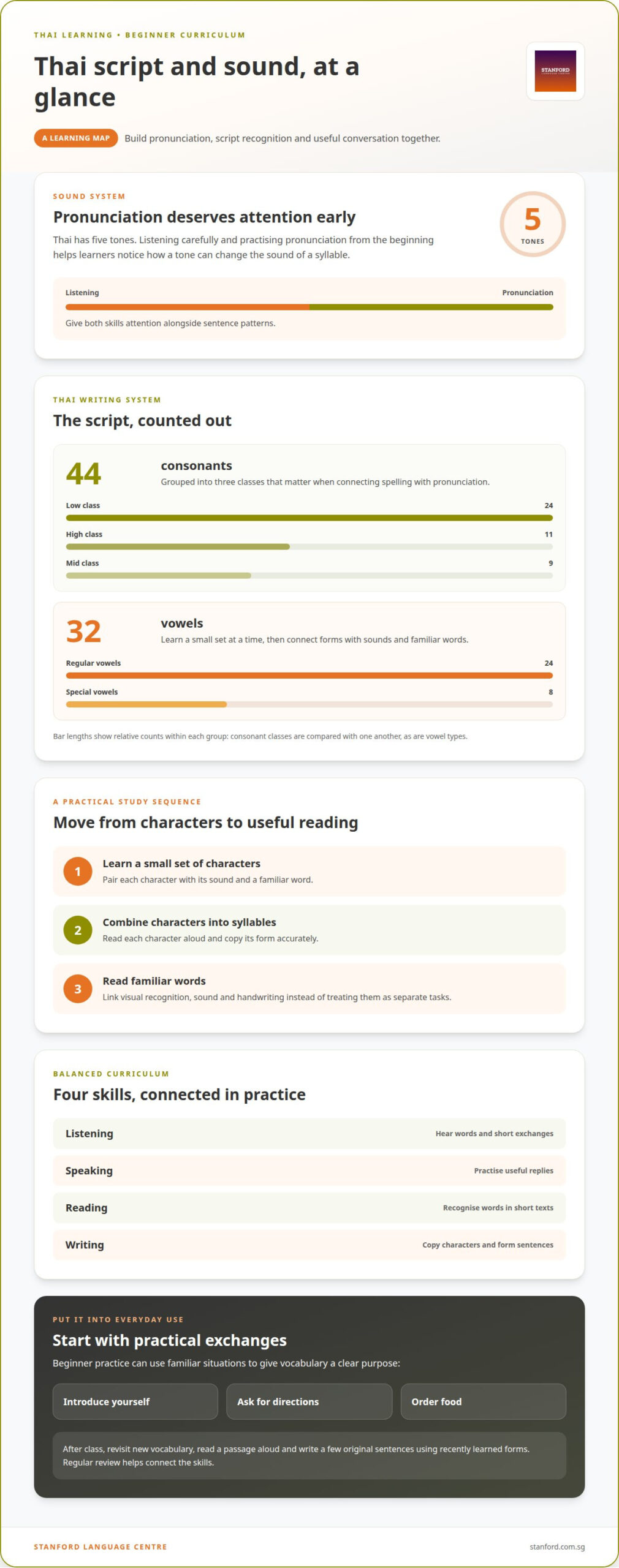
Thai has five tones, so pronunciation and listening deserve attention from the beginning. The tone can change how a syllable sounds. Grammar is only one part of learning: you’ll also build vocabulary, recognise sentence patterns, and practise forming useful replies.
Reading and writing add another learning track. The Thai writing system has 44 consonants and 32 vowels, so learners can benefit from studying a few characters at a time. Pairing each character with its sound and a familiar word gives practice a clear, repeatable structure.
Course duration depends on lesson frequency, practice between sessions, and whether your goal is conversation alone or literacy too. Compare the timetable with your routine and decide how much review time you can set aside each week. A manageable plan makes regular practice easier to sustain.
Where can I take Thai language classes in Singapore? Adults can choose small-group lessons, private classes, or online study. Consider whether you learn best by practising with classmates, receiving individual attention, or studying remotely from a familiar setting.
What are the class schedules and course durations for Thai lessons in Singapore? Schedules vary by format and programme. Compare class times with your work commitments, then consider how often you can review notes and practise speaking between lessons.
Are Thai classes in Singapore available for children and adults? Adult learners can find courses suited to beginner goals. Before enrolling, check that the programme is designed for the intended age group and experience level, so lesson activities match the learner.
Learning materials may include vocabulary lists, dialogue examples, and writing exercises. After class, review new phrases, listen to them again, and use them in a short exchange. For example, practise a greeting and introduction aloud, then write down the words you want to remember.
Do Thai language courses in Singapore include cultural activities or certification? Cultural context can explain when a phrase feels natural, while certification is a separate course feature. Compare the stated course content with your goals rather than assuming either is included.
What qualifications and experience do Thai teachers in Singapore have? Thai proficiency, teaching experience, and the ability to explain pronunciation are useful qualities. Look for instruction that connects grammar to real examples, such as forming a request or responding in a simple conversation.
Course levels can take learners from foundational phrases toward broader communication skills. Choose a starting point based on your current ability, then build from everyday conversation toward more complex exchanges. With proper Thai lessons, learners can become fairly comfortable discussing everyday matters within three months; regular practice supports that progress.
Thai speaking, reading and writing curriculum
A balanced Thai curriculum develops listening, speaking, reading, and writing. Beginners can start with practical exchanges, such as introducing themselves, asking for directions, or ordering food. These situations give vocabulary a clear purpose. Learners can then practise hearing similar-sounding words and responding in complete, useful sentences.
Thai script takes focused practice because its writing system includes 44 consonants and 32 vowels. The consonants fall into three classes: 9 mid, 24 low, and 11 high. These groups matter when learners connect spelling with pronunciation. Instead of memorising symbols alone, practise reading each character aloud and copying it accurately.
The vowel system has 24 regular vowels and 8 special vowels. A practical study sequence is to learn a small set of characters, combine them into syllables, then read familiar words. For writing, copy each form carefully before using it in a short word or sentence. This links visual recognition, sound, and handwriting instead of treating them as separate tasks.
Speaking lessons can progress from model dialogues to independent replies. Listen to a short exchange, repeat each line, then change one detail, such as the place or activity. This helps you move beyond memorised scripts. Feedback can also highlight unclear sounds and help you speak more confidently.
Reading and writing practice can use short notices, simple messages, and everyday vocabulary. First identify familiar words, then read a short passage for its main idea. Writing can progress from copying characters to completing a sentence and composing a brief message. These tasks help you check comprehension and script accuracy.
As your skills develop, advanced work can combine discussion, longer reading, and structured writing. You might explain a preference, compare two options, or summarise a short text. Discussion practice works best when you listen, respond to another person’s point, and support your view with examples. Reading can introduce less familiar vocabulary in context.
For steady progress, connect each class activity to a review task. Revisit new vocabulary, read the same passage aloud, and write a few original sentences using recently learned forms. A notebook divided into speaking phrases, characters, and writing corrections can make review easier and show which skills need more attention.
When comparing course curricula at Stanford Language Centre, look for a clear progression from useful conversation to script skills and more detailed communication. A Thai reading and writing class suits learners who want to work directly with the alphabet, while a broader curriculum can balance script with spoken practice. Choose based on whether your immediate goal is conversation, literacy, or both.
Alphabet study can demand a patient, sustained routine rather than a quick pass through unfamiliar forms. Dedicated learners taking Thai classes singapore often need an entire year to master the full Thai alphabet, a reminder to keep character practice active alongside listening and conversation.
Joanne Tan says she has 8 years of experience speaking Thai. Her experience offers a concrete example of sustained engagement with spoken Thai; regular practice can keep speaking work connected to the broader curriculum.
Group Thai classes and schedules
Group lessons suit adults who want guided practice alongside other learners. A classmate may ask the same question you had, and paired exercises give you chances to respond in real time. For example, practise a café order by taking turns as customer and server, then switch roles and adapt the dialogue.
Are private Thai tutors or group classes better in Singapore? Neither format is right for everyone. A group class offers peer conversation and shared activities, while private tuition can focus more closely on your pace and goals. Choose based on whether interaction with classmates or individual attention matters more to you.
A group schedule works best when it fits your regular routine. Compare the lesson time with work commitments, travel time, and the energy you have available after class. Someone with changing work shifts, for example, may find a fixed weekly slot harder to maintain than someone with a predictable calendar.
Before enrolling, identify what you want each class to help you do. A learner preparing for a trip might prioritise common requests and directions. Someone communicating with Thai-speaking colleagues may need practice introducing a topic, asking follow-up questions, and responding clearly. A specific goal helps you judge whether class activities match your needs.
Group learning also means sharing speaking time. Notice how a lesson balances teacher explanation, pair practice, and individual feedback. If a session focuses mainly on listening, take an active part in speaking exercises when they arise. Set a personal target, such as contributing an original sentence during each conversation activity.
For a more useful lesson, prepare a short list of questions in advance. You might note a phrase you heard in conversation or a sentence you struggled to form. Bring the example to class, practise it aloud, and write down the correction. This connects each session with daily life.
Online and onsite formats can both support group learning, but the setting changes the experience. An onsite classroom makes it easier to read gestures and practise face-to-face exchanges. An online session avoids the journey to class, but calls for a quiet space and reliable access to the lesson platform.
Keep your schedule realistic across several weeks, not just for the first session. Set aside regular review time between lessons, such as revisiting notes after work or practising a short dialogue before the next class. Consistency matters more than choosing an ambitious timetable that clashes with recurring commitments.
Before deciding, compare the format, lesson timing, learning goals, and opportunities to speak. A small-group Thai class can work well if you value peer practice; private tuition may suit someone seeking a more individual pace. The right choice supports steady attendance and active participation.
Registration dates and course schedules
Plan around the course calendar. Identify the intake, first lesson date, and expected end date before arranging your week. A course starting during a busy work period, for example, may be harder to attend consistently than one beginning after a project deadline.
Next, compare the class timetable with your fixed commitments. Add the lesson time to your work calendar, then account for commuting or setting up for an online session. A Tuesday evening class may fit someone with regular office hours but conflict with a recurring late meeting.
Before registering, decide which course format and learning goal suit you. A beginner focused on conversation may need a different course from someone prioritising Thai script. Write down your preferred format, current experience, and main goal to help select a suitable starting point.
Use this practical sequence to organise your enrolment:
- Choose a course level that matches your Thai experience, such as a beginner starting with basic phrases.
- Compare the lesson schedule with work, family, and travel commitments.
- Review the registration requirements and prepare the requested details.
- Record the start date, lesson time, and any preparation needed before class.
Registration details depend on the course format. A group course may follow a set timetable, while private tuition can be arranged around individual learning needs. For online study, reserve a quiet place, keep lesson materials nearby, and plan to join on time.
Ask yourself how much time you can set aside for lessons and review. A learner with regular business travel, for example, may find a fixed group schedule difficult to maintain. With a stable weekly routine, you can plan around a recurring class and reserve time afterward to review vocabulary.
Check the course calendar beyond the first session. Note any breaks, changes in lesson timing, or registration deadlines. Add the course name, start date, class location or online format, and a reminder to prepare materials before the first lesson to your calendar.
Course duration and total learning hours depend on the programme structure and lesson frequency. Compare the full schedule with the time you can commit, rather than judging fit from one class alone. If you have a specific milestone, such as handling a basic introduction, look for regular practice that supports it.
Once you have selected a course, complete the registration steps and save the schedule somewhere you’ll see it daily. Keep your course confirmation and joining instructions together. This helps prevent missed details and makes it easier to arrive ready for your first Thai lesson.
Beginner Thai conversation and writing
Beginner lessons work best when you practise useful phrases and connect them with clear writing tasks. Start by choosing a course that matches your goal, whether that’s everyday conversation, reading Thai script, or building both skills.
Beginner Thai Conversation
Conversation practice should help you listen, respond, and reuse phrases in everyday situations. Practise introducing yourself, asking for directions, or ordering a meal, then change one detail in each exchange. Look for activities that give you time to speak, not just repeat after the teacher. Listening before answering also connects pronunciation with meaning.
Thai has five tones, so beginners benefit from hearing and practising words aloud in context. Listen to a short phrase, repeat it, then use it in a new sentence. For example, turn a memorised greeting into a brief introduction. This helps you focus on tone, word choice, and clear speech without trying to master everything at once.
Which Thai classes in Singapore are best for beginners? Choose a course that starts with foundational skills and offers guided speaking practice. Small-group lessons provide opportunities for partner exchanges, while private tuition offers a more individual pace. Online classes are another option when remote study fits your routine.
To make progress between lessons, choose a small speaking task to repeat. Practise a greeting, a request, and a short response, then try them without reading your notes. If you get stuck, write down the phrase and bring it to your next lesson. Turn a real communication gap into a practical learning prompt.
Beginner Thai Writing
Writing instruction can take you from recognising characters to forming words and short sentences. Look for lessons that include guided practice, not just a chart of symbols. A practical sequence is to trace a character, copy it independently, then use it in a familiar word. This builds recognition and accuracy together.
Thai writing includes 44 consonants, so beginners can benefit from learning a manageable group before moving onward. Pair each character with its sound and a word example, then review it again later. When practising, compare your copy with the model and correct the shape before adding more characters. This makes each review focused and easier to repeat.
Reading aloud can connect script practice with speaking. Choose a short written phrase, identify familiar characters, and sound it out before checking its meaning. A beginner learning to write can keep a notebook of new forms, vocabulary, and corrections. Reviewing that notebook before class helps identify what needs more practice.
For structured practice in both skills, consider a beginner Thai class with conversation and writing options. Choose a small-group or private format based on whether you prefer peer exchanges or individual attention.
Choose a short written phrase to read aloud, then write it from memory and check it against the model. This links recognition, pronunciation, and recall in one manageable exercise. Beginner learners can pick up basic conversational Thai within 3 months if they practise daily with someone qualified in Thai.
Stanford Language Centre: Professional Adult Chinese learning in Singapore
Stanford Language Centre provides professional adult Chinese learning in Singapore, with small-group Mandarin classes for expats and foreigners, Japanese speakers, and Korean speakers. If you’re also looking to build Mandarin skills, choose a class suited to your language background and learning goals.
Small-group lessons give adult learners structured opportunities to practise Mandarin with others. Expats and foreigners can join a tailored group, while Japanese and Korean speakers have dedicated class options. These formats let you start with instruction suited to your language-learning context.
For help choosing a Mandarin class that fits your needs, contact Stanford Language Centre.
Make Thai practice part of your routine
Your next step is to turn your interest into a learning habit. Choose one everyday situation you want to handle in Thai, then use it to guide your practice. A short introduction, a simple request, or a conversation with a Thai-speaking colleague can give your learning a clear purpose.
Before starting, decide what would make lessons sustainable for you. Consider whether you prefer learning with others or individually, and whether online or onsite study fits your week. A manageable schedule makes it easier to practise between lessons and build confidence gradually.
If you’re ready to explore Thai classes in Singapore, choose a learning format that supports your goals and routine. Stanford Language Centre offers Thai learning options for adults, including group and private classes. Contact Stanford Language Centre to take the next step and begin building practical Thai skills at a pace that works for you.
Frequently Asked Questions
Is Thai grammar hard?
Thai grammar can feel unfamiliar, but beginners can learn it through practical sentence patterns. Verbs generally don’t change form to show tense or who is acting; time words and context help communicate timing. Focus first on clear sentences for everyday situations, such as describing a routine or making a request. Thai classes in Singapore can help you practise these patterns step by step.
How do I register for Thai classes in Singapore, and what are the enrolment requirements?
Choose a beginner course and decide whether you want in-person or online lessons, then complete the registration process with the school. Stanford Language Centre’s basic Thai course for non-Thai speakers consists of 10 lessons over 2 months. The package includes instructional time, practice materials, and access to native trainers. Select the format that suits your routine and use the course details to prepare for your first lesson.