The best thai class singapore option isn’t necessarily the fastest or most intensive one. It’s the format that gives you useful speaking practice and fits your schedule, whether you’re learning for travel, personal interest, or work. If you’re new to Thai, you may be wondering what a beginner course covers, how group lessons compare with private or online classes, and whether a short course matches your goals.
Stanford Language Centre’s 10-Lesson Basic Thai Course runs for 2 months and focuses on conversation for non-Thai speakers. Lessons are available in person or online, with small-group classes, private one-to-one lessons, and corporate training to suit different learning needs.
This guide explains what to expect from a beginner course and how to compare formats based on your goals and routine. You’ll also find practical ways to prepare, so you can choose a manageable starting point for building conversational Thai without expecting fluency overnight.
Key Takeaways
- Choose a thai class singapore option by the kind of practice you want and how you prefer to learn.
- Use the 10 lessons over 2 months as a structured starting point for conversational Thai, not a promise of instant fluency.
- Compare small-group, private, and online lessons by interaction, individual attention, and flexibility.
- Set a clear learning goal, then choose a class format and decide whether in-person or online learning fits your routine.
- Explore small-group, private one-to-one, online, or corporate Thai learning to find a practical next step.
Thai Class Singapore: What Can Adult Beginners Expect?
A beginner Thai class gives you guided practice with useful language. You build familiarity step by step: listening to examples, learning words and phrases, and trying them with a teacher. For adults who feel unsure about speaking a new language, a relaxed, practical setting can make it easier to get started.
At Stanford Language Centre, the Basic Thai Course focuses on conversation for non-Thai speakers. It provides an entry point for learners who are new to the language, with practice centred on spoken exchanges. Feeling more prepared to take part in a simple conversation is a useful early goal. It’s different from broad language mastery, which can include deeper listening, reading, writing, and a wider range of topics.
Conversational Thai learning builds confidence with useful spoken exchanges; broader language mastery develops wider skills across communication and contexts.
What does a beginner Thai class usually focus on?
Expect guided practice rather than a list of phrases to memorise without context. A teacher can introduce conversational expressions, model how they’re used, and help learners practise saying them. Dialogue, vocabulary, examples, and exercises work together: phrases give you words to try, sample exchanges show how they fit into a conversation, and practice helps you get more comfortable using them.
For example, you might want to practise a greeting, asking for something, or making a basic request. These are examples of everyday communication, not a guaranteed lesson sequence. The pace and emphasis can vary with the class format and learning goals. To make practice relevant, think of situations where you’d like to use Thai and keep those in mind as you learn.
Thai also has features that learners may explore as their goals develop. The Thai language overview provides background on its classification and writing system. You don’t need to learn every aspect at once to begin practising conversation.
Who may benefit from a Thai class?
A class can suit adults starting from scratch, as well as non-Thai speakers who want structured practice instead of learning alone. You might be learning for personal interest, preparing for everyday interactions, or developing language skills relevant to work. Set a practical goal by identifying the kinds of conversations you’d like to feel more prepared for, rather than expecting one short course to cover everything.
Stanford Language Centre offers Thai learning in person or online. In-person learning may appeal if you value a shared class setting, while online lessons let you study remotely. Consider which setting makes it easier for you to participate regularly. A manageable starting point and a clear reason for learning can help you stay focused as your goals develop.
How Stanford’s 10-Lesson Basic Thai Course Builds Conversation
A defined course structure gives beginners a clear starting point. Stanford Language Centre’s Basic Thai Course consists of 10 lessons spread over 2 months. It focuses on conversational Thai for adults who are non-Thai speakers, giving learners a structured way to practise spoken exchanges.
The Basic Thai Course offers 10 lessons over 2 months, focused on conversational Thai for non-Thai speakers.
What the 10 lessons and 2 months mean in practice
The course length tells you the total number of lessons and the overall period. It doesn’t specify a particular weekly schedule or lesson duration, so use the two-month period to consider how the course fits alongside your other commitments. When planning, think about which times in your routine you can set aside for lessons and practice.
Regular attendance helps you stay connected to the course material. During lessons, listen closely, try speaking, and note expressions you want to revisit. Between lessons, practise saying those phrases aloud or review your notes in a way that fits your routine. These steps give you a practical way to engage with what you’ve learned, while recognising that each learner’s pace is personal.
If you’re comparing course options, the Thai course details can help you explore the learning path and find a suitable next step.
Conversation first, with other learning goals in view
The stated focus of the Basic Thai Course is conversation. That gives adult beginners a clear direction for practice: speaking and useful exchanges. Broader language learning may include other skills, so decide what you want to use Thai for and keep that goal in view as you take part and practise.
For learners curious about the wider context of language and education in Thailand, the U.S. Department of Commerce’s International Trade Administration provides background on the Thai education system and language programs. It’s useful context, while Stanford’s Basic Thai Course remains focused on spoken conversation for non-Thai speakers.
Reading and writing are separate learning goals. Stanford also offers Thai reading and writing classes, so learners interested in those skills can consider them as a distinct option rather than expecting them to be part of the Basic Thai Course. This distinction can help you choose a starting point: begin with conversation if speaking is your priority, then explore literacy-focused learning when it matches your aims.
For a thai class singapore search, compare the course structure with your schedule and learning goal. The 10 lessons over 2 months provide a defined framework for beginning conversational Thai. Your attendance and practice can help you engage with the course, while your longer-term goals can guide what you learn next.
Group, Private, or Online Thai Class: Which Format Fits You?
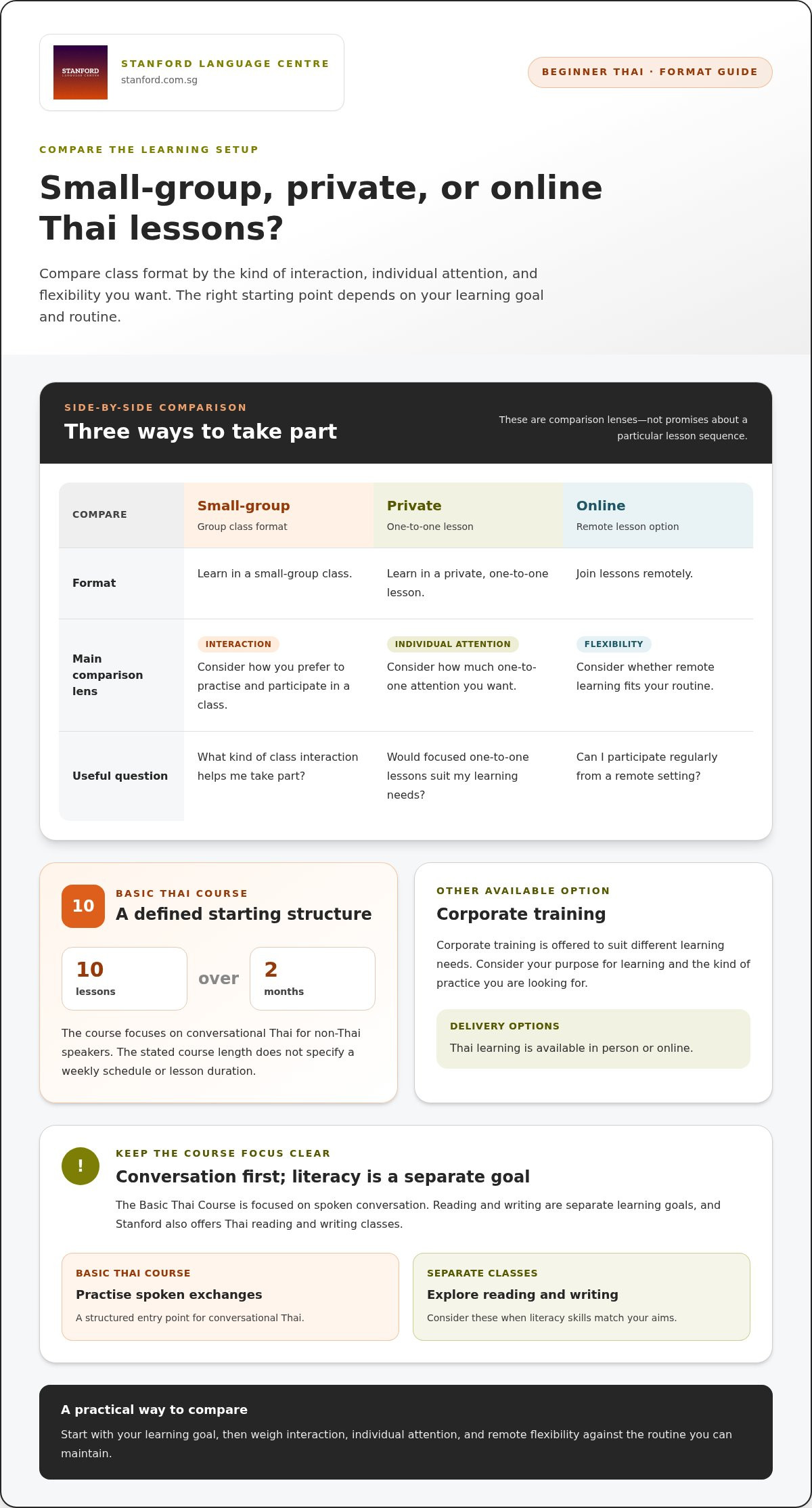
No single format is automatically best. Your choice depends on how you like to practise, how much individual attention you want, and whether learning online or in person fits your routine. For a thai class singapore search, compare the learning experience you want, not just the format label. Online describes how you attend, while group and private describe who you learn with.
| Format | Interaction | Personalisation | Learning context |
|---|---|---|---|
| Small group | Shared, interactive practice | Learning is shaped around the group | Relaxed class setting; cost-efficient |
| Private one-to-one | Direct interaction with a teacher | Individual attention | Timing and location chosen by the student |
| Online | Teacher-led learning remotely | Depends on whether the lesson is group or private | Study without attending in person |
These options can overlap. A group or private lesson may be taken online or in person, so consider both the class structure and how you’d prefer to attend.
When a small-group Thai class may suit you
Small-group classes may suit you if you enjoy practising alongside other learners. Stanford’s group classes are relaxed and interactive, with opportunities to take part in shared practice. They’re also cost-efficient. If you miss a class, Free make-up when available is offered, subject to availability.
Choose this setting if shared practice feels motivating and you’re comfortable learning with others. When deciding, consider whether interacting with a group would help you stay engaged and give you regular opportunities to try spoken Thai. Group classes are a practical fit for learners who value a shared, interactive experience.
When private or online Thai lessons may fit better
Private Thai lessons are one-to-one, with timing and location chosen by the student. Consider this format if you prefer individual instruction or want to fit lessons around your own schedule and preferred location. It provides a more personal learning context than a group class. Learners prioritising individual attention can explore the guide to private Thai lessons for more detail.
Online Thai classes are another option if you’d rather learn remotely; classes are also available in person. Online learning can work with either a group or private format. Decide whether you value shared practice or one-to-one attention first, then choose how you want to attend.
A simple way to choose: pick group learning for shared interaction, private lessons for one-to-one attention, and online attendance if remote learning suits your routine. Consider which arrangement you can participate in comfortably and consistently.
How to Choose and Prepare for a Thai Class
A little preparation can make choosing a class simpler. Start with the communication you hope to practise, then choose a learning format and decide whether you prefer online or in-person lessons. This gives you a clear basis for comparing options without expecting one class to meet every possible goal.
Use this sequence to narrow down your choice:
- Set a goal. Name a situation where you’d like to use conversational Thai, such as everyday interactions or work-related communication.
- Choose a format. Decide whether shared practice in a small group or individual attention in a private lesson matters more to you.
- Choose how to attend. Consider whether online learning or in-person lessons fit your routine and preferences.
- Ask about arrangements. Find out about course content, current scheduling, a suitable start, and pricing.
This order helps you focus on fit before getting caught up in details. If you’re comparing a thai class singapore option, keep your goal at the centre of the decision: do you mainly want to practise conversation, receive one-to-one attention, or learn alongside others?
Set a realistic goal before your first lesson
Make your goal specific enough to guide your learning. Instead of “learn Thai,” you might aim to practise useful spoken exchanges for travel, personal interest, or communication connected to work. A focused goal helps you notice relevant vocabulary and participate with purpose, while leaving room for your interests to change as you learn.
Plan a manageable practice routine alongside class attendance. You could revisit notes or say new phrases aloud between lessons, choosing an amount of practice that feels sustainable. The aim is steady engagement, not an unrealistic daily commitment. Conversational progress is one part of language learning, so keep your expectations focused on the speaking goals you’ve set.
Prepare questions about course arrangements
Before you enquire, jot down what you need to know. Ask about the course content and how it relates to your goal, as well as current class arrangements and the next suitable start. If you’re deciding between formats, explain whether shared practice or individual attention is your priority. This makes it easier to identify an option that suits your needs.
Pricing is available on request. Include it among your questions so you can understand the current fee for the course you’re considering. You can also note whether online or in-person learning works better for your routine. A few clear questions make it easier to understand the practical next steps.
Ready to discuss your goals and course arrangements? Enquire about Thai classes and take a practical first step towards learning.
Start Your Thai Class with Stanford Language Centre
Once you know what you want from a class, match that goal to a learning format. Stanford Language Centre offers small-group Thai classes, private one-to-one lessons, online Thai classes, and corporate Thai language training. Lessons are available in person or online, so you can consider both how you want to learn and how you prefer to attend.
The Basic Thai Course is a structured option for adults who are non-Thai speakers and want to focus on conversation. It consists of 10 lessons over 2 months. That gives you a defined starting point and a clear course focus: conversational Thai.
Choose a learning format that matches your priorities
If you enjoy practising alongside others, a small-group class offers relaxed, interactive shared learning. Private lessons provide one-to-one instruction and let you choose the timing and location. Online learning offers another way to attend, while in-person classes provide a shared classroom setting. The right format depends on the kind of practice you value and what feels manageable in your routine.
For workplace learning, corporate Thai training offers a format for organisations. Eligible corporate groups may qualify for an additional Training Grant from SSG. Eligibility matters, so the grant shouldn’t be assumed for every company. When considering personal options, weigh what matters most to you: conversation practice, individual instruction, or learning with a group.
Use your goal as a guide when comparing the available class formats and deciding whether online or in-person learning suits you. You don’t need to settle every long-term learning aim before starting. A clear first priority is enough to help you choose.
Ask about current course details
Before deciding, enquire about current class schedules and the next suitable start. You can also ask about course content and how it relates to your goal, whether you’re considering small-group learning, private lessons, an online class, or corporate training. These details help you understand the practical arrangements and plan around your routine.
Pricing is available on request. For current course details or pricing, contact Stanford Language Centre at 9737 9914 or 9656 2095. Having your preferred format and learning goal ready can make the enquiry more useful and help you focus on a practical next step.
If you’re ready to explore a thai class singapore option that fits your goals, enquire about Thai classes.
Take the First Step Toward Speaking Thai
Starting to learn a language doesn’t require having every future goal mapped out. Begin with a reason that matters to you, then let your interests guide what you practise over time. Your priorities may shift as you become more familiar with Thai, and that’s a normal part of learning.
As you explore a thai class singapore option, focus on finding a starting point you can follow through with. Make a short note of the phrases or conversations you hope to work towards. That gives your practice a personal purpose without putting pressure on yourself to master everything at once.
The next step can be a straightforward enquiry. Explore the available Thai learning options, share what you hope to learn, and get the details you need to decide at your own pace.
Explore Thai classes and enquire about the right format. Every confident conversation starts somewhere, and you can begin with one practical step.
Frequently Asked Questions
How long is a basic Thai class course at Stanford Language Centre?
The Basic Thai Course consists of 10 lessons spread over 2 months. This gives you a clear framework for planning your learning. Before starting, consider how the course fits with your other commitments and what you’d most like to practise. That can help you connect the lessons to your personal or work-related aims.
Can I take Thai classes online?
Yes, Thai classes are available online as well as in person. If you’re learning remotely, choose a place where you can focus and take part in spoken practice without distractions. Keep a notebook nearby for phrases or questions you want to revisit. Then choose the setting that makes regular participation easier for you.
Are Thai classes suitable for complete beginners?
Yes, adult learners who are new to Thai can start with the Basic Thai Course, which focuses on conversation for non-Thai speakers. You don’t need to arrive with phrases already memorised. It may help to think of one situation you’d like to communicate in more comfortably, such as a simple everyday exchange. Use that goal to guide your attention and practice as you learn.
Should I choose a group Thai class or private lessons?
Choose a group class if you’re drawn to relaxed, interactive learning with shared practice; choose private lessons if you prefer one-to-one instruction. Consider whether you’d feel more at ease trying phrases with a teacher individually or learning alongside others. Private lessons let the student choose timing and location. Group classes offer Free make-up when available, subject to availability.
Are Thai classes available for corporate groups?
Yes, Stanford Language Centre offers corporate Thai language training. It can suit teams developing Thai communication skills for their work context. Eligible corporate groups may qualify for an additional Training Grant from SSG, but the grant shouldn’t be assumed for every group. Organisations can describe their learning goals when enquiring about training arrangements.
How much does a Thai class cost?
Pricing is available on request. When requesting details, specify whether you’re interested in a small-group class, private lessons, or corporate training. You can also ask about the course structure and current arrangements, so you can consider the relevant details together before deciding.