The most intensive Mandarin class isn’t automatically the best fit. The right choice depends on how you learn, what you want to say, and how much time you can set aside. If you’re comparing Mandarin classes Singapore learners can take, it’s understandable to wonder whether group, private, online, or intensive lessons will give you the speaking practice you need.
A short course can provide a clear starting point when its lessons have a practical focus. Stanford Language Centre’s basic Mandarin course consists of exactly 10 lessons over 2 months, with a conversational focus and native trainers. That gives you a defined structure to compare with your goals and schedule.
In this guide, you’ll see how group, one-to-one, online, and intensive formats differ, and what to consider when choosing between them. We’ll also explain the basic course structure and practical options for getting started, including in-person and online lessons. Whether you’re learning for everyday conversations or work, you can use these details to choose a format that fits your routine.
Key Takeaways
- Compare group, private, online, intensive, and workshop formats to find a learning style and schedule that work for you.
- Use the 10-lessons-over-2-months course structure as a practical reference when weighing your options.
- Choose group classes for peer interaction or private lessons for one-to-one teaching, then weigh your goal, level, schedule, and preferred interaction.
- Explore Mandarin classes Singapore learners can take in person or online, with a practical conversation focus.
- Stanford’s Mandarin programmes are NTUC UTAP-claimable. Review current eligibility and scheme terms before planning to claim.
Mandarin Classes in Singapore: What Adult Learners Can Expect
Mandarin classes provide guided learning, regular instruction, and planned opportunities to practise speaking. Rather than piecing everything together alone, learners work through new material with a trainer and use it in spoken practice. When comparing Mandarin classes Singapore has available, consider more than whether a course is for beginners. Look at its teaching approach, the opportunities to speak, and whether the format fits your goals, current level, and available study time.
Adults learn for different reasons. You might want to handle everyday conversations, feel more comfortable speaking with Mandarin-speaking colleagues, or pursue a personal interest. Your reason for learning can help you decide what to prioritise. A conversation-focused course may suit someone who wants to use Mandarin aloud, while the amount of individual guidance or interaction with other learners can influence how comfortable the experience feels.
A practical Mandarin class combines guided instruction with repeated speaking practice, so you can work on using the language in relevant situations. Mandarin Chinese has its own history and linguistic features; the Mandarin Chinese language overview offers broader context. When choosing a class, start with what you want to practise and how you learn best.
What can a beginner Mandarin class help you practise?
For adults starting out, Stanford’s beginner Mandarin course focuses on conversation. Guided instruction gives you a path through the material, while practice lets you try speaking, listen, and become more familiar with using Mandarin. This is practical engagement with the language, not a fixed vocabulary target or a promise that every learner will progress at the same pace.
Think about situations you’d like to feel more prepared for, such as introducing yourself or taking part in a simple exchange. These examples can help you decide whether a conversation-focused class matches your reason for learning. You can also consider whether you’re comfortable practising with others or would prefer individual attention as you work through new material.
Which learners may benefit from structured Mandarin lessons?
Structured lessons give adult beginners and non-native speakers a clear setting to learn and practise, whether their motivation is everyday communication, a personal goal, or professional interaction. Consider the situations you want to handle, then look for a course format that supports those aims and suits the time you can set aside.
For broader context on adult learning options, Stanford’s adult Chinese learning guide explores course choices beyond the first beginner decision. As you compare options, note your current level, desired speaking practice, and preferred way to learn. These details give you a useful starting point before weighing formats and schedules.
Compare Mandarin Class Formats by Schedule and Learning Style
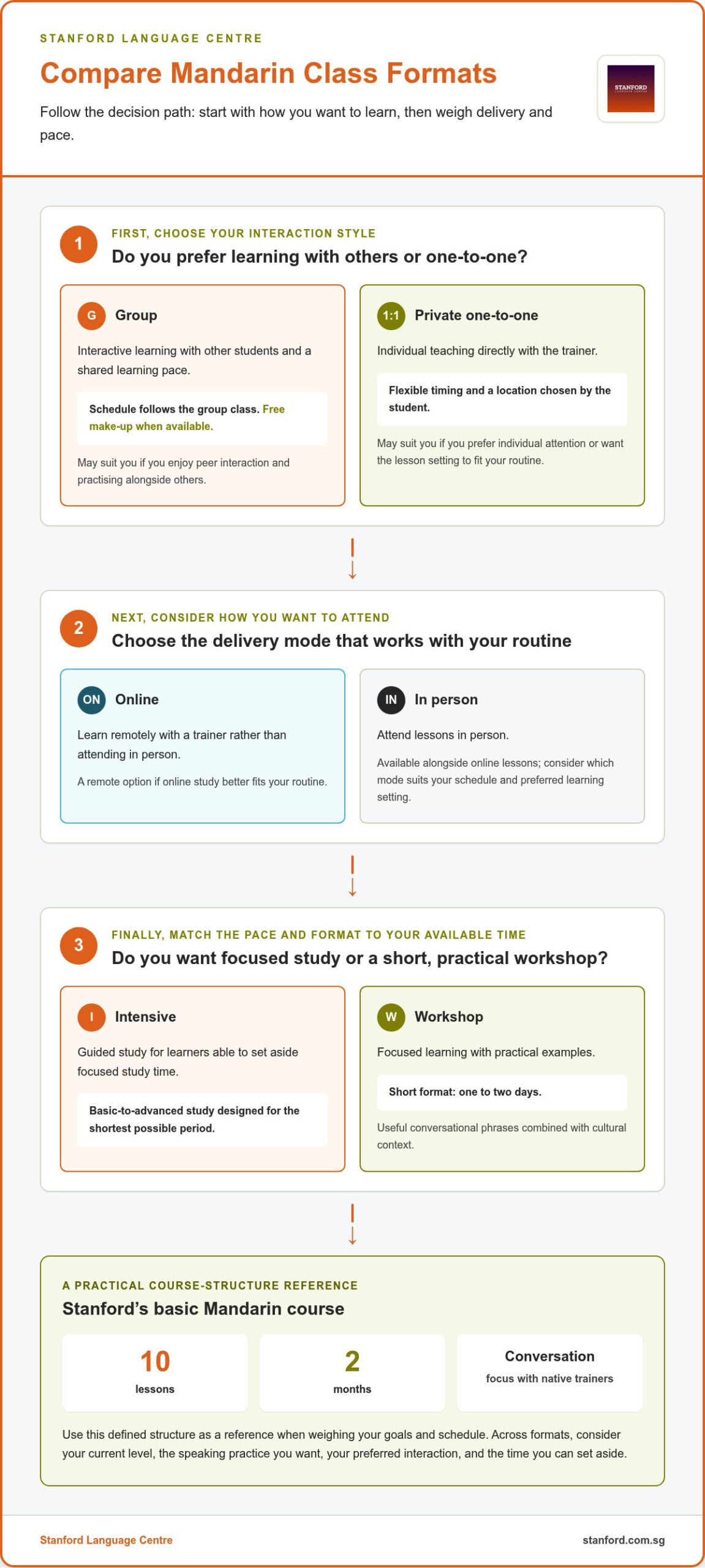
The format shapes how you practise, interact, and fit lessons into your routine. Use this comparison to narrow down the Mandarin classes Singapore offers according to what matters most to you. Each option balances peer interaction, scheduling flexibility, and pace differently.
| Format | Interaction | Scheduling flexibility | Pace and intended use |
|---|---|---|---|
| Group | Interactive learning with other students | Follows the group class schedule; Free make-up when available | Shared learning pace; suits learners who enjoy practising with peers |
| Private one-to-one | Individual teaching with the trainer | Flexible timing and a student-chosen location | One-to-one learning; useful for learners who prefer individual attention |
| Online | Learning with a trainer remotely | Study online rather than in person | A remote option for Mandarin lessons |
| Intensive | Guided study with a trainer | Suited to learners able to set aside focused study time | Basic-to-advanced study designed for the shortest possible period |
| Workshop | Focused learning with practical examples | Short format, lasting one to two days | Useful conversational phrases combined with cultural context |
Group or private Mandarin lessons: which suits your priorities?
Choose group learning if you like an interactive setting and want opportunities to learn alongside others. Stanford’s group classes include Free make-up when available, so a make-up lesson depends on availability. Private lessons are one-to-one, with flexible timing and a location chosen by the student. This can suit learners who prefer individual teaching or want the lesson setting to fit their routine.
Picture how you’ll participate before deciding. Do you enjoy hearing other learners try a phrase and taking turns speaking? A group may feel engaging. Would you rather focus directly on your own questions with the trainer? Private lessons offer a one-to-one structure. Choose the format that makes regular practice feel manageable.
Online, intensive, or workshop learning: what changes?
Mandarin lessons are available online or in person, so you can choose the delivery mode that works with your routine. Online learning may appeal if you prefer remote study; Coursera’s range of online Mandarin courses for adults also illustrates how structured study can be offered online. Intensive lessons suit learners able to concentrate their study into the shortest possible period, with content spanning basic to advanced levels.
A workshop is a shorter option, lasting one to two days and combining useful conversational phrases with cultural context. It can suit learners looking for a focused introduction rather than an ongoing class format. To compare Stanford’s group, private, online, and other Mandarin learning options, explore Mandarin class options.
How Stanford’s 10-Lesson Mandarin Course Fits a Two-Month Plan
A defined course length can make it easier to plan your learning around work and personal commitments. Stanford’s basic course gives adult beginners a clear framework for practising conversational Mandarin. Use the structure to understand the course format, then consider how attendance and practice outside class fit your routine.
Stanford’s 10-Lesson Basic Mandarin Course consists of exactly 10 lessons over 2 months. The lesson count and duration describe the course structure, not a guaranteed result or a fixed pace of progress for every learner.
What does a two-month basic Mandarin course include?
The basic course consists of 10 lessons spread across 2 months, with a practical conversational focus for adult learners. That gives you a defined period of guided study to work on using Mandarin in conversation. It’s a useful reference point when comparing Mandarin classes Singapore learners can choose, especially if you want a course with a clear start-to-finish structure.
The structure sets out the number of lessons and the overall duration, but not a weekly timetable or session length. Consider whether a two-month course period suits your calendar and how consistently you can attend. A course plan is a framework for learning, not a measure of what each person will achieve.
Can a short Mandarin course create useful progress?
A short course can offer a practical starting point, particularly when the teaching focuses on conversation. Useful learning may mean becoming more familiar with speaking practice or building a foundation to continue from. Individual progress varies, and the course structure doesn’t guarantee fluency, a test result, or the same outcome for every student.
Attendance helps you take part in lessons and follow the course structure. Practice outside class can give you more opportunities to revisit what you’ve been learning. Keep it manageable: set aside time to review class material and think of everyday situations where you’d like to use Mandarin. These are personal practice habits, not extra course requirements or promised results.
For a wider view of formal study, edX’s overview of structured Mandarin learning programs offers another reference for how courses organise language learning. To explore practical speaking contexts in more detail, Stanford’s conversational Mandarin guide provides related learning context. These resources can help you decide whether a focused basic course is a sensible next step or part of a longer learning plan.
Choose a Mandarin Class Using These Practical Questions
A good choice starts with your priorities, not with the format that sounds most intensive. Before enrolling, work through four questions: what you want to do in Mandarin, where you’re starting from, how much study time you can set aside, and whether you learn best with peers or one-to-one support. Your answers can help turn a broad search into a practical shortlist.
- What’s your immediate goal? Decide whether you’re focused on everyday conversation, professional communication, or a structured beginner start. A clear goal helps you judge whether a class’s practical focus matches what you want to practise.
- What’s your current level? Be realistic about what you can already understand or say. If you’re new to Mandarin, a beginner course can provide a guided starting point. If you have some experience, consider what you’d like to strengthen next.
- How much time can you set aside? Think about your typical week and the study time you can sustain alongside work and other commitments. A realistic plan is more useful than choosing a course pace that feels difficult to maintain.
- How do you prefer to interact? If you enjoy practising alongside other learners, group classes offer an interactive setting. If you’d rather focus on individual questions and one-to-one teaching, consider private lessons.
What should you decide before enrolling?
Consider how you want to take part in class. Learners who value peer interaction may find group learning motivating, while those who prefer individual attention may feel more comfortable with private lessons. If your schedule is busy, private lessons offer flexible timing, and online learning provides a remote way to take lessons. Choose based on what you can realistically keep up with.
For group learning, think about how interaction supports your goal. If practising with classmates is a priority, Stanford’s small-group Mandarin lesson comparison can help you consider that format more closely. Group classes are interactive and include Free make-up when available.
How can expats and different learners find a suitable starting point?
Adults bring different language backgrounds, reasons for learning, and preferences for classroom interaction. You may be starting from scratch or building on Mandarin you’ve encountered before. Stanford offers specialised small-group Mandarin programmes for Japanese speakers and Korean speakers, alongside adult Mandarin learning options. The Mandarin course guide for expats adds context for learners considering their starting point.
Use your answers as a simple decision guide: match your goal to the kind of practice you need, choose a starting level that feels appropriate, and pick a format you can fit into your routine. That makes comparing Mandarin classes Singapore offers more personal and less overwhelming. Explore Mandarin learning options that suit your goals and preferred way to learn.
Start Mandarin Classes with Stanford Language Centre
You’ve compared learning formats and considered what you want from a course. Stanford Language Centre offers adult Mandarin learning through group classes, private one-to-one lessons, online lessons, intensive lessons, and a basic course with a defined structure. Classes focus on practical conversation and are taught by native trainers, giving adult learners a guided setting to practise using Mandarin.
What makes Stanford’s Mandarin learning approach practical?
The conversational focus connects learning to spoken use. Group classes are interactive, which can suit learners who enjoy practising alongside others. They include Free make-up when available. Private lessons provide one-to-one teaching, with flexible timing and a location chosen by the student. If remote study fits your routine better, Mandarin lessons are available online as well as in person.
Stanford also offers intensive lessons and a basic Mandarin course. The basic course consists of exactly 10 lessons over 2 months. These options give you different ways to approach study, whether you prefer an ongoing class, individual instruction, remote lessons, or a more intensive format. The right fit depends on the learning style and schedule you’ve identified.
Google-sourced testimonials mention friendly staff and engaging lessons, as well as reasonable prices and effective progress. These comments offer a glimpse of learners’ experiences, but individual experiences can vary. Use them as one point of reference alongside the course format, conversational focus, and practical details that matter to you.
How can adults enquire about Mandarin classes?
To explore an option, contact Stanford Language Centre by phone at 9737 9914 or 9656 2095, or email info@stanford.com.sg. Pricing is available on request. You can ask for details about the Mandarin learning option you’re considering rather than relying on estimates or assumptions.
Stanford’s Mandarin programmes are NTUC UTAP-claimable. Eligibility and scheme terms can change, so review the current NTUC UTAP requirements before planning to make a claim. This keeps your course decision grounded in both learning fit and the information relevant to your circumstances.
You don’t need to settle every learning goal before taking a first step. Start with the format that feels manageable, then build your routine from there. Explore Mandarin classes with Stanford.
Take the Next Step at Your Own Pace
Your first Mandarin class doesn’t need to define your entire learning journey. Start by choosing one practical aim, such as feeling more comfortable in a simple conversation or building a foundation for future study. Then pick a format you can realistically make room for. A manageable start can make it easier to continue learning on your terms.
If you’re still weighing Mandarin classes Singapore offers, use the details that matter most to make the decision clearer. Stanford’s online and in-person options provide different ways to take part, while the basic course’s 10 lessons over 2 months gives you a defined starting structure. Google-sourced reviews also mention friendly staff and engaging lessons, which may help you picture the learning environment.
You don’t need to wait until you feel completely ready. Explore the available options, choose a next step that fits your routine, and let your goals guide what comes after. Explore Mandarin classes with Stanford Language Centre and begin at a pace that feels right for you.
Frequently Asked Questions
How much do Mandarin classes in Singapore cost?
Stanford’s current fees are available on request. When enquiring, mention whether you’re interested in group, private one-to-one, or online learning, along with your learning goal. That helps you ask about the class that fits your needs instead of relying on a general estimate. Call 9737 9914 or 9656 2095, or email info@stanford.com.sg.
How long is Stanford’s basic Mandarin course?
Stanford’s 10-Lesson Basic Mandarin Course consists of exactly 10 lessons spread over 2 months. It’s designed for adults seeking conversational Mandarin, but the course structure doesn’t guarantee that every learner will reach the same level. When comparing Mandarin classes Singapore offers, consider whether this timeframe suits your plans, then request current course details and pricing before deciding.
Can I take Mandarin classes online?
Yes, Stanford offers Mandarin lessons online as well as in person. Online learning may suit you if remote lessons fit more easily around work or other commitments. Consider whether you prefer interaction with other learners or one-to-one teaching, then share your preferred format and learning goal when enquiring.
Are Mandarin classes suitable for complete beginners?
Yes, adults new to Mandarin can consider Stanford’s basic course, which focuses on conversational learning. It consists of 10 lessons over 2 months, providing a defined structure for starting out. Before choosing, think about whether you’d feel more comfortable learning in a group, privately, or online. You can then request current course details and pricing based on the format you’re considering.
What happens if I miss a group Mandarin class?
Stanford offers Free make-up when available for group classes. The availability condition matters, so a make-up lesson isn’t guaranteed for every missed session. If your schedule can change unexpectedly, factor this into your decision. Private lessons provide another format to consider, with flexible scheduling that may better suit changing commitments.
Can eligible companies receive an SSG Training Grant for Mandarin training?
Eligible corporate groups may qualify for an additional Training Grant from Singapore SkillsFuture (SSG) alongside a special corporate rate. Eligibility isn’t automatic for every company or participant, and current scheme terms apply. Stanford provides corporate Mandarin training tailored to business communication needs. For an enquiry, email info@stanford.com.sg or call 9737 9914 or 9656 2095 to discuss your training requirements.