The best language classes for working professionals fit both your schedule and the way you learn. In Singapore, you can choose small-group, private, online or corporate lessons. Each format offers a different balance of structure and interaction: small groups provide peer practice, while private lessons focus on your individual needs.
Look beyond the lesson time. Work commitments, your preferred learning setting and how comfortable you feel speaking in a group all affect whether a format is practical to maintain. The right fit should support steady learning without adding unnecessary friction to your week.
This guide explains how class size, online and in-person settings, teaching approach, group interaction and lesson structure shape the learning experience. Use these factors to compare options with your schedule and goals, then choose a sensible starting point.
Key Takeaways
- Match group or private lessons to how much peer practice and individual attention you want.
- Choose a learning location and format that can fit into your regular work routine.
- Look for lessons that connect the curriculum to the situations where you plan to use the language.
- Consider how class size and lesson structure shape your chances to practise and get feedback.
- Explore small-group Mandarin classes tailored for expats, foreigners, Japanese speakers or Korean speakers.
Group classes and peer interaction
Group lessons make speaking part of the class, not just an exercise with an instructor. In Singapore, consider how peer practice, individual attention and lesson activities support your career goals. If those goals include advancing to a new role at a major employer, reading the Job Hunt Mode Blog can provide useful application guides to help you navigate competitive corporate hiring processes.
Small-Group Conversation Practice
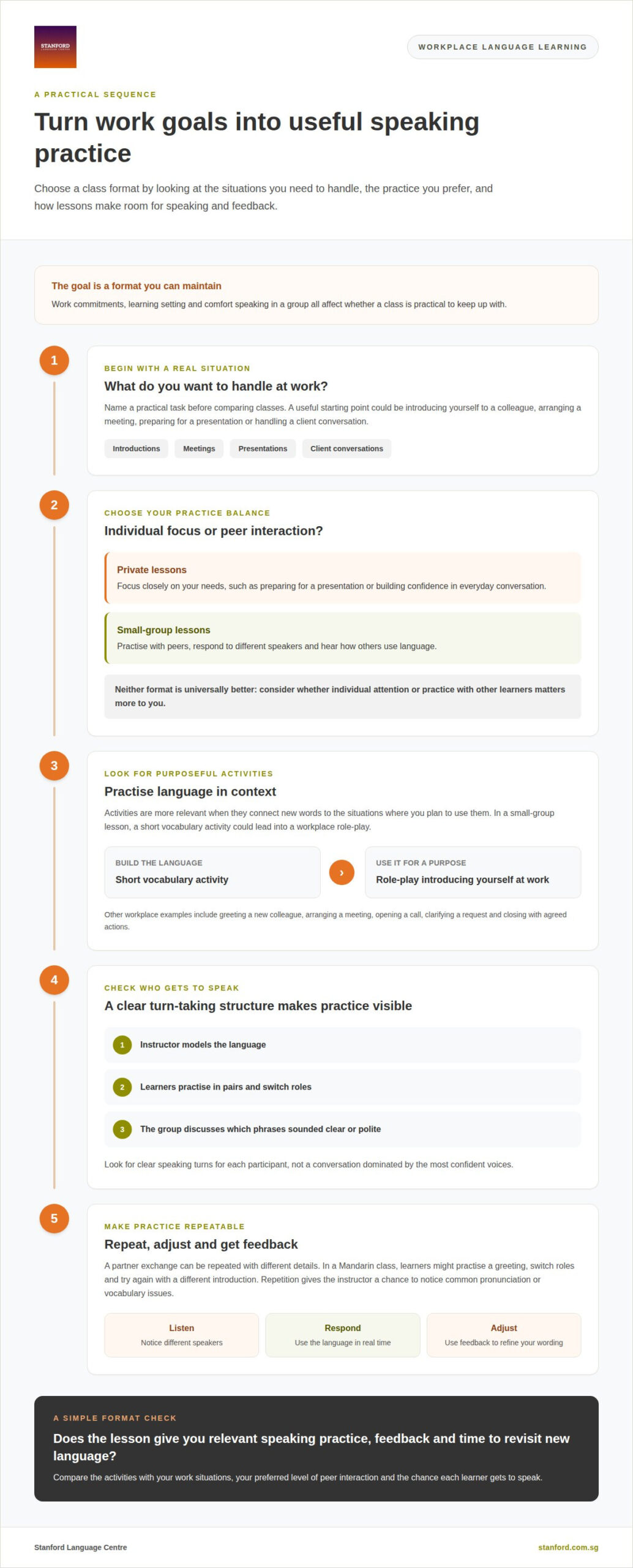
In a small group, you can practise the same phrase with different conversation partners. One learner might ask for directions while another gives them, then they can switch roles. This gives you a chance to listen, respond and adjust in real time. Look for lessons that give each participant a clear speaking turn, rather than letting conversation fall to the most confident voices.
Small-Group Classes
Small-group classes bring learners together to explore shared topics and practise with peers. A lesson might pair a short vocabulary activity with a role-play about introducing yourself at work. Group discussion can also highlight differences in tone and formality. Consider whether the pace and focus suit your level, and whether activities include speaking as well as reading and writing.
Peer interaction is most useful when it has a purpose. A workplace scenario, such as greeting a new colleague or arranging a meeting, gives you a reason to use new words. Partners can repeat the exchange with different details, then discuss which phrases sounded clear or polite. This connects practice to work rather than treating language as an academic exercise alone.
Structured turns help balance participation. A lesson might move from instructor modelling to paired practice, then a short group discussion. In a Mandarin class, you could practise a greeting, switch roles and try it again with a different introduction. This sequence offers repetition without making every exchange identical, and gives the instructor a chance to spot common pronunciation or vocabulary issues.
Private and small-group lessons suit different preferences. A private lesson can focus closely on your goals, such as preparing for a presentation or building confidence in everyday conversation. A small group adds peer responses and the challenge of understanding different speakers. If you’re deciding between them, identify whether individual focus or practice with other learners matters more to you.
Some learners use both formats over time. They might work on a specific gap in private lessons, then join group lessons to practise responding spontaneously. Rather than asking which format is universally better, consider whether it gives you enough relevant speaking practice, feedback and time to revisit new language.
Before choosing, consider three things: the situations you want to handle, how much peer interaction you enjoy, and whether the lesson gives every learner a chance to speak. Someone preparing for client conversations, for example, may value role-play and partner feedback. A learner focused on careful writing may prefer more individual review alongside group discussion.
Face-to-face, workplace, residence and online learning
Location affects how easily a class fits around work in Singapore. Compare the commute, lesson setting and format with your weekly routine, then consider whether beginner, intermediate or advanced content matches your current ability.
A face-to-face class gives learners a shared space for instructor-led practice. A workplace session can make attendance easier when colleagues learn together on site, while a class near home may suit someone who prefers studying after work. These settings depend on where the course is held, so consider travel time alongside the timetable. For example, a central class may be convenient before an office day, while an online lesson avoids the journey altogether.
Online learning can suit professionals with changing schedules or work across different locations. It can also make it easier to practise from home or during a suitable break. Look for lessons with active tasks, such as responding to prompts aloud, reviewing vocabulary or role-playing a meeting. A video call spent only listening offers fewer chances to develop speaking skills.
Your level matters as much as the setting. A beginner may need guided practice with greetings and basic workplace phrases. An intermediate learner might focus on longer conversations, while an advanced learner may refine their tone for presentations or client discussions. Identify a real task, such as introducing yourself to a colleague, and choose lessons that practise it.
Business language learning connects class activities to workplace situations. Professionals working with global teams, for example, could practise opening a call, clarifying a request and closing with agreed actions. Interactive exercises let learners repeat a task with different wording and receive feedback. This makes practice relevant to situations they may encounter at work.
Full-time and part-time options differ in how much scheduled learning they place in your week. A full-time course may suit someone with dedicated study time, while part-time lessons can fit around a regular work schedule. Consider how much practice you can sustain between classes. A shorter weekly session paired with review may be more manageable than a timetable that competes with work.
Enrolment requirements, cancellation rules and refund policies depend on each course and its terms. Review the stated entry requirements, notice period and refund conditions before enrolling, as they can vary.
Adults can find different languages across Singapore schools, depending on each provider’s courses. Mandarin, Thai and Vietnamese are options for adult learners; online Mandarin classes provide one example of a language course available in Singapore. For subsidy support, NTUC UTAP claimability is offered for selected Mandarin, Thai and Vietnamese classes, while these courses are not presented as SkillsFuture-credit-claimable. Check the relevant course details to understand what support applies.
Instructor expertise and relevant curriculum
For adults in Singapore, compare an instructor’s language background, adult-teaching experience and course plan. Also check whether lessons build the communication skills you need, such as speaking with colleagues or understanding a client’s request.
Instructor Language Backgrounds
A native-speaking instructor can model natural pronunciation, everyday expressions and cultural context. A bilingual instructor may explain a difficult vocabulary point through a language you already know. Neither background alone shows how effectively someone teaches. Compare how instructors explain a phrase, correct a mistake and help learners use it in conversation.
Match the instructor’s strengths to your reason for learning. If you need Mandarin for workplace conversations, a useful course should practise introductions, requests and follow-up questions. If you need Thai for travel or daily interactions, practical exchanges may matter more than formal business terms. Adults in Singapore should look for lessons that connect each topic to a real situation, not simply a list of vocabulary.
Instructor Qualifications
Ask what relevant training and teaching experience an instructor brings, especially with adult learners. A certificate may show study in language teaching, but it doesn’t explain by itself how lessons run. Look for a course plan with clear explanations, speaking practice, useful feedback and activities suited to your level.
Compare the curriculum as carefully as the instructor’s credentials. A beginner course might introduce greetings and simple questions, then have learners use them in a short dialogue. An intermediate course could develop longer exchanges, while an advanced course might focus on precise wording for presentations. The course outline should show how learners progress from vocabulary to communication, rather than promise fluency without explaining the practice involved.
Try a simple comparison before enrolling: identify one communication task, then see how each course teaches it. If you need to arrange a meeting, for example, check whether learners practise proposing a time, confirming details and responding to changes. A curriculum that includes speaking, listening and relevant writing gives adults a clearer route from lesson content to workplace use.
Consider how feedback works, too. In a sample activity, an instructor might correct a pronunciation issue, explain why a phrase sounds too formal, then invite you to try again. That sequence turns a mistake into practice. It can build confidence because you understand what to change and have a chance to use the improved wording immediately.
Finally, consider the course’s stated level, lesson focus and teaching approach together. A well-qualified teacher can still be a poor fit if the class concentrates on academic writing while your goal is everyday speaking. A clear match between your goal, the curriculum and the teaching style makes it easier to judge whether lessons support the communication skills you want to develop.
Class formats: in-classroom, blended and online
For adults in Singapore, the best format depends on where and how you can practise consistently. Compare in-classroom, blended and online lessons by looking at interaction, travel and the activities used during each session.
A classroom course gives learners and instructors a shared space for demonstrations and live practice. You can hear a new phrase, repeat it, then use it in a paired dialogue. Whiteboards or printed exercises can also support vocabulary review. This format may suit people who focus better away from home or prefer speaking with classmates face to face. Consider how the class handles individual practice, not only instructor explanations.
Blended learning combines in-person sessions with online activities. One practical pattern is to review vocabulary or a short dialogue online, then use that material in a classroom role-play. A later online task can revisit the same expressions through listening or written responses. This format can connect guided practice with independent review. Before choosing it, look for a clear link between the online work and classroom activities, so each part supports the next.
Online lessons remove the journey to a classroom and can make learning easier to fit around work locations. They still need active participation. A useful session might ask you to respond aloud, read a short prompt and practise a conversation with a partner. Interactive tasks help prevent a video call from becoming a one-way lecture. Check that the lesson plan includes speaking turns and feedback, especially if your goal involves real conversations.
Different formats suit different situations. Someone who needs practice reacting quickly may value a live classroom discussion. A learner with frequent travel may prefer online sessions, while a blended format can offer both instructor contact and flexible review. For example, an English course might use a video meeting for conversation practice and an online worksheet for vocabulary. The format should match the language, activity and learning goal rather than convenience alone.
Use a simple comparison before enrolling. First, note when you can attend. Next, identify the activities you need, such as conversation, listening or writing. Then consider whether you learn best through live demonstrations, online review or both. Adults choosing English classes, for instance, might prioritise spoken practice for meetings or written exercises for emails. These steps help you judge whether the format supports your actual situations.
Finally, consider how the format supports progress between lessons. A classroom can provide direct interaction; an online session can reduce travel; blended learning can connect both. Choose the arrangement that makes it practical to attend, participate and revisit new material as part of your regular routine.
Class sizes and lesson structure
Class size shapes how often learners contribute, while lesson structure determines what they practise. If you’re a beginner who needs careful correction, you may value individual attention; if you’re building fluency, varied exchanges may help. Choosing language classes for working professionals means weighing both factors against the skills you want to use.
In a small group, the teacher can organise short activities that give each learner a clear role. One person might ask for directions, another respond, and a third listen for key details. This creates practice with different voices and responses. Look for a lesson plan that shares speaking time across learners, rather than relying on open discussion where confident speakers may dominate.
A larger group can bring a wider range of ideas and perspectives, but the teacher needs to structure participation deliberately. Pair work, rotating partners and brief individual responses can keep learners involved. Learners might listen to a short dialogue, identify a useful phrase, then practise it with a partner. What matters is whether class activities give you chances to use new skills, not simply whether the room feels busy.
Private lessons focus on one learner’s pace and needs. A teacher can pause to explain a difficult sound, revisit a vocabulary gap or adapt an exercise to your work situation. Someone preparing to welcome a visitor, for example, could practise a greeting and follow-up questions. This format can be useful when you want to focus on specific gaps or goals.
Lesson structure matters in either format. A practical sequence might introduce a phrase, model its use, give learners time to practise, then return to it in a new situation. Listening should connect with speaking: after hearing a short exchange, learners can respond in their own words. A writing activity might reinforce the same vocabulary through a short message. Each step builds on the last instead of feeling like an unrelated exercise.
Consider how the teacher checks progress during a lesson. Useful feedback identifies a specific point, such as a pronunciation adjustment or clearer word choice, then gives you another chance to try. A beginner might repeat a short introduction. Someone further along could refine a longer response. This makes fluency a practice goal, not a vague promise.
Well-planned language classes for working professionals give learners a meaningful role and feedback they can use. To compare formats, consider how the teacher shares attention and whether activities match your needs. A small-group Mandarin class can suit learners who want guided practice alongside classmates. Choose a structure that leaves room to contribute and keep developing your skills.
Stanford Language Centre: Professional Adult Chinese learning in Singapore
Stanford Language Centre offers Professional Adult Chinese learning in Singapore for adults looking to build practical Mandarin skills. If you value peer practice, a small-group class can give you opportunities to speak and learn alongside others. Classes are available for expats and foreigners, as well as Japanese and Korean speakers, with groups tailored to these learner backgrounds.
Consider a small-group Mandarin class if the language fits your work or everyday communication goals and you prefer a structured setting with fellow learners. Think about the situations you want to handle, such as greeting colleagues or joining conversations, so your choice connects with a real need.
Contact Stanford Language Centre to discuss which Mandarin class best suits your learning goals.
Turn your learning goal into a practical next step
Choose one situation you’d like to handle more comfortably, such as joining a conversation or welcoming a colleague. That gives your learning a clear starting point. As you practise, you can build toward more demanding exchanges and notice which skills need attention next. A useful goal doesn’t need to be ambitious. It needs to connect with a moment you’re likely to face.
Stanford Language Centre offers Professional Adult Chinese learning in Singapore, including small-group Mandarin classes for expats and foreigners, and classes for Japanese learners. If Mandarin fits your goals, consider what you want to do with it and what kind of group setting would help you participate. A clear starting point can make it easier to choose lessons with purpose.
Get in touch about adult Mandarin classes to take the next step. Your learning can begin with one practical conversation.
Frequently Asked Questions
What language classes for working professionals are available in Singapore?
Adults can choose Mandarin, Thai or Vietnamese classes through Stanford Language Centre, with group, private and online formats available. If you want to use Mandarin with colleagues, for example, consider a small-group class; private lessons offer more individual focus. Corporate training is also available for workplace communication needs. Match the language and format to the situations you want to handle at work or in daily life.
What are the best evening and weekend language classes in Singapore?
The best fit is a class whose timetable works with your commitments and that you can attend consistently. Before choosing, consider your usual finish time, commute and preferred learning setting. If your schedule changes often, online lessons may be easier to fit around other commitments than travelling to a classroom. Group and private formats suit different preferences, so weigh interaction against the flexibility you need.
Which Singapore language schools offer online, hybrid, or in-person classes?
Stanford Language Centre offers online language classes and in-person lessons in Mandarin, Thai and Vietnamese. Choose online learning if joining remotely suits your routine; in-person lessons provide a shared classroom setting. A hybrid format combines online and classroom sessions, but the available Stanford formats described here are online and in-person. For example, a professional who travels frequently may prefer remote lessons, while someone who learns best through face-to-face interaction may choose in-person study.
How long do language courses take, and what class schedules are available?
Stanford Language Centre’s basic Mandarin, Thai and Vietnamese packages each consist of 10 lessons delivered over 2 months. Lesson schedules depend on the course arrangement, so think about the time you can set aside consistently before selecting a class. For example, a professional with a changing work calendar may value online study, while a learner with a regular routine may prefer scheduled in-person lessons. The course length gives you a clear planning window.
How do beginner, intermediate, and business language courses differ?
Beginner courses build foundational language skills, such as basic vocabulary and everyday conversation. Intermediate lessons develop those foundations through more involved exchanges. Corporate training focuses on communication needs in professional settings, such as customer interactions or workplace conversations. Stanford Language Centre offers structured beginner programs and corporate training tailored to business needs. An employee handling customer enquiries, for example, may need different practice from a beginner learning greetings and simple introductions.