You can begin speaking Mandarin before learning Chinese characters. A basic Chinese class often starts with everyday conversation, while beginner phrase guides cover 105 essentials for greetings, numbers, directions, ordering food and asking for help. Some Chinese-for-beginners courses focus on speaking without requiring character study.
It’s natural to wonder how quickly you can move from first phrases to confident conversation, and what a course includes. A clear structure helps: lessons build practical skills step by step, giving you opportunities to practise and use new language.
This guide explains what beginners typically learn, how Mandarin skills progress through course levels, and what fees may cover. You’ll also see how class format can shape the learning experience, from small-group practice to private lessons. By the end, you’ll have a practical way to assess which starting point suits your goals, schedule and preferred pace, without needing prior knowledge of Mandarin.
Key Takeaways
- Start with practical phrases for everyday situations, then build confidence through regular conversation practice.
- Learn how Pinyin and tone practice can help you pronounce Mandarin words more clearly.
- Use course levels to find a suitable starting point and understand how beginner skills can develop over time.
- When comparing course fees, look at what the fee covers and how the class format fits your learning needs.
- Explore small-group options tailored for expats and foreign learners, Japanese speakers, and Korean speakers.
Daily-life conversations and communication
Daily Mandarin starts with useful exchanges, not long speeches. Beginners might greet a neighbour, introduce themselves, or ask for directions. These situations help learners listen for key words and respond clearly. Asking where a train station is, for example, combines a question, a place, and a direction. Ordering a drink at a food court adds a choice and a polite request. Each exchange gives new vocabulary a clear purpose.
Everyday topics make practice easier to apply. Learners can role-play meeting someone, discussing family, buying groceries, or arranging a meal. In Singapore, a conversation might involve finding a shop, choosing a dish, or asking how to get somewhere. Try this sequence: listen to a model exchange, repeat each turn, then change one detail, such as the dish, destination, or meeting time. This develops flexible communication rather than relying on memorised lines.
Real conversations also involve asking for help when something is unclear. Beginners can practise asking someone to repeat, speak more slowly, or clarify a word. Listen for the main idea first, rather than trying to catch every detail. If a speaker mentions a place and a time, those details may be enough to respond. In a paired role-play, one learner asks for directions and the other gives them. Then they switch roles and change the destination.
Elementary business Chinese uses familiar exchanges in workplace settings. Learners might practise greeting a colleague, introducing their role, arranging a meeting, or asking about a schedule. A short dialogue can follow a practical sequence: greet the other person, state the purpose, confirm a detail, and close politely. For example, rehearse confirming a meeting time. The aim is clear, appropriate communication, not complex negotiation or specialist vocabulary.
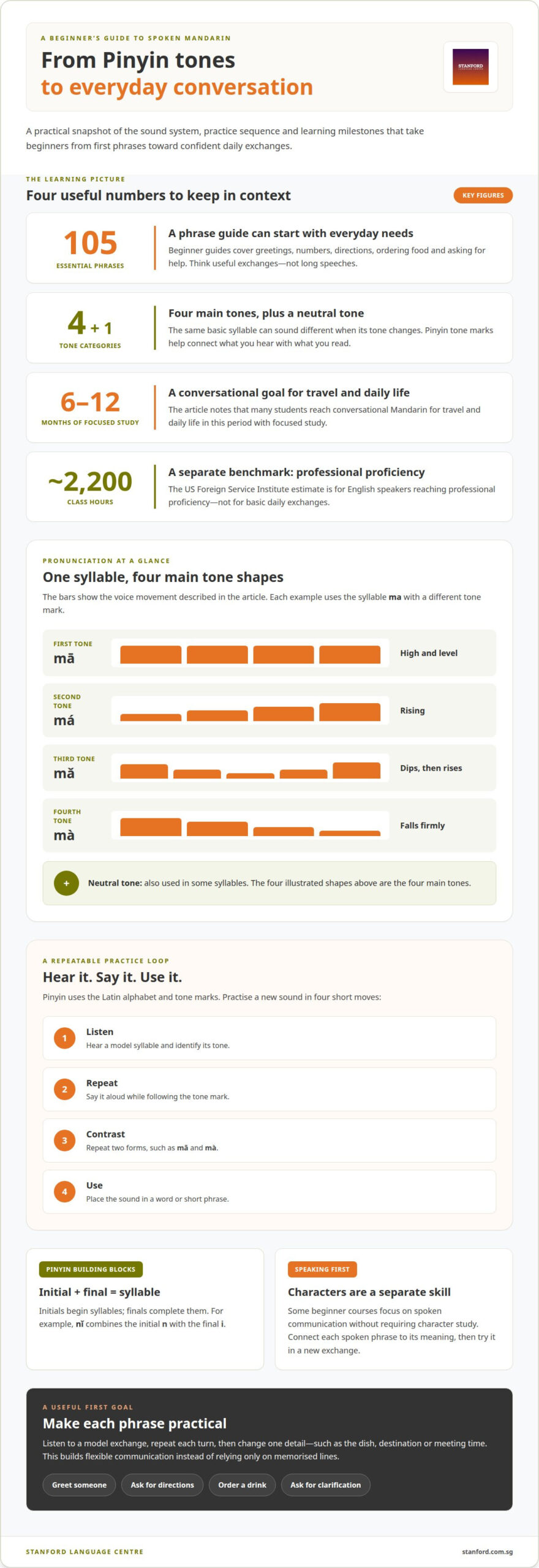
Progress takes sustained study. The US Foreign Service Institute estimates that English speakers need around 2,200 class hours to reach professional proficiency in Mandarin. That estimate describes professional proficiency, not the time needed for basic daily exchanges. The institute also classifies Mandarin as a Category IV language. A beginner can focus first on useful conversation, while understanding that broader proficiency requires continued learning and practice.
Reading can support speaking, but it needn’t dominate an early conversation goal. Some courses focus on spoken communication without requiring learners to study Chinese characters. Lessons can connect a spoken phrase with its meaning, then use it in a new exchange. To practise a conversation, listen, respond, and adapt one detail. This gives each dialogue a practical next step.
Mandarin pronunciation, tones and Pinyin
Hanyu Pinyin writes Mandarin sounds with the Latin alphabet and tone marks. It helps beginners connect spoken words with readable spellings. For example, mā, má, mǎ and mà use the same basic syllable but different tones. Tone marks show how the voice moves, so pronunciation practice starts with listening and repeating, not guessing from English spelling.
Mandarin has four main tones, plus a neutral tone used in some syllables. The first tone stays high and level, as in mā. The second rises, as in má. The third dips before rising, as in mǎ. The fourth falls firmly, as in mà. Practise one syllable across the four tones to hear the contrast.
- Listen: Hear a model syllable and identify its tone.
- Repeat: Say it aloud while following its tone mark.
- Contrast: Repeat two forms, such as mā and mà.
- Use: Place the sound in a word or short phrase.
Pinyin also introduces initials and finals. Initials begin syllables, while finals complete them. For instance, nǐ combines the initial n with the final i. Practise a new sound by listening, repeating it, and then using it in a familiar phrase. This step-by-step approach builds pronunciation alongside basic vocabulary.
English spelling can mislead learners: a Pinyin letter may not sound exactly like its English counterpart. Listen to a teacher’s model before reading a new syllable aloud. Repeat it slowly, notice your mouth shape, and then try it at a natural pace. For example, practise zh and z in separate syllables. Clear feedback helps you notice the difference between sounds.
Pinyin supports speaking and early reading, but it isn’t the same as writing Chinese characters. A beginner program may prioritise spoken Mandarin, with character recognition taught as a separate skill. Learning is more manageable when each lesson links a sound, tone, meaning, and example. A short review can revisit vocabulary and check pronunciation and tone before introducing new material.
For guided practice with Pinyin and spoken Mandarin, explore adult Mandarin learning in Singapore.
Regular, focused practice can make a clear goal feel more approachable. Many students reach conversational Mandarin for travel and daily life in 6-12 months of focused study. Keep that goal tied to communication: learn a useful phrase, listen for its tones, and say it aloud until its sounds feel familiar. When a phrase is difficult, return to its individual syllables, check the Pinyin, then rebuild the whole expression at a natural pace. This keeps pronunciation connected to meaning rather than treating tone marks as decoration.
Public examples can also remind learners that spoken Mandarin is used in formal settings as well as everyday exchanges. Mark Zuckerberg gave a Mandarin speech at Tsinghua University in 2014. For a beginner, the practical takeaway is to build confidence gradually: practise short exchanges, notice how tones distinguish syllables, and reuse familiar vocabulary in new phrases. Consistent listening and speaking give learners a way to apply Pinyin beyond the page, whether preparing for travel or handling daily conversations.
Chinese course progression from Levels 1 to 3
Levels offer beginners a route from supported phrases to more independent conversations. Look at the skills practised at each stage, not just the level number.
Progression Through Course Levels
Level 1 is the starting point for learners new to Mandarin. Lessons can build basic vocabulary, pronunciation, introductions, and short exchanges. At Level 2, a course can extend those skills through longer conversations, more varied topics, and less reliance on prompts. Level 3 can focus on expressing opinions, handling detailed situations, and responding with greater flexibility.
Level names don’t guarantee identical content across schools. Compare the course descriptions by asking what learners can understand and say at each stage. For example, can a Level 1 learner introduce themselves? Can a Level 2 learner manage a familiar conversation? Can a Level 3 learner explain a preference? These outcomes make progression easier to judge.
Entry Requirements and Placement
Adult beginner courses are designed for learners with little or no Mandarin experience. Prior study may affect placement, so providers may assess listening, speaking, vocabulary, and reading. There isn’t one entry rule for every Chinese course in Singapore. The key distinction is whether you’re starting fresh or already understand basic phrases.
A short placement conversation can reveal whether a learner should begin at Level 1 or enter a later class. For example, someone who can introduce themselves but struggles to follow replies may need more listening practice before moving ahead. Placement should reflect practical language skills, not confidence alone.
Beginner Course Coverage
A beginner course commonly develops spoken Mandarin through greetings, introductions, simple questions, and everyday topics. Some programs also introduce Pinyin, tones, and basic character recognition. Speaking-focused courses can prioritise conversation without requiring learners to study Chinese characters. Compare course content with your goals, such as speaking at work or managing daily interactions.
Online and in-person beginner classes are available in Singapore. Hybrid learning combines both, but its availability depends on the course format. Group lessons give learners practice with classmates, while private tutoring can focus more directly on an individual’s pace and goals.
Course length and class frequency depend on the program schedule, lesson structure, and time for practice between sessions. A steady timetable supports regular review; longer gaps may mean you need to revisit vocabulary before each class. Ask how the course progresses and how lessons build on previous work.
For a personalised study plan, set a clear goal first, such as introducing yourself or handling a workplace exchange. Then match the course level, format, and conversation practice to that goal. This keeps learning practical and gives beginners a clear next step.
Course fees and estimated payable fees
Course fees in Singapore vary with lesson format, course length, and materials. Group courses and private tuition use different teaching arrangements, so their fees aren’t directly comparable. A learner focused on speaking, for example, may need different materials from someone studying pronunciation, reading, and Chinese characters. Compare what each course includes, not only its headline fee.
The price depends on the course and is provided after a quote request. Factors include lesson format, course duration, class frequency, materials, and whether instruction is tailored to workplace needs. A clear estimate should separate tuition from other course components. Check whether materials, assessments, or additional practice sessions are included, as these details affect the total payable amount.
SkillsFuture Credit may be used by self-sponsored Singapore Citizens aged 25 and above to pay eligible course fees. This does not mean every Mandarin course qualifies, so the key detail is whether the specific course is eligible. Singapore Citizens aged 50 and above may also qualify for an NSA subsidy of up to 50% off the course fee. Eligibility and the resulting payable amount depend on the course and applicable subsidy conditions.
Estimate your budget by organising the costs into clear categories:
- Tuition: identify the course format and its teaching period.
- Materials: note whether books, digital resources, or practice sheets are included.
- Assessment: see whether progress checks form part of the course.
- Funding: distinguish the stated fee from any eligible credit or subsidy.
A learner choosing a speaking-focused course can compare its format and included materials with a course that also teaches characters. A working adult might value scheduled group lessons, while someone else may need private instruction for specific workplace conversations. Your learning goal shapes what feels valuable, even before considering funding.
Ask for a clear breakdown of the estimated payable fee before deciding. Review each item separately and consider how it supports your goals. If pronunciation practice is your priority, instruction and feedback may matter more than written resources. For professional communication, relevant workplace content may be more useful. Comparing these details helps you assess course value without relying on an unsupported market average.
The Chinese for Beginners course’s first module is estimated to take 5 hours to complete. The fourth module is estimated to take 4 hours to complete. These estimates provide a module-level view of the time involved, which can be considered alongside the course fee and the learning materials included.
When reviewing an estimated payable amount, keep these module estimates distinct from the fee breakdown: they describe estimated completion time, not a price. They may help you consider how the course’s learning commitment fits your priorities, while the provider’s quote remains the basis for understanding tuition and any included components.
What do beginner Chinese classes in Singapore cover?
A beginner Mandarin course builds useful speaking skills through familiar situations. Learners practise introductions, greetings, simple questions, and short replies. They might say their name, ask where someone lives, or explain what they’d like to eat. These exchanges give new words a clear purpose. In Singapore, learners can connect practice to conversations at work, shops, and food outlets.
Vocabulary often centres on practical topics. A lesson might cover numbers, dates, family, food, transport, or directions. Learners can use those words in short tasks, such as asking for a price or arranging a meeting. HSK 1 is associated with around 150 vocabulary items, a useful reference point for beginner-level word learning. It isn’t a measure of every course’s syllabus, so lesson outcomes matter more than matching a vocabulary count.
Speaking-focused courses can teach conversation without requiring learners to study Chinese characters. Beginners can practise listening to a prompt, responding aloud, and repeating the exchange with a new detail. For instance, they might change a food order or destination while keeping the same sentence pattern. This approach builds spoken communication before learners take on character reading or writing.
Some courses include reading and writing alongside conversation. Learners may connect spoken phrases with Pinyin, recognise selected characters, and practise writing simple forms. A useful progression is to hear a word, say it, identify its meaning, and then read or write it if the course includes those skills. The balance depends on the course aims and learners’ goals.
Culture can also shape practical language choices. A class may explain how greetings differ by context or why a polite request sounds more natural than a blunt instruction. Learners can compare two ways to ask for help, then practise choosing one for a shop or workplace exchange. These examples connect language practice with everyday interaction instead of treating vocabulary as an isolated list.
Assess course content by matching it with a real task you want to handle. For ordering lunch, look for food vocabulary, listening practice, and role-play. For workplace communication, prioritise introductions, scheduling, and polite requests. A clear beginner course explains what learners practise and how each lesson builds toward useful conversations.
Explore adult Mandarin course options to find a learning path suited to your goals.
Stanford Language Centre: Professional Adult Chinese learning in Singapore
Stanford Language Centre provides Professional Adult Chinese learning in Singapore for adults ready to build practical Mandarin skills. Its small-group classes include options for expats and foreign learners, Japanese speakers, and Korean speakers. These focused learning environments give adults a structured place to practise Mandarin and develop confidence in everyday communication.
Choose a class suited to your background and learning needs. A small-group format can suit learners who value practising with others, while a class designed for Japanese or Korean speakers offers a relevant starting point for those groups. If you’re ready to begin or continue learning Mandarin, contact Stanford Language Centre to discuss your next step.
Take Your First Step Toward Speaking Mandarin
Choose a learning goal you can use in real life, such as introducing yourself or joining a simple conversation. That goal can guide your choice of class and help you notice progress beyond memorised words. A basic Chinese class is a practical place to start building those skills, one lesson and one exchange at a time.
Stanford Language Centre offers adult Chinese learning in Singapore, including small-group classes for expats and foreign learners, and for Japanese speakers. To discuss a suitable starting point, contact Stanford Language Centre.
Every new phrase gives you another way to connect. Start with a clear purpose, keep practising, and let your Mandarin grow at a pace that works for you.
Frequently Asked Questions
Where can I take a basic Chinese class in Singapore?
You can take adult Mandarin lessons with Stanford Language Centre in Singapore. Options include small-group classes for expats and foreign learners, as well as Japanese and Korean speakers. An expat seeking everyday communication, for example, can choose a class designed for foreign learners. Consider whether you prefer group or private lessons, and whether you want to learn in person or online.
What are the best beginner Mandarin classes in Singapore for adults?
The best fit depends on your starting level, learning goal, and preferred class style. Stanford Language Centre offers beginner-focused adult Mandarin learning, including small groups tailored to expats and foreign learners, Japanese speakers, and Korean speakers. If you want to practise with peers, a group class may suit you. If you prefer individual attention, private Mandarin lessons are another option.
How much do basic Chinese classes cost in Singapore?
Course fees depend on the class format, duration, and learning materials, and the price is given after a quote request. Stanford Language Centre’s basic Mandarin package consists of 10 lessons over 2 months, including instructional time, practice materials, and access to native trainers. UTAP-claimable Mandarin options are available. Compare what each fee covers alongside the schedule and teaching format.
What should I look for when choosing a beginner Chinese class?
Start with the situations you want to handle, such as introducing yourself to colleagues or making a simple request at work. Then look for lessons that practise those tasks through dialogue and feedback. Check that the class suits your current Mandarin level and preferred format. A useful course description explains what learners practise, how lessons are delivered, and whether the focus is speaking, characters, or both.