Fast progress comes from steady practice, not cramming vocabulary. An adult Chinese class in Singapore usually builds Mandarin through structured lessons, groups learners by their starting level, and checks progress through practical speaking and listening activities. The exact weekly schedule and assessment style depend on the course.
It’s understandable to want a clear plan before committing your time. You’ll learn what weekly lessons can cover, how beginner and more experienced learners are placed, and how progress checks help identify what to practise next. We’ll also explain how group, private, online and workplace learning options can suit different goals, so you can picture a learning routine that fits your needs.
Key Takeaways
- Look for lessons that turn new Mandarin into practical speaking and listening practice through interactive activities.
- Use the course schedule and lesson rhythm to judge how learning can fit around your weekly routine.
- Choose learning materials and practice tasks that match your current proficiency, from beginner foundations to everyday conversation.
- Find out how progress is assessed and what evidence of learning a course provides before you enrol.
- Consider small-group classes designed for adult learners, including options for expats, foreigners, Japanese speakers and Korean speakers.
Teaching methods and interactive activities
Mandarin becomes more usable when class time includes practice, not only explanations. A lesson might introduce a greeting, model its tones, then have learners practise it in a short conversation. For example, one learner asks for directions and another responds. The teacher can then correct pronunciation and word choice while the exchange is still fresh.
Choose a group class for shared conversation practice or private lessons for one-to-one learning. For workplace goals, corporate training can be tailored to business communication needs. For example, practise everyday introductions with classmates, focus on a personal learning goal in a private lesson, or work on job-related exchanges through corporate training.
Useful activities give learners a clear speaking task. A pair can role-play ordering food, asking a shop assistant about an item, or arranging a meeting. A short listening exercise can lead into a response using the same expressions. Repeating the exchange with a different partner helps learners adapt words instead of memorising one fixed script.
As your Mandarin develops, build on familiar phrases by practising longer exchanges and responding to follow-up questions. A role-play could move from greeting a colleague to explaining a schedule change. Other practice can focus on describing preferences, clarifying a misunderstanding, or summarising a short conversation. Your learning goals can guide which situations you practise.
Mandarin classes can focus on conversational skills for everyday or workplace situations. A learner might practise spoken introductions, read a short message, write a simple reply, or role-play a workplace discussion. Identify the situations you need Mandarin for, then choose a course and practice activities that match those goals.
Learning Mandarin for workplace conversations is different from business translation or interpretation. A class can help learners practise phrases for meetings or client interactions, but it is not a translation or interpretation service. For example, a learner can rehearse introducing a project in Mandarin without expecting a translated document or live interpreter.
Which adult Chinese classes in Singapore have the best reviews and course outcomes? There’s no reliable single “best” choice based on reviews alone. Compare recent learner feedback with practical details, such as whether classes include speaking practice and how progress is assessed.
Are SkillsFuture credits, subsidies, or other funding available for adult Chinese courses in Singapore? NTUC UTAP-claimable Mandarin classes are available. SkillsFuture credits do not apply to Stanford Language Centre’s Mandarin classes. Check the relevant funding route and its eligibility terms before enrolling.
Before choosing, write down one real situation you want to handle in Mandarin, such as greeting a colleague or ordering lunch. Then compare your goal with the course format and learning focus. If the lessons give you opportunities to listen, respond, and try again, you can see how practice connects to everyday use.
Course duration and weekly lesson structure
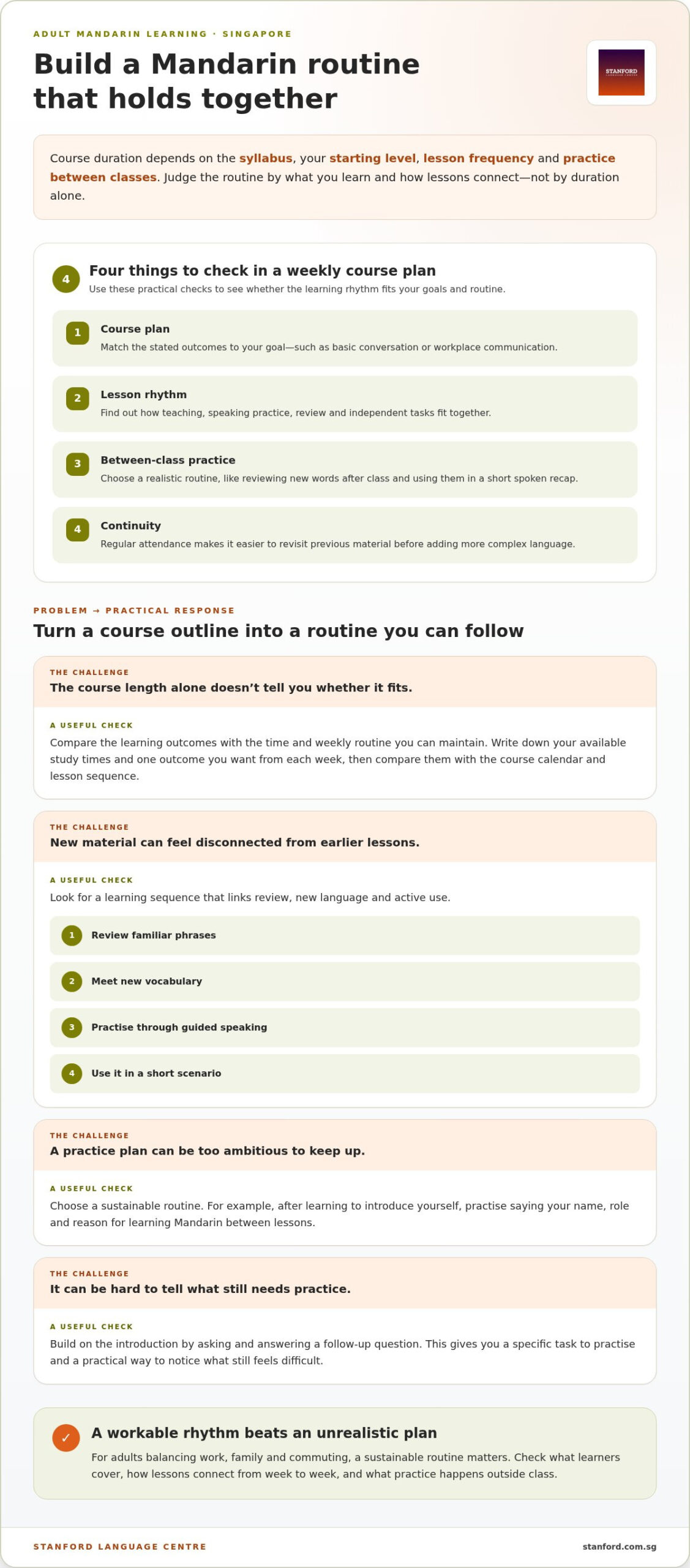
Course duration depends on the syllabus, starting level, lesson frequency, and practice between classes. A beginner learning introductions and everyday phrases has different needs from someone refining workplace conversations. Rather than assuming every Mandarin course follows the same calendar, compare the stated learning outcomes with the time and weekly routine you can maintain.
Look for a clear learning sequence. A useful plan connects new material with repeated practice, so each lesson builds on earlier work. For example, learners might review familiar phrases, meet new vocabulary, practise it through guided speaking, and finish by using it in a short scenario. That sequence makes it easier to see how class activities connect.
Use these steps to assess whether a schedule suits you:
- Check the course plan. Match its stated outcomes to your goal, such as basic conversation or workplace communication.
- Review the lesson rhythm. Find out how teaching, speaking practice, review, and independent tasks fit together.
- Plan between-class practice. Choose a realistic routine, such as reviewing new words after class and using them in a short spoken recap.
- Consider continuity. Regular attendance makes it easier to revisit previous material before adding more complex language.
For instance, after learning how to introduce yourself, practise saying your name, role, and reason for learning Mandarin between lessons. Next, build on that exchange by asking and answering a follow-up question. This progression gives you a specific task to practise and a practical way to notice what still feels difficult.
Busy schedules need a workable format, not an unrealistic study plan. If fixed group timing is difficult, private Mandarin lessons can provide a one-to-one learning format. The lesson focus can be aligned with your goals, such as practising a conversation for work or revisiting a topic that needs more attention. Review the private Mandarin lesson option when individual instruction better matches your routine.
Before enrolling, write down your available study times and one outcome you want from each week. Then compare those priorities with the course calendar and lesson sequence. In Singapore, adults may be balancing work, family, and commuting, so a sustainable routine matters more than an ambitious schedule that quickly becomes hard to follow.
Duration alone doesn’t show whether a course fits. Check what learners cover, how lessons connect from week to week, and what practice happens outside class. A clear structure helps you understand the commitment and decide whether the pace supports your Mandarin goals.
Daily Chinese for different proficiency levels
Adult Mandarin classes in Singapore include group and online formats, while private lessons offer another way to learn. Hybrid study combines classroom and online sessions, so compare the stated delivery format with your routine. The right proficiency level also matters: starting with familiar daily situations helps you practise language you can use immediately.
For beginners, a Level 1 course can establish core words and simple exchanges. Start with greetings, names, and introductions. Practise asking someone’s name, then respond with your own. Next, work on everyday requests, such as ordering a drink or asking where an item is. Short, repeated exchanges help you connect a phrase with its purpose. If you know some Mandarin already, consider whether you can understand and answer these prompts without relying on a script.
As your Mandarin develops, turn familiar topics into longer conversations. Practise explaining a preference, describing a routine, or asking a follow-up question. For example, move beyond ordering lunch by asking about an ingredient and explaining what you would like instead. Reading a short message and replying in your own words can also build useful skills. Focus on making choices in conversation, not only recalling memorised lines.
Advanced learning can focus on detail and nuance. A learner might compare options, explain a problem, or summarise a discussion. For instance, describe a change to a work schedule, give the reason, and respond to a colleague’s question. Reading a longer passage or drafting a clear message can complement speaking practice. These examples describe possible learning goals, not a fixed syllabus shared by every course.
- Beginner: practise greetings, introductions, numbers, and basic requests.
- Intermediate: extend familiar conversations with details, reasons, and follow-up questions.
- Advanced: explain, compare, summarise, and respond to less predictable prompts.
What adult Chinese language classes are available in Singapore? Options include beginner Mandarin, small-group classes, private lessons, online classes, and workplace training. Choose based on format and purpose: a learner seeking everyday conversation has different needs from a team preparing for workplace exchanges.
Which Singapore Chinese schools offer beginner, intermediate, and advanced adult classes? Course levels differ, so compare the skills and outcomes described for each stage. A beginner course should explain its foundations, while higher-level learning should help you develop longer, more independent communication.
To choose a level, write down three situations you want to handle in Mandarin. Try describing each one aloud, such as introducing yourself, asking for help, or explaining a preference. If basic phrases feel unfamiliar, begin with foundational lessons. If you can manage the exchange but struggle to add details, an intermediate course may fit better. Match the class level to what you can do today and the conversations you want to manage next.
Assessments and certificates
Assessing your Mandarin can help you see which skills to practise. A short speaking task, listening exercise, reading passage, or written response can each reveal a different strength. For example, you may recognise a spoken request but need more practice answering naturally. Connect your practice to your goals rather than relying on one test alone.
Useful progress checks connect directly to situations you want to manage. Practise introducing yourself, answering simple questions, or following instructions in a short dialogue. As you develop, try explaining a preference, responding to a follow-up question, summarising a discussion, or writing a clear message. These activities show what you can do with Mandarin, not just what you can recall.
When comparing courses, consider how feedback is delivered. Specific comments are more useful than a general score. For instance, feedback might identify unclear tones, missing details, or a sentence that needs a more natural word order. Turn each comment into one practice goal: repeat the conversation, revise the message, or listen again for the phrase that caused difficulty.
- Speaking: Can you complete a role-play without reading every line?
- Listening: Can you identify the main request in a short exchange?
- Reading: Can you understand the key point in a message?
- Writing: Can you reply with relevant details and understandable sentences?
A certificate and a learning assessment serve different purposes. An assessment gives information about current ability or progress. A certificate records a course-related outcome, and its meaning depends on the issuer and what it says. Before enrolling, read the course description for details on whether a certificate is awarded and what completion represents. Don’t assume every Mandarin course provides the same document or credential.
For workplace learning, define the task before judging progress. If your goal is to greet Mandarin-speaking clients, practise an introduction and a suitable follow-up. If you need to understand routine instructions, use listening tasks based on that purpose. A useful assessment makes the target clear, then shows which part needs more work.
Keep a simple record after each class: note one task completed, one point of feedback, and one skill to practise next. For example, write down that you completed a spoken introduction, need clearer tones, and will rehearse the opening again. Comparing those notes over time makes progress easier to describe and helps you choose a sensible next learning goal.
Beginner entry requirements
Starting Mandarin as a beginner doesn’t require pretending you already know the language. Begin by identifying what you can currently do: recognise a few words, introduce yourself, or understand a short spoken phrase. If none feels familiar, choose a course designed for beginners. For example, a learner who cannot yet introduce themselves can start with basic expressions.
Before choosing a course, consider how much Mandarin you already know. If you have little or no experience, a beginner course can help you build the foundations. If you have studied before, describe what you can understand and say so you can choose a suitable starting point. The goal is to begin with learning that matches your current skills.
Before enrolling, describe your experience accurately. Include any Mandarin you’ve learned through family, travel, work, or self-study. For example, you may understand spoken greetings but have difficulty responding. That distinction can help you decide whether to begin with foundational learning or focus on developing your existing skills. Also note whether your priority is speaking, listening, reading, or writing.
What are the enrolment requirements, placement tests, cancellation rules, and refund policies? Review the written enrolment information for the relevant course before paying. Check its prerequisites, any placement steps, cancellation deadlines, and refund conditions rather than assuming the terms are the same for every course.
Use this checklist to compare the practical details:
- Entry: Check whether the course expects prior Mandarin knowledge or welcomes complete beginners.
- Placement: Find out whether a conversation, written task, or self-assessment determines your starting level.
- Materials: Review what learners need for class, such as course materials or a way to join online lessons.
- Changes: Read how cancellations, missed lessons, and refund requests are handled.
Keep a copy of the terms you reviewed, along with your enrolment confirmation. If a cancellation deadline is stated, add it to your calendar. For example, a reminder before that deadline gives you time to consider a schedule change without relying on memory. Save any written explanation of your learning level, too, so you can refer to it later.
Prepare a short self-check before selecting a class. Write down whether you can introduce yourself, understand a simple question, or read familiar Mandarin words. Then record your goal, such as handling a basic conversation at a Singapore café. These concrete examples make it easier to describe your starting point and choose a course whose entry level matches your needs.
Stanford Language Centre: Professional Adult Chinese learning in Singapore
Stanford Language Centre offers professional adult Chinese learning in Singapore for people who want structured Mandarin study. Adult learners can choose a small-group class, private lessons, or online learning. Small-group Mandarin classes are also available for Japanese and Korean speakers, alongside classes for expats and foreigners.
Consider these classes when you want adult-focused instruction and a clear starting point for learning Mandarin. To compare the available options with your goals, explore the Mandarin classes in Singapore. Contact Stanford Language Centre to discuss which class suits your learning needs.
Make Mandarin part of your next step
Choose one real conversation you want Mandarin to make easier, then use it as a personal benchmark. It could be joining an exchange with neighbours, following a conversation at a community event, or expressing your own view without relying on prepared phrases. Write down what you want to understand and say. This gives your learning a purpose beyond completing lessons and helps you choose situations to practise as your confidence grows.
The right adult Chinese class in Singapore should connect with the way you want to use Mandarin. Think about the conversations you hope to manage and the learning environment that feels right for you. To take a practical next step, explore Mandarin classes with Stanford Language Centre. Start with a goal that matters to you, and build from there at a pace that works for your learning.
Frequently Asked Questions
What are the schedules, class duration, and locations for adult Chinese courses in Singapore?
Basic Mandarin courses consist of 10 lessons spread over 2 months, with classes available online or in person. Private lessons are one-to-one and scheduled at a time and location chosen by the student. Group-class schedules depend on the course arrangement. If you’re comparing options, consider whether regular online sessions or in-person learning at a suitable location better fits your routine.
Which adult Chinese classes in Singapore have the best reviews and course outcomes?
There’s no reliable single “best” choice based on reviews alone. Compare recent learner feedback with practical details, such as whether classes include speaking practice and how progress is assessed.