Vietnamese connects learners with a language spoken by about 95 million people in Vietnam. For adults who want to learn Vietnamese in Singapore, it can help make everyday conversations more natural and support communication at work. You don’t need a single reason to start: personal connections, travel, and professional goals can all give your learning direction.
It’s normal to wonder which learning approach fits your schedule and goals. This guide explains why adults choose to learn Vietnamese in Singapore and what to expect as they build practical conversation skills. You’ll also see how group classes, private lessons, and corporate training support different needs, from everyday conversations to communicating with colleagues. The aim is to help you find a clear starting point and make the language feel approachable.
Key Takeaways
- Connect your reason for learning Vietnamese, such as personal relationships or work, to practical speaking goals.
- Understand how beginner, elementary, and intermediate study can build skills step by step.
- Practise useful conversation for everyday situations, including asking for directions and ordering food.
- Compare group classes, private lessons, and corporate training to find an approach that suits your learning needs.
- Explore what to consider when choosing a Vietnamese learning option in Singapore.
Why learn the Vietnamese language?
Vietnamese connects learners with about 95 million people in Vietnam. Its six tones make pronunciation a useful early focus, especially when a small sound change can affect meaning. Adults may study for family connections, travel, or work. A practical goal, such as introducing yourself or discussing a work task, helps shape what to practise first.
For a beginner course, review the stated entry requirements before enrolling. If you already know some Vietnamese, describe what you can do, such as ordering food or understanding a simple greeting, to help identify a suitable starting level. Consider speaking, listening, reading, and writing separately: recognising vocabulary does not necessarily mean you can use it in conversation.
Short, regular study sessions are easier to fit into a busy week. Pair Vietnamese audio with flashcards to review tones and vocabulary, then say each phrase aloud. Google Translate can help with a quick word lookup, but listen to audio and review examples rather than treating a single translation as a conversation lesson.
Vietnamese courses in Singapore can suit adult beginners and heritage learners, depending on their goals and starting point. An adult course may not meet a child’s learning needs. Heritage learners can identify whether they want more speaking practice, literacy support, or stronger grammar foundations before choosing a class.
To find conversation practice in Singapore, search local community event listings for Vietnamese-language meetups. Choose a session with guided conversation or prompts on topics such as introductions or travel for more structured practice. A language exchange can complement lessons when participants share speaking time and correct misunderstandings respectfully.
NTU Vietnamese courses are aimed at undergraduate study, rather than being automatically open-enrolment adult classes. Students can use NTU’s course information and academic arrangements to understand how Vietnamese fits their degree or study plan. Adults outside university can compare a course’s format and level with their goals, such as everyday conversation or workplace communication.
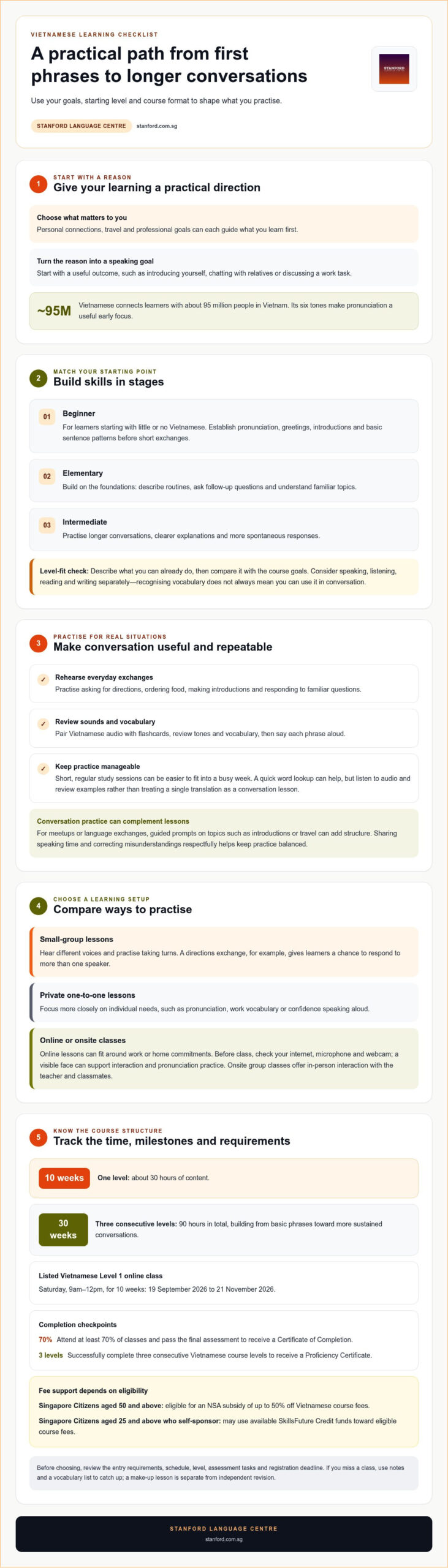
Course structures can make progress easier to track. A Vietnamese level runs for 10 weeks and contains about 30 hours of content. Three consecutive levels take 30 weeks and total 90 hours. These stages let learners build from basic phrases toward more sustained conversations, rather than trying to master every skill at once.
Assessment provides a clear checkpoint. Participants who attend at least 70% of classes and pass the final assessment receive a Certificate of Completion. Those who successfully complete three consecutive Vietnamese course levels receive a Proficiency Certificate. Check the course requirements early so attendance, assignments, and final assessment tasks fit your schedule.
Course fees and subsidies depend on the course and eligibility. Singapore Citizens aged 50 and above are eligible for an NSA subsidy of up to 50% off Vietnamese course fees. Singapore Citizens aged 25 and above who self-sponsor may use available SkillsFuture Credit funds toward eligible course fees. Compare the schedule, course level, assessment requirements, and registration deadline before committing.
Beginner, elementary, and intermediate classes
A beginner class suits learners starting with little or no Vietnamese. Lessons can establish pronunciation, greetings, introductions, and basic sentence patterns before moving into short exchanges. Elementary study builds on those foundations, helping learners describe routines, ask follow-up questions, and understand familiar topics. At intermediate level, practice can shift to longer conversations, clearer explanations, and more spontaneous responses. Use a real goal, such as chatting with relatives or making a simple work introduction, to decide what to practise.
For a structured starting point, Vietnamese Level 1 is designed for beginners. One listed online class runs every Saturday from 9am to 12pm for 10 weeks, from 19 September 2026 to 21 November 2026. This schedule gives learners a regular session to practise listening and speaking, then review between classes. If you already know some Vietnamese, compare your current skills with the level’s learning goals before choosing a beginner course.
Small-group lessons give learners chances to hear different voices and practise taking turns. A classmate might ask for directions while another gives a response, creating a useful change from rehearsed phrases. A private one-to-one lesson can focus more closely on an individual’s needs, such as pronunciation, work vocabulary, or confidence speaking aloud. Small-group Vietnamese classes and private lessons offer two formats to consider when choosing a learning setup.
Online lessons can make regular study easier to fit around work or home commitments. Before class, test your internet connection, microphone, and webcam, then position the camera so your face is visible. A webcam can support face-to-face interaction and help learners notice a teacher’s mouth movements during pronunciation practice. The listed Saturday course is online; a group class held onsite instead offers in-person interaction with the teacher and classmates.
Missed classes need a practical catch-up plan. Keep a vocabulary list, note the lesson topic, and ask a classmate for the activity instructions covered during your absence. For example, if a session practised restaurant orders, review the phrases and rehearse a short exchange before the next lesson. A make-up lesson is a separate arrangement from independent revision, so build a realistic study routine around the class schedule.
Choose a level by matching its goals to what you can already do, not simply by picking the next label. If you can introduce yourself but struggle to follow replies, focus on listening practice before moving ahead. For online study, prepare your camera and audio before class; in a group, come ready to speak and listen. Small preparations can make each lesson more useful.
Everyday conversation, directions and ordering food
Useful Vietnamese starts with small exchanges you can repeat in real situations. Practise greeting someone, giving your name, and asking a simple follow-up question. For example, role-play meeting a colleague: introduce yourself, ask where they work, then respond to their answer. This builds a short conversation rather than a list of disconnected words.
Practise asking for directions with a clear destination and landmarks. Use a simple map showing a station, a café, and a street crossing. Ask where the café is, understand whether to turn left or right, and check the route if you’re unsure. Then swap roles. Giving directions helps you practise location words and listen for key instructions.
At a food stall or restaurant, practise a short ordering sequence. Choose an item from a menu, ask for it, and respond to a follow-up question. Add useful details, such as requesting water or asking for the bill. Keep the exchange realistic: one person takes the order while the other asks for clarification before finishing.
Build each role-play around a few repeatable actions:
- Start politely: Use an appropriate greeting before asking for help or placing an order.
- State your need: Name the destination, menu item, or information you want.
- Listen and respond: Repeat the key detail in your own words, or ask the speaker to say it again.
- Close the exchange: Thank the other person or confirm the next step.
Listening practice matters as much as speaking. Play a short Vietnamese audio clip, identify the words you recognise, then listen again for the overall meaning. Answer aloud using a complete, simple sentence. In a directions exercise, listen for the destination and turn. In a food-ordering exercise, listen for the item and any question about your choice.
Make practice more useful by changing one detail each time. Order a different dish, ask about another landmark, or use the same greeting with a new follow-up question. This keeps the dialogue from becoming pure memorisation. Note the phrases that caused hesitation, then use each in a fresh example the next day.
In Singapore, learners can practise these situations before travelling or speaking with Vietnamese-speaking friends and colleagues. Focus first on getting your meaning across, then refine word choice and pronunciation with feedback. Repeating a short exchange about finding a café or ordering lunch gives you a practical way to practise listening, responding, and keeping a conversation moving.
Group, private, and corporate Vietnamese training
Choose a learning format that matches your speaking goals and routine. A group class lets you hear different voices and practise taking turns. A private lesson can focus on your priorities, such as pronunciation or conversation practice. Corporate training can centre on workplace situations, including introductions, meetings, and customer conversations.
In a group, learners can practise the same scenario from different roles. One person asks for directions, another explains the route, and a third listens for key details. This gives participants practice responding to different speaking styles. Group learning may suit adults who enjoy discussion and benefit from hearing classmates try the same phrases. Stanford Language Centre’s group classes include free make-up when available.
A private tutor can adapt practice to your immediate needs. For example, someone preparing to speak with Vietnamese-speaking colleagues could work on greetings, clarifying questions, and short work updates. A learner who understands more than they can say could spend more time forming replies aloud. Bring a clear goal to lessons and use it to guide practice and review.
Corporate Vietnamese training works best when examples reflect real workplace communication. A team might practise welcoming a visitor, confirming a meeting time, or asking a colleague to repeat a point. Employers can identify the situations employees face and use them to shape lessons. This keeps practice relevant to daily interactions rather than abstract vocabulary lists.
When choosing a Vietnamese tutor or course, look for a clear learning structure, speaking practice, and feedback that addresses your goals. Decide whether you need workplace role-play, everyday conversation, or individual attention. These priorities will help you choose a format that makes class time relevant.
Compare the learning format with the way you prefer to practise. If you learn by speaking with others, a group offers partner exercises and different responses to listen to. If you want to focus on pronunciation or specific vocabulary, individual lessons give more attention to those areas. For a work team, identify shared communication needs first.
Online lessons suit learners who prefer studying remotely, while in-person classes bring participants together face to face. Either format can include conversation practice, listening tasks, and useful phrases. For example, learners can role-play a short introduction online or practise a workplace exchange in class. Choose the setting that makes it easier to attend and participate regularly.
Use a simple decision process: write down your main goal, choose a supporting format, and identify situations to practise. Someone focused on social conversation might prioritise taking turns. A team preparing for regular interactions with Vietnamese-speaking partners might focus on greetings and meeting exchanges. Clear goals make each lesson more purposeful.
Where can I learn Vietnamese in Singapore?
Adults in Singapore can learn Vietnamese through structured lessons, online classes, or individual tuition. Start with your main goal: everyday conversation, communication at work, or regular practice with classmates. Someone who wants to speak with Vietnamese-speaking colleagues may prefer lessons that practise introductions and workplace exchanges. A learner focused on personal conversation may prioritise listening and speaking.
Compare three practical formats before deciding. A small group offers chances to practise with classmates and hear different responses. Private one-to-one lessons can focus on personal goals, such as pronunciation or vocabulary for a specific setting. Online learning removes the need to travel to a classroom, while in-person lessons let participants practise face to face. Each format supports a different routine.
Look for adult Vietnamese lessons with a clear level and learning sequence. Beginners should be able to start with foundational conversation without prior fluency. If you already speak some Vietnamese, identify what feels easiest and hardest: understanding a reply, forming sentences, or reading familiar words. Use these examples to choose a suitable starting point and avoid repeating skills you already use confidently.
A course schedule affects how well lessons fit your week. Write down your regular commitments, then compare them with the class timetable before registering. An online Saturday morning lesson, for example, may suit someone with weekday work commitments. For in-person classes, consider travel time and set aside time after each lesson to review vocabulary and practise speaking aloud.
Before enrolling, compare the course format, level, schedule, and assessment expectations. A simple checklist can keep your decision focused:
- Goal: Name a situation you want to handle, such as a work introduction or a short conversation.
- Starting point: Note whether you are a complete beginner or already know useful phrases.
- Format: Decide whether group interaction, individual attention, or online access suits you best.
- Routine: Choose a timetable you can attend consistently and make room for practice between lessons.
For adults seeking structured Vietnamese lessons in Singapore, Stanford Language Centre offers small-group, private one-to-one, and online classes. These formats can support different goals, from building conversation skills to practising language for work. The centre also provides corporate Vietnamese language training for workplace needs. Match the course format to your goal when choosing where to start.
To take a practical next step, explore Vietnamese course options and consider which format best fits your learning routine. A clear goal, such as holding a short conversation or contributing to a work exchange, makes it easier to choose a course and focus your practice from the first lesson.
Stanford Language Centre: Professional Adult Chinese learning in Singapore
Stanford Language Centre also offers adult Chinese learning in Singapore, including small-group Mandarin classes for expats and foreigners, Japanese speakers, and Korean speakers. These may suit you if you also want to build Mandarin skills. The best fit depends on your preferred class setting and learning needs.
For Vietnamese study, use the course information in the sections above to compare learning formats and choose a practical starting point. If Mandarin is another language you’d like to learn, explore adult Mandarin classes to see which group option suits you.
Contact Stanford Language Centre or visit stanford.com.sg to learn more about its Mandarin classes.
Choose your next conversation to practise
Start with one conversation you’d like to handle more comfortably, then make it your first practice goal. It could be a friendly introduction, a simple exchange with a colleague, or a chat with someone close to you. A clear purpose helps you stay focused as you learn Vietnamese in Singapore and turn study into a skill you can use beyond class.
If Mandarin is also on your list, Stanford Language Centre offers Professional Adult Chinese learning in Singapore, including small-group Mandarin classes for expats and foreigners, and for Japanese and Korean speakers. Choose the language that best matches your next personal or professional goal, then take the first step at a pace that works for you.
Contact Stanford Language Centre to explore a suitable learning direction. Every useful conversation starts with a first attempt, and yours can begin now.
Frequently Asked Questions
What Vietnamese language courses are available in Singapore for beginners?
Beginners can choose structured Vietnamese classes, private one-to-one lessons, or online study. Stanford Language Centre offers adult Vietnamese learning, including small-group and private lessons. A basic course provides a defined starting structure for learners with little prior experience. Before enrolling, consider whether you want regular interaction with classmates or more individual attention. For example, a complete beginner may focus first on greetings, introductions, and listening to simple replies.
Which Vietnamese tutors or language schools in Singapore offer private lessons?
Stanford Language Centre offers private one-to-one Vietnamese lessons for adult learners. This format can suit someone who wants to focus on a particular goal, such as speaking with Vietnamese-speaking relatives or practising work-related exchanges. Unlike a group class, private lessons centre on individual needs. Prepare a few situations you want to handle, such as introducing yourself or clarifying a point in conversation.
How much do Vietnamese classes and tutors cost in Singapore?
Vietnamese class and tutor fees vary by lesson format and course arrangement. Stanford Language Centre pricing is available on request, so contact the centre for details. When comparing options, consider whether the course is a group class, private tuition, or workplace training, and how its schedule fits your routine. If you’re considering an eligible course, check whether NTUC UTAP support applies to your circumstances before budgeting.
Are there in-person and online Vietnamese lessons available in Singapore?
Yes. Stanford Language Centre offers Vietnamese lessons in person and online. Online study can suit learners who prefer joining remotely, while in-person lessons provide a shared classroom setting. For either format, prepare a notebook and a short list of speaking goals. Online learners can test their audio before class, while in-person learners can plan their travel around the lesson time.
How long does it take to learn conversational Vietnamese?
Time to develop conversational ability depends on your starting point, practice routine, and the situations you want to manage. Stanford Language Centre’s basic Vietnamese course consists of 10 lessons spread over 2 months. Use the course to build a routine, then practise between lessons by reviewing phrases and speaking aloud. A goal such as introducing yourself or asking a simple question gives you a practical way to track progress.