The best Mandarin classes for adults in Singapore aren’t necessarily the largest or most intensive. The right fit depends on what you want to do with Mandarin and how you prefer to learn. Before enrolling, compare the format and focus, from everyday conversation to small-group practice or one-to-one lessons.
It’s understandable to want practical lessons that fit around work and feel comfortable for a beginner. A good course should give you opportunities to use Mandarin in relevant situations, while the learning format should suit your need for personal guidance or group interaction. This guide explains what adult classes may cover, how customised and public group options differ, and what to consider when choosing a small class. You’ll also find out what to expect from the registration process, so you can take a clear next step without feeling overwhelmed.
Key Takeaways
- Compare class schedules and make-up lesson arrangements with your work and personal commitments in mind.
- Look for lessons that build useful vocabulary and give you practice with everyday conversations.
- Choose a learning approach that can be tailored to your goals, experience and areas for improvement.
- Consider whether public group lessons suit your preference for learning alongside other students.
- Think about how class size affects your chances to practise speaking and receive individual guidance.
Need more course info?
Compare the timetable, lesson format, course scope and enrolment steps before choosing an adult Mandarin class. These details help you judge whether a beginner course fits your routine and learning goals.
Scheduling and Make-Up Lessons
Start with the published lesson days, start times and course dates. Check whether each session is held in person or online, and note any attendance requirements before enrolling. For a missed lesson, make-up arrangements depend on the school’s policy; look for details on rescheduling, joining another class or accessing lesson materials. If your work calendar changes often, compare the timetable with your regular commitments before choosing a course.
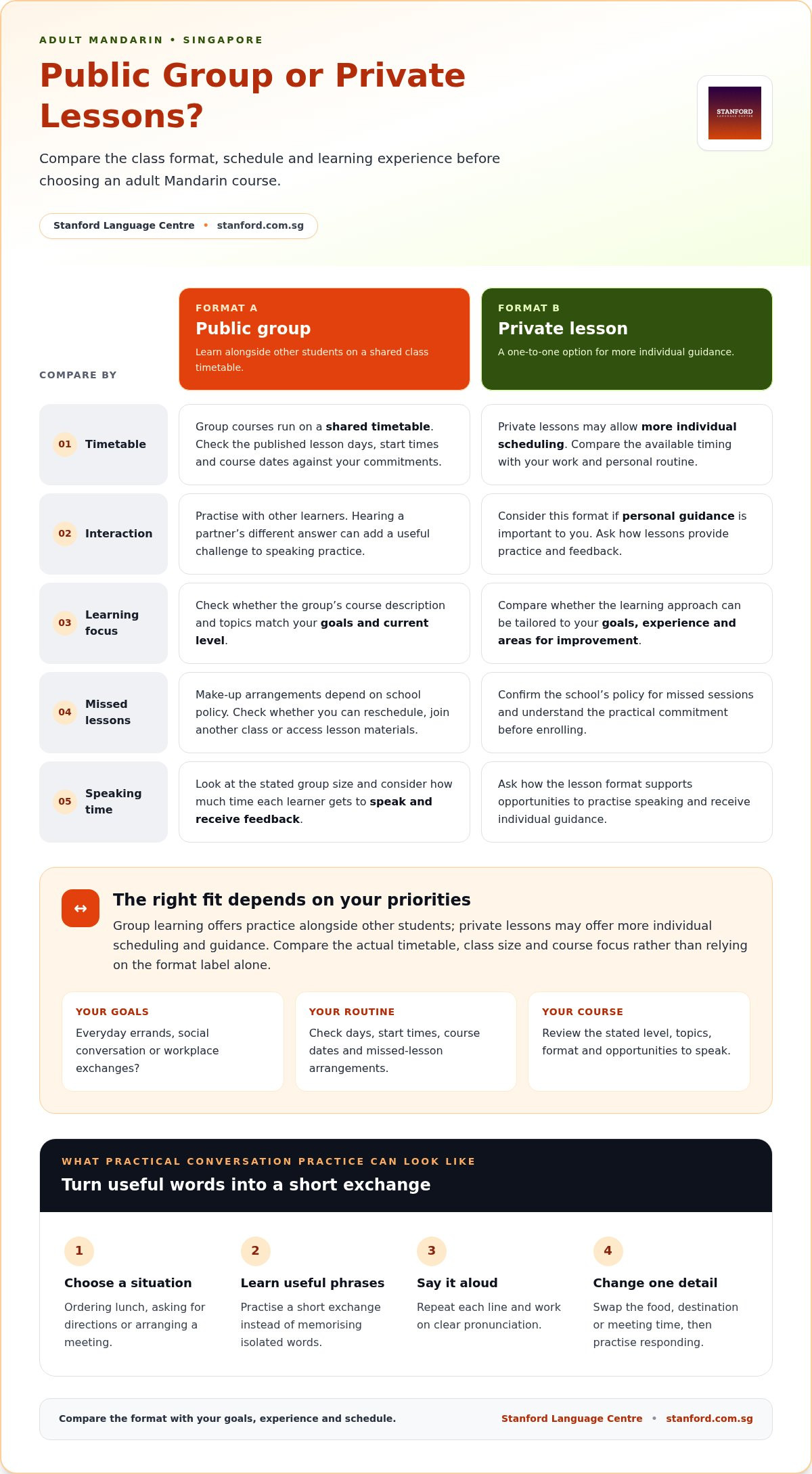
Class size affects scheduling too. A group course runs on a shared timetable, while private lessons may allow more individual scheduling. Compare the format that fits your week, then review how missed sessions are handled so you understand the practical commitment.
Fees and SkillsFuture Credit
Course fees depend on factors such as lesson format, course length and whether teaching is private or shared. The price depends on the course and is provided after a quote request; compare what the fee covers, including lessons and any stated learning materials. Avoid comparing only the headline amount. A course with a different number of sessions or delivery format may represent a different learning commitment.
Check funding eligibility separately from the course fee. Stanford Language Centre offers an NTUC UTAP-claimable Mandarin option, but its Mandarin courses are not claimable with SkillsFuture Credit. These are separate schemes, so confirm the specific course and scheme terms before budgeting.
Course Formats and Teaching Quality
Adult Mandarin classes in Singapore may be offered in person, online or in a hybrid format; availability varies by school and intake. Compare the delivery method with your commute, preferred learning environment and need for live speaking practice. Class sizes also differ. Look for the stated group size and consider how much time each learner gets to speak and receive feedback.
To assess a course, look beyond star ratings. Read reviews for specific comments about lesson structure, teacher feedback, beginner support and speaking practice. Compare those details with the course description. Stanford Language Centre’s Mandarin lessons focus on conversational learning, so consider whether that approach matches your goals.
Course Duration and Languages
Course duration and lesson frequency vary, so compare the full timetable rather than relying on a course label such as “beginner.” Check how many sessions are included, how often they meet and what topics the course aims to cover. A beginner overview should explain the starting level and whether lessons focus on practical conversation, vocabulary, pronunciation or other skills.
For enrolment, identify your current level and preferred format first. Then compare the course dates and learning focus. If you’re a beginner, Stanford Language Centre offers structured Mandarin courses for adults, including small-group and private lessons. Use your goals and schedule to choose a suitable option.
Everyday vocabulary and conversational skills
Practical adult Mandarin lessons connect useful words with situations you may meet in Singapore. Examples include greeting a colleague, ordering lunch, asking for directions or arranging a meeting. Rather than memorising isolated vocabulary, practise each phrase in a short exchange. That helps you remember what to say and how a conversation might continue.
For example, practise introducing yourself, asking someone’s name and responding politely. A restaurant role-play could cover requesting a menu item, asking its price and saying thank you. These exercises let you rehearse familiar situations before using Mandarin outside class. A useful beginner course also makes space to repeat phrases aloud and receive feedback on pronunciation.
Adult conversational Mandarin courses can focus on speaking and listening, while adding reading or writing where those skills support your goals. Before enrolling, identify the situations you want to handle: everyday errands, social conversation or workplace exchanges. Then look for course descriptions that name relevant topics and show how learners practise them, such as paired dialogues, role-play or guided questions.
Singapore schools use different course labels and level structures, so there isn’t one shared progression from beginner to advanced. Compare each school’s descriptions and placement approach to find a starting point suited to your experience. Stanford Language Centre’s structured Level 1 programme is for beginners; this doesn’t establish the availability of other levels.
- Choose a situation: Pick one, such as ordering food or making an introduction.
- Learn useful phrases: Practise a short exchange, not just a vocabulary list.
- Say it aloud: Repeat each line and work on clear pronunciation.
- Change one detail: Swap the food, destination or meeting time to practise responding.
For instance, practise asking for a drink, then change the order and repeat the exchange. This variation encourages flexible speaking instead of relying on one memorised script. In a group class, listening to a partner’s different answer adds another useful challenge.
When comparing courses, check whether conversation practice matches your goals and current level. A beginner may want guided introductions and everyday requests; someone with prior knowledge may prefer longer exchanges or workplace scenarios. Review the adult Mandarin course information to see how a structured beginner option fits into your shortlist.
Customised curriculum
A customised Mandarin curriculum connects lesson choices to your starting point, goals and available study time. One adult may need Mandarin for workplace introductions, while another wants to follow family conversations or manage everyday errands. Before enrolling, define the situations you want to handle. That gives you a practical basis for discussing course priorities.
Personalisation can involve the topics, pace, practice activities or balance of speaking, listening, reading and writing. For example, a learner preparing for workplace conversations might prioritise introductions, meeting vocabulary and polite requests. Someone focused on daily life could practise transport questions, appointment arrangements and simple purchases. These are useful goals to discuss, not a guarantee that every course includes those exact lessons.
A simple planning process helps you compare course options:
- Set a goal: Name a situation you want to manage, such as introducing yourself to colleagues.
- Describe your starting point: Note any Mandarin you already understand or use.
- Choose priorities: Decide whether speaking, listening, reading or writing matters most.
- Review the course plan: Compare its topics and practice activities with your goal.
Make your curriculum choices concrete. If you understand spoken Mandarin but struggle to respond, look for opportunities to practise speaking. If unfamiliar vocabulary slows you down, focus on lessons that introduce and revisit useful words. A clear link between your learning goal and classroom activities is more useful than a broad promise of tailored lessons.
Customisation can also mean adjusting support to suit different experience levels. A complete beginner may need clear explanations and repeated practice with basic sentence patterns. A learner with prior study may benefit from identifying gaps, correcting common errors and extending familiar topics. Ask how the course handles different starting points, and whether learning priorities can be revisited as you progress.
For adults balancing work and personal commitments, a focused curriculum can make class time more relevant. Private lessons at Stanford Language Centre are one-to-one, with flexible timing and a location chosen by the student. Group classes provide shared, interactive practice. Compare these formats with your schedule and the kind of guidance you want.
Before you enrol, write down one main goal and two situations where you hope to use Mandarin. Use those examples to assess whether the course content, practice format and level match your needs. This keeps your choice focused on a clear learning purpose.
Public group classes
A public group class brings adult learners together for a shared Mandarin course. The teacher follows a common lesson plan, while students practise through paired dialogues, questions and group activities. For example, one learner can practise asking for directions while another responds. This format offers conversation with classmates, rather than one-to-one attention throughout the lesson.
Before enrolling, compare the adult Chinese class Singapore course level, lesson format and published schedule. A beginner class should explain its starting point and describe the skills or topics it covers. If you already know basic phrases, check how the school places learners into suitable groups. A mismatch can make lessons feel either too fast or too familiar, so use your previous study and speaking experience when assessing the level.
Group learning works well when you want regular interaction with different speakers. A partner may phrase an answer differently, giving you practice listening and responding beyond a memorised script. Lesson time is shared, however. If you need focused feedback on pronunciation or work-related vocabulary, consider whether private lessons would better suit that goal.
Use these steps to compare options in Singapore:
- Check the level: Match the class description to your Mandarin experience.
- Review the timetable: Compare lesson days and times with your weekly routine.
- Look at activities: Find examples of pair work, role-play or guided conversation.
- Consider your goal: Decide whether shared practice supports your reason for learning.
Some adult learners prefer a class designed for people with similar backgrounds or learning needs. Stanford Language Centre offers small-group Mandarin classes for expats and foreigners, as well as classes for Japanese and Korean speakers. Read the course description to understand its intended audience and decide whether it suits your needs.
Ask how missed sessions are handled before committing. Group classes follow a shared timetable, while private lessons offer flexible timing. Stanford Language Centre provides free make-up lessons for group classes when available. Review your work calendar alongside the schedule to judge whether you can attend consistently.
Finally, compare reviews for specific details, not ratings alone. Comments about clear explanations, speaking opportunities and teacher feedback can help you understand the classroom experience. Read several recent comments and look for repeated themes. Then weigh those observations against the class format, level and schedule, rather than choosing from a single review or a broad claim.
Small class sizes
A small Mandarin class can create more chances to speak during each lesson, but size alone doesn’t show how much practice you’ll get. Look at the activities and how participation works. For example, paired dialogues give learners time to speak, while a teacher-led explanation may leave fewer chances to respond.
Check the stated class size before enrolling, then consider what students do during class. Do learners take turns answering, practise in pairs or receive individual corrections? A small group can support interaction, but a clear plan matters too. Ask yourself whether the class format gives you room to try a sentence, make a mistake and practise it again.
Teacher feedback is another useful consideration. In a class practising introductions, for example, a teacher might correct a phrase, explain a pronunciation point and invite the learner to repeat it. Review the course description for details about speaking practice and feedback, rather than treating “small class” as a complete description of the learning experience.
Group composition also affects classroom interaction. Learners with similar starting points may be able to work through activities at a shared pace. In a mixed-level class, some students may need more support while others want more challenging prompts. Look for a clear level description and consider whether your experience matches the group’s focus.
Use these points to compare adult Mandarin classes in Singapore:
- Find the class limit: Check the stated maximum, not only the word “small.”
- Review practice activities: Look for pair work, role-play or time to answer individually.
- Consider feedback: See whether learners receive corrections during speaking practice.
- Match the level: Compare your experience with the class description.
- Think about your goal: Choose a format that supports the situations you want to handle.
For example, if you want to practise workplace introductions, look for a lesson that gives you a chance to introduce yourself and respond to follow-up questions. If you’re nervous about speaking, a supportive pace and clear turn-taking can make participation easier. If you already speak comfortably, varied prompts can keep practice useful.
Finally, balance group interaction against your need for individual attention. A group provides opportunities to listen to other learners and respond to different speaking styles. Private lessons focus more directly on one learner’s pace and priorities. Compare those trade-offs with the course schedule, lesson activities and your learning goals before choosing.
Stanford Language Centre: Professional Adult Chinese learning in Singapore
Stanford Language Centre offers professional adult Chinese learning in Singapore, with small-group Mandarin classes for expats and foreigners, Japanese speakers, and Korean speakers. These options suit adults who want structured learning alongside classmates with a similar background. The centre also provides a structured Level 1 programme for beginners, giving new learners a clear starting point.
Use the course focus and format you’ve considered in this guide to decide whether a group class fits your goals. If you’re starting from the basics or prefer learning with peers, explore the adult Mandarin course options. Contact Stanford Language Centre to discuss a suitable class.
Turn your Mandarin goal into a first step
Before choosing, write down one real situation where you’d like to use Mandarin. It could be joining a conversation with colleagues, speaking with neighbours or handling a familiar task more independently. That goal gives you a useful starting point for deciding what to practise and which class format feels right.
For adults comparing the best Mandarin classes for adults in Singapore, Stanford Language Centre offers professional adult Chinese learning, including small-group Mandarin classes for expats and foreigners and for Japanese learners. Use your goal and learning background to decide which class format best suits your next step. A focused starting point can make your learning feel more connected to daily life.
To discuss your Mandarin learning, contact Stanford Language Centre. Every useful conversation begins with a first phrase, and you can build from there at your own pace.
Frequently Asked Questions
What are the best Mandarin Chinese classes for adults in Singapore?
The best fit depends on your learning goal, starting level and preferred class format. Stanford Language Centre offers adult Mandarin learning, including small-group classes for expats and foreigners, Japanese speakers and Korean speakers. Its beginner Level 1 programme provides a structured starting point. If you want individual attention instead, compare private lessons with group learning. Choose a course based on its stated focus and how you want to use Mandarin.
How much do adult Mandarin classes cost in Singapore, including registration and materials fees?
Adult Mandarin course fees vary, and Stanford Language Centre provides pricing on request rather than publishing a course price. Before enrolling, compare the total quoted amount and ask which items it covers, including lessons, registration and materials. These charges can be presented separately, so look at the full course cost rather than a headline fee. Consider the course format and length when comparing options, without assuming one fee structure applies to every school.
Are there SkillsFuture credits or other subsidies for adult Mandarin courses in Singapore?
Stanford Language Centre’s Mandarin courses are not claimable with SkillsFuture Credit, but the centre lists an NTUC UTAP-claimable Mandarin option. These are separate schemes, so don’t treat one as interchangeable with the other. Before budgeting, identify the exact course and funding scheme you intend to use, then review the scheme’s eligibility terms. A course being described as claimable under one programme doesn’t mean it qualifies under another.
What should adults look for when choosing a Mandarin class in Singapore?
Start with your practical goal, such as speaking with colleagues or handling everyday conversations, then compare courses by level, format and lesson focus. Check whether activities match your needs, such as guided speaking practice or workplace communication. Also review the class schedule, stated group size and missed-lesson policy. If you’re comparing reviews, look for specific comments about teacher feedback and opportunities to participate, rather than relying on star ratings alone.
How can adults enroll in Mandarin classes in Singapore, and what placement tests are required?
To enrol, identify your current Mandarin experience, preferred format and main learning goal, then compare these with the course’s level description and upcoming schedule. Placement approaches differ between schools; some may use a conversation or a short assessment to understand your starting point. Don’t assume a test is required for every course. For a beginner programme, check that its stated entry level matches your experience before completing enrolment.
Are there Mandarin classes in Singapore focused on business Chinese, conversation, or exam preparation?
Yes, adult courses can focus on different outcomes, so check each programme’s stated content. Stanford Language Centre offers conversational Mandarin learning and corporate language training tailored to business communication needs. For example, a workplace learner may prioritise introductions and job-related exchanges. Exam preparation is a separate requirement, so look for a course that explicitly describes the relevant exam preparation before enrolling.