Vietnamese is spoken by a population of 95 million people in Vietnam, making it a practical language to learn for travel, relationships and work connected with the country. If you’re considering Vietnamese lessons in Singapore, your reason for learning can help you choose a course that fits your goals and starting point.
It’s natural to wonder whether you need prior experience, how much speaking time you’ll get in a group, or whether private lessons would suit you better. The right choice depends on what you want to practise, how you prefer to learn and how much time you can set aside.
This guide explains why Vietnamese may be worth learning and what to consider when comparing course formats. You’ll find out how class size can shape your practice, what beginners can expect, and when one-to-one lessons may offer a more focused way to work toward your goals.
Key Takeaways
- Connect your reason for learning Vietnamese, such as travel, relationships or work, to the skills you want to practise.
- Compare beginner and more advanced course levels against your current speaking, listening, reading and writing ability.
- Consider how class size affects your chances to practise speaking and receive individual feedback.
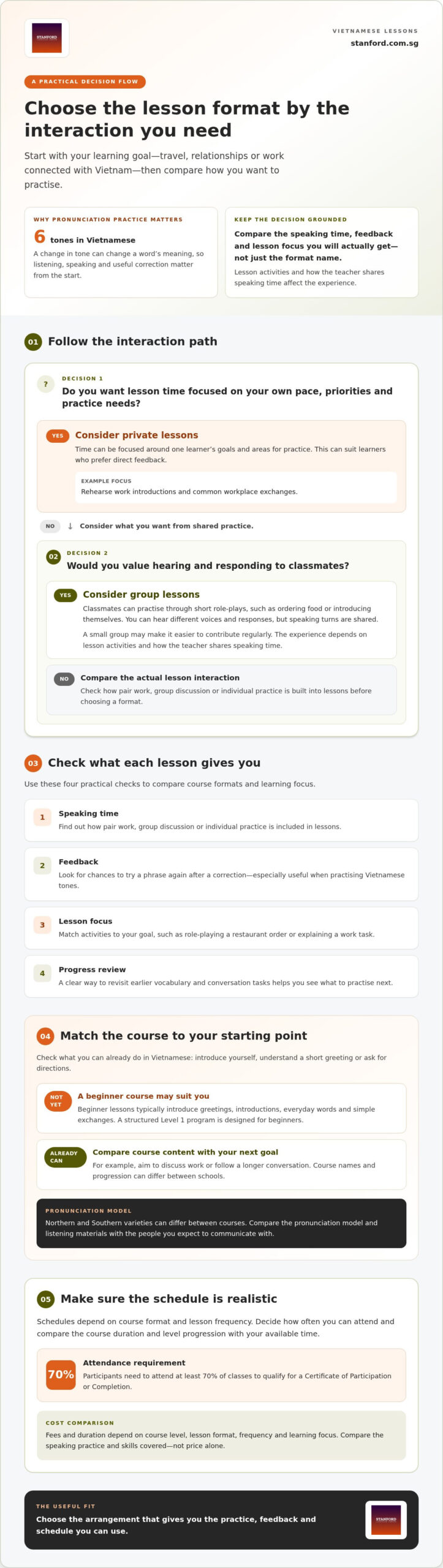
- Choose private lessons if you want learning time focused on your own pace, priorities and practice needs.
- Before choosing a course, weigh its format and learning focus against your schedule and preferred way of studying.
Why learn the Vietnamese language?
Vietnamese can connect language learning with travel, family ties, and work involving Vietnam. It is spoken by a population of 95 million people in Vietnam, and more than 4 million ethnically Vietnamese people live across North America, Europe, Australia and Asia. For learners in Singapore, those connections can make practical conversation a clear starting goal.
Vietnamese pronunciation is based on six tones. A change in tone can change a word’s meaning, so listening and speaking practice matter from the start. For example, practise hearing and producing tones in short greetings before moving on to longer exchanges. This builds useful habits alongside vocabulary and basic sentence patterns.
Do Vietnamese courses in Singapore teach Northern or Southern Vietnamese? The regional variety can differ between courses. Compare the pronunciation model and listening materials with the people you expect to communicate with.
Course levels help match lessons to your current ability. Beginner lessons typically introduce greetings, introductions, everyday words and simple exchanges. At the next stage, learners can build longer conversations, understand more spoken language and handle familiar situations with less support. Advanced study can focus on nuanced conversation, broader vocabulary and expressing complex ideas. These are learning goals, not a fixed structure shared by every school, so course names and progression may differ.
Use a practical step to judge your starting point: list what you can already do in Vietnamese. Can you introduce yourself, understand a short greeting or ask for directions? If not, a beginner course may suit you. If you can already manage those exchanges, compare the course content with your next goal, such as discussing work or following a longer conversation. A structured Level 1 program is designed for beginners.
Fees and duration depend on the course level, lesson format, frequency and learning focus. Before comparing fees, consider whether lessons are in a group or private, what level they cover and how often they take place. Don’t compare price alone: consider the speaking practice and skills covered at each stage.
Schedules depend on the course format and lesson frequency. Before choosing, decide how often you can attend and whether you prefer steady weekly practice or a schedule shaped around your learning needs. This helps you compare course duration and level progression against your available time, without assuming every course follows the same timetable.
Self-sponsored Singapore Citizens aged 25 and above may use available SkillsFuture Credit to pay course fees. Singapore Citizens aged 50 and above are eligible for an NSA subsidy of up to 50% off course fee.
Class size and student-teacher interaction
Class size affects how often each learner speaks, listens and receives feedback. In a group, students can practise Vietnamese with classmates through short role-plays, such as ordering food or introducing themselves. These exchanges add variety, but speaking turns are shared. Consider whether you learn well by listening to peers as well as practising with a teacher.
Teacher feedback is especially useful when you need specific corrections. Vietnamese uses tones, so feedback can help you notice when a sound or tone differs from the intended word. For example, repeat a short phrase, listen to the correction, then try it again in a sentence. Ask how lessons balance pronunciation feedback, vocabulary and conversation practice.
A small group may make it easier to contribute regularly while giving you chances to hear different voices and responses. The experience depends on lesson activities and how the teacher shares speaking time. Notice whether a classmate’s question or mistake prompts an explanation that also helps you understand the language pattern.
Private lessons offer focused time around one learner’s goals and areas for practice. Someone preparing for work conversations, for instance, could spend more time rehearsing introductions and common workplace exchanges. This format can suit learners who prefer direct feedback, while group practice offers more chances to respond spontaneously to other learners.
How do you choose a Vietnamese tutor or language school in Singapore? Look for relevant teaching experience, a clear course structure and feedback on pronunciation, grammar and vocabulary. Check that the learning goals match your level and intended use, such as travel conversation or workplace communication.
Compare options by focusing on the interaction you’ll actually get. Consider these practical points:
- Speaking time: Find out how pair work, group discussion or individual practice is built into lessons.
- Feedback: Look for opportunities to practise a phrase again after receiving a correction.
- Lesson focus: Match activities to your goal, such as role-playing a restaurant order or explaining a work task.
- Progress review: A clear way to revisit earlier vocabulary and conversation tasks helps you see what to practise next.
For a more individual learning experience, compare vietnamese lessons singapore options with the kind of teacher interaction you prefer. The right fit is the one that gives you useful practice, clear feedback and a comfortable way to take part.
Choose the format that delivers the interaction you value, whether focused individual feedback or opportunities to hear and respond to classmates.
Participants need to attend at least 70% of classes to qualify for a Certificate of Participation or Completion. Consider this attendance requirement when comparing lesson formats and schedules, and choose an option you can realistically attend. Alongside class size and feedback, the practical fit of the schedule can help you decide which learning arrangement best matches your needs.
Beginner entry requirements
Starting Vietnamese usually calls for a clear goal, not prior fluency. Before choosing a class in Singapore, note what you can already do. Can you greet someone, introduce yourself or understand a short phrase? If you’re starting from zero, look for beginner lessons that introduce core language step by step. Entry requirements differ, so read the stated level and learning aims rather than assuming every school has the same requirements.
A quick self-check can help you choose a starting point. Write down one task you want to manage, such as ordering a meal, speaking with relatives or greeting a Vietnamese-speaking colleague. Then consider whether you can already do it in Vietnamese. If not, a beginner course may suit you better than a class focused on longer conversations. If you know some words, note whether you can use them without prompts.
Prior exposure can come from family conversations, travel or language apps. It may help with familiar words, but doesn’t always prepare you for structured lessons. For instance, you might recognise greetings but struggle to answer a follow-up question. Consider speaking, listening, reading and writing separately. This gives you a clearer picture than simply labelling yourself “beginner” or “not a beginner.”
Vietnamese uses the Latin alphabet, so many words are written with familiar letters. However, recognising written words doesn’t automatically mean you understand spoken language or can pronounce words clearly. A useful first-week routine is to review lesson notes, listen again to assigned audio and practise a short dialogue aloud. Set a realistic study time around work or family commitments, even if it’s brief.
Before enrolling, compare the beginner course outline with your starting point. Look for lessons that explain what you’ll practise, such as introductions, common questions or basic exchanges. Check whether the class starts with foundational material or expects you to know certain phrases. A short placement conversation can help distinguish someone who needs first-step instruction from a learner ready for more conversation practice.
Use this checklist to prepare for your first lesson:
- Set one goal: Choose a situation, such as introducing yourself to a new colleague.
- Record what you know: List familiar words, phrases and any previous study.
- Identify your sticking point: Note whether listening, speaking, reading or writing feels hardest.
- Review the course outline: Match its starting level and activities to your goal.
For example, someone who knows a few greetings but cannot answer “How are you?” may benefit from lessons that build short exchanges gradually. A learner who can already manage that exchange might need a class that moves beyond introductions. These examples help clarify fit, but they aren’t formal entry tests. Choose based on the skills you can demonstrate and the next task you want to handle in Vietnamese.
Private Vietnamese lessons
Private tuition gives one learner focused time with a teacher. It can suit someone preparing for a specific conversation, such as introducing themselves to Vietnamese-speaking colleagues. The teacher can tailor practice to that goal, then build the vocabulary and sentence patterns needed for similar exchanges. One-to-one lessons also make it easier to spend extra time on pronunciation, listening or a topic you find difficult.
Can I find group, private, online, or in-person Vietnamese lessons in Singapore? Yes, options include small-group classes, private one-to-one tuition and online lessons. In-person classes are another format to consider. Choose based on how you prefer to practise: groups offer interaction with classmates, while private lessons focus directly on your learning priorities.
Which Vietnamese language schools and tutors in Singapore offer classes? Language centres and independent tutors are two options. Compare course outlines, teaching experience and approaches to speaking practice. Look for a clear explanation of what lessons cover, how feedback works and whether the teaching supports your goal. For example, role-play can be useful if you want to practise everyday conversations.
Are there Vietnamese lessons for children or families in Singapore? Families can learn together when their goals and starting levels are compatible, but children need age-appropriate instruction. Adult courses are intended for adult learners, so don’t assume their pace or materials suit children.
Private lessons can be useful when you have a defined purpose. A learner preparing for a family visit might practise introductions, polite questions and conversation about familiar topics. Someone focused on work could rehearse a greeting, explain their role and practise asking for clarification. These examples help you judge whether a tutor’s approach matches your real-life needs.
To compare private options, prepare a short brief before choosing:
- Your goal: Name a situation you want to handle, such as a workplace introduction.
- Your starting point: Note any previous study and what you can already say or understand.
- Your priorities: Choose whether speaking, listening, reading or writing needs the most attention.
- Your preferred format: Decide whether you learn best face to face or online.
Private tuition isn’t automatically the best fit for every learner. A group may suit you better if you value peer conversation and hearing different responses. If individual feedback and focused practice matter more, one-to-one lessons may be a closer match. For Vietnamese lessons in Singapore, use your goals, preferred format and desired level of interaction to narrow the choice.
Where can I take Vietnamese lessons in Singapore?
In Singapore, Vietnamese learners can choose small-group classes, private tuition or online lessons. The best format depends on how you want to practise, your schedule and whether you value peer interaction or individual attention. For example, a learner keen to practise spontaneous conversation may enjoy a group, while someone targeting specific work phrases may prefer one-to-one lessons.
Small-group classes bring learners together for shared activities. You can listen to classmates, take turns speaking and practise short exchanges with different partners. In a role-play about meeting a new colleague, for instance, each student can try asking and answering questions. Group learning can suit you if you enjoy learning alongside others and progressing through shared practice.
Private lessons focus on one learner’s needs. You might use a session to rehearse a family introduction, practise a presentation or work on pronunciation. The teacher can spend more time on a task you find challenging. This format may suit you if your schedule or goals call for a more individual approach.
Online classes offer a way to study without travelling to a classroom. They can fit learners who prefer joining from home or need to avoid a commute across Singapore. A video lesson can include conversation practice, listening tasks and feedback. Choose a suitable learning space, keep your notes close and test your audio before the session begins.
In-person lessons make face-to-face interaction part of learning. You can practise speaking with a teacher and classmates in the same room. For example, pair work lets you respond to a partner’s questions in real time. Consider travel time alongside lesson timing, especially if you’ll attend after work or between other commitments.
To narrow down Vietnamese lessons in Singapore, compare the practical details of each format:
- Learning goal: Match the lesson activities to conversation, family or workplace needs.
- Interaction: Decide whether you prefer classmates, direct tutor attention or online speaking practice.
- Schedule: Choose a format that fits your regular commitments and travel plans.
- Study setting: Consider whether you focus better in a classroom or at home.
Then review the course focus and decide what you want to practise during your first lesson. If you want to compare a small group, private tuition or online study, explore these Vietnamese course options and choose the format that fits your learning goals.
Stanford Language Centre: Professional Adult Chinese learning in Singapore
Stanford Language Centre provides professional adult Chinese learning in Singapore. If Mandarin is also on your learning list, its small-group classes include options for expats and foreigners, Japanese speakers and Korean speakers. These focused classes let learners study Mandarin alongside others with relevant language backgrounds.
For example, an expat who wants practical Mandarin conversation can consider the class for expats and foreigners. Japanese and Korean speakers can explore classes designed for their respective groups. These are Mandarin courses, distinct from the Vietnamese options discussed above.
If you’re interested in adult Chinese learning or a Mandarin class suited to your background, contact Stanford Language Centre to learn more.
Make your next step a practical one
Choose one situation where you’d like to use Vietnamese, then make it your first learning goal. You might introduce yourself, join a family conversation or handle a simple exchange at work. A specific purpose gives your practice direction and helps you decide which skills to focus on first.
As you consider Vietnamese lessons in Singapore, think about the format that will keep you engaged. You might prefer practising with a group or focusing on your goals in private lessons. Stanford Language Centre offers Vietnamese learning options, including small-group and private one-to-one classes. Contact the centre to discuss which option suits your learning needs.
Contact Stanford Language Centre to take the next step. Start with a clear goal and build your Vietnamese practice from there.
Frequently Asked Questions
How much do Vietnamese lessons cost in Singapore?
Vietnamese course fees are available on request, rather than published as a standard price. The fee depends on the course and lesson format, so compare like with like when planning your budget. For example, check whether you’re considering a group course or one-to-one lessons, then review what the quoted fee covers. This makes it easier to understand the cost before choosing a course that fits your plans.
Are Vietnamese classes in Singapore available for beginners and advanced learners?
Beginners can start with a structured Level 1 program or a basic conversational Vietnamese course. The basic course consists of 10 lessons spread over 2 months. If you already know some Vietnamese, compare your current speaking and listening ability with the course goals before choosing. For example, consider whether you can manage a short conversation without prompts. That gives you a practical way to judge your starting point.
What are the schedules and locations of Vietnamese classes in Singapore?
Vietnamese lessons are available in person or online in Singapore. The basic Vietnamese course runs across 10 lessons over 2 months, while the exact class schedule depends on the course arrangement. Online study can suit learners who want to join from home; in-person lessons offer face-to-face learning. When comparing formats, consider your regular commitments and whether you prefer learning remotely or in a classroom setting.
Are trial lessons, package discounts, or learning materials included in Vietnamese course fees?
Don’t assume a trial lesson, package discount or learning materials are included in the course fee. Review the fee details and course terms before enrolling, including whether materials are provided or purchased separately. This helps you compare the full cost and prepare for lessons. If you prefer studying between classes, ask what materials support review and practice outside lesson time.