What if your first Mandarin goal wasn’t fluency, but a relaxed two-minute conversation? For adults who want to learn mandarin singapore, starting with an everyday goal can make learning feel more manageable. You don’t need to master everything at once. Choose a reason to learn, such as greeting colleagues or handling a basic conversation, and use it to guide your practice.
It’s also understandable to wonder whether group, private, intensive, or online lessons will fit your life. Work and personal commitments can make consistency feel like the hardest part. This guide will help you set a practical conversational goal, compare lesson formats, and build a routine you can maintain. You’ll also find out what a beginner course can involve, including Stanford Language Centre’s 10-lesson Basic Mandarin Course spread over 2 months. Start with a format that suits your schedule, then make Mandarin part of your week one manageable step at a time.
Key Takeaways
- Set a practical speaking target first, then decide whether reading or writing belongs in your longer-term plan.
- Build beginner skills through listening, speaking, repetition, and feedback linked to familiar conversations.
- Compare group, private, and online classes by the interaction and scheduling style that suits you. Stanford group classes are interactive, with Free make-up when available.
- Make progress manageable: choose a goal, attend lessons, practise briefly, and review what is becoming easier.
- Explore ways to learn mandarin singapore, including group, private, online, and intensive options at Stanford Language Centre.
Learn Mandarin in Singapore: Start with a Practical Goal
Before choosing a class or setting a study schedule, decide what you want to do with Mandarin. Practical Mandarin learning means building confidence for everyday spoken interactions, one useful situation at a time. That could mean greeting a colleague, making a simple request, or taking part in a short conversation. It isn’t a promise of fluency. It’s a clear starting point that helps you focus your effort.
Your reason for learning may come from work, relationships, or daily routines. You might want to communicate more comfortably with Mandarin-speaking colleagues, connect with friends or family, or use familiar phrases in everyday interactions. Mandarin, also known as Standard Chinese (Mandarin), is one of Singapore’s official languages. Your own priorities should guide what you practise first.
Choose a first Mandarin goal you can use
Pick a situation you already expect to encounter. A useful first milestone might be introducing yourself, greeting someone, or asking a simple question. Keep it small enough to practise aloud and specific enough that you can notice when it feels easier. Instead of aiming to “speak Mandarin” in general, name the moment you want to handle with more confidence.
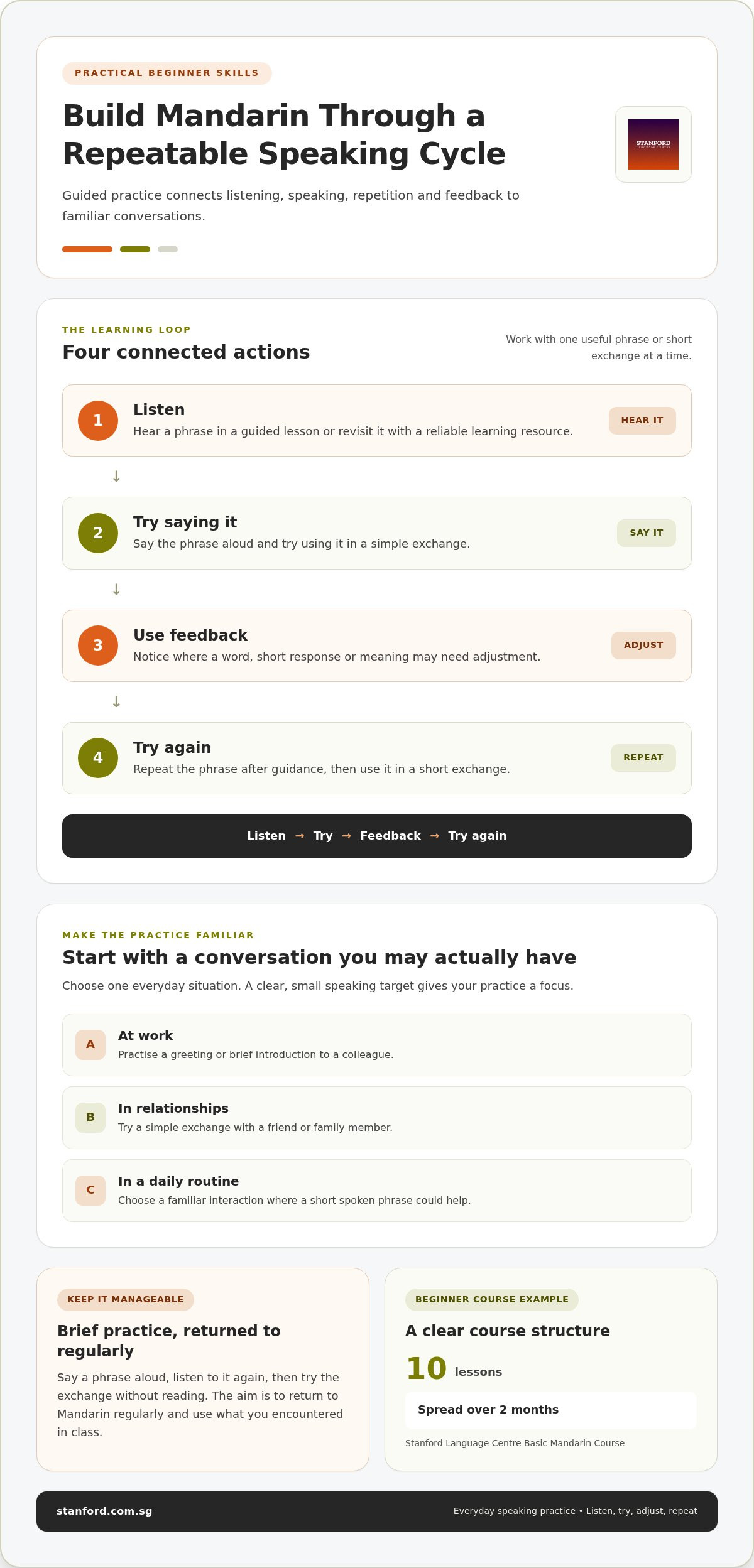
- At work: Start with a greeting or a brief introduction to a colleague.
- In relationships: Focus on a simple exchange with a friend or family member.
- In a daily routine: Choose a familiar interaction where a short spoken phrase could be useful.
These are starting points, not limits. As you gain experience, you may want to extend a conversation, discuss work topics, or explore reading and writing. Learners who want guided practice can explore adult Mandarin lessons and use their first goal to help decide what to focus on.
Understand what beginner Mandarin learning involves
Beginner learning can start with guided practice that supports communication. Listen to a phrase, try saying it, repeat it, and use feedback to adjust. The aim is to become more familiar with spoken exchanges, not to absorb every part of the language at once. Repeating a short practice can feel more manageable than trying to study everything together.
Keep your first goal focused on speaking. Reading and writing can be meaningful longer-term ambitions, but they don’t need to come before trying a simple conversation. You can decide later whether you want to recognise written words, read more comfortably, or practise writing. If your needs change, your learning priorities can change too.
That distinction makes it easier to learn mandarin singapore with purpose: begin with a useful spoken milestone, then build on it as your confidence and experience grow. A realistic goal helps you choose a lesson format and identify what to practise next, without confusing early conversational progress with complete fluency or mastery.
How Adult Beginners Build Practical Mandarin Skills
Practical learning takes more than recognising a phrase on a page. You need chances to hear it, try saying it, and use it in a simple exchange. Guided speaking practice brings listening, phrase recall, repetition, teacher feedback, and another attempt together. It gives you a way to practise understanding and responding in familiar situations. Progress varies, but a steady routine creates regular opportunities to work on the skills you’re building.
Mandarin may be part of someone’s home, work, or community life, and every learner’s experience is different. The National Library Board’s overview of Singapore’s Bilingual Policy offers context for the role of language learning here. Your own practice can stay focused on the conversations you want to handle, rather than trying to learn everything at once.
Why regular speaking practice matters
Saying a phrase aloud lets you practise recalling and using it, rather than only recognising it when someone else says it. Short exchanges are a manageable place to start. You might practise asking for information, responding to a question, or introducing a topic that comes up in a familiar setting. Focus on one exchange, then repeat it with a small change, such as trying a different response.
Between lessons, fit in a brief practice session when it works for you. Say a phrase aloud, listen to it again using a reliable learning resource, then try the exchange without reading. You don’t need a long study block every time. The aim is to return to Mandarin regularly and use what you’ve encountered in class.
How teacher feedback can support progress
A teacher can help you notice where a phrase needs adjustment and guide you towards a clearer way to communicate. Feedback may help with how you say a word, how you put a short response together, or whether your meaning is coming across. Treat it as useful direction, not a test you have to pass perfectly on the first try.
Make lessons active. Ask questions when something feels unclear, try the phrase again after receiving feedback, and practise using it in a short exchange. If you feel hesitant, start with a simple response and build from there. Repeating a phrase after guidance connects listening with speaking and gives you a focused way to practise.
A practical plan to learn mandarin singapore can follow a simple cycle: listen, try, receive feedback, and try again. Use that cycle with exchanges connected to work, social life, or other familiar settings. Consistency is a helpful habit, not a guarantee of a particular result, so keep your practice realistic and adjust it as your needs change. If guided lessons would help you practise speaking, explore Stanford Language Centre’s adult Mandarin learning options.
Group, Private, or Online Mandarin Lessons: Compare Your Options
The right lesson format is one you can attend and participate in consistently. Consider how you prefer to practise, how much control you need over timing, and whether you learn best in a shared or individual setting. Mandarin lessons are available in person or online, so think about which environment works comfortably for you too.
| Format | Interaction | Scheduling | Learning environment |
|---|---|---|---|
| Group | Interactive learning and shared practice with other learners | Attend according to the group class schedule | In person or online, depending on the class |
| Private | One-to-one lessons with a teacher | Timing and location are chosen by the student | Individual learning setting |
| Online | Join a Mandarin lesson remotely | Choose an online class format that fits your plans | Learn online rather than in person |
When group Mandarin classes may suit you
Group classes can suit you if you value interactive lessons and want to practise alongside other learners. Shared activities create opportunities to listen to different speakers, take turns, and try short exchanges in a class setting. The format may also appeal if you enjoy learning with others and benefit from a regular class structure.
Stanford Language Centre’s group classes are relaxed and interactive, with Free make-up when available. A make-up lesson depends on availability, so it isn’t guaranteed for every missed session. If you’re comparing group learning with other approaches, the Center for Applied Linguistics’ Benefits of Learning Chinese guide offers broader context on learning opportunities and resources.
When private or online lessons may fit better
Private lessons are one-to-one, with the student choosing the lesson time and location. That can suit adults who prefer individual instruction or need lessons arranged around their own schedule. Consider whether having a teacher’s attention focused on your practice would make it easier to ask questions and work at a comfortable pace.
Online lessons offer another way to learn Mandarin without attending in person. They may suit you if remote learning fits more naturally into your routine or preferred study environment. The format alone doesn’t determine what you’ll learn, so choose one that makes it realistic for you to participate and keep up with lessons.
To decide, rank your priorities: shared interaction, one-to-one attention, control over lesson time and location, or learning online. If private instruction best matches your needs, explore Stanford Language Centre’s adult Mandarin learning options. The best way to learn mandarin singapore is to choose a format that aligns with your preferences and makes regular participation realistic.
Build a Mandarin Study Routine Around Your Real Schedule
A useful routine should fit around the commitments you already have, not compete with them. For adults learning Mandarin, a clear goal and a few repeatable steps can make practice easier to return to. Short, repeated sessions support continuity without requiring a fixed number of study hours or a perfect week.
Use this four-step cycle as a flexible guide:
- Choose a goal. Pick one upcoming situation where Mandarin could be useful, such as greeting a colleague or making a simple request. Write down what you’d like to say or understand. A specific situation helps you focus your lesson and practice choices.
- Attend lessons. Choose a lesson format and schedule that you can realistically maintain. Bring your goal into the learning process so you can connect new practice with situations you expect to encounter at work, in relationships, or in your routine.
- Practise briefly. Review a phrase or short exchange from your lesson. Say it aloud, then try using it in a way that relates to your chosen situation. Keep the practice small enough to fit into a natural break in your day.
- Review your progress. Notice which phrases feel more familiar and which still take effort. Use that reflection to choose what to revisit or ask about in your next lesson. Adjust your goal as your interests and confidence develop.
Prepare for your first Mandarin lesson
Before class, note a few situations you hope to handle and the kinds of phrases you’d like to practise. You don’t need a complete study plan. A short list gives you a useful starting point and helps you explain what matters to you. You can also prepare questions about the lesson format, schedule, and how your learning goals can guide your practice.
Keep practice manageable between lessons
After a lesson, review your notes and repeat familiar spoken phrases. Try recalling them without looking, then check your notes and practise again. Link each phrase to a relevant moment, such as a work conversation or an everyday interaction, so practice has a clear purpose. Keep track of what feels easier and what you’d like to revisit. For another practical reference, look for guidance on beginner conversational Mandarin and daily exchanges.
Keep the routine flexible. If a busy day interrupts practice, return to it when you can instead of treating one missed session as failure. A routine that bends around real life is often easier to sustain than an ambitious plan that feels difficult to restart. If structured lessons would help, explore adult Mandarin learning options at Stanford Language Centre.
Start Learning Mandarin with Stanford Language Centre
Once you’ve identified a practical reason to learn, choose a lesson option that fits your needs and routine. Stanford Language Centre offers adult Mandarin learning through group classes, private lessons, online classes, intensive lessons, and workshops. You can begin with a structured basic course or choose a format that better suits the way you prefer to learn.
The 10-Lesson Basic Mandarin Course consists of 10 lessons spread over 2 months. This gives you a defined course structure to consider as you plan your learning. It doesn’t promise a particular level of progress, since outcomes depend on individual learning and practice. Use the course details to understand the time commitment and decide whether this starting point aligns with your goal.
Choose a Mandarin learning format at Stanford
Group classes offer relaxed, interactive learning and shared practice, while private lessons provide one-to-one instruction with timing and location chosen by the student. Mandarin lessons are available in person or online, giving you a choice of learning environment. Intensive lessons and workshops are also available for adults considering alternatives to a regular group or private format. Workshops run for one to two days and focus on useful conversational phrases and cultural context.
To narrow your options, think about what will help you participate consistently. Do you enjoy learning alongside others? Would one-to-one instruction suit your preferences? Is joining online more convenient than attending in person? These questions help you compare formats based on your schedule, learning environment, and comfort with shared or individual practice. You can explore Mandarin course details to see the available learning options.
Keep the decision practical. A group class may suit you if interactive learning appeals to you. Private lessons may be a better match if you prefer individual instruction and want to choose the lesson time and location. Online learning is another option if you’d rather join remotely. There isn’t one format that suits every adult learner, so focus on the approach you’re most likely to continue.
Take the next step with a clear enquiry
Before making a decision, note your current Mandarin experience, the situations you’d like to prepare for, and the lesson format you’re considering. A clear enquiry can focus on the course structure, schedule, or differences between learning options. This helps connect your original goal with a suitable next step, without needing to map out every stage of your learning in advance.
Pricing is available on request. If you’re ready to learn mandarin singapore, review the course information and choose an option that feels like a manageable beginning. There’s no need to aim for everything at once. Start with a format that fits your preferences, then build your learning routine from there.
Take Your First Step Toward Mandarin Conversations
Your next step doesn’t need to be a big commitment. Choose one conversation you’d like to feel more prepared for, and let that intention guide how you begin. As you learn mandarin singapore, your reasons for studying may shift: a phrase that once felt like a challenge can become the starting point for a new goal. Give yourself room to learn at a pace that works with your life.
Treat learning as a series of practical choices rather than a test of how quickly you progress. Stay curious, notice what you want to understand next, and keep making space for practice. A clear first step is enough to get moving.
Explore Mandarin courses at Stanford Language Centre and choose a way to begin that feels right for you. You don’t need to have every future goal mapped out. Start with one useful conversation, and build from there.
Frequently Asked Questions
Is Mandarin difficult to learn as an adult?
It depends on your goals, previous language-learning experience, and chances to practise. If you’re new to Mandarin, start with one useful task, such as introducing yourself at work or following a brief exchange with a neighbour. You don’t need to tackle every skill at once. A structured course can provide direction, while regular practice gives you opportunities to use what you’re learning. Progress varies, so no timeline is guaranteed.
How much Mandarin can I learn in 2 months?
There isn’t one set amount, because outcomes depend on your starting point, goals, attendance, and practice. Stanford’s Basic Mandarin Course consists of 10 lessons over 2 months, but that structure doesn’t promise a particular level of fluency. Before starting, choose a concrete aim, such as handling a short introduction or asking a simple question. Then consider which class format fits your routine and helps you participate consistently.
Can I join Mandarin classes if I am not a Singapore resident?
Yes. Mandarin lessons aren’t limited to Singapore residents. You can consider online learning if attending in person doesn’t suit your situation, and choose a format and schedule that fit your circumstances. For example, someone living outside Singapore may prefer lessons they can join remotely, while a learner who is in Singapore may consider in-person classes. Your location doesn’t need to define your learning goal.
Are make-up lessons guaranteed if I miss a group Mandarin class?
No. Stanford group classes offer Free make-up when available, so a make-up lesson isn’t guaranteed for every absence. If you expect attendance to be difficult, factor that condition into your plans before choosing a class. Private and online Mandarin lesson options are also available, which may suit learners weighing different ways to keep learning around changing commitments.
Can I use SkillsFuture credits for Mandarin classes at Stanford?
No. Stanford Language Centre doesn’t accept SkillsFuture Credits for its Mandarin classes. This is separate from the SSG Training Grant, which eligible corporate groups may qualify for in addition to a special corporate rate. The grant isn’t automatic for every company or available to individual learners as personal credit. If you’re arranging employee training, consider the corporate option rather than treating SkillsFuture Credits and the SSG Training Grant as interchangeable.
Can I use NTUC UTAP for Mandarin classes?
Stanford Language Centre offers NTUC UTAP claimable Mandarin programmes, but don’t assume every learner or course automatically qualifies. UTAP eligibility and claim conditions depend on the applicable programme requirements, so review the relevant UTAP information for your circumstances before relying on a claim. If you’re comparing ways to learn mandarin singapore, include eligibility in your planning. Course pricing is available on request.