What if the best Chinese course for adults isn’t the most intensive one, but the one you can keep attending? If you’re balancing work, family and other commitments, choosing a class can feel almost as challenging as learning Mandarin itself. You might wonder whether you need experience before joining a beginner course, or whether group, private or online lessons would suit you better.
You don’t need to have everything figured out before you start. A structured beginner programme gives you a clear starting point, while the right format can help you practise at a pace that fits your routine. Stanford Language Centre offers adult Mandarin learning through small-group, private one-to-one and online classes.
This guide compares those formats and shows how to match them to your schedule and reasons for learning, from everyday conversation to speaking with colleagues or local friends. You’ll also learn how to set practical goals and choose a sensible next step, whether you’re starting from scratch or returning to Mandarin after a break.
Key Takeaways
- Match your Mandarin goals to real situations, such as everyday conversations, social connection or workplace communication.
- A structured beginner course can help you build foundational communication skills, even if you’re starting from scratch.
- Compare small-group, private one-to-one and online classes by how each format fits your learning preferences and routine.
- Choose a chinese course for adults by considering your goal, starting level, preferred format and realistic time for practice.
- Explore adult Mandarin options at Stanford Language Centre, including beginner Level 1 programmes and specialised small groups.
Choosing a Chinese Course for Adults: Start with Your Everyday Goals
You can begin learning Mandarin as an adult, even if you have little or no experience. A structured beginner class gives you a starting point and makes a broad goal easier to approach. Before choosing a chinese course for adults, decide where you want to use Mandarin first. A specific, everyday aim can help you identify the practice that will be most useful.
Your reason for learning shapes what you want to practise. Everyday conversation might mean greeting a neighbour, asking a simple question or ordering a meal. Social connection could involve chatting with a friend’s family or joining a community gathering. Workplace communication may call for polite introductions or basic exchanges with Mandarin-speaking colleagues. These goals call for different practice, so be more specific than “learn everything” when deciding where to begin.
What do you want to do in Mandarin?
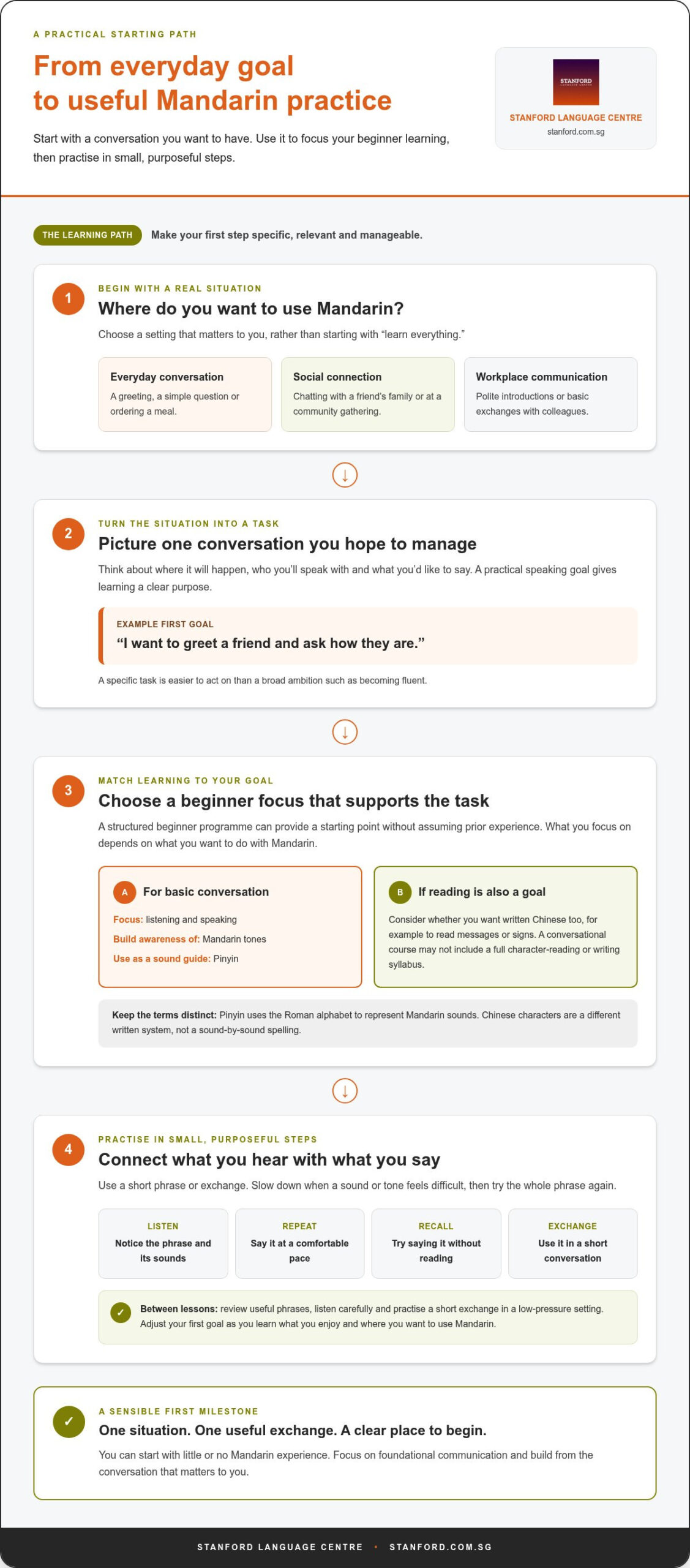
Picture one real conversation you hope to manage. Where will it happen, who will you speak with, and what would you like to say? You might want to introduce yourself to a neighbour, ask for directions or exchange a few words with a colleague. Turning this into a practical speaking goal gives your learning a clear purpose. Fluency can be a longer-term ambition, but it doesn’t need to be your first milestone.
Write your goal as a simple task: “I want to greet a friend and ask how they are.” That’s easier to act on than “I want to become fluent.” It also gives you a way to think about course fit: look for learning that supports the situations you care about. For a broader overview of adult learning options in Singapore, explore this adult Chinese learning guide.
It can help to be clear about the variety of Chinese you want to learn. Standard Chinese (Mandarin) is the variety commonly meant by Mandarin language learning. Your immediate goal can stay practical and personal: start with a conversation you’re likely to use, then build from there as your needs develop.
Can adults begin with little or no experience?
Yes. A structured beginner class offers an entry point for adults building foundational Mandarin skills. You don’t need to arrive knowing how to pronounce every word. It’s normal to feel unsure about tones, pronunciation or speaking aloud at first. These are part of learning, not signs that you’re unsuited to the language.
Progress involves practice both in and between lessons. Review useful phrases, listen carefully and practise a short exchange in a low-pressure setting. Rather than setting a fixed deadline for a particular result, choose a first goal that feels achievable. Adjust it as you learn more about what you enjoy and where you want to use Mandarin.
Keep the first step small: identify one situation, one person or type of conversation, and one thing you’d like to communicate. That focus will help you compare learning options without losing sight of why you started.
What an Adult Mandarin Course Can Cover at Beginner Level
A beginner Mandarin course gives learners a structured way to build foundational communication skills. Instead of trying to absorb the whole language at once, you work towards understanding and using basic Mandarin in relevant situations. The focus depends on the course and learner needs. Someone focused on conversation may prioritise listening and speaking, while another learner may also want an introduction to reading and writing.
Mandarin is a spoken language variety, while Chinese is a broader term that can refer to several related language varieties and written forms. This distinction can help you describe what you want to learn. When choosing a chinese course for adults, consider whether your priority is speaking, understanding spoken Mandarin or developing written skills too. A structured beginner Level 1 programme can provide a clear starting point without assuming prior experience.
Beginner learning may introduce spoken Mandarin, tones and Pinyin. Tones help distinguish spoken words, while Pinyin represents Mandarin sounds using the Roman alphabet. These are different learning tools, and the time devoted to each depends on the course focus.
Speaking, listening and Mandarin tones
Mandarin is tonal, so the pitch pattern used for a syllable can change its meaning. Build awareness by listening closely, noticing tone differences and trying the sounds aloud. Listening and speaking work together: hear a phrase, repeat it, then use it in a short exchange. At beginner level, the aim is to develop careful habits and confidence, not to expect every tone to feel natural immediately.
Make practice simple and purposeful. Listen to a phrase, repeat it at a comfortable pace, then try saying it without reading. Repeating a short exchange connects what you hear with what you say. If a sound or tone feels difficult, slow down and focus on it before practising the full phrase again.
Pinyin and Chinese characters: understand the difference
Pinyin is a romanisation system that uses the Roman alphabet to represent Mandarin sounds. It can help you read pronunciations and practise speaking. Chinese characters are different: they represent written Chinese and aren’t simply a sound-by-sound spelling system. A conversational course may focus on spoken communication, so don’t assume it includes a full character-reading or writing syllabus.
Think about what you want to do with Mandarin. If your immediate aim is basic conversation, spoken practice may be the priority. If you want to read messages or signs, written Chinese may also matter to your goals. You don’t have to choose one focus forever. Decide what you want to work on first, then consider how the course content supports that aim.
Before starting, note whether speaking, listening, Pinyin or characters matter most to your reason for learning. That gives you a practical way to consider adult Mandarin learning options at Stanford Language Centre and choose a starting point that suits your needs.
Small Group, Private or Online: Compare Adult Chinese Course Formats
The best format depends on how you like to learn and what will help you keep practising. Do you feel comfortable speaking with other learners, prefer individual attention, or need a remote option? Each format has benefits and trade-offs. Use this comparison as a starting point, not a ranking: the right chinese course for adults is one that fits your needs and routine.
| Format | Potential fit | Trade-offs to consider |
|---|---|---|
| Small group | You enjoy learning alongside others and want opportunities for shared practice. | Class time is shared, so you’ll interact with peers as well as the instructor. |
| Private one-to-one | You prefer an individual learning setting and want lessons centred on your own learning needs. | You won’t have the same group dynamic or peer interaction as in a small-group class. |
| Online | You prefer remote learning or want to avoid travelling to a physical class. | You’ll need to feel comfortable participating online and manage the learning environment where you join class. |
When might a small-group Mandarin class suit you?
Learning with peers can make practice feel more like a conversation. You can listen to other learners, take turns speaking and share the experience of building confidence. A small-group setting may also appeal if you prefer a class structure to anchor your learning. Stanford Language Centre offers small-group Mandarin classes, including specialised groups for expats and foreigners, as well as Japanese and Korean speakers.
Consider how you feel about speaking in front of others. If practising with classmates sounds motivating, a group may suit you. If you’d rather take time to form each response before speaking, another format may feel more comfortable. Neither preference is a measure of ability. It’s about finding an environment where you can take part.
When might private or online lessons fit better?
Private one-to-one lessons provide an individual format for learners who would rather focus on their own questions and goals than practise in a group. Online classes suit learners who prefer remote lessons. They remove the need to travel to a classroom, though you’ll still want a place where you can listen and participate without too many interruptions.
Think about your typical week, too. A format can sound appealing in theory, but it needs to work alongside your existing commitments. Consider which setting makes it easiest to attend, speak and practise between lessons. No format guarantees a particular pace or result; your engagement and regular practice matter as well.
For workplace learning organised by an employer, corporate Mandarin training is a separate option. It supports an organisation’s learning needs, rather than replacing an individual adult class. If you’re choosing for yourself, compare the three learner formats against your preferred way to practise and your day-to-day schedule.
How to Choose a Chinese Course Around Your Schedule and Learning Needs
A good fit starts with four practical questions. Use this checklist to compare options before choosing a chinese course for adults:
- Goal: What would you like to do in Mandarin first, such as make conversation, connect socially or communicate at work?
- Starting level: Are you new to Mandarin, returning after a break or looking to build on some existing knowledge?
- Preferred format: Would you rather learn in a small group, in private one-to-one lessons or online?
- Realistic schedule: Which class commitments can you fit around work and personal routines, and when could you practise between lessons?
Prior language experience is useful context, not a promise of faster progress. You might recognise Mandarin words from daily life, have studied another language or have attended a Mandarin class before. Note what you’ve encountered and what still feels unfamiliar. This gives you a clearer picture of your starting point and the kind of support you may need.
Match the course to your starting point
If you’re new to Mandarin or unsure about the basics, foundational instruction can offer a structured beginning. If you’ve studied before, think about what you can already understand or say and what you want to practise next. Jot down any Mandarin exposure, including familiar words, listening experience or previous classes. This context can help you decide whether a beginner course suits you. For a closer look at beginner expectations, use this Mandarin Level 1 adult guide.
Make room for consistent practice
Look at your calendar before settling on a class format. Account for the lesson itself, travel if needed, work demands and personal commitments. Then identify small practice opportunities that feel realistic, such as reviewing a phrase during a quiet moment or repeating material after class. There’s no single weekly study-hour target that suits every adult. A manageable routine you can maintain is a more useful starting point than an ambitious plan that clashes with your week.
Also consider what might interrupt your routine. If work shifts or family plans change often, think about which class format feels practical to attend consistently. If you prefer a set class structure, map that commitment onto your usual week. Choose a learning arrangement that leaves room to revisit what you’ve practised, rather than relying on lessons alone.
Some Mandarin programmes include NTUC UTAP-claimable options. Claimability doesn’t automatically mean every learner or course is eligible. Before making a decision based on UTAP, review NTUC’s current eligibility rules and claim requirements, which may apply to both the learner and the course. Factor the time and practice you can realistically commit into your choice as well.
Once you’ve noted your goal, starting point, preferred format and available practice time, you have a practical basis for comparing adult Mandarin learning options. Explore Mandarin course options at Stanford Language Centre and consider which format aligns with your needs.
Explore Stanford Language Centre’s Chinese Courses for Adults
Once you’ve considered your goals and preferred way to learn, you can compare the adult Mandarin options that match them. Stanford Language Centre offers structured beginner Level 1 programmes, small-group classes, private one-to-one lessons and online classes. These formats give adult learners different ways to begin or continue learning, whether they value peer interaction, individual instruction or remote participation.
Which Stanford Mandarin format may fit your needs?
Small-group classes provide a shared setting where learners can practise alongside others. Stanford offers specialised small groups for expats and foreigners, as well as Japanese and Korean speakers. If you’re an expat considering how Mandarin learning can support everyday life in Singapore, this Mandarin course guide for expats offers a relevant overview.
Private one-to-one lessons offer an individual format for learners who prefer instruction focused on their needs. Online Mandarin classes provide a remote option for those who would rather learn without attending a physical classroom. Choose based on how you prefer to participate and what works alongside your other commitments. Each format offers a different learning setting, not a guaranteed pace or result.
For workplace learning organised by an employer, Stanford also offers corporate Mandarin training. This is a workplace solution, distinct from choosing an individual class for personal learning. If you’re selecting a course for yourself, consider the class format alongside your starting point and the Mandarin situations you want to handle.
Take a simple next step
Start by identifying what you want from a class. A beginner Level 1 programme can provide structure if you’re new to Mandarin. A small group may appeal if you value shared practice, while private lessons offer one-to-one instruction and online classes a remote learning format. You don’t need to settle every long-term goal now. Focus on a suitable place to begin, then build your learning around your needs.
Some Mandarin programmes are NTUC UTAP-claimable. Eligibility and claims depend on current programme rules, so review the latest NTUC requirements before relying on a claim as part of your decision. This helps you assess the course based on its learning format and your circumstances, rather than assuming the same claim conditions apply to every learner or programme.
Stanford Language Centre has offered language learning since 2004, with adult Mandarin options spanning beginner, group, private and online formats. Take a low-pressure next step: explore adult Mandarin course options and consider which starting format best matches your goals and routine.
Turn Your Mandarin Goal into a First Step
Starting a language doesn’t require a perfect plan. Choose one useful thing you’d like to say or understand, then let that intention guide your first steps. Your goal can change as you learn. What matters now is choosing a beginning that feels manageable and gives you a reason to keep practising.
A chinese course for adults can be more than a place to study. It gives you a regular opportunity to use Mandarin and make learning part of your routine. Give yourself room to be a beginner, make mistakes and build confidence through practice. Small, steady steps count.
If you’re ready to find a starting point, explore adult Mandarin courses at Stanford Language Centre. Choose the option that fits your needs and take your first step towards using Mandarin with greater confidence.
Frequently Asked Questions
Is Chinese the same as Mandarin?
Not exactly. “Chinese” is a broad term that can refer to different spoken varieties and written forms, while Mandarin is one spoken variety. In Singapore, people may use “Chinese” informally when they mean Mandarin, so clarify your language goal when choosing learning materials or a class. If you want to speak Mandarin, focus on a course that teaches spoken Mandarin rather than assuming every Chinese-language resource covers the same variety.
Can adults learn Mandarin if they have no previous experience?
Yes. Adults can start from the basics without having studied Mandarin before. You might begin by practising greetings, introducing yourself or understanding a simple question. It’s normal to need time to get comfortable with unfamiliar sounds, so focus on participating and practising rather than comparing yourself with experienced speakers. A beginner-friendly chinese course for adults can provide a structured place to start, while regular review helps make class learning part of daily life.
Do I need to learn Chinese characters to speak Mandarin?
No, learning characters isn’t a prerequisite for speaking basic Mandarin. You can develop spoken communication by listening, practising pronunciation and learning useful words and phrases. Characters become relevant if you also want to read messages, menus or signs, or write in Chinese. For example, someone preparing for spoken conversations at work may initially prioritise listening and speaking, then add reading practice if it becomes useful for their role.
How long does it take an adult to learn basic Mandarin?
There isn’t one reliable timeline for every adult. It depends on what you mean by “basic,” how often you practise and which skills you’re learning. Being able to introduce yourself is a narrower goal than understanding a range of everyday conversations. Choose a specific task, such as greeting a neighbour or asking a simple question, and use it to identify what you can do now and what you want to practise next.
Is Pinyin enough to learn Mandarin?
Pinyin can help you read Mandarin pronunciations, but it isn’t the whole language. To communicate, you’ll also need to build vocabulary, understand how words work in phrases and practise listening and speaking. Pinyin alone won’t teach you to understand a conversation or read Chinese characters. If your goal is spoken Mandarin, use Pinyin as a pronunciation aid while making time to listen to and say words in context.
Can I use NTUC UTAP for an adult Mandarin course?
Some Mandarin programmes are NTUC UTAP-claimable, but that doesn’t mean every learner or course automatically qualifies. Eligibility and claim requirements follow NTUC’s current rules, so review the latest guidance before enrolling or planning around a claim. Check the relevant course and learner conditions in the current programme information. Don’t assume that UTAP and other forms of training support have the same requirements.