Fluency doesn’t depend on choosing between speaking and grammar. It grows when you use each to strengthen the other. The question of conversational practice vs grammar drills for fluency matters because grammar exercises can feel far removed from real conversations, while speaking without familiar sentence patterns can be frustrating. Both methods have a role: conversation helps you respond more naturally, and grammar gives you tools to make those responses clearer and more accurate.
If you’re learning Mandarin or another language as a busy adult in Singapore, you don’t need to spend all your study time on one method. A balanced routine can help you speak with greater ease while building the structure to express what you mean. This guide explains what conversation practice and grammar drills each contribute, when to use them, and how to fit both into your study time. You’ll also see how focused practice and feedback can help turn a rule you’ve studied into language you can use in everyday situations.
Key Takeaways
- Fluency means communicating with increasing ease, not speaking perfectly. Speed, accuracy, confidence, and being understood can improve at different rates.
- Conversation builds listening, quick responses, and the ability to keep an exchange moving. Drills reinforce specific language patterns.
- Conversational practice vs grammar drills for fluency works best as a feedback loop, not an either-or choice.
- Try a practical routine: choose a communication goal, practise a useful pattern, use it in conversation, then review what needs more attention.
- Guided adult classes at Stanford Language Centre connect structured learning with communication through small-group, private, online, and corporate formats.
Conversational Practice vs Grammar Drills: What Does Fluency Require?
Fluency isn’t a perfect accent or a flawless sentence every time. It’s the growing ability to find useful words, follow what someone is saying, and respond with less effort. You may still pause or make mistakes. What matters is whether you can communicate your meaning and keep the exchange going.
Fluency means communicating with increasing ease, even while you’re still learning to speak accurately. It has several parts. You might understand a question quickly but need time to answer, or speak confidently while mixing up a verb form. Speed, clarity, accuracy, and confidence don’t always develop together.
Conversation practice and grammar drills support different parts of this process. Conversation asks you to retrieve language, listen, respond, and adjust in real time. A drill gives you focused repetition of a particular form or sentence pattern. The grammar behind a pattern helps explain how words fit together; practice helps you recognise and use that pattern when communication calls for it. Neither activity measures your whole ability on its own.
What does being fluent actually mean?
Practical fluency is not the same as native-like pronunciation or complete grammatical accuracy. Imagine asking for directions in Mandarin: you might use a simple sentence, miss a measure word, and still understand the reply well enough to continue. If your meaning gets across and you can respond, you’re communicating effectively, even with errors.
That takes more than knowing a rule. You need to find familiar words while listening, choose a useful structure, and keep track of the exchange. A grammar exercise lets you practise a pattern without the pressure of a live conversation. Conversation gives you a chance to retrieve that pattern while also paying attention to what someone else says. These activities have different goals, and both can contribute to practical communication.
Why do learners feel stuck between speaking and studying?
Knowing a rule and using it aloud are separate challenges. You might complete a written exercise correctly, then hesitate when you need the same structure in conversation. The rule may be clear, but retrieving it quickly while listening and forming a reply takes practice.
The opposite can happen too. You may be willing to speak but get stuck because a key word or sentence pattern isn’t familiar yet. In either case, frustration is useful information, not proof that you’re bad at languages. Trouble forming a sentence can point to a pattern worth reviewing. A long pause to search for words may show that you need more chances to retrieve language in context.
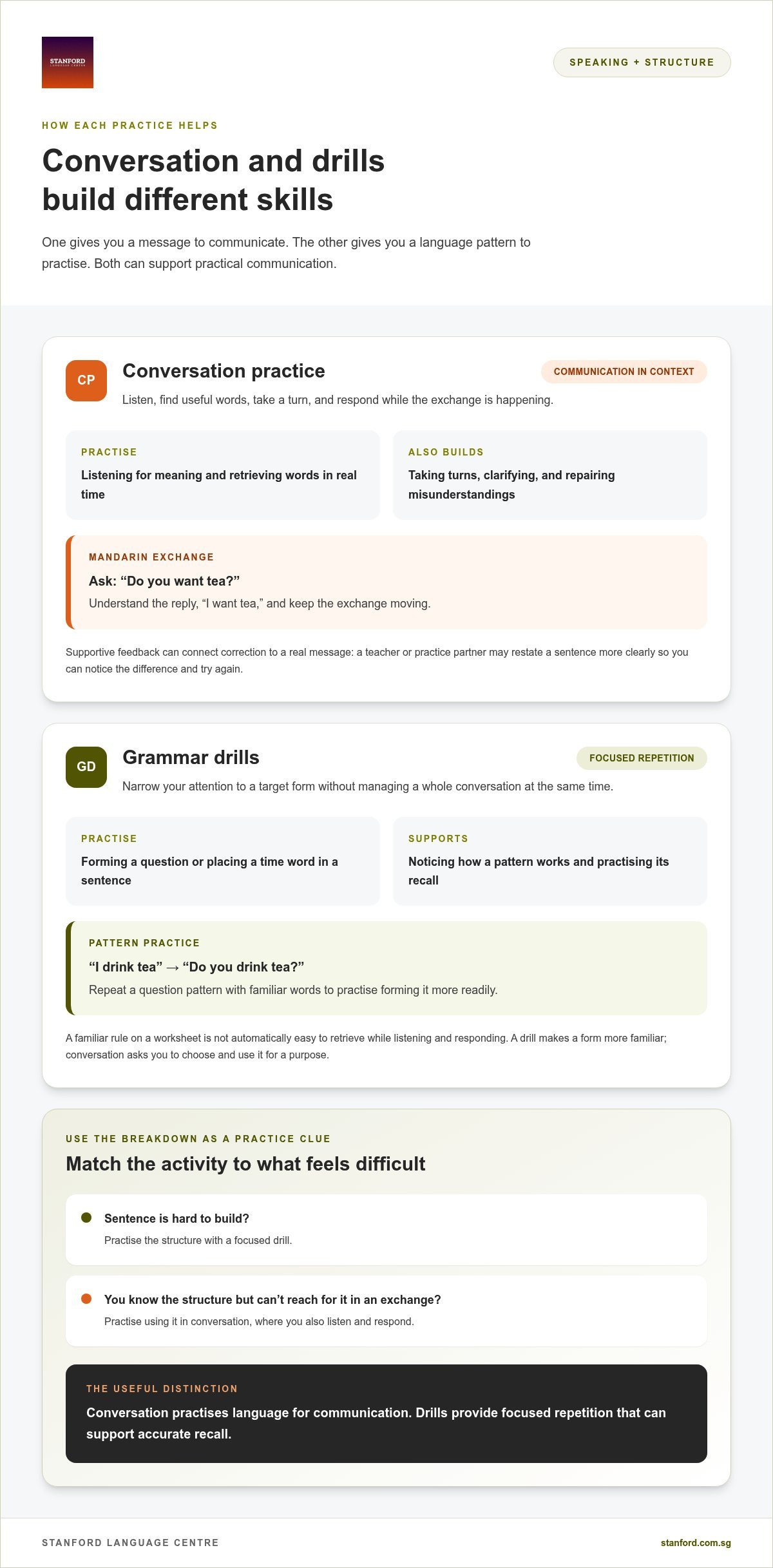
That’s the practical question behind conversational practice vs grammar drills for fluency: which part of communication needs attention right now? Notice what breaks down. If you can’t build the sentence, practise its structure. If you know the structure but can’t reach for it during an exchange, practise using it in conversation. Next, consider how each method builds these skills.
How Conversation Practice and Grammar Drills Build Different Skills
Conversation and drills ask you to do different jobs. One gives you a message to communicate; the other gives you a language pattern to practise. Knowing the difference helps you choose an activity that matches the skill you want to strengthen, rather than expecting every exercise to improve everything at once.
What conversation practice helps learners do
A conversation asks you to listen for meaning, take a turn, and retrieve words while someone is waiting for your response. It also gives you a reason to clarify or repair a misunderstanding. In a beginner Mandarin exchange, for example, you might ask the equivalent of “Do you want tea?” and respond to “I want tea.” The goal is to understand and keep the exchange moving, not recite a perfect line.
Supportive feedback can make these attempts more useful. A teacher or practice partner might restate a sentence with a clearer word or structure, giving you a chance to notice the difference and try again. That connects correction to a real message. Learners working on tones can also explore this practical guide to learning a tonal language, since tone practice also benefits from hearing and using sounds in context.
What grammar drills are useful for
A drill narrows your attention to one target, such as forming a question or placing a time word in a sentence. You might practise changing “I drink tea” into “Do you drink tea?” with different subjects or objects. This focused repetition helps you notice how a pattern works and practise recalling it without managing a whole conversation at the same time.
Recognising a rule on a worksheet is not the same as retrieving it while listening and responding. A drill can make a form more familiar; a conversation asks you to select and use it for a purpose. Conversation practises language for communication; drills provide focused repetition that can support accurate recall. Neither activity needs to work alone.
Consider the difference in task:
- Conversation: Find a way to ask for a drink, understand the reply, and respond.
- Drill: Practise a question pattern with several familiar words until you can form it more readily.
Both tasks can reveal what to work on. If you can complete the drill but hesitate in conversation, you may need more chances to retrieve the pattern in context. If you keep making the same form error while speaking, a short, focused exercise can help you pay attention to that structure before using it again.
This is the practical value of conversational practice vs grammar drills for fluency: the methods develop complementary skills, and your difficulties can show you how to connect them. Guided adult Mandarin classes at Stanford Language Centre offer a structured setting for language learning and communication practice. Explore adult language learning with Stanford Language Centre to bring focused study and speaking practice together.
Do Grammar Drills Slow Fluency? Compare the Trade-Offs
Grammar drills don’t automatically slow fluency. They can help when a particular sentence pattern keeps causing confusion. The trade-off appears when practice focuses only on getting answers right and never asks learners to use those patterns to express a real message. Conversation has the opposite risk: speaking regularly builds comfort, but repeated errors can go unnoticed without reflection or guidance.
Compare each method against the skill you want to work on. Neither one gives a complete picture of speaking progress.
| Area | Conversation practice | Grammar drills | Useful when you need to |
|---|---|---|---|
| Speaking confidence | Offers practice responding and keeping an exchange going. | Lets you practise a pattern before using it spontaneously. | Speak with less hesitation or prepare for a tricky structure. |
| Accuracy | Shows how well you can apply language while communicating. | Brings one form into focus for careful practice. | Notice and work on a recurring error. |
| Recall | Requires you to find words and forms as you listen and respond. | Repeats a target pattern, but may offer clues that make recall easier. | Retrieve a structure with less support. |
| Engagement and transfer | Connects language to a purpose, but familiar topics may not expose every gap. | Can feel repetitive if meaning and feedback are missing. | Make focused study relevant to real communication. |
When can conversation practice be the better priority?
Prioritise speaking if you understand basic patterns but hesitate to use them. Start with familiar, low-pressure topics, such as describing a meal or asking about someone’s plans. Add a detail or ask a follow-up question. After the exchange, note one phrase you used well and one you want to try differently. This brief reflection keeps communication flowing without interrupting to correct every sentence.
When can grammar drills make practice more effective?
Choose a drill when the same form repeatedly makes your meaning unclear. Keep the target narrow, such as forming questions, and practise it in a few useful examples. Then use the pattern in a short, meaningful exchange. The drill gives you time to focus; the exchange shows whether you can apply it. Accuracy matters, but it’s only one part of speaking progress.
Use the comparison as a guide, not a strict rule. If speaking feels difficult because you’re searching for a structure, pause to practise that form. If you can complete exercises but struggle to respond naturally, spend more time using familiar language in conversation. Conversational practice vs grammar drills for fluency is less about choosing a winner and more about matching practice to the obstacle in front of you.
How to Combine Speaking Practice and Grammar Drills in One Routine
A useful routine doesn’t need to be complicated or take up a large block of your day. Give each activity a clear job: use a grammar drill to prepare one useful pattern, then try it in conversation. Review what happened and let that guide your next practice. This connects studying a form with using it to communicate.
A repeatable practice loop for busy adult learners
Start with one everyday goal, such as asking someone what they usually eat for lunch. Review only the words and sentence structure you need for that exchange. Practise the pattern aloud, then use it in a short conversation. Finish by noting one thing that went well and one point to revisit. Keep each step brief enough to fit your schedule, and repeat the loop rather than waiting for a perfect study session.
- Choose a communication goal. Make it specific, such as asking about a familiar daily topic or describing a simple plan.
- Prepare the language. Review a small set of useful words and one sentence pattern that supports the goal.
- Practise aloud. Say a few variations so the structure feels familiar, not just recognisable on the page.
- Use it in an exchange. Ask and answer questions, or practise with a partner who can respond naturally.
- Review and choose a next step. Record a phrase you used and one recurring difficulty to work on later.
For a beginner working on Mandarin, the goal might be to ask a simple question about food, then add a follow-up question based on the answer. This conversational Mandarin Level 1 practical guide can help beginners consider where to start with practical language use.
How to choose what to practise next
Use what happens during practice to decide how to adjust the balance. If the same grammar form repeatedly makes your message hard to understand, isolate it for a short drill, then try it in a new exchange. If you understand the pattern but hesitate when it’s your turn to speak, spend more time on supported conversation with familiar topics and prepared prompts.
Keep a simple record: note the communication goal, whether you completed an exchange, and any pattern that caused trouble more than once. This gives you a more useful way to track progress than judging how fluent you felt on a particular day. You may still pause, but you can see whether you’re completing more of the conversation or using a target structure more reliably. That’s how conversational practice vs grammar drills for fluency becomes a routine, not a contest.
Guided adult language classes can bring structured study and communication practice into the same learning experience. Explore adult language classes at Stanford Language Centre to practise Mandarin, Thai, or Vietnamese.
Build Fluency with Guided Adult Language Practice
A balanced routine is easier to sustain when you have structure and opportunities to use the language. Guided adult classes can bring those together: new words and sentence patterns are introduced with a purpose, then learners practise applying them in communication. The focus isn’t on choosing conversation over grammar. It’s on connecting what you study with what you want to say.
Stanford Language Centre teaches adult learners Mandarin, Thai, and Vietnamese through small-group, private one-to-one, online, and corporate classes. Each format offers a different way to take part in guided practice. Consider your goal, the kind of interaction that helps you learn, and how you want to fit language study into your life. Those preferences can help you choose a setting that supports your next step.
Choose a learning format that supports your practice goals
Small-group learning gives you opportunities to practise alongside other adult learners. Hearing different responses can expose you to more ways to express an idea, while taking turns lets you practise listening as well as speaking. A small-group Mandarin class, for example, gives learners a setting to try useful language with peers.
Private one-to-one lessons provide an individual learning format. They may suit learners who prefer focused instruction shaped around their learning needs. Online classes let adults study Mandarin, Thai, or Vietnamese remotely. Corporate language training provides a class format for workplace learning. The right option depends on what you’re practising and the kind of learning environment you prefer.
These formats don’t change the value of combining focused study with practical communication. They shape how you work on that balance. A learner who wants more opportunities to interact with peers may prefer a group setting, while someone looking for individual instruction may find one-to-one lessons a better fit. Online classes offer another way to take part in guided study remotely.
Take a practical next step toward fluency
Before beginning a course, name one real conversation you’d like to feel more prepared for. It could be introducing yourself, asking a colleague a simple question, or ordering a drink. A clear goal gives your learning direction. It also helps you identify the words or structures you need and where more speaking practice could help.
If Mandarin is your focus, this 2026 adult Chinese learning guide offers relevant information for adult learners. It can help you think about your starting point and what you want to practise.
The question of conversational practice vs grammar drills for fluency doesn’t have to be settled by picking one method. Look for guided adult learning that connects language patterns with communication, then choose a format that suits your goals. Explore adult language classes at Stanford Language Centre when you’re ready to take that step.
Make Your Next Conversation a Starting Point
Choose one conversation you’d like to feel more prepared for. It might be greeting a new colleague, asking a question at a café, or joining a discussion with friends. Keep that situation in mind as you plan your next step. A clear personal reason for learning makes practice more relevant and helps you notice where you want to grow.
The choice between conversational practice vs grammar drills for fluency doesn’t need to become a fixed rule for every study session. Let your current goal guide your focus, and adjust as your needs change. Progress can start with one useful phrase, one question, or one exchange you feel ready to try.
For guided adult language learning, explore adult Mandarin, Thai, and Vietnamese classes at Stanford Language Centre. Start with the conversation you want to have and take the next step at a pace that feels manageable. Each time you put your learning to use, you build toward more confident communication.
Frequently Asked Questions
Is conversation practice or grammar more important for fluency?
Both matter, and the balance depends on what’s holding you back. If you can form basic sentences but avoid speaking, make conversation your priority. If you often can’t express a simple idea because you’re unsure how to structure it, review that pattern first. Let a real communication goal show you which kind of practice would help next.
Can you become fluent without studying grammar?
Some learners pick up patterns through listening and using a language without studying grammar rules in detail. But relying only on exposure may make it harder to understand why a sentence works or express a more precise idea. You don’t need to memorise every rule. Learning a few useful structures, such as how to ask a question or describe something that happened earlier, can make communication clearer.
Do grammar drills improve speaking?
They can support speaking by helping you practise a sentence form before you need it in conversation. For example, if you’re learning how to ask questions, practise changing statements into questions with different familiar words. Then try asking those questions aloud without looking at a model. Written exercises alone may not give you enough practice retrieving the pattern while listening and responding.
How much time should I spend on conversation practice versus grammar?
There’s no single ratio that suits every learner. For a short study session, spend a few minutes reviewing one useful phrase or pattern, most of your time speaking, then a moment noting what you want to try again. If a recurring grammar issue makes your meaning unclear, give that pattern more attention next time. Keep the plan small enough to fit your schedule consistently.
What happens if I only practise speaking and ignore grammar?
You may become more comfortable expressing familiar ideas, but repeated sentence habits can go unnoticed or make more complex messages difficult to phrase. For example, you might manage everyday requests yet struggle to explain a reason or compare options clearly. You don’t need to stop speaking to address this. After a conversation, note one sentence that felt awkward and check whether the same structure causes trouble again.
Can grammar drills help beginners speak Mandarin?
Yes. A beginner can use short drills to practise useful Mandarin sentence patterns, such as asking a basic question or making a simple negative statement. Keep the examples connected to situations you may encounter, like asking whether a shop is open. Then practise saying the question and responding to a possible answer. Drills can help organise the sentence, while listening and speaking practice help you use it in context.