What if the most useful Vietnamese for logistics and procurement specialists isn’t a long list of industry terms, but the words and phrases you need in your next work conversation? Generic lessons can feel disconnected from supplier calls, delivery updates, and day-to-day coordination. Vietnamese tones and unfamiliar vocabulary can also make speaking feel daunting, especially when work leaves little time to practise.
A practical way to start is to learn through realistic situations. Rehearse how to greet a business contact, ask for an update, clarify a quantity, or confirm a next step. These focused exchanges help you build useful language at a manageable pace. You don’t need to master every technical term before starting. A few well-practised conversations can help you take part more confidently in routine work discussions.
This guide explains which communication skills matter in logistics and procurement, how to practise vocabulary through relevant scenarios, and how to choose a learning format that fits your schedule. You’ll also see how private lessons can focus on individual priorities, while small-group, online, and corporate Vietnamese training offer different ways to practise. The aim is practical progress, one conversation at a time.
Key Takeaways
- Learn how practical Vietnamese can support rapport and clearer routine exchanges with Vietnamese-speaking counterparts, without treating it as a job-search shortcut.
- Build a reusable phrase bank for introductions, polite requests, quantities, specifications, deadlines, and clarifying details.
- Choose vietnamese for logistics and procurement specialists training by matching your work goals, preferred practice style, schedule, and need for team alignment.
- Turn work situations into a learning plan: collect useful phrases, practise aloud, role-play, and review generic examples that protect confidential information.
- Explore private, small-group, online, or corporate Vietnamese training at Stanford Language Centre to find a format suited to individual or team learning needs.
Why Vietnamese Can Help Logistics and Procurement Specialists Communicate at Work
Searching for a logistics or procurement job in Vietnam is different from learning how to communicate with Vietnamese-speaking counterparts in a current role. Job listings may describe vacancies, but they don’t show you what to say when introducing yourself to a supplier, confirming a delivery date, or asking someone to clarify an update. A practical starting point is to prepare for the routine conversations your work may involve.
Vietnam’s business and trade context can help you understand where logistics and procurement conversations fit. The Economy of Vietnam offers a broad overview of the country’s economic framework and key sectors. Background knowledge alone won’t tell you which phrases your role needs, though. Useful language depends on who you speak with, what you’re discussing, and whether the exchange happens in person, by phone, or through a messaging platform.
Where Vietnamese may fit into logistics and procurement work
Use lessons to rehearse realistic scenarios, not to assume every role requires Vietnamese. You might practise introducing yourself to a supplier, confirming an order quantity, discussing a delivery date, or asking for a shipment-status update. A short exchange could involve checking that both parties mean the same item or asking someone to repeat a detail. Prioritise phrases based on your role, counterpart, and usual communication channel.
Speaking practice serves a different purpose from handling formal documents. Contracts, customs paperwork, specifications, and other official records may require specialist review. Conversational Vietnamese can help you ask questions or follow routine updates, but it doesn’t replace careful document handling or established work processes.
What Language Learning Can and Cannot Do
Practising common exchanges can make it easier to begin a conversation, confirm what you’ve heard, and follow up politely when a detail is unclear. That practice can support rapport and confidence in basic interactions. It won’t replace operational knowledge, professional judgement, or the need to verify important information through the right work processes.
Role-specific language practice means rehearsing the Vietnamese phrases you’re likely to use in your own work situations. For vietnamese for logistics and procurement specialists, focus on useful exchanges rather than trying to learn every technical term at once. Start with the conversations you encounter most, then build from there.
The Vietnamese Skills to Practise for Procurement, Shipments, and Supplier Updates
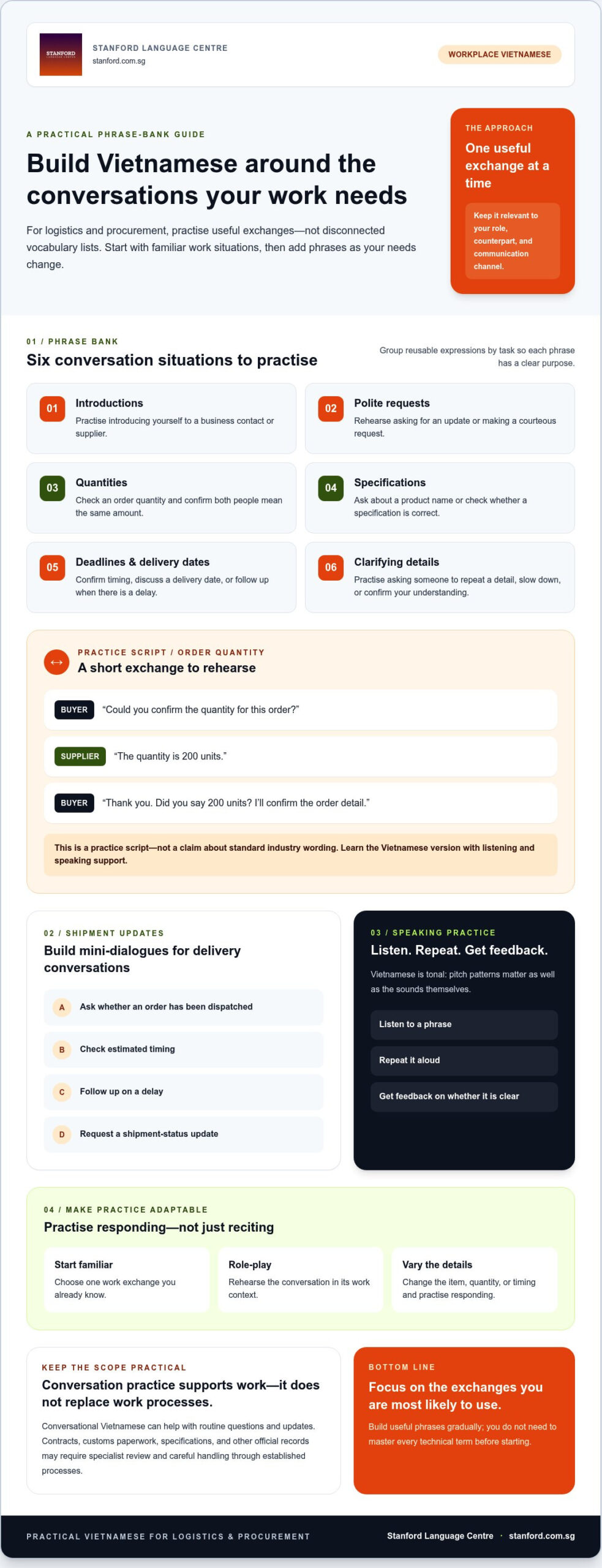
A useful workplace phrase bank is a set of reusable expressions grouped around tasks you already know. Instead of memorising disconnected vocabulary, organise phrases by situation: introducing yourself, making a polite request, checking a quantity, discussing a specification, confirming a deadline, or asking for clarification. This gives practice a clear purpose and makes it easier to add phrases as your work scenarios change.
Procurement practice might focus on asking about a product name, checking whether a specification is correct, discussing an order change, or confirming that both parties understand the same quantity. A Purchase Order can provide a familiar document context for a role-play, but everyday spoken phrases don’t replace accurate document review. Keep technical wording and formal records clear through your usual work processes.
Build a phrase bank around procurement conversations
Include polite ways to ask someone to repeat a detail, slow down, or confirm your understanding. For example, practise a short exchange around an order:
- Buyer: “Could you confirm the quantity for this order?”
- Supplier: “The quantity is 200 units.”
- Buyer: “Thank you. Did you say 200 units? I’ll confirm the order detail.”
This is a practice script, not a claim about standard industry wording. Learn the Vietnamese version with listening and speaking support rather than guessing translations for document terms. Vietnamese is tonal, so pitch patterns matter as well as the sounds themselves. Listen to a phrase, repeat it aloud, and seek feedback on whether it’s clear. Short, regular practice helps you notice and adjust your pronunciation.
Practise shipment and delivery updates
Build separate mini-dialogues for asking whether an order has been dispatched, checking estimated timing, following up on a delay, and requesting a status update. A Bill of Lading can serve as a reference point in a scenario. For background on the production and supply-chain context behind procurement conversations, see Vietnam’s manufacturing ecosystem.
Scenario practice makes vocabulary easier to retrieve because you rehearse the words alongside the situation where you may need them. Start with one familiar exchange, then vary the item, quantity, or timing so you practise responding, not just reciting. This is a practical foundation for vietnamese for logistics and procurement specialists: focused language practice shaped around real communication needs, without trying to master every technical term at once.
For guided practice around workplace communication goals, explore Vietnamese learning options at Stanford Language Centre.
How to Choose Vietnamese Training for Individual or Team Work Needs
The right format depends on what you need to practise and how you learn best. Start by identifying the work conversations you want to handle, such as speaking with suppliers, checking updates, or making polite requests. Then consider whether you’d benefit most from individual attention, peer practice, online learning, or a shared team approach. Rather than aiming for a promised fluency level, choose a format that gives you useful opportunities to practise.
Private, group, or online Vietnamese lessons?
Private lessons can focus on your individual priorities, including the situations you find most challenging. Small-group classes provide peer interaction and shared speaking practice, which can suit learners who enjoy practising with others. Online classes offer a remote way to learn and may help you fit lessons around other commitments. Compare each option with the time you have available and the way you prefer to practise.
Use these questions to compare your options:
- Work goals: Do you want to build general conversational confidence or focus on specific workplace situations?
- Practice style: Would you rather receive focused individual attention or practise alongside other learners?
- Schedule and setting: Would online learning suit your routine, or do you prefer a group learning environment?
- Team alignment: Do colleagues need to practise similar conversations and build a shared approach?
For vietnamese for logistics and procurement specialists, match the format to everyday communication needs. Private lessons may suit one learner with specific priorities, while a small group can provide shared speaking opportunities.
When a company should consider corporate Vietnamese training
Before arranging team learning, employers can identify which roles will take part and what recurring conversations they need to practise. Different employees may need to rehearse supplier introductions, routine requests, or follow-ups. Defining these needs gives training a practical focus. Stanford Language Centre offers corporate Vietnamese language training tailored to business communication needs, so a team’s learning can be shaped around its goals.
Consider whether employees need consistent shared practice or more individual attention. A corporate programme can support common communication priorities across a team, while private lessons may suit a learner who needs to concentrate on personal goals. For a closer look at employer considerations, read the corporate Vietnamese training buyer’s guide.
How to Build a Practical Vietnamese Learning Plan Around Your Work
A manageable plan starts with the conversations you’re most likely to need, then turns them into short, repeatable practice. Keep it focused: a few relevant scenarios are more useful than trying to learn every logistics term at once. For vietnamese for logistics and procurement specialists, connect practice to real communication needs while keeping supplier and shipment information confidential.
Turn recurring work tasks into practice scenarios
Choose two or three routine conversations, such as checking an order, requesting an update, or confirming a delivery date. For each one, write a simple goal: ask a question, confirm a detail, or summarise what you understood. Use generic examples rather than real company names, order numbers, prices, supplier details, or shipment records. This keeps practice useful without exposing sensitive information.
Build your practice in a clear sequence:
- Choose scenarios: Pick recurring tasks and decide what you want to communicate in each.
- Collect phrases: Gather useful expressions for the task, including a polite way to ask someone to repeat or slow down.
- Practise aloud: Listen to a model, repeat the phrases, and pay attention to pronunciation and tone.
- Role-play: Practise both sides of the exchange. Change one detail, such as the quantity or timing, to practise responding naturally.
- Review: Note which phrases felt clear and which ones need another round of practice.
Because Vietnamese uses tones, listening and careful repetition matter. For more guidance on pronunciation practice, read this guide to learning a tonal language.
Track progress without making fluency promises
Look for small, observable signs of progress. Can you complete your target role-play with fewer prompts? Can you ask for clarification, confirm the key detail, and summarise the exchange more clearly? These checks keep your learning connected to practical communication rather than an unrealistic promise of fluency by a set date.
Teacher feedback can help you refine tone, word choice, pronunciation, and conversational clarity. After each practice, note one point to improve and revisit it in your next role-play.
A realistic measure of progress is being able to complete a familiar work exchange more clearly and with fewer prompts. For guided practice shaped around your work communication goals, explore Vietnamese learning options at Stanford Language Centre.
Start Learning Vietnamese for Logistics and Procurement with Stanford Language Centre
You’ve identified the work conversations you want to practise. The next step is to match those goals with a learning format that suits you or your team. Stanford Language Centre offers adult Vietnamese learning through private one-to-one lessons, small-group classes, online classes, and corporate training. Each format can support practical communication practice without promising a particular job outcome or a fixed level of fluency.
Match a learning format to your goal
If you’re learning on your own, private lessons can focus on the workplace conversations you want to practise, such as making a request or following up on an update. Small-group classes offer a shared setting for speaking practice and interaction with other learners. Online Vietnamese classes provide a remote learning option. Choose based on your goals, preferred practice style, and how learning fits into your routine.
For an employer, corporate Vietnamese training can be tailored to the team’s business communication needs. Define the communication situations that matter to your team and use them to shape a relevant learning focus. For employers comparing their options, the corporate language training guide offers a helpful starting point.
Take the next step with a clear learning brief
A short brief helps make your learning goals easier to discuss. Note your role, the conversations you want to handle, and your preferred format. For example, an individual might want to practise routine supplier conversations in private lessons, while a team might want to build confidence with recurring business exchanges through a corporate programme.
For a team, outline which learners need practice and the general work scenarios they encounter. Use generic examples rather than confidential supplier names, shipment details, or order information. This gives the learning plan useful context while protecting sensitive business data.
Vietnamese for logistics and procurement specialists is most practical when learning stays connected to real communication goals. Explore Stanford Language Centre’s Vietnamese learning options and contact the centre to discuss a format that fits your individual or team needs.
Make Your Next Vietnamese Conversation Easier to Start
Useful Vietnamese learning starts with the conversations you want to handle, not a promise of instant fluency. Choose a few familiar work situations, practise phrases for asking, confirming, and following up, then review your pronunciation and clarity. A focused plan makes vietnamese for logistics and procurement specialists more practical by connecting new language to everyday communication.
The learning format matters too. Stanford Language Centre offers adult Vietnamese classes in private, small-group, and online formats. For employers, corporate Vietnamese training can be tailored to business communication needs, helping teams focus practice on relevant workplace scenarios.
Whether you’re learning for yourself or planning for a team, begin with clear goals and a format that suits your preferred way of practising. Explore Vietnamese learning options with Stanford Language Centre and take a manageable first step. With steady, relevant practice, you can build confidence one conversation at a time.
Frequently Asked Questions
Is Vietnamese useful for logistics and procurement specialists?
Vietnamese can help logistics and procurement specialists take part in basic conversations with Vietnamese-speaking counterparts. Useful practice might include introducing yourself, confirming an order detail, asking for an update, or politely requesting clarification. The value depends on your role, counterpart, and communication channel. Language learning can support rapport and clearer routine exchanges, but it doesn’t replace operational knowledge, professional judgement, or the review of formal documents.
What Vietnamese should procurement professionals learn first?
Start with practical conversational phrases for introductions, polite requests, quantities, specifications, deadlines, and clarification. Practise asking someone to repeat a detail and confirming what you understood. You can organise these phrases around a familiar task, such as checking an order or discussing a change. Learn pronunciation by listening, repeating phrases aloud, and getting feedback, especially because Vietnamese tones can affect how words are understood.
Can I learn Vietnamese for logistics if I am a complete beginner?
Yes. Begin with foundational Vietnamese and gradually practise workplace conversations as you build your skills. Stanford Language Centre offers structured beginner programmes for adults. Start with simple goals, such as introducing yourself or asking a polite question, then add familiar work scenarios. You don’t need to master technical vocabulary before practising basic exchanges, and progress depends on your learning and practice, not a guaranteed timeline.
How can Vietnamese lessons support supplier communication?
Lessons can help you practise common exchanges, such as asking for an update, confirming a quantity, or checking whether you understood a response. Role-play gives you a chance to rehearse both asking and replying, while feedback can help refine pronunciation, tone, and word choice. Use generic examples during practice rather than confidential supplier names, order information, or shipment details. Lessons support communication skills, not professional translation or document review.
Should I choose private or corporate Vietnamese training for my team?
Private lessons suit an individual who wants focused practice around personal communication priorities. Corporate Vietnamese training may suit an employer whose team shares recurring business communication needs. Stanford Language Centre tailors corporate training to those needs. Before choosing, identify which roles need practice and what conversations recur. If learners need individual attention rather than shared team practice, private lessons may better fit those priorities.
Can Vietnamese be learned online for work?
Yes. Online Vietnamese classes are available as an adult learning format and can support practice for workplace communication goals. Use lesson activities to rehearse introductions, polite requests, or routine updates, then revisit phrases between classes. Choose online learning if remote lessons fit your learning preferences and work routine.
Does NTUC UTAP cover Vietnamese language courses?
Stanford Language Centre offers NTUC UTAP-claimable Vietnamese courses. Whether you can make a claim depends on the current eligibility rules and claim conditions, so review the latest NTUC UTAP guidance before enrolling. Don’t assume that every learner or course automatically qualifies. This is separate from SkillsFuture credits, which are not accepted for the centre’s Vietnamese courses.