What makes Mandarin useful in a client meeting is often not a polished pitch, but a series of small exchanges that help a client feel heard. That’s the practical starting point for mandarin for client relationship managers singapore: building trust one conversation at a time.
You already know that strong client relationships depend on listening and clear follow-up. But opening a conversation in Mandarin, asking useful questions or choosing a suitably polite phrase can feel challenging, especially when your schedule is full of meetings and follow-ups.
This guide covers ways to start professional conversations, clarify what clients need and confirm key details. You’ll find examples for greetings, needs-based questions and next steps, plus a focused practice routine for busy workdays. For teams with shared communication goals, tailored corporate Mandarin training can centre practice on everyday client-facing situations.
Key Takeaways
- You don’t need immediate fluency to use workplace Mandarin. A few relevant phrases can support rapport, while attentive listening and follow-through remain essential.
- Organise your phrase bank around client interactions, so you can choose language for a specific purpose instead of memorising disconnected lines.
- Build confidence by paying attention to tone and context. When you’re unsure, check your understanding rather than guessing.
- Make mandarin for client relationship managers singapore manageable with short practice sessions based on recurring work situations and upcoming conversations.
- Tailored corporate Mandarin training can help teams practise scenarios that reflect their shared client-facing needs.
Why Mandarin can help client relationship managers build trust in Singapore
Useful workplace Mandarin doesn’t require immediate fluency. A few well-chosen phrases can make an opening feel more personal and help a conversation move smoothly. But language is only one part of trust. Listening carefully, responding to the client’s needs and following through on agreed actions matter just as much.
Role-specific client relationship Mandarin is practical language for welcoming clients, understanding their needs, sharing updates and agreeing on next steps. It’s different from negotiation skills, specialist financial or technical vocabulary, and the broader proficiency needed to manage an entire conversation independently. Learning relevant phrases gives you a starting point, not a substitute for those wider skills.
Where Mandarin fits in the client relationship cycle
Start with the conversations that recur in your work. At first contact, a greeting and a respectful transition into the meeting can set a considerate tone. During needs discovery, simple questions and prompts to explain further can encourage a client to share what matters. For service updates, prepared language can introduce an update or explain what you’ll follow up on. After a meeting, a brief confirmation can reinforce the agreed next step.
The aim isn’t to speak more for the sake of it. Use Mandarin where it helps you connect, then keep your attention on what the client is saying. If colleagues have similar client-facing needs, a corporate language training guide can help you consider how team-wide practice might fit recurring workplace scenarios.
What practical progress looks like before fluency
Early progress can be specific: introducing yourself, welcoming a client, confirming a meeting time or checking that you understood a straightforward detail. Prepare these exchanges in advance, practise saying them aloud and use them in appropriate situations. If a conversation moves into unfamiliar terms, detailed advice or complex negotiation, recognise the limits of prepared phrases. Use the appropriate language or support to keep communication clear.
Mandarin in Singapore includes standard and colloquial forms. A brief overview of Singaporean Mandarin explains why everyday speech may differ from formal learning materials. You don’t need to master every variation before starting. Focus on clear, respectful language that fits your role, and let attentive listening guide your response. Mandarin can support rapport, but it can’t guarantee a business outcome or replace reliable service.
The Mandarin conversation toolkit for client relationship managers
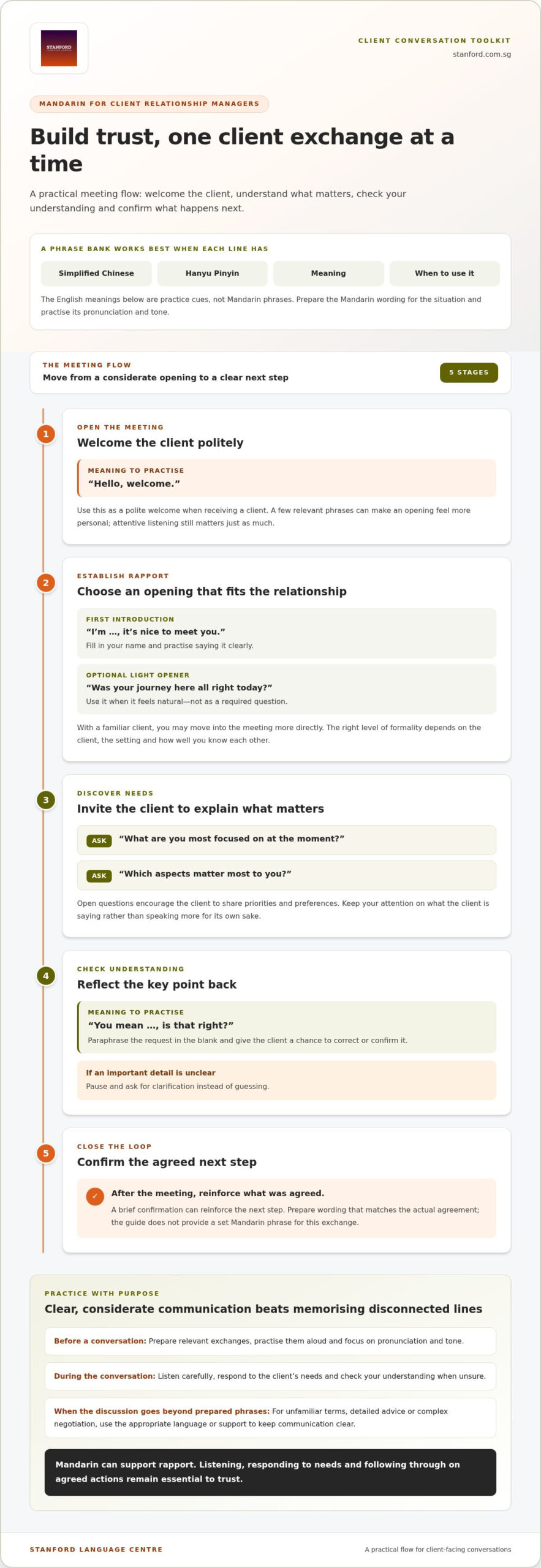
Build your phrase bank around what you need to accomplish in a conversation, not around isolated words. For each line, learn the simplified Chinese, Hanyu Pinyin, meaning and situation where it fits. Use the examples below as starting points, and practise their pronunciation and tone before using them with clients.
Opening a meeting and establishing rapport
A greeting can make the start of a meeting feel more considered. For example:
- 您好,欢迎您。 Nín hǎo, huānyíng nín. “Hello, welcome.” Use this as a polite welcome when receiving a client.
- 我是……,很高兴见到您。 Wǒ shì…, hěn gāoxìng jiàndào nín. “I’m …, it’s nice to meet you.” This works for a first introduction. Fill in your name and practise saying it clearly.
- 今天路上还顺利吗? Jīntiān lùshang hái shùnlì ma? “Was your journey here all right today?” Use it as a light opener when it feels natural, rather than treating it as a required question.
With a familiar client, you may move into the meeting more directly. With someone you’re meeting for the first time, a brief introduction can help establish who you are. The right level of formality depends on the client, the setting and how well you know each other. In Singapore’s multilingual context, the National Library Board’s overview of Singapore’s bilingual language policy offers background on the place of mother tongue languages.
Discovering needs and confirming understanding
Use open questions to invite detail, then reflect back the key point before moving on:
- 您目前最关注什么? Nín mùqián zuì guānzhù shénme? “What are you most focused on at the moment?” Ask this to explore a client’s priorities.
- 您比较看重哪些方面? Nín bǐjiào kànzhòng nǎxiē fāngmiàn? “Which aspects matter most to you?” Use it to invite the client to explain their preferences.
- 您的意思是……,对吗? Nín de yìsi shì…, duì ma? “You mean …, is that right?” Paraphrase the request in the blank and give the client a chance to correct or confirm it.
If you miss an important detail, pause and ask for clarification instead of guessing. Stanford Language Centre’s adult Mandarin learning options include structured learning for adults who want to build their skills.
Common Mandarin mistakes in client conversations and how to avoid them
Memorising a phrase can help you get started, but it doesn’t automatically make a conversation sound natural. The same words may land differently depending on tone, pace, relationship and situation. With mandarin for client relationship managers singapore, the aim isn’t flawless speech. It’s clear, considerate communication, along with the confidence to check when you’re unsure.
Tone, pace, and literal translation
Mandarin is tonal, so changing a syllable’s tone can change its meaning. Rushing through a prepared line can also make it harder to understand. Practise short phrases aloud at a steady pace, focusing on how each word sounds as well as how it is written.
Literal translation has its own risks. An English phrase may rely on warmth, indirectness or context that doesn’t transfer word for word into Mandarin. Avoid adding casual expressions or overly familiar terms just because they seem friendly in English. Instead, choose wording suited to the setting and relationship, and pay attention to how the client responds. There isn’t one etiquette rule that fits every Mandarin-speaking client.
How to recover when you miss a detail
Don’t guess at a name, date, preference or agreed action. Pause, ask, repeat what you heard and invite the client to confirm it. A simple check is 您是说……,对吗? (Nín shì shuō…, duì ma?), meaning “You mean …, is that right?” Fill in the detail you want to verify, such as a meeting date or preferred option.
- For a name: Repeat it slowly and ask whether you heard it correctly.
- For a date: Say the date back, including the month, to make the reference clear.
- For a preference: Summarise the option the client selected and check that it matches their request.
- For an agreed action: Restate who will do what, then confirm the next step.
A comprehension check isn’t a promise. Don’t turn “I understand that you’d like…” into “I will…” unless you’re authorised and ready to make that commitment. If the meaning remains unclear, switch to a shared language or another suitable way to verify the detail. SkillsFuture Singapore’s directory of tailored corporate language training is another reference for considering language learning in a professional context.
How client relationship managers can practise Mandarin around a busy schedule
A useful routine can fit around work if it focuses on conversations you’re likely to have instead of trying to study everything at once. For mandarin for client relationship managers singapore, start with a recurring task and practise a short exchange for that situation. A practical Mandarin Level 1 guide can help you build beginner foundations alongside job-focused practice.
A repeatable practice loop for real client scenarios
Use the same loop each time: choose one task, prepare a few useful lines, practise them aloud, then review what felt clear or difficult. Keep scenarios realistic but anonymised. Don’t include client names or confidential details in your notes.
- Choose one recurring task. Pick an introduction, a service update or arranging a meeting. Keep the focus narrow.
- Prepare only relevant language. Write a short exchange for that task, including a question and a way to check your understanding. Add pronunciation notes for words you find difficult.
- Practise aloud. Say both sides of the exchange, or ask a learning partner to respond. Rehearse at a calm pace, then try answering without reading every line.
- Review and adjust. After practice, note what you could say confidently, what you understood and where you needed to pause. Record useful corrections in a personal phrase log.
Repeat the loop when a similar situation comes up. Before a client meeting, review only the language connected to that conversation. This keeps practice purposeful and prevents a long phrase list from becoming another task to manage.
Choosing individual or team-based learning
Private Mandarin lessons may suit you if you want to focus on individual goals, work through specific client scenarios or learn at a comfortable pace. Small-group classes give you opportunities to practise with other learners and respond to different voices and approaches. Online classes offer another way to fit learning into a professional routine. Explore adult Chinese learning options to consider which format matches your preferences.
Track progress through practical signs, not a promised fluency deadline. Are you more willing to begin an exchange? Can you recognise familiar phrases or confirm a detail with less hesitation? Note changes over time, while remembering that confidence and comprehension can develop at different rates. Stanford Language Centre offers Mandarin learning options for adults, including private, small-group and online classes.
Build job-relevant Mandarin with tailored corporate language training
Once you know which conversations you want to handle more comfortably, training can turn those needs into focused practice. For mandarin for client relationship managers singapore, that means working with language connected to real client interactions, rather than relying only on general vocabulary or scripted examples.
What role-specific Mandarin practice can focus on
Stanford Language Centre provides corporate Mandarin training tailored to business communication needs. Training can use recurring scenarios from your organisation’s client relationships as the basis for practice. For example, activities might cover welcoming a client, asking about their priorities, giving a service update or confirming follow-up actions. The examples should reflect your team’s work and communication needs, not just generic business scripts.
Shared scenarios give colleagues a chance to practise clear, consistent communication. That doesn’t mean everyone must use identical wording. A team can work on the same purpose, such as checking a client’s understanding, while adapting the language to the situation and each person’s speaking level. This makes practice more relevant to daily work and gives colleagues a way to identify where they need further support.
Useful preparation starts with the moments your team handles regularly. Consider where Mandarin may help, which details need careful confirmation and what kinds of client questions staff commonly encounter. These needs can guide the choice of role-play situations and practice language.
Choose a learning format that fits work
The right format depends on who is learning and how they prefer to practise. Private Mandarin lessons can focus on an individual’s goals and learning pace. Small-group classes create space to practise with other learners and try different conversational roles. Online Mandarin classes give adults another option for fitting learning around work.
For a team, consider schedules, learning preferences and the kinds of practice employees need. A shared client-facing role may call for team-based scenarios, while individuals with different starting points may value more personalised practice. Stanford Language Centre offers adult Mandarin learning in private, small-group and online formats, so learners can choose an approach suited to their situation.
Training is a way to practise and build language skills, not a promise of particular business results. Start with the conversations that matter most to your work, then shape learning around them. If you’re considering a practical next step for yourself or your team, explore corporate Mandarin training.
Take the next step with practical Mandarin
Building client relationships in Mandarin doesn’t require perfect fluency from day one. Start with useful exchanges for introductions, discovering client needs and confirming next steps. Practise them aloud in short, focused sessions, and ask for clarification whenever you’re unsure rather than guessing.
The most relevant mandarin for client relationship managers singapore is language that fits real conversations and the needs of your role. For teams, shared practice around recurring client scenarios can make learning more focused. Stanford Language Centre provides corporate Mandarin training tailored to business communication needs.
Whether you’re building your own skills or exploring learning for a team, consider which format fits your work and what conversations you want to practise first.
Frequently Asked Questions
Is Mandarin useful for client relationship managers in Singapore?
Yes, Mandarin can be useful when a client prefers to communicate in it. For mandarin for client relationship managers singapore, practical starting points include greetings, simple questions and confirming meeting details. Its value depends on your role, client base and the conversation at hand. Mandarin can support rapport, but it doesn’t replace attentive service or guarantee a stronger business relationship. Identify recurring work situations, then build relevant vocabulary and listening skills.
Do client relationship managers need to be fluent in Mandarin?
Not necessarily. Prepared introductions, straightforward questions and clarification phrases can help with some workplace interactions. More complex discussions call for stronger speaking and comprehension skills. Be honest about your current level, and don’t suggest you’ve understood something if you haven’t. A steady learning plan can build useful skills over time, but progress varies with your starting point, practice and goals. Focus on communicating clearly within your ability while continuing to develop.
What Mandarin phrases should a client relationship manager learn first?
Start with phrases for introducing yourself, welcoming a client, asking about priorities, checking details and arranging a follow-up. Choose language that matches conversations you regularly handle, rather than memorising a long list without context. Practise each phrase with its pronunciation and intended use. It’s also useful to learn how to request clarification, so you have a clear next step if you miss something.
How can I practise Mandarin for client meetings if I am busy?
Choose one recurring meeting task and practise a short exchange for it. For example, rehearse arranging a meeting or asking a client to confirm a detail. Say the language aloud and practise how you’d ask for clarification if you didn’t understand the response. Keep a brief note of pronunciation points and useful corrections, then review it before a similar conversation. Short, focused practice can be easier to maintain than an ambitious routine that competes with work.
Can beginner Mandarin help with client communication?
Yes, beginners can practise simple prepared exchanges, such as greetings or arranging a meeting, while staying aware of their limits. Recognising spoken replies may take more practice than recalling a memorised phrase. Keep your wording clear, check important details and ask for clarification when needed. Don’t use a few beginner phrases to imply that you can manage a complex or sensitive discussion independently. Build listening and speaking skills gradually alongside practical phrases.
What is the difference between business Mandarin and conversational Mandarin?
Conversational Mandarin develops everyday speaking and listening, while business Mandarin focuses practice on workplace communication. They overlap in client-facing work, where a conversation might move from an introduction to everyday rapport and then to a work-related question. For relationship managers, useful learning connects a solid language foundation with relevant situations. Specialised terms may help in some roles, but memorising business expressions alone won’t prepare you to understand responses or handle an unscripted exchange.
Can corporate Mandarin training be tailored to client relationship managers?
Yes. Corporate Mandarin training can be tailored to an organisation’s communication needs and recurring client scenarios. Practice might cover introductions, needs discovery, service updates and follow-up. Stanford Language Centre provides corporate training tailored to business communication needs, helping teams focus on practical, role-related situations rather than generic scripts alone. Companies can also consider employees’ schedules, learning preferences and opportunities to practise when choosing a training format.