What if clearer site communication starts with fewer words, not more? A short instruction can still be misunderstood if pronunciation or tone is unclear. Basic vietnamese for construction site managers should therefore pair each message with a simple way to check that it was understood.
It’s understandable to feel unsure about speaking Vietnamese at work. Tone marks may look unfamiliar, and a small difference in pronunciation can change what a listener hears. You don’t need fluent Vietnamese to make everyday exchanges warmer and clearer. Start with brief instructions, polite workplace language and a clear check-back routine.
This guide covers useful greetings, simple work instructions, pronunciation tips and ways to check understanding during routine site conversations. It also explains when basic language skills aren’t enough: safety-critical directions must follow approved site procedures, and an interpreter should be used where required. For teams building skills beyond a short phrase list, structured Vietnamese lessons and tailored corporate training can support ongoing workplace communication.
Key Takeaways
- Start with a small set of basic vietnamese for construction site managers, focused on routine, low-risk interactions.
- Group useful instructions by purpose so you can choose a phrase that fits the situation.
- Use a consistent check-back routine to confirm understanding instead of relying on a nod or gesture alone.
- Practise a few phrases at a time and repeat them in familiar situations to build confidence.
- Structured Vietnamese lessons can develop speaking and listening skills beyond a memorized phrase list, with corporate training tailored to workplace communication needs.
Basic Vietnamese for construction site managers: what to learn first
Basic Vietnamese for construction site managers means learning practical phrases for routine, low-risk exchanges, not replacing technical expertise or site safety procedures. Begin with language for greeting people, getting attention, making a polite request and thanking someone. These phrases can make everyday coordination more approachable, but they can’t confirm that a complex instruction has been understood.
Keep routine coordination separate from technical, contractual or emergency communication. If a message concerns a hazard, a high-risk task, a specification change or an urgent response, follow the site’s approved process and use qualified interpretation where required. Simple Vietnamese can support communication, but it must not replace formal safety training or established site procedures.
Which everyday site interactions are a useful starting point?
Choose phrases you can use consistently when arriving, opening a conversation or asking someone to pause and listen. For example, Xin chào means “Hello” and is roughly pronounced “sin chow.” Cảm ơn means “Thank you,” with a rough pronunciation like “gahm uhn.” These English sound guides are only approximations. Adapt your greeting and level of formality to the person, relationship and workplace context, since a phrase list can’t capture every social nuance.
Practise introductions and polite requests in calm, familiar situations before using them during busy coordination. A greeting can help open an exchange, and a request for attention can prepare someone to listen. Then keep the message brief and focused on one point.
What should managers know about Vietnamese pronunciation?
Vietnamese is tonal, so pitch and tone can affect a word’s meaning. Tone marks are part of the written word, not decoration, so keep them visible when reading or practising. The Vietnamese language uses the Latin-based chữ Quốc ngữ writing system, and its spelling includes diacritics. Pronunciation also varies by speaker and region. An English-style guide can help you get started, but it can’t reproduce the full sound or tone.
Learn each phrase as a complete sound: look at the spelling, listen to a spoken model, then practise saying it at a natural pace. For more ways to approach tones and listening practice, explore how to learn a tonal language. Build confidence gradually, and use established communication methods whenever precision is essential.
Essential Vietnamese phrases for giving simple site instructions
Useful instructions are short, specific and easy to practise. For basic vietnamese for construction site managers, group phrases by purpose so you can find suitable wording for routine coordination. These examples are starting points, not approved translations for technical or safety-critical instructions. Have a fluent Vietnamese speaker review spelling, tone marks, naturalness and intended meaning before using a phrase with a team.
- Get attention: Xin chú ý means “Please pay attention.” Use it to open a routine conversation or briefing, then give the message clearly.
- Indicate a location: Đặt ở đây means “Put it here.” Use it only when the object and location are clear to both people. Point to the intended place as a visual aid.
- Give a sequence: Trước tiên means “First,” and sau đó means “after that.” These can introduce steps in a simple, familiar task. Explain one step at a time.
- Make a basic request: Vui lòng chờ một chút means “Please wait a moment.” It can suit a routine pause, but the situation and tone still matter.
How can a manager make a short request politely?
A simple structure is vui lòng (“please”) plus an action, such as Vui lòng chờ, “Please wait.” For “Please come over here,” Mời anh/chị qua đây is one possible polite wording. Vietnamese forms of address depend on age, relationship and context, so anh/chị isn’t a universal choice. Have a fluent speaker adapt requests to the people and workplace relationship involved.
How should site-specific vocabulary be introduced?
Build a small glossary under familiar categories, such as tools, work areas and basic actions. Start with terms the team uses often, and record the Vietnamese spelling, intended meaning and an example context. Have a qualified bilingual subject-matter reviewer check specialist vocabulary. Don’t translate safety labels, warnings or emergency instructions informally; use approved terminology and the site’s established communication process.
Keep slang and clipped commands out of a beginner phrase sheet. A phrase that sounds direct or natural in one relationship may not suit another. Review the list with a fluent speaker, then practise the approved wording in low-risk, familiar interactions. Teams ready to build workplace vocabulary beyond a short list can explore corporate Vietnamese language training tailored to business communication needs.
How to check understanding when speaking basic Vietnamese
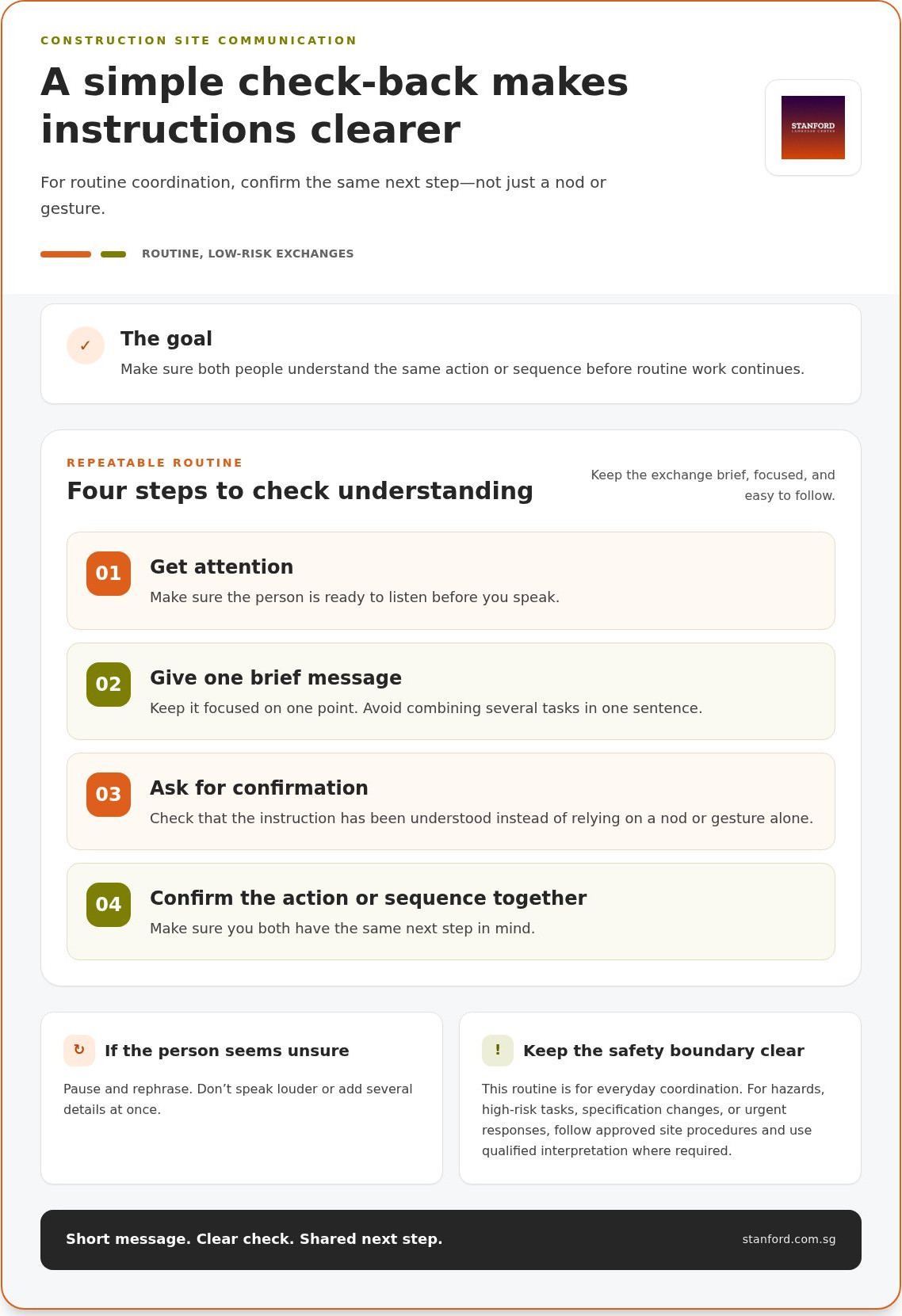
A short instruction helps only when both people understand the same next step. For routine coordination, use a repeatable check: get the person’s attention, give one brief message, ask for confirmation, then confirm the action or sequence together. Avoid combining several tasks in one sentence. If the listener seems unsure, pause and rephrase rather than speaking louder or adding several details at once.
- Get attention: Make sure the person is ready to listen before you speak.
- Give one message: State a single routine action or next step in plain language.
- Check: Ask a calm, specific question about the message.
- Confirm: Where appropriate, invite the person to show or restate the routine next step, then correct any mismatch together.
A nod or gesture can be useful, but it doesn’t always show that the words, location or sequence were understood. The listener may be acknowledging you, responding politely or trying to keep work moving. For an ordinary task, a demonstration or brief restatement can show whether you’re aligned. Keep your tone respectful. Checking is part of teamwork, not a test of the worker.
What is a simple phrase-based comprehension check?
One possible prompt is Anh/chị có thể nhắc lại bước tiếp theo không?, meaning “Could you repeat the next step?” The forms of address anh/chị depend on the people and relationship involved, so have a fluent Vietnamese speaker review the phrase for naturalness and fit before using it. Ask about one clear next step, then listen without rushing the response.
You can also invite a demonstration for a familiar, low-risk action. For example, after describing where an item should go, ask the person to show the intended location before continuing. If the response differs from what you meant, clarify calmly with simpler words or a visual reference. That feedback helps both sides align.
When are basic phrases not enough?
Don’t improvise beginner Vietnamese for urgent, technical or high-risk instructions. A misunderstood warning, equipment direction or emergency message can have serious consequences. Follow established site communication procedures and use qualified interpretation where required. A phrase list can support routine exchanges, but it cannot qualify a manager or worker to communicate safety-critical information.
A language check complements site protocols; it never replaces them. Use basic vietnamese for construction site managers to support everyday coordination, while keeping formal safety processes in control whenever a message affects hazards, technical requirements or emergency response.
A practical routine for learning and using Vietnamese on site
Build skill in small steps. Instead of memorizing a long phrase list, choose a few expressions for recurring, low-risk interactions and practise them until you can use them comfortably. This makes basic vietnamese for construction site managers easier to apply during everyday exchanges, while complex and safety-critical communication remains within approved procedures.
Keep a reviewed phrase card for practice. Include the Vietnamese spelling with tone marks, its English meaning and the situation where it fits. Add a pronunciation note only as a guide, then check the sound with an instructor or fluent speaker. A card is a learning aid, not a substitute for listening to natural speech.
How can managers practise phrases before using them at work?
Use brief role-plays based on ordinary situations: greeting a colleague, making a routine request or confirming a simple next step. Switch roles to practise listening as well as speaking. Ask a Vietnamese instructor to check pronunciation and wording, then repeat the exchange at a natural pace. Listening to different speakers can also help you get used to variations in voice and accent.
Keep practice calm and specific. If a phrase feels difficult to say or understand, slow down, listen again and work on the sound before relying on it in conversation. Practise the full expression in context rather than memorizing isolated words.
How can a team build steady language-learning habits?
Choose a recurring practice time that fits the team’s work schedule. The aim is consistency, not a demanding routine. Small-group sessions give colleagues a chance to practise together, while private one-to-one or online learning may suit different schedules and learning preferences. Track progress by noting which phrases learners can say and understand naturally, not just recognize on a page.
As confidence grows, add a few relevant expressions and review earlier ones so they stay familiar. Corporate Vietnamese language training can be tailored to business communication needs and help teams build skills beyond a short list. For teams seeking a structured way to develop those skills, explore corporate Vietnamese training.
Build stronger workplace communication with structured Vietnamese learning
A phrase list is a useful starting point, but it can’t help you practise responding to an unexpected answer. Structured Vietnamese lessons give learners opportunities to work on pronunciation, listening and everyday exchanges, building communication skills step by step. For managers learning basic vietnamese for construction site managers, practice can focus on routine workplace interactions while technical and safety-critical communication stays within approved procedures.
What can structured Vietnamese learning add to a phrase list?
Guided practice helps learners hear tones, try phrases aloud and respond in context, rather than only recognize words on a page. Lessons can focus on practical goals such as greeting colleagues, making simple requests or following a routine exchange. Progress takes practice and varies by learner. Language learning doesn’t guarantee fluency, prevent misunderstandings or qualify anyone to give safety instructions in Vietnamese.
Which learning format may suit a working team?
Small-group learning gives participants a setting to practise exchanges together. Private one-to-one lessons can focus on an individual’s learning needs, while online classes offer another way to study. Stanford Language Centre offers beginner Vietnamese learning in all three formats, alongside corporate Vietnamese training tailored to business communication needs. Choose the setting that best fits learners’ schedules and communication goals.
For workplace learning, useful goals might include becoming more comfortable with routine greetings, improving listening to familiar phrases or practising polite requests. A structured programme can support those aims beyond memorized lines, without presenting language lessons as specialist safety training. Keep using established site procedures and qualified interpretation where required for high-risk, technical or urgent messages.
Explore Vietnamese learning options for individuals and teams, including corporate training shaped around business communication needs.
Turn a few useful phrases into stronger everyday communication
Basic Vietnamese for construction site managers works best when short, practical phrases are paired with a check that the message was understood. Start with routine greetings and requests, practise pronunciation and listening, and keep instructions brief. For technical, urgent or safety-critical communication, follow approved site procedures and use qualified interpretation where required.
A phrase list is a first step, not the whole learning journey. Structured lessons can help build speaking and listening skills over time. Stanford Language Centre offers beginner Vietnamese classes in small groups, private one-to-one and online formats. Corporate Vietnamese training can also be tailored to business communication needs.
Choose a learning approach that fits your goals and practise one useful exchange at a time. Explore Vietnamese language learning with Stanford Language Centre and take a practical next step toward clearer everyday conversations.
Frequently Asked Questions
What Vietnamese phrases should construction site managers learn first?
Start with greetings, thanks, polite requests and simple ways to get someone’s attention. For example, Xin chào means “Hello,” Cảm ơn means “Thank you,” and Vui lòng chờ means “Please wait.” Learn each phrase with its tone marks and the situation where it fits. Basic vietnamese for construction site managers is most useful for routine exchanges, not complex technical or safety instructions.
How do you say “thank you” in Vietnamese?
“Thank you” in Vietnamese is Cảm ơn. A rough English pronunciation guide is “gahm uhn,” but it can’t fully show the Vietnamese sounds or tone. Practise by listening to a fluent speaker and repeating the phrase, keeping the written tone marks in view. Forms of address and polite wording can depend on the relationship and context, so learn the phrase as part of a complete, natural exchange.
Is Vietnamese difficult for English speakers to pronounce?
Vietnamese pronunciation can take practice for English speakers because it uses tones, and tone marks are part of the written words. Beginners can still make progress by listening and speaking aloud instead of relying only on English sound approximations. An instructor or fluent speaker can help you hear tone differences and adjust pronunciation. Focus on a few useful expressions at a time, then practise them in short exchanges.
Can basic Vietnamese be used for construction safety instructions?
Basic Vietnamese phrases shouldn’t be relied on for safety-critical instructions. A beginner phrase guide can support everyday coordination, but it doesn’t replace formal safety training, approved site procedures or qualified interpretation where required. For urgent, technical or high-risk messages, use the established communication process and make sure the message is conveyed through the appropriate channel. Never treat memorized phrases as proof that someone is qualified to give or understand safety directions.
How can a manager check that a Vietnamese instruction was understood?
First get the listener’s attention, then give one short message and ask them to restate or demonstrate the routine next step where appropriate. A nod or gesture alone may not show that you share the same understanding. Keep the check calm and specific, and clarify together if the response differs from what you intended. This is a practical teamwork habit for routine tasks, not a replacement for approved safety communication procedures.
Do Vietnamese phrases differ by region?
Yes, pronunciation and some everyday word choices can vary by region, so a phrase may sound different from one speaker to another. Vietnamese spelling and tone marks still provide a useful written reference, but an English pronunciation guide may not capture regional speech. For workplace phrases, have a fluent Vietnamese speaker familiar with the team’s communication context review the wording, tone and intended meaning before using it regularly.
How can a team learn basic Vietnamese without disrupting work?
Keep practice short, regular and focused on a few routine phrases for low-risk situations. Teams can practise listening and speaking through small-group lessons, while private one-to-one or online classes offer other learning formats. Corporate Vietnamese training can be tailored to business communication needs. Set manageable goals that fit the work schedule, and track phrases people can use naturally rather than words they only recognize.