Learning Vietnamese is not easy but is possible !
What if you could stop worrying about "impossible" tones and start hearing the music in the language instead? Learning basic vietnamese for foreigners often feels like a steep mountain to climb. You might feel intimidated by the six distinct tones or lose sleep over a pronoun system that feels like a puzzle. It’s completely normal to fear being misunderstood when a slight pitch shift changes your meaning entirely. We know that feeling, and we’re here to help you move past it.
This guide simplifies your journey. You’ll master the foundations of Vietnamese tones, pick up essential phrases, and learn the social etiquette needed to communicate with confidence. Practical results. No fluff. Whether you want to order street food like a local or show respect to business partners, these lessons provide the clarity you need. We’ll break down the "social map" of pronouns and provide a clear roadmap for navigating daily life. By the end of this guide, you’ll have a solid foundation for further fluency and the tools to build real connections with ease.
Key Takeaways
- Build trust quickly. Learn why basic vietnamese for foreigners is your most valuable asset for building professional rapport in 2026.
- Simplify pronunciation. Treat the six tones like musical notes to make your speech feel more natural and far less intimidating.
- Master social respect. Understand the unique “family term” pronoun system to navigate daily interactions with the right level of politeness.
- Choose your path. Compare flexible small group and private lesson formats to find the learning style that fits your busy schedule.
- Navigate with ease. Acquire essential survival phrases for dining and shopping that allow you to move through daily life in Vietnam confidently.
Why Learn Basic Vietnamese in 2026?
Vietnam is currently a central hub in the Southeast Asian economic corridor. By 2026, its role in global manufacturing and digital services will only grow. For anyone working or living there, learning basic vietnamese for foreigners is no longer just a hobby. It’s a strategic move. It’s about more than just vocabulary; it’s about showing that you’re invested in the local community. This investment pays off in every interaction you have.
Vietnamese people deeply appreciate the effort of those who try to speak their tongue. While the six tones of Vietnamese phonology can be challenging at first, making the attempt signals a high level of respect. This effort builds immediate trust that English alone cannot achieve. It transforms you from a temporary visitor into a respected partner. You’ll find that even a few correctly placed words can open doors that were previously closed.
Business Advantages for Professionals
The business environment in Vietnam is famously "relationship first." You don’t just sign contracts; you build long-term bonds. Knowing how to greet a senior partner correctly or offer a toast at dinner changes the room’s energy. It breaks the ice instantly. These small gestures prove that you understand the local etiquette and value the partnership beyond the bottom line.
Many organizations now view corporate vietnamese language training singapore as a vital asset for their teams. It gives employees the confidence to network without a constant reliance on a translator. This independence is a massive competitive advantage. You’ll understand the nuances of a meeting that others might miss, and you’ll build rapport during the informal "gap" moments of a business day.
Enhancing the Expat Experience
Living in Vietnam is far more rewarding when you step outside the "foreigner bubble." Basic language skills turn a stressful trip to the wet market into a friendly social exchange. You’ll find that daily life becomes much smoother when you can handle simple tasks yourself. For example:
- Negotiating prices at local markets becomes a game rather than a struggle.
- Giving specific directions to ride-hailing drivers is seamless and fast.
- Ordering specialized dishes at local eateries is no longer a guessing game.
Building a foundation in the language helps you connect with neighbors and staff on a personal level. These small daily wins create a sense of belonging. Vietnam also serves as a gateway to understanding broader Indochinese culture. By learning the logic of the language, you gain a unique perspective on the shared history and traditions of the region. It makes your time in Vietnam feel like home rather than just a temporary workplace.
Decoding the 6 Tones: The ‘Music’ of Vietnamese
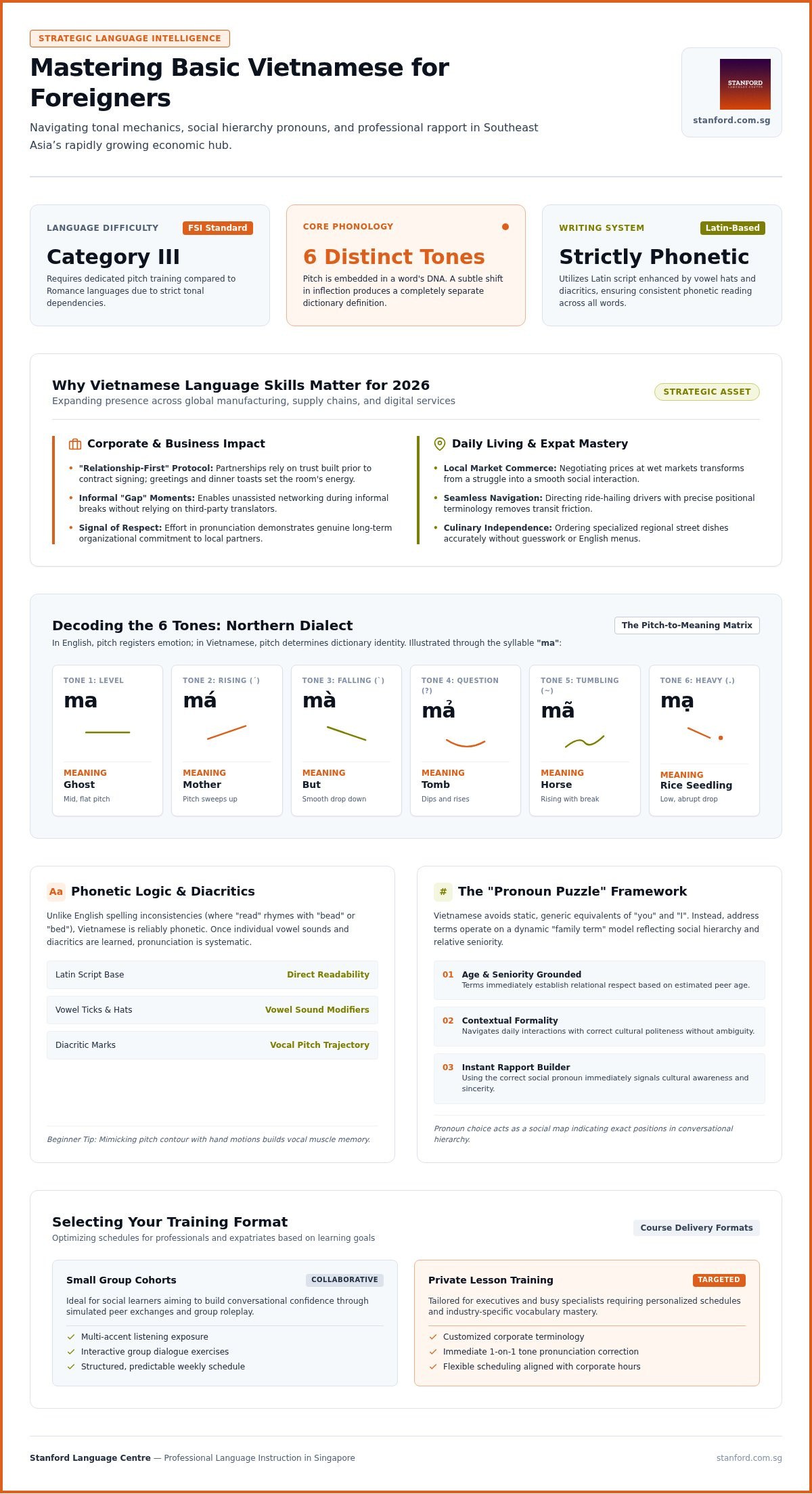
Tones are the heartbeat of the language. For many newcomers, they represent the biggest hurdle. In English, we use pitch to express emotion or ask a question. In Vietnamese, pitch is part of the word’s DNA. Changing the tone doesn’t just change the mood; it changes the dictionary definition entirely. It’s helpful to think of the language as a melody where every syllable has a specific note you must hit.
The Foreign Service Institute language difficulty rankings classify Vietnamese as a Category III language. This means it requires more time than Romance languages, largely because of the tonal system. There are six tones in the Northern dialect: Level, Rising, Falling, Question, Heavy, and Tumbling. Take the syllable "ma" for example. Depending on the tone, it can mean ghost, mother, but, tomb, rice seedling, or horse. It’s a common fear for those starting basic vietnamese for foreigners, but your ears will adapt quickly with the right practice.
Visualizing the Tones with Diacritics
Vietnamese uses a Latin based alphabet, which makes reading easier than you might expect. The "hats" and "ticks" you see on vowels are diacritic marks that tell you which tone to use. A rising accent (´) means your voice should go up, while a heavy dot (.) under a vowel indicates a short, low drop. Many students find it helpful to use hand movements to mimic the pitch while speaking. If the tone goes up, move your hand up. It builds muscle memory for your vocal cords. Don’t worry about sounding perfect on day one; focus on the direction of the sound first.
Phonetic Foundations for Beginners
One major advantage is that Vietnamese is highly phonetic. Unlike English, where "read" can rhyme with "bead" or "bed," Vietnamese is consistent. Once you learn the sound of a letter and its tone, you can pronounce almost any word you see. Vowels carry the weight of the tone, so mastering them is your first priority. If you’re feeling overwhelmed, remember that tones are just another skill to be practiced, much like learning to drive or play an instrument. You can how to learn a tonal language more effectively by focusing on listening before speaking. Developing a "tonal ear" is the secret to moving from basic vietnamese for foreigners to conversational confidence. If you want to accelerate this process, joining a small group Vietnamese class provides the real time feedback you need to stay on track.
Essential Basic Vietnamese Phrases for Daily Use
Mastering the first 30 seconds of a conversation changes everything. It sets the tone for the entire interaction. While the grammatical structure and history of Vietnamese might seem complex, the language is actually quite logical. It’s an isolating language. This means words don’t change their form based on tense or gender. This makes learning basic vietnamese for foreigners much faster than many expect. You just need the right building blocks to start communicating.
Politeness is a key pillar of Vietnamese culture. You can sound much more respectful by simply adding the particle "ạ" at the end of your sentences when speaking to elders or in formal settings. It’s a small addition that shows you understand the social nuances. Beyond the standard "Xin chào" for hello, knowing how to express gratitude with "Cảm ơn" and offer a sincere "Xin lỗi" for an apology will get you very far in your daily travels.
Daily Interaction Essentials
Navigating daily life requires a few specific survival tools. If you’re exploring a local market or taking a taxi, these phrases are your best allies. Start with "Cái này bao nhiêu tiền?" to ask for a price. If you find yourself in need of facilities, "Nhà vệ sinh ở đâu?" is the question to ask. These are practical, results-oriented phrases that solve immediate problems.
Food is the heart of Vietnamese social life. Ordering your first "Cà phê sữa đá" (iced coffee with condensed milk) is a rite of passage. Don’t worry about perfect grammar here. Focus on the keywords. Shop owners are usually very patient and will appreciate your effort to speak their language. Using basic vietnamese for foreigners in these settings builds a bridge between you and the local community.
Numbers and Counting
The numbering system is surprisingly straightforward. Once you learn 1 through 10, you can count to 99 with ease. For example, eleven is "mười một" (ten-one) and twenty is "hai mươi" (two-tens). This logical flow makes it easy to handle transactions quickly without getting confused.
Dealing with the Vietnamese Dong can be overwhelming because of the large denominations. You’ll often see prices in the thousands or millions. It’s helpful to remember that 10,000 is "mười ngàn". Mastering these large numbers is essential for market transactions and ensures you’re always paying the correct amount. Practice these numbers daily, and you’ll find that your confidence in handling currency grows rapidly.
The Pronoun Puzzle: Understanding Social Hierarchy
English speakers are used to "I" and "You" being the universal standard for every conversation. In Vietnamese, these words are rarely used in daily life. Using them can actually sound blunt or even disrespectful in many contexts. Instead, the language relies on kinship terms that treat everyone like a member of an extended family. For anyone starting with basic vietnamese for foreigners, understanding this "social map" is the key to being accepted and respected by locals.
The choice of pronoun depends entirely on the age and gender of the person you’re talking to relative to yourself. If you get it right, you show that you understand the heart of the culture. If you get it wrong, people will usually forgive you, but you’ll miss out on that immediate sense of connection. In 2026, the trend in major cities is moving toward more relaxed interactions, but the core hierarchy remains a pillar of the language. You’ll find that "Tôi" is a safe, neutral way to say "I," but it can feel a bit distant and formal for casual chats.
The Social Map of Vietnamese Speech
Think of every conversation as a way to find your place in a family tree. If you’re talking to a man who looks slightly older than you, you call him "Anh" (older brother). If she’s an older woman, she’s "Chị" (older sister). Anyone younger than you, regardless of gender, is "Em" (younger sibling). This system isn’t just about labels; it’s about showing "Lịch sự," or politeness. It signals that you recognize and respect the other person’s seniority. When you use these terms correctly, the "foreigner barrier" drops almost instantly. It makes your basic vietnamese for foreigners sound natural rather than robotic.
Vietnamese for the Workplace
In a professional setting, these nuances become even more critical. Addressing a manager or a senior partner with the wrong level of formality can create unintended tension. Corporate culture in Vietnam is deeply rooted in these social layers. You need to know how to navigate the shift from formal meetings to the more relaxed atmosphere of a business lunch. This is why specialized corporate language training singapore focuses so heavily on these social dynamics. It’s not just about the words; it’s about the social intelligence behind them. If you want to build lasting business relationships, mastering this puzzle is your first priority. You can also join a private 1-1 Vietnamese class to practice these specific social cues in a supportive, low-stress environment.
Choosing the Right Vietnamese Language Course in Singapore
Finding the right environment is half the battle when you start learning a new language. While some suggest "learning as you go" during trips, this approach often leaves beginners feeling lost. A structured foundation is essential. It prevents you from picking up bad habits that are hard to break later. When looking for basic vietnamese for foreigners, you need a program that balances theory with real world practice. You need a mentor who understands the specific hurdles foreigners face.
You have several options depending on your schedule and goals. Small group classes offer a social environment where you can learn from your peers. They’re often the most affordable entry point for those starting out. On the other hand, a private 1-1 Vietnamese class provides maximum flexibility. It’s the perfect choice for busy professionals who need a customized pace. Both formats are available in online and offline versions. This ensures you can stay consistent regardless of your location or travel schedule.
Financial support is a major factor for many learners in Singapore. It’s vital to check for available subsidies before you enroll. While SkillsFuture credits don’t apply to Vietnamese courses, many programs at Stanford Language Centre are NTUC UTAP claimable. This makes high quality education accessible to more adult learners. It’s a pragmatic way to invest in your personal growth. You get professional training without the heavy price tag.
Small Group Learning Benefits
Learning in a group creates a supportive community. You’ll practice tones with others who are at the same level. This lowers the pressure. Our structured Level 1 curriculum is designed specifically for adults. It focuses on the most useful phrases first. This approach builds your confidence quickly. You’ll find that having a regular class schedule keeps you accountable. It’s an efficient way to master basic vietnamese for foreigners while making new connections with fellow expats.
The Stanford Advantage
Stanford Language Centre has been a trusted name since 2004. We specialize in adult learners and understand the specific needs of busy executives. Our instructors are experts at making complex topics like tones and pronouns easy to grasp. We don’t just teach words; we teach you how to use them in real life settings. Whether you’re an individual or looking for Vietnamese language lessons singapore for your team, we have a solution that fits. You can enroll in our small group Vietnamese class today and start your journey toward fluency with a team that views themselves as your partner.
Your Future in Vietnam Starts with a Single Tone
You now have a clear roadmap to navigate the tonal landscape and the social hierarchy of pronouns. Mastering basic vietnamese for foreigners isn’t about reaching perfection overnight. It’s about making a genuine effort to connect with the local community. These foundations will help you build immediate trust in both social and professional settings as Vietnam’s economy continues to expand. At Stanford Language Centre, we’ve specialized in teaching adults since 2004. Our small class sizes ensure you receive the personalized attention required to master tricky pronunciation and social nuances. Since our programs are NTUC UTAP claimable, you can advance your skills while maximizing your benefits. Start your Vietnamese journey today with our small group classes! The music of the language is waiting for you. Step out of the foreigner bubble and start speaking with confidence today.
Frequently Asked Questions
Is Vietnamese hard for English speakers to learn?
Vietnamese is often considered a Category III language, meaning it’s moderately challenging but very logical. While the tones require focus, the grammar is actually simpler than many European languages. There are no complex verb conjugations or gendered nouns to memorize. Foreigners usually find the Latin-based script helps them progress much faster than they expected. With the right guidance, the foundations become accessible quite quickly.
How many tones does the Vietnamese language have?
Standard Vietnamese has six distinct tones that change word meanings. These include the mid-level, rising, falling, question, tumbling, and heavy tones. Each tone is represented by a specific diacritic mark above or below the vowel. Mastering these pitch contours is a core part of learning basic vietnamese for foreigners. It ensures you are understood correctly in both daily interactions and professional business settings.
Can I learn basic Vietnamese in 3 months?
You can reach a functional level of conversational Vietnamese within three months of consistent study. By focusing on Level 1 foundations, you’ll handle basic greetings, order food, and navigate simple social situations with ease. While full fluency takes more time, a structured 12-week program provides enough vocabulary to communicate with confidence. It’s a realistic goal for anyone willing to practice their tones and essential phrases regularly.
What is the difference between Northern and Southern Vietnamese dialects?
The main differences involve pronunciation and specific vocabulary choices between the regions. Northern Vietnamese, centered in Hanoi, is the standard for formal education and uses six clear tones. Southern Vietnamese, spoken in Ho Chi Minh City, has a more melodic flow and typically uses five tones in practice. Most courses for foreigners teach the Northern dialect first. This provides a clear phonetic foundation that is understood throughout the entire country.
Can I use SkillsFuture credits for Vietnamese courses at Stanford?
No, you cannot use SkillsFuture credits for Vietnamese courses at Stanford Language Centre. While we provide professional language programs, our Vietnamese modules are not currently under the SkillsFuture credit scheme. Instead, we focus on high-quality, pragmatically designed courses that prioritize real-world results for adult learners. We recommend exploring our other financial assistance options, such as the NTUC UTAP scheme, to help manage your course fees effectively.
Are Vietnamese classes claimable under NTUC UTAP?
Yes, our Vietnamese language classes are claimable under the NTUC UTAP scheme for eligible union members. This assistance is an excellent way to upgrade your skills while reducing your out-of-pocket costs. It’s specifically designed for professionals who want to stay competitive in the regional business landscape. We suggest verifying the current claim limits for 2026 with NTUC before you begin your enrollment to ensure you maximize your benefits.
Do I need to learn the Vietnamese alphabet or just speaking?
Learning the alphabet is highly recommended because Vietnamese uses a Latin-based script. Unlike languages with complex characters, you can learn to read and write this script quite quickly. This skill is essential because the diacritic marks tell you exactly which tone to use for every word. Even if your primary goal is speaking, being able to read menus and signs makes navigating daily life in Vietnam much more efficient.
Is it better to learn Vietnamese online or in a classroom?
Both formats offer unique benefits depending on your lifestyle. Classroom learning provides immediate feedback on your pronunciation, which is invaluable for beginners. Online classes offer the flexibility to learn from anywhere, making it easier for busy professionals to stay consistent. At Stanford, we’ve provided these options since 2004 to ensure you find a style that fits your schedule. It’s a practical way to master basic vietnamese for foreigners.