What if your biggest hurdle to career growth in Singapore isn’t your technical skill, but the “tonal wall” of the local language? You’ve likely sat in a business meeting or a local coffee shop wishing you could chime in. The fear of making a tonal mistake often keeps you silent. It’s frustrating when you’re a high-achieving professional but feel like a total beginner the moment you try to learn mandarin language basics. You don’t have time for long, academic courses. You certainly don’t want to sit in a classroom full of children.
This article provides a practical roadmap to help you master essential conversational Mandarin without the stress of traditional schooling. You’ll gain the confidence to handle business and social conversations while understanding the cultural nuances of the Singaporean workplace. We will look at efficient strategies for busy schedules and the benefits of adult-only environments. We’ll also explain how to use NTUC UTAP subsidies to keep your training affordable and accessible.
Key Takeaways
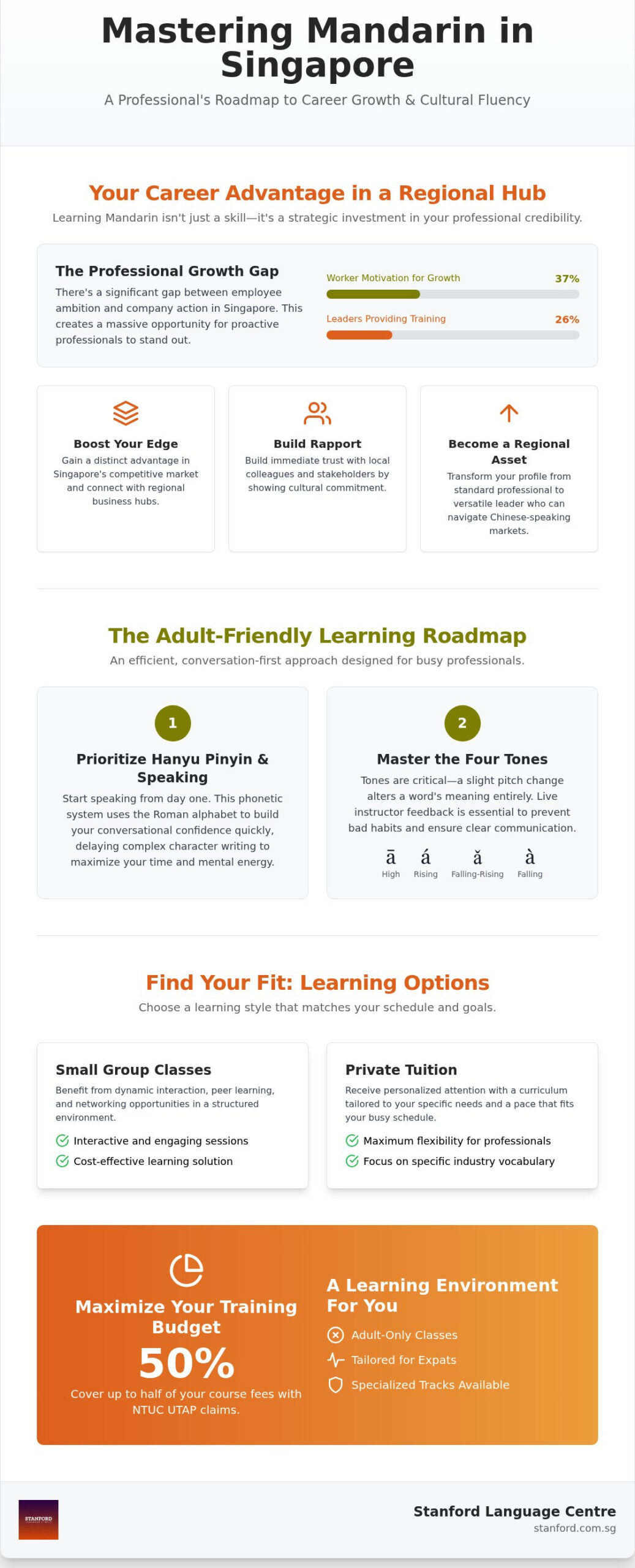
- Boost your professional edge in Singapore by mastering conversational skills that open doors to regional business hubs.
- Save time and effort by prioritizing Hanyu Pinyin and speaking over the complexities of character writing.
- Choose between small group interactions or private lessons to learn mandarin language at a pace that fits your professional schedule.
- Maximize your training budget with NTUC UTAP claims, which can cover up to 50% of your course fees.
- Access adult-only environments tailored for expats, including specialized tracks for Japanese and Korean speakers.
Why Learning Mandarin is Your Best Career Move in Singapore for 2026
Singapore remains a vital gateway for Southeast Asian trade. In 2026, professional growth here often hinges on your ability to connect with regional partners. While English is the primary business language, a foundational understanding of Standard Chinese serves as a powerful bridge to local and regional business hubs. It’s about more than just translation; it’s about building rapport.
When you decide to learn mandarin language, you aren’t just picking up a hobby. You’re investing in professional credibility. Bilingualism in Singapore is a distinct advantage that builds immediate trust with local colleagues and stakeholders. It shows you’re committed to the local culture and ready to engage at a deeper level.
Many busy professionals are moving beyond simple self-study apps. While apps are convenient, they often lack the depth needed for a fast ROI. A 2026 report indicated that 37% of workers in Singapore cite growth and development as their main motivator. However, only 26% of business leaders have sent staff for training recently. This gap creates a massive opportunity for proactive expats. Choosing to learn mandarin language through a structured course ensures you gain the conversational skills that actually matter in a boardroom.
Mandarin in the Professional Singaporean Landscape
Effective communication within a team improves when you understand the cultural context behind the words. In 2026, the shift toward regional connectivity means businesses need leaders who can navigate Chinese-speaking markets with ease. This skill impacts client relationships and internal team dynamics. Mandarin proficiency acts as a career multiplier by turning a standard professional profile into a versatile regional asset.
Social Integration for Expats and Foreigners
Living in Singapore is more rewarding when you can break out of the “expat bubble.” Basic fluency allows you to navigate daily life with confidence. Whether you’re ordering at a hawker center or chatting with a neighbor, these interactions build a sense of belonging. You’ll feel more at home when you can understand the nuances of local life. Practical examples of daily Mandarin use include:
- Building rapport with local vendors during your morning routine.
- Understanding subtle social cues during community or festive events.
- Participating in local networking sessions without feeling like an outsider.
- Navigating transport or service requests with increased clarity and speed.
Confidence comes from practice. A structured, adult-friendly environment provides the safe space you need to make mistakes and grow quickly. By focusing on practical speaking first, you’ll see immediate results in your social and professional circles.
The Adult-Friendly Roadmap: Prioritizing Conversational Skills and Phonetics
Learning a new language as a busy adult is different from childhood education. You need speed. You need utility. Traditional academic routes often bury students in complex characters too early, leading to frustration. For expats in Singapore, the most effective way to learn mandarin language is to start with Hanyu Pinyin. This phonetic system uses the Roman alphabet to represent sounds. It acts as a bridge between what you see and what you say. It lets you start speaking from day one.
The “Conversation-First” philosophy is about efficiency. By delaying the study of complex characters, you free up mental energy to perfect your speech. This approach respects your time. It focuses on the results you can use in a business meeting or a local coffee shop. The importance of Mandarin here is supported by historical initiatives like Singapore’s Speak Mandarin Campaign, which solidified the language’s role in the local identity.
Mastering the Four Tones for Clear Communication
Tones are the biggest hurdle for most learners. English speakers often struggle because a slight pitch change can completely change a word’s meaning. Live instructors are non-negotiable for this stage. Apps can’t catch the subtle nuance of a rising tone versus a flat one in real time. Immediate correction from a trainer prevents bad habits from becoming permanent. You can find more specific tips in this guide on how to learn a tonal language to help you navigate these vocal shifts with confidence.
The Foundational Level 1 Curriculum
A 10-week foundational course should feel like a toolkit, not a chore. You’ll focus on essential daily expressions and workplace introductions. Instead of trying to memorize thousands of characters, you build a functional vocabulary of high-frequency words. This prevents burnout and keeps you motivated. By the end of a conversational mandarin level 1 program, you’ll be able to handle basic social interactions and introduce yourself professionally. Setting realistic goals is key to long-term success. Starting with a small group mandarin class provides the social support and expert guidance needed to stay on track.
Most adult learners can achieve basic fluency in common scenarios within just a few months. It’s about consistency over intensity. Short, focused sessions with a native speaker provide the best return on your investment. You don’t need to be a linguist to succeed; you just need a roadmap designed for your lifestyle.
Group Classes vs. Private Tuition: Finding Your Learning Style
Deciding how to learn mandarin language depends entirely on your personal goals and schedule. For most expats, the choice boils down to a balance between social interaction and high-speed customization. Both formats offer unique advantages for the modern professional in Singapore. It’s about finding the environment where you feel most comfortable making mistakes and growing.
The Power of Small Group Interaction
Small group Mandarin classes are perfect for those who thrive on social motivation. Learning alongside peers who share similar professional backgrounds reduces the anxiety of adult learning. It creates a built-in community. You can role-play real-world scenarios, like negotiating a business deal or navigating a networking event. Stanford Language Centre specifically limits group sizes to ensure every student gets ample speaking time. This high-interaction model is a strategic advantage in business, as it mimics the collaborative nature of the Singaporean workplace.
Group classes are also the most cost-effective option. You receive high-quality instruction at a lower price point than private tutoring. Plus, seeing your classmates progress keeps you accountable. It turns a challenging task into a shared social experience.
Private 1-1 Lessons for Busy Executives
If your schedule is unpredictable, a private Mandarin class for foreigners and expats might be the better fit. Executives in specialized fields like finance, tech, or law often need a syllabus tailored to their specific industry jargon. You don’t have to wait for a group to catch up. The instructor focuses 100% on your pace. This allows for significantly accelerated progress compared to traditional tracks.
Flexible scheduling is the primary benefit here. If you travel frequently for work or have back-to-back meetings, you can shift your lessons without missing a beat. Whether you choose an in-person session or an online Mandarin class, the one-on-one focus ensures you never lose momentum. You get immediate, personalized feedback on your tones and pronunciation, which is vital for building confidence quickly.
Balancing flexibility with immersion is key. While online classes offer convenience, many professionals find that in-person interaction provides a deeper level of engagement. Being in a physical classroom helps you pick up on non-verbal cues and cultural nuances that are easily missed on a screen. Choosing the right format is the first step toward achieving the conversational fluency you need to succeed in Singapore’s competitive market.
Maximizing Your Investment: UTAP Claims and Corporate Training
Professional development in Singapore is highly supported by local labor unions. When you decide to learn mandarin language, you aren’t just gaining a skill; you’re accessing a network of financial support designed to keep the workforce competitive. Understanding these subsidies can significantly reduce your out-of-pocket expenses while you focus on your career growth.
How to Claim Your UTAP Benefits
The Union Training Assistance Programme (UTAP) is a training benefit for NTUC members. It aims to encourage lifelong learning by defraying the cost of training. As of June 2026, members can claim 50% of unfunded course fees for approved programs. The annual funding cap is S$250 for members below 40 years old. For those aged 40 and above, the cap increases to S$500 per year. To qualify, you must maintain at least 75% course attendance and submit your claim within six months of completing the course.
Checking your eligibility is straightforward. Visit the official NTUC U Portal and search for your specific course provider under the UTAP-supported list. This ensures your chosen program qualifies for reimbursement before you enroll. It’s a simple step that provides peace of mind and clear financial planning for your education.
Customized Corporate Language Solutions
For organizations looking to expand into regional markets, a Mandarin-literate workforce is a massive asset. Corporate training isn’t a one-size-fitt-all solution. Effective programs are tailored to your company’s specific industry terminology, whether that’s in finance, legal, or technology. This level of customization ensures that your team isn’t just speaking the language, but using it to drive business results.
Flexible delivery is essential for busy teams. Many companies choose a mix of on-site sessions and online Mandarin classes to accommodate diverse schedules. The long-term ROI is clear. Teams that can communicate directly with regional partners build faster rapport and close deals more efficiently. Investing in your staff’s ability to learn mandarin language pays dividends in professional credibility and market reach.
Ready to boost your team’s potential? Explore our Corporate Mandarin Language Training options to find a program that fits your business goals.
Start Your Journey with Stanford Language Centre’s Expert-Led Programs
Choosing the right partner makes all the difference when you decide to learn mandarin language. At Stanford Language Centre, we don’t believe in intimidating academic postures. We believe in results. Our methods are pragmatic and designed specifically for the busy professional. Since 2004, we’ve focused on lowering the barrier to entry for new learners through a supportive and relaxed environment. We prioritize practical application over theoretical complexity to ensure you see progress from your very first lesson.
Our approach is grounded in a “Student-First” mentality. This means we value your time and your specific goals. We offer a no-frills, honest approach to quality education. We see ourselves as your partners in this journey rather than distant authorities. You’ll find a community of passionate, down-to-earth experts who are invested in your success. Whether you’re looking for a small group Mandarin class or a private Mandarin class for foreigners and expat, we provide the tools you need to succeed.
Tailored Classes for Expats and Foreigners
Our classes aren’t for children. We provide a dedicated “Adult-only” environment to differentiate ourselves from typical tuition centers. This ensures you’re learning alongside peers with similar career goals and life experiences. We focus on the practical Singaporean context. You’ll learn the cultural etiquette needed for local business meetings and social gatherings. For a deeper look at our approach and current offerings, check out the 2026 guide: adult chinese learning in singapore. This curriculum is built to help you navigate daily life and professional networking with ease.
Specialized Mandarin for Japanese and Korean Speakers
We offer something few other centers do. We provide specialized tracks for Japanese and Korean speakers. These programs leverage linguistic overlaps to speed up your progress. If you already know Kanji or Hanja, you have a massive head start in character recognition. We help you use that knowledge to your advantage. Our trainers also address specific pronunciation challenges unique to these language groups. A small group mandarin class for Japanese or Korean speakers fosters peer-to-peer support. You won’t feel lost in a crowd. Instead, you’ll learn in a setting optimized for interaction and fast-paced results.
Gaining confidence in a new language shouldn’t be a stressful ordeal. It should be an empowering career move. Our expert-led programs provide the roadmap you need to master conversational essentials. By focusing on speaking and phonetics first, we help you overcome the fear of making mistakes. It’s time to unlock the professional and social opportunities that come when you learn mandarin language in a supportive, adult-focused environment.
Unlock Your Potential in Singapore’s Global Market
Mastering a new language is more than just a personal achievement; it’s a strategic professional tool. By prioritizing conversational fluency and phonetics, you bypass the burnout of academic memorization. Whether you choose the social energy of a small group or the focused pace of private lessons, the right environment makes all the difference. Your growth is supported by local initiatives, making it easier than ever to invest in your future.
When you decide to learn mandarin language, you’re opening doors to regional business hubs and deeper local connections. Stanford Language Centre provides the pragmatic, adult-only setting you need to succeed without the stress. With NTUC UTAP claimable courses and specialized tracks for expats and corporate teams, we ensure your journey is both cost-effective and highly relevant. Our small group sizes are optimized for maximum interaction, giving you the confidence to speak from day one.
Ready to bridge the gap between basic greetings and meaningful business dialogue? Start your conversational journey today with Stanford Language Centre. We’re here to guide you every step of the way.
Frequently Asked Questions
Is it possible to learn Mandarin as an adult with no prior experience?
Yes, it’s absolutely possible to learn mandarin language as an adult without any prior background. We design our Level 1 programs specifically for absolute beginners. By focusing on Hanyu Pinyin and foundational phonetics first, we remove the intimidation of complex characters. This allows you to start speaking and understanding basic phrases from your very first session. Our supportive, adult-only environment ensures you’re learning alongside peers in a low-pressure setting.
How long does it take to become conversational in Mandarin?
You can achieve basic conversational fluency in common social and business scenarios within approximately 10 weeks. Our foundational programs focus on high-frequency vocabulary and practical daily expressions. While full mastery takes longer, this initial timeframe provides the tools needed to handle introductions and basic requests. Consistency is key; attending small group sessions once or twice a week helps reinforce your learning and builds the confidence required for real-world interactions.
Can I use SkillsFuture credits for Mandarin classes at Stanford Language Centre?
No, Stanford Language Centre does not currently accept SkillsFuture credits for any of our language courses. While we are not a SkillsFuture-approved provider, we offer significant financial support through the NTUC UTAP scheme. This allows eligible union members to claim back a portion of their course fees. We prioritize providing high-quality, results-oriented training for adults while helping you navigate the available subsidies that make professional development more affordable.
What is the difference between Level 1 and HSK 1 courses?
Level 1 at Stanford Language Centre focuses on practical, conversational skills rather than the academic requirements of the HSK 1 exam. HSK is a standardized proficiency test often used for university admissions or specific visa requirements. To support your academic goals, you can explore Admissions Consulting and Strategy Fees to ensure your application is as strong as possible. In contrast, our Level 1 curriculum is designed for expats and professionals who need to communicate effectively in Singapore’s social and business environments. We prioritize speaking and listening over the intensive character writing typically found in HSK-aligned courses.
Online Mandarin classes are highly effective when they include live, real-time interaction with an expert trainer. We ensure our digital sessions mirror the engagement of our physical classrooms. You still benefit from immediate tonal corrections and peer interaction in a small group setting. This format offers the flexibility busy professionals need while maintaining the rigorous standards of our in-person lessons. It’s a pragmatic solution for those with demanding work schedules or travel commitments.
How does the NTUC UTAP claim work for language courses?
The NTUC UTAP claim allows union members to receive 50% of unfunded course fees back after completing their training. For members under 40, the annual cap is S$250; for those 40 and above, it increases to S$500. You must maintain at least 75% attendance to qualify for this benefit. To learn mandarin language cost-effectively, ensure your membership is active before the course starts and submit your claim through the NTUC portal within six months of completion.
Do you offer Mandarin lessons for children or students?
No, we do not offer Mandarin lessons for children or school-aged students. Stanford Language Centre is strictly an adult-only environment, specializing in professional and conversational language training for expats and working professionals. This focus allows us to tailor our teaching methods and classroom dynamics to the specific needs of adult learners. By maintaining this boundary, we ensure a mature, distraction-free atmosphere where you can focus entirely on your own personal and professional growth.
What happens if I miss a lesson in a small group class?
If you miss a lesson in a small group Mandarin class, we provide the relevant course materials to help you stay on track. While we encourage consistent attendance to maximize your learning momentum and meet UTAP requirements, we understand that professional commitments can occasionally interfere. You can review the missed content with your instructor or peers in the following session. Our trainers are dedicated to ensuring no student falls behind, providing a supportive safety net for busy adults.