What if I told you that your “bad” singing voice has absolutely nothing to do with your ability to speak Mandarin? Many people in Singapore hesitate to start because they think they’re tone-deaf. They worry about being mocked or misunderstood when ordering food or chatting with colleagues. The truth is that figuring out how to learn a tonal language isn’t about having a musical ear. It’s about building physical muscle memory in your throat and mouth.
It’s completely normal to feel frustrated when popular apps don’t correct your pronunciation. You might feel like you’ll never get the rhythm of Thai or Vietnamese right. We’re here to tell you that you can do this. This guide will show you how to master these tones using simple physical techniques and structured practice. You’ll discover how to speak clearly enough to be understood in any social setting without the stress. We’ll break down the mechanics of sound and give you a clear path to conversational confidence.
Key Takeaways
- Understand that tones are physical habits rather than musical talents, and you already use pitch every day to change meaning in English.
- Master the mechanics of sound by anchoring your pitch and discovering how to learn a tonal language through muscle memory in your throat.
- Compare the different tonal structures of Mandarin, Thai, and Vietnamese to find the right starting point for your personal learning journey.
- Use the “Mimicry Loop” to record and compare your voice with native speakers, ensuring you are understood in real-world social settings.
- Learn why real-time feedback in a supportive classroom environment helps you overcome the “feedback gap” found in most language apps.
What is a Tonal Language? Demystifying the ‘Musical’ Barrier
Many people think they need a musical ear to speak Thai or Mandarin. That’s a myth. What is a tonal language exactly? It is a language where the pitch of a word changes its fundamental meaning. It isn’t about singing a song. It is about using your voice to distinguish between different words that otherwise sound the same. If you are looking for how to learn a tonal language, start by realizing you already have the physical tools to do it. You’ve been using pitch your entire life without even realizing it.
Being tone-deaf in the musical sense rarely stops someone from becoming fluent. Research shows that linguistic tone and musical pitch are processed differently by the brain. For parents looking to understand how these cognitive pathways develop in early childhood, the Firststep Psychology & Child Development Centre offers expert guidance on child psychology and growth. You don’t need to hit a perfect C-sharp to be understood at a hawker centre in Singapore. You just need to train your throat muscles to move in specific patterns. It is more like learning a new sport than learning the violin. It’s about muscle memory, not artistic talent.
Early intervention is a key part of this journey, helping to identify and address any communication delays before they impact a child’s learning. To learn more about these evaluations, you can visit Stars Assessment Program for professional support tailored to infants and toddlers.
Tone vs. Intonation: You’re Already Doing It
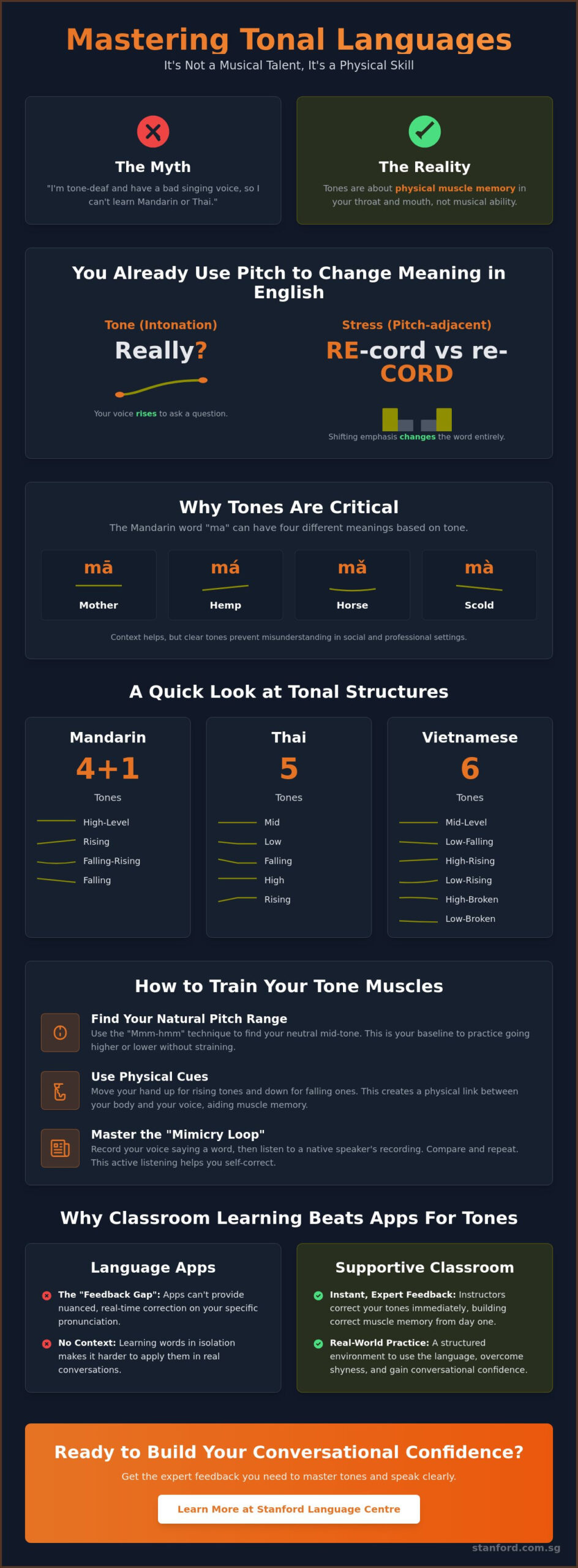
Think about how you say the word “Really?” to ask a question. Your voice naturally rises at the end. Now say “Really.” as a flat statement. You just used pitch to change the meaning of a sentence. English speakers also use pitch-adjacent concepts with word stress every day. Think about the word “record.” You say “RE-cord” for the noun but “re-CORD” for the verb. The shift in emphasis changes the word entirely. Shifting your mindset from “singing” to “emphasising” makes the process feel much less daunting. You aren’t learning to sing; you’re learning where to put the weight in your speech.
Why Tones Matter for Practical Conversation
The most famous example is the Mandarin word “Ma.” Depending on the tone, it could mean mother, hemp, horse, or scold. This sounds scary, but context is your best friend. If you are at a stable and point at an animal, nobody will think you are calling your mother a horse. Even if your tone is slightly off, the rest of your sentence helps the listener understand you. When you start how to learn a tonal language, focus on being “clear enough” rather than perfect. In social settings, people are generally helpful and will understand you based on the situation; for instance, if you’re visiting a colleague with a gift from Tai Kang Healthy Fruits, the context of your arrival makes your greetings much easier to interpret. Mastery comes with time, but being understood happens much sooner than you think.
The Mechanics of Tone: How to Train Your Throat and Tongue
Learning a tonal language is more like going to the gym than going to music school. You have to train the muscles in your larynx and throat to behave in new ways. While the challenges of learning tonal languages are real for English speakers, they are purely physical. You aren’t learning to sing. You’re learning to control your vocal cords. Tone is a physical habit developed through mimicry.
One of the most effective ways to understand how to learn a tonal language is through pitch anchoring. You need to find your natural high, mid, and low registers. If you try to speak outside your normal range, you’ll get tired quickly. You’ll also sound unnatural to native speakers. Finding your “home base” pitch is the first step toward consistency.
Finding Your Natural Pitch Range
Try the “Mmm-hmm” technique. Say “Mmm-hmm” as if you’re casually agreeing with a friend. That initial “Mmm” is usually your neutral mid-tone. This is your baseline. From here, you can practice going higher or lower without straining. Use your hands to guide your voice physically. Move your hand up as you speak a rising tone and down for a falling one. It sounds silly, but it creates a physical link between your body and your voice. This helps your brain map the sound to a specific movement.
The Physicality of Speaking
Your tongue position also changes how a tone resonates. In languages like Thai or Vietnamese, the resonance shifts based on where your tongue sits in your mouth. For falling tones, try short, punchy exhales. This provides the drop in energy needed for the sound to feel authentic. Don’t be afraid to exaggerate these movements at first. Beginners often speak too softly because they’re shy. Instead, be loud and clear. Big movements are easier for your brain to remember. Once the muscle memory is set, you can dial it back to a natural speaking volume. Much like how you might visit SgGolfCoach to refine your physical form on the course, mastering language tones requires a focus on precise bodily mechanics.
Vowel length is another secret weapon for clarity. In Thai, the length of a vowel is just as important as the tone itself. If you cut a long vowel short, the tone won’t have enough time to finish its shape. Practice holding your vowels a split second longer than feels natural. This gives you the space to hit the tone correctly. If you want a structured way to build these habits, private language lessons can provide the immediate feedback you need to stay on track.
Comparing Tones: Mandarin vs. Thai vs. Vietnamese
Choosing your first tonal language is an exciting step. If you’re researching how to learn a tonal language, you’ll quickly notice that each one has a unique “personality.” Some feel like a steady climb, while others feel more like a melody. In Singapore, we’re lucky to be surrounded by these sounds every day. Understanding the differences between Mandarin, Thai, and Vietnamese will help you choose the path that fits you best.
Mandarin is often called the “gateway” tonal language. It features four main tones: high level, rising, dipping, and falling. You’ll see these clearly marked in Pinyin with small symbols above the vowels. The dipping tone is usually the biggest hurdle for beginners. It requires you to drop your voice low before letting it rise again. Mastery of these four sounds is the foundation of any Conversational Mandarin Level 1 course. Once you get these down, the logic of tonal speech starts to click.
Mandarin Tones for the English Speaker
Visualising the tones is a great way to start. Think of the first tone as a flat line, like a robot’s voice. The second tone is like asking a question: “Huh?” The third tone dips like a rollercoaster. The fourth tone is a sharp, short drop, like saying “No!” with emphasis. A common pitfall for students in Singapore is mixing up the rising and dipping tones. This happens because they both involve an upward movement at the end. Focusing on the “bottom” of the dip is the secret to telling them apart.
The Rhythmic Beauty of Thai and Vietnamese
Thai tones feel more like a song than Mandarin. There are five tones: mid, low, falling, high, and rising. What makes Thai unique is the importance of vowel length. You can’t just get the pitch right; you also have to get the timing right. A short vowel with a rising tone means something completely different than a long vowel with that same tone. If you’re drawn to this rhythmic style, a Thai Language School Singapore can help you coordinate your pitch with your pacing.
Vietnamese is often considered the most challenging with six tones. It uses “broken” tones that involve a glottal stop. This feels like a tiny, quick catch in your throat mid-word. You can see these tones in the “diacritics” or small marks on the written letters. Learning to read these marks before you speak is a huge advantage. It gives you a visual map of what your voice should be doing. While Vietnamese has more tones, the logic remains the same. It is all about training your throat to hit specific marks.
Which one is the “hardest”? For a Singaporean beginner, the answer usually depends on what you hear most often. Mandarin might feel easier because it is everywhere. Vietnamese might feel tougher because of the glottal sounds. However, don’t let the numbers scare you. Figuring out how to learn a tonal language is about progress, not perfection. Start with the language that excites you most, and the tones will eventually become second nature.
5 Practical Habits to Master Tones as a Beginner
Once you understand the physical mechanics of speech, you need a daily routine to lock in those skills. Many people fail because they only listen passively to podcasts or music. While listening is helpful, it doesn’t build the active muscle memory required for clear speech. If you want to know how to learn a tonal language effectively, you must move from being a listener to being a performer. These five habits will help you bridge the gap between understanding a tone and actually saying it correctly.
Maintaining a high level of performance requires both discipline and recovery. Just as physical rest is part of any training regime, taking time to visit The Outcall Spa for a mobile massage can help you stay refreshed and ready for your next practice session.
The Mimicry Loop Technique
Your brain often lies to you about how you sound. When you speak, you hear your voice through the vibration of your own skull, which distorts the actual pitch. To fix this, use the Mimicry Loop. First, play a short audio clip of a native speaker. Second, record yourself saying the same phrase using your phone. Third, listen to both clips back-to-back. You will likely notice a “gap” where your tone didn’t quite match the original. Standard voice memo apps are perfect for this, as they allow you to hear your voice as others hear it.
Tone Pairs and Context
Practising words in isolation is a common mistake for beginners in Singapore. In a real conversation, tones always appear next to other tones. It is much easier to hear a high tone when it’s placed right after a low one because the contrast is sharper. A tone pair is a foundational drill where you practice two words together to master the transition between different pitches. Try combinations like “High-Low” or “Low-High” to build your internal pitch compass. This method helps you move beyond single words and toward flowing sentences.
Visualisation also plays a huge role in success. Many learners associate specific tones with colours or shapes to create a mental shortcut. You might imagine a rising tone as a bright yellow arrow pointing up or a falling tone as a heavy red block. This bypasses the need for complex linguistic theory and gives your brain a simple image to follow. Finally, nothing beats the value of a qualified mentor. A tutor can spot subtle errors in your pitch before they become hard-to-break habits. If you’re ready to build these habits with expert guidance, our private language lessons offer the immediate feedback you need to speak with confidence.
Why Classroom Learning Beats Apps for Tonal Languages
Language apps are excellent for building vocabulary on the go, but they often fail when it comes to pitch. If you’re figuring out how to learn a tonal language, you’ll quickly notice the “feedback gap.” An app might tell you that you’ve said a word correctly, but it can’t always distinguish between a flat tone and a rising one. This creates a false sense of security. You might think you’re making progress, only to find that native speakers can’t understand you in real-world social settings.
Human interaction is the only way to bridge this gap. A native teacher provides the nuanced correction that an algorithm simply cannot match. They hear the subtle shifts in your voice and can tell you exactly how to adjust. This structured support removes the stress of being misunderstood. It allows you to focus on the joy of connecting with others rather than worrying about every single syllable. Learning becomes a shared experience with a mentor who is invested in your success. This same philosophy of live, expert-led guidance is why many beginners turn to Ansaar Arabic when starting their journey into Quranic Arabic.
The Importance of Real-Time Correction
At Stanford Language Centre, our instructors catch pronunciation errors before they become permanent habits. They don’t just listen to the sound; they observe your physical cues. Sometimes, a slight change in mouth shape or posture is all it takes to hit a difficult Thai or Vietnamese tone. These are the “invisible” mistakes that apps miss. Even in our Online Language Classes, you get the benefit of live, interactive feedback. You’ll build your confidence by speaking with other beginners in a supportive environment where everyone is learning together.
SkillsFuture and Accessible Learning in Singapore
Our branch at Peninsula Shopping Centre offers a convenient, central location to start your journey. You’ll join a community of local learners who share your challenges and your goals. This social aspect makes the process feel like a hobby rather than a chore. While you’re in the city, you might also be interested in other hallmarks of precision and success; for instance, you can find out more about luxury watch collections available in Singapore.
Mastering a tonal language is about more than just passing a test. It is about being able to order a meal, chat with colleagues, and navigate new cultures with ease. A classroom provides the structured path you need to move from basic sounds to flowing conversation. You’ll get the tools, the practice, and the encouragement to succeed. Join our next Conversational Level 1 intake and start speaking with confidence today.
Start Your Journey Toward Clearer Conversations
Mastering tones is about training your body, not just your brain. You already have the tools to speak clearly by focusing on muscle memory and the physical mechanics of sound. Whether you choose Mandarin, Thai, or Vietnamese, remember that consistency and real-world context are your best friends. Figuring out how to learn a tonal language is a personal journey that becomes much more enjoyable with the right support and a bit of daily practice.
The journey of learning begins in childhood, and a supportive environment is key to developing strong communication habits. As an example of high-quality early education, you can discover Trinity Early Learning & OSC, which provides licensed childcare designed to foster growth and confidence from a young age.
Since 2004, we’ve helped thousands of students in Singapore find their voice and build social confidence. Our Mandarin courses are SkillsFuture credit-eligible; our centre is conveniently located at Peninsula Shopping Centre for easy access after work or on weekends. You don’t have to navigate these linguistic hurdles alone. Start your language journey at Stanford Language Centre today and experience the difference that expert, human-led instruction makes. We’re here to help you turn those challenging tones into natural, effortless speech. You’ve got this!
Frequently Asked Questions
Is it possible to learn a tonal language if I am tone-deaf?
Yes, musical tone-deafness doesn’t stop you from speaking fluently. Linguistic tones are about relative pitch and muscle memory rather than hitting a specific musical note. Most people find that they can master the sounds through physical practice and mimicry even if they can’t carry a tune. It is more about the physical shape of the sound than any inherent musical ability.
Which tonal language is the easiest for English speakers to start with?
Mandarin is generally the easiest starting point because it only has four distinct tones. Thai has five and Vietnamese has six, making them slightly more complex for a beginner. Mandarin also uses Pinyin, which provides a clear visual map for each sound using familiar English letters. This makes the transition much smoother for those who are new to the concept of pitch-based meaning.
How long does it take to master tones in Mandarin or Thai?
You can learn to be understood in basic social settings within 10 to 15 weeks of consistent, structured study. While perfect mastery takes years of immersion, reaching a level where you can order food or greet colleagues happens quickly in a Level 1 course. Focus on basic clarity first rather than worrying about achieving a perfect accent right away.
Can I learn tones just by listening to podcasts or watching movies?
Passive listening helps your ear, but it won’t teach you how to speak. Figuring out how to learn a tonal language requires active practice where you record your voice and compare it to native speakers. You need to physically engage your vocal cords to build the necessary muscle memory for these new sounds. Watching movies is a great supplement but not a replacement for active practice.
Do I need to learn to read the script to understand the tones?
You don’t need to learn the script right away to start speaking. Most beginner courses use phonetic systems like Pinyin or Romanization to help you focus on the sounds first. These systems include tone marks that tell you exactly when your voice should rise or fall. This allows you to build conversational skills before tackling the complexity of reading and writing different scripts.
What happens if I use the wrong tone in a conversation?
Most native speakers will still understand you based on the context of your sentence. If you make a mistake, people are generally helpful and will often gently correct you to help you learn. Don’t let the fear of being “wrong” stop you from trying to connect with others socially. Context is a powerful tool that fills in the gaps even when your pitch is slightly off.
Are there any apps that actually help with tone correction?
Apps are great for vocabulary, but they often struggle with accurate tone feedback. They can’t see your mouth position or hear the subtle nuances in your pitch that a human can detect. A native teacher in a classroom setting is still the most reliable way to get accurate, real-time correction. This ensures you don’t develop bad habits that are difficult to break later on.
How can I use my SkillsFuture credits to learn a tonal language in Singapore?
You can easily use your SkillsFuture credits for our Mandarin courses at Peninsula Shopping Centre. When you enroll in a Conversational Mandarin Level 1 class, our team will guide you through the claim process on the government portal. It is a simple, stress-free way to invest in your personal growth and learn a valuable new skill without significant out-of-pocket costs.