What if the biggest barrier to your goal to learn Thai language isn’t your memory, but the fear of a single misplaced tone? It’s a common worry for many professionals. You want to order street food or chat with colleagues in Bangkok without that awkward silence when someone doesn’t understand you. The unique script often looks like an impossible puzzle, and finding time for classes between meetings feels like a second job. We understand that your time is valuable and your goals are practical.
You’re right to feel that traditional academic methods don’t always fit a busy lifestyle. This guide provides a structured roadmap designed specifically for adults who need results, not just theory. We’ll show you how to master the five tones, decode the alphabet, and build real conversational confidence. You will learn the most effective ways to navigate Thai grammar and sentence structure without feeling overwhelmed. We also preview how to find local courses that offer financial support through NTUC UTAP, making your professional development even more accessible. Let’s turn that intimidation into your next success story.
Key Takeaways
- Thai grammar is surprisingly straightforward, with no complex verb conjugations or genders to memorize.
- Discover a structured two-month roadmap to learn Thai language by focusing on phonetics and practical survival vocabulary.
- Mastering the five tones early is the key to moving beyond basic phrases and building genuine cultural connections.
- Select the right learning path for your schedule, from interactive small groups to customized private 1-1 sessions.
- Maximize your professional development budget by claiming NTUC UTAP support for eligible Thai language programs.
Why Learn Thai Language? Beyond the ‘Land of Smiles’
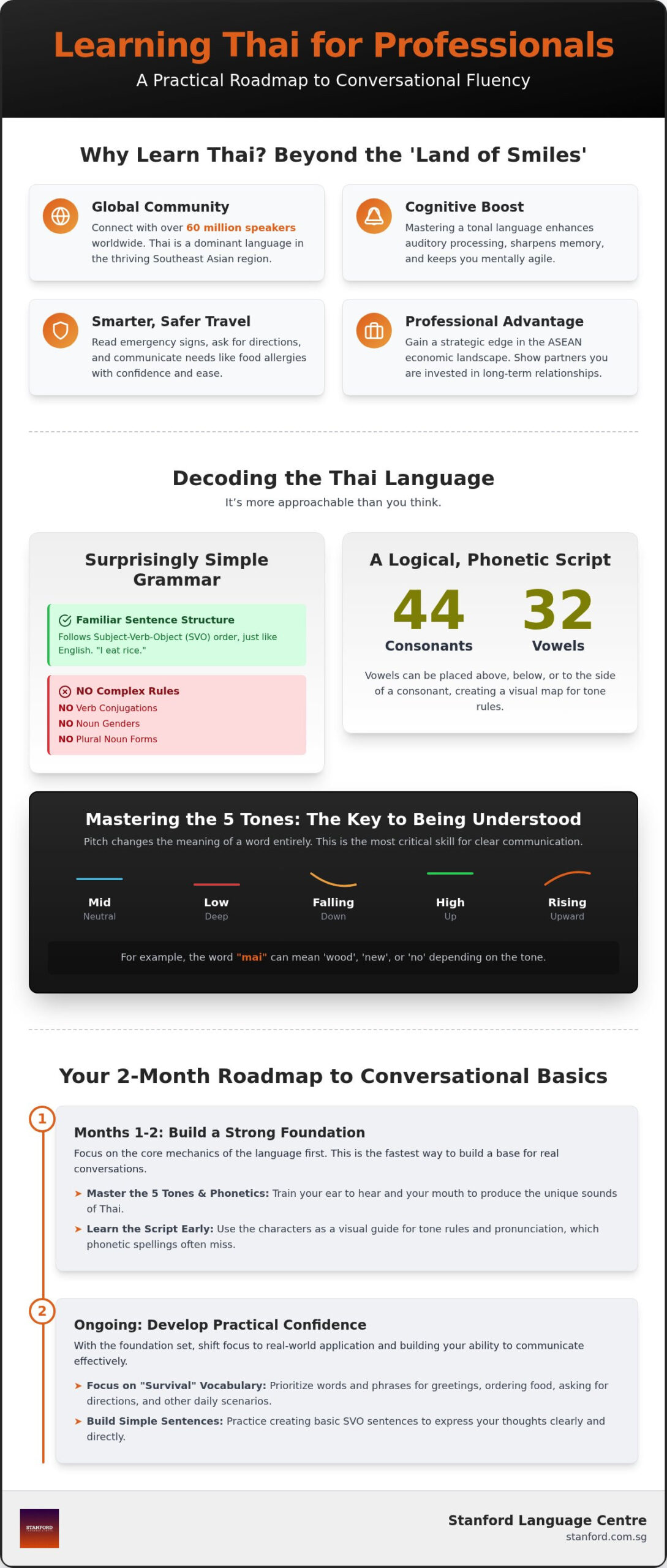
Deciding to learn Thai language is about more than just ordering a pad thai in Phuket. It’s your ticket to a massive global community. With over 60 million speakers worldwide, the Thai language is a dominant force in Southeast Asia. Most learners start for travel, but they stay for the deeper benefits. Mastering a tonal language actually changes your brain. It enhances your auditory processing and keeps your memory sharp. These cognitive gains help you stay mentally agile in your professional life too.
Practicality is a major draw for busy adults. Basic Thai makes your travels significantly safer. You can read emergency signs, ask for directions, or explain food allergies to a chef without confusion. It’s also cost-effective. When you speak the local tongue, you avoid the “tourist tax” and navigate local transport like a pro. You’ll feel more confident navigating busy markets or booking local services without a middleman. It’s about taking control of your experience and feeling at home in a new environment.
The Cultural Connection
Understanding “Thainess” starts with linguistic nuances. It’s not just about vocabulary; it’s about respect. Using polite particles like “khrap” or “ka” correctly changes how people perceive you instantly. These small additions build immediate trust with locals, especially when you venture into non-tourist areas. You’ll find that people are more willing to help a professional who makes a visible effort to respect their culture. Learning the script also opens doors to regional literature and media. You can finally enjoy Thai cinema, music, or news without relying on clunky translations.
Business and Networking in Southeast Asia
If you want to learn Thai language for professional growth, you’re making a smart move. Thailand is a central player in the emerging ASEAN economic landscape. If you work in trade, tech, or finance, speaking the language is a strategic advantage. It differentiates you in corporate negotiations. It shows your partners that you’re invested in the local culture and the long-term relationship. The expat community continues to grow, and conversational fluency is the key to building a strong network. You won’t just be another face in a meeting. You’ll be a partner who understands the subtle cues that define Thai business etiquette.
Decoding the Thai Language: Tones, Script, and Grammar
Many busy professionals hesitate to learn Thai language because they assume the grammar is a nightmare. In reality, Thai grammar is surprisingly simple. You won’t find any verb conjugations, plurals, or noun genders here. Unlike European languages, the words don’t change their endings to indicate time or quantity. This Thai language grammar and vocabulary structure allows you to focus on building your word bank rather than memorizing complex charts. The sentence structure follows a familiar Subject-Verb-Object (SVO) pattern. If you can say “I eat rice” in English, you already understand the basic logic of a Thai sentence. It’s a refreshingly direct way to communicate.
Mastering the Five Tones
While the grammar is easy, the pitch is where the real work begins. Thai uses five distinct tones: mid, low, falling, high, and rising. These aren’t just for emotional emphasis; they change the actual meaning of the word. For example, the word “mai” can mean wood, new, or a question particle depending entirely on your pitch. This is the most critical part of being understood by native speakers. English speakers often struggle because we use pitch to show excitement or confusion, but in Thai, pitch is a fixed part of the word itself. To get a head start, you can explore our guide on how to learn a tonal language to train your ears for these subtle shifts.
Introduction to Thai Script
The Thai script might look like a series of intricate loops, but it’s a logical, phonemic system. It features 44 consonants and 32 vowels. Unlike the Roman alphabet, vowels can be placed above, below, or even to the side of a consonant. We always encourage students to learn the script early. It acts as a visual map for tone rules that phonetic transcriptions often miss. Once you recognize a few key characters, you’ll find yourself identifying common signs and menu items with ease. It’s a satisfying milestone that makes navigating Thailand feel much more personal. If you’re looking for a supportive environment to practice these basics, consider joining structured Thai lessons designed for adult learners. You’ll find that having a guide makes the transition from script to speech much smoother.
Choosing Your Path: Group Classes vs. Private Tuition
Deciding how to learn Thai language often comes down to your personal learning style and your professional calendar. In Singapore, busy adults usually weigh the social benefits of a classroom against the precision of one-on-one coaching. Self-study apps are popular for basic vocabulary, but they often fail when you need to master tonal accuracy. You need a live instructor to catch subtle pitch errors before they become permanent habits. A human guide ensures you don’t just memorize sounds; you actually learn to communicate in a way that locals understand.
The “Singapore Choice” involves balancing three main factors: cost, schedule, and learning efficiency. You want a course that respects your time without draining your wallet. Finding a balance between these priorities is the key to staying committed for the long term. Whether you prefer the energy of a group or the focus of a private session, the goal is to find a path that keeps you moving forward every week.
The Benefits of Small Group Learning
Small group classes provide a dynamic, social environment that mirrors real-world interaction. You aren’t just listening to a teacher; you’re practicing conversations with peers who are at your exact level. This peer-to-peer learning builds confidence quickly. It’s also a highly cost-effective way to follow a structured curriculum. You can see how this structured approach benefits learners in our guide to conversational Mandarin level 1, which uses a similar framework for success. Group settings also offer:
- Opportunities to hear different voices and accents.
- A built-in support system of fellow learners.
- Consistent weekly sessions that help establish a routine.
- Lower costs per hour compared to individual coaching.
When to Opt for Private Thai Lessons
Private 1-1 lessons are the gold standard for professionals with unpredictable work hours. If your schedule changes weekly, a private tutor offers the flexibility you need to stay on track without missing content. These sessions allow for deep customization. You might want to focus on specific business terminology or niche interests like regional trade or hospitality. With 100% of the teacher’s attention, your progress is often much faster. It’s a pragmatic choice for those who value efficiency and want a roadmap tailored specifically to their career goals. When you learn Thai language privately, the pace is entirely up to you.
The Roadmap to Fluency: What to Focus on First
Success isn’t accidental. It’s planned. When you decide to learn Thai language, you need a strategy that prioritizes high-impact skills first. Most adults get overwhelmed because they try to learn everything at once. Instead, break your journey into manageable milestones. This structured approach prevents burnout. It ensures you’re actually speaking from the very first week. Focus on what matters most for your immediate needs and build from there.
Your first three months should follow a logical progression:
- Month 1: Foundation. Focus on phonetics and greetings. Master those five tones we discussed earlier. It’s about training your ear to hear the music of the language.
- Month 2: Survival. Build your vocabulary for daily life. Learn numbers, food names, and how to give directions to a taxi driver. This is where the language becomes a practical tool.
- Month 3: Connection. Start building simple sentences using the Subject-Verb-Object pattern. You’ll also begin recognizing basic characters in the Thai script.
Beyond Level 1, your focus should shift toward reading and writing for long-term mastery. This allows you to self-correct and expand your vocabulary without a teacher’s constant help.
Priority Vocabulary for Beginners
Politeness is the cornerstone of Thai culture. You must master polite particles immediately. Men use “Krap” and women use “Ka” at the end of almost every sentence. It’s the simplest way to show respect and build rapport. Next, focus on numbers. They are essential for professional negotiations, telling time, and bargaining at local markets. Finally, learn your question words. Knowing how to ask “Who”, “What”, and “Where” keeps a conversation moving even if your vocabulary is still limited.
Developing Listening Skills
Your ears need as much training as your tongue. Try passive listening during your morning commute. Listen to Thai podcasts or news. You won’t understand every word, but you’ll absorb the tonal rhythm naturally. Pay close attention to vowels. Some Thai vowels sound very similar to English ears but carry entirely different meanings. Use digital tools to record yourself and compare it to native speakers. Consistent exposure outside the classroom is what separates casual learners from confident speakers. Ready to start your first month? Explore our structured Level 1 Thai courses to begin your journey with expert guidance.
Start Your Journey with Stanford Language Centre
At Stanford Language Centre, we’ve been helping professionals master new skills since 2004. Our goal is simple. We want you to learn Thai language in a way that’s practical, efficient, and low-stress. We don’t believe in burying you under academic jargon. Instead, we focus on a “student-first” mentality that prioritizes your ability to communicate. Our structured Level 1 courses are designed for busy adults who need to see results quickly. You’ll start speaking from your very first lesson. Our instructors aren’t just experts; they’re supportive mentors who understand exactly where non-native speakers struggle most.
We pride ourselves on being a local, relatable entity. We understand the specific constraints of working professionals in Singapore. Whether you’re learning for personal growth or a career move, we provide a relaxed environment that makes challenging goals feel attainable. It’s about building a community of learners who support each other’s success.
Small Group and Corporate Training
We keep our classes small for a reason. This ensures you get maximum participation time and direct, real-time feedback on your tones. If your company is expanding into the Southeast Asian market, we also offer corporate Thai language training. These solutions are customized to your specific industry needs, whether you’re in hospitality, trade, or tech. You can check out our 2026 guide for adult Chinese learning to see how our broader teaching philosophy applies across all our programs. We prioritize interpersonal connection and real-world utility in every session.
Financial Support: NTUC UTAP for Thai
We know that professional development is an investment of both time and money. That’s why we’ve made our Thai programs as accessible as possible for local learners. If you’re an NTUC member in Singapore, you can maximize your value through the Union Training Assistance Programme (UTAP). Eligible members can claim up to 50% of their unfunded course fees. This provides a significant advantage for those looking to upskill without a heavy financial burden. To utilize this benefit, simply follow these steps:
- Register for an eligible Thai course at Stanford Language Centre.
- Maintain an active NTUC membership throughout the duration of your course.
- Submit your claim via the NTUC portal after you successfully complete your lessons.
It’s important to note a few specific constraints. While our programs are UTAP claimable, we don’t offer SkillsFuture credit claimable Thai classes at this time. We focus exclusively on adult learners, so we don’t provide lessons for children. By focusing on these specialized areas, we ensure that every professional who wants to learn Thai language with us receives the highest quality of targeted instruction.
Take Your Next Step Toward Thai Fluency
Mastering the five tones is the foundation for clear communication, and the surprisingly simple grammar means you can start speaking basic sentences sooner than you think. Whether you choose a collaborative small group or a flexible private session, having a live instructor is essential for catching pronunciation errors early. Choosing to learn Thai language is a strategic investment in your personal and professional growth within Southeast Asia.
Since 2004, Stanford Language Centre has provided a specialized adult curriculum that fits the busy schedules of Singapore’s workforce. Our programs are designed for practical results and are fully NTUC UTAP claimable for eligible members, ensuring you get the best value for your professional development. Don’t let the unique script or tonal shifts hold you back any longer.
Enroll in our Beginner Thai Course and claim your NTUC UTAP benefits today! Your journey to confident conversation starts with a single word. We’re here to help you get it right from day one.
Frequently Asked Questions
Is Thai difficult for English speakers to learn?
Thai isn’t inherently difficult; it’s just different. While the five tones require ear training, the grammar is actually simpler than English. There are no verb conjugations, plurals, or genders to memorize. This makes the initial stages of your goal to learn Thai language quite fast. If you focus on conversational patterns and tones first, you’ll find that you can build sentences and communicate basic needs with surprising ease.
How long does it take to become conversational in Thai?
Most adult learners reach a basic conversational level within two to three months of consistent study. Our Level 1 program focuses on survival Thai, allowing you to handle greetings, numbers, and food orders quickly. Reaching full fluency takes more time and practice, but the first 10 to 12 lessons provide the foundation needed for independent travel and basic social interactions. Consistency is the key to retaining what you learn each week.
Can I use SkillsFuture credits for Thai courses at Stanford Language Centre?
No, SkillsFuture credits cannot be used for Thai language programs at our centre. We focus on providing high quality, professional instruction supported through other financial avenues. While SkillsFuture isn’t an option, many of our students take advantage of NTUC UTAP funding. This allows eligible members to offset a significant portion of their course fees, making professional language development much more affordable for working adults across Singapore.
What is the difference between Level 1 and Thai Reading & Writing classes?
Level 1 focuses primarily on speaking and listening using a phonetic system. It’s designed to get you conversational as quickly as possible. In contrast, our Thai Reading & Writing class dives deep into the 44 consonants and 32 vowels of the Thai script. While Level 1 builds your verbal foundation, the reading and writing course is essential for long term mastery and understanding the complex rules that govern Thai tones.
Are there online options for learning Thai in Singapore?
Yes, we offer online Thai language classes for those who prefer the flexibility of learning from home or the office. These sessions maintain the same structured curriculum and expert instruction as our in person classes. Online learning is an excellent choice for busy professionals who need to save on commuting time. You still get the benefits of live feedback and interactive practice, ensuring your tonal accuracy remains a top priority.
How do I claim NTUC UTAP for my Thai language course?
Claiming your NTUC UTAP benefit is a straightforward process. First, ensure you are an active NTUC member before and during the course. Once you complete your Thai lessons, log in to the NTUC portal to submit your claim. You can typically claim up to 50% of the unfunded course fees. It’s a pragmatic way to lower the barrier to entry while you learn Thai language and expand your professional skill set.
Do you offer Thai language classes for children?
We do not offer Thai language classes for children. Our curriculum and teaching methodology are specifically designed for adult learners and corporate entities. We focus on the unique needs of professionals, such as business etiquette and practical conversational skills for the workplace. By specializing in adult education, we ensure our instructors can provide the level of focus and maturity required for a productive, results oriented learning environment.
What happens if I miss a lesson in a small group class?
If you miss a small group lesson, we provide the course materials and notes so you can catch up on the content. Our instructors are supportive and will help you stay on track during the next session. While we encourage consistent attendance for maximum participation, we understand that professional schedules can be unpredictable. You can also consider our private 1-1 lessons if you require a more flexible schedule that adapts to your weekly changes.