Imagine standing at a Maxwell Food Centre stall, ready to order your favorite chicken rice, but you freeze because you don’t know how to ask for “less rice” without pointing. It’s a common frustration for many expats and professionals in Singapore. You want to join the office banter or build rapport with local clients, yet the fear of making tonal mistakes or being overwhelmed by characters keeps you on the sidelines. You aren’t alone in feeling like an outsider in your own neighborhood.
Finding the right approach to conversational mandarin for beginners shouldn’t feel like a second full-time job. This 2026 guide reveals the most efficient roadmap to mastering basic speaking skills for your daily life and work. We’ll show you how to skip the academic complexity and focus on practical “survival patterns” that get you talking immediately. You’ll discover how to order food confidently, navigate the city independently, and finally understand the local chatter. It’s time to trade that social anxiety for genuine connection through a supportive, low-stress learning path designed specifically for busy adults.
Key Takeaways
- Transition from a polite observer to a confident local by mastering the social nuances of Singaporean office banter and hawker culture.
- Prioritize Hanyu Pinyin and tonal mastery to speak clearly from day one without the stress of memorizing thousands of characters.
- Learn why structured social interaction is more effective for conversational mandarin for beginners than relying solely on language apps.
- Follow a practical 30-day roadmap that builds “survival patterns” for essential greetings and polite etiquette in professional settings.
- Take advantage of small group environments and NTUC UTAP claims for a cost-effective, results-oriented learning experience near City Hall.
Why Conversational Mandarin is Essential for Life in Singapore
In Singapore, English is the language of business and law. It’s the bridge that connects everyone. However, Mandarin is often the bond that builds deeper personal and professional relationships. If you’ve spent time in a local hawker centre, you’ve likely felt the social gap. You hear the “uncle” at the drink stall joking with regulars. You see colleagues laughing in the office pantry, switching languages effortlessly. Learning conversational mandarin for beginners helps you step across that line. It turns you from a polite observer into an active participant in the community.
Choosing a conversational path is simply more effective than traditional academic methods. Most beginners feel overwhelmed by the thought of memorizing thousands of Chinese characters. By focusing on speaking and listening first, you remove that barrier. You gain the “survival patterns” needed for daily life without getting bogged down in theory. It’s about practical utility. It’s about being able to say what you mean right now.
Mandarin vs. Singdarin: What Beginners Should Know
Many newcomers are surprised by the blend of languages they hear in the heartlands. This colloquial style is part of the broader spectrum of Singaporean Mandarin, which often incorporates loanwords from English and local dialects. While Singdarin is colorful and efficient, a standard foundation is vital for any learner. You need to understand the core rules before you can comfortably adopt local nuances. A structured course helps you decode these daily interactions. It gives you the confidence to distinguish between formal speech and the casual banter you hear at the coffee shop.
The ROI of Language Learning for Professionals
There’s a significant professional advantage to speaking the language. Singapore is a massive regional hub. Building trust with local partners often happens during “soft” moments, like business lunches or casual networking events. Showing that you’ve put in the effort to learn signals respect and commitment. It’s a boost to your Cultural Intelligence (CQ) that sets you apart from other expats.
The 3 Pillars of Beginner Conversational Mandarin
Mastering a new language feels like a mountain. It’s much easier when you break it down into three manageable parts. Mandarin is one of the most widely spoken languages in Singapore, and these core pillars ensure you start on the right foot. You don’t need to be a linguist to succeed. You just need a solid foundation in the basics that actually matter for daily life.
Mastering Pinyin: The Beginner’s Best Friend
Hanyu Pinyin is the official Romanized system used to transcribe Mandarin sounds into the Latin alphabet. It’s your secret weapon for rapid progress. By using Pinyin, you can start speaking immediately without touching a single Chinese character. It allows you to use digital dictionaries and translation apps the moment you step out of the classroom.
English speakers often face specific hurdles here. Sounds like “q,” “x,” or “zh” don’t exist in the same way in Western languages. It’s easy to fall into the trap of pronouncing them like English letters. A good course helps you fix these pitfalls early. This prevents bad habits that are hard to break later. Once you master these sounds, you can read any Pinyin text with perfect pronunciation.
Tackling Tones without the Fear
Tones are the heartbeat of the language. They can be intimidating for anyone. A single syllable like “ma” can mean mother, hemp, horse, or a scolding depending on the pitch. It’s why many people hesitate to start. However, you don’t need to be perfect to be understood. Visualizing the tones as physical movements helps build muscle memory in your speech.
Context usually saves you even if your pitch isn’t 100% accurate. If you are ordering at a hawker centre, nobody will think you’re calling your mother a horse. It’s about being “close enough” to communicate effectively. These are the types of practical exercises used in professional adult Chinese learning in Singapore. Focusing on the flow of speech rather than individual perfection makes the process much more enjoyable.
Sentence Patterns and Survival Vocabulary
Mandarin grammar is surprisingly logical. There are no complex verb conjugations or gendered nouns to memorize. You just need “plug-and-play” sentence patterns. By learning a few basic structures, you can swap out words to fit different situations. Focus on high-frequency vocabulary first. Words like “this,” “that,” “want,” and “where” carry a lot of weight in daily survival. You don’t need a massive vocabulary to be functional. You just need the right words for your routine. Our Mandarin classes for adults emphasize these high-impact patterns to get you talking in weeks, not years.
Structured Classes vs. Self-Study: Which is Better for Beginners?
Many people start their journey with a mobile app. It’s convenient. It’s cheap. However, tonal languages like Mandarin present a unique challenge that software often misses. If you’re looking for conversational mandarin for beginners, an app might teach you how to say “apple,” but it won’t tell you if your pitch is wrong. You need real-time feedback. Without it, you risk building bad habits that are difficult to correct later. Professional guidance ensures you learn the right sounds from day one.
Learning in a vacuum is hard. Active recall and social interaction are the fastest ways to reach fluency. When you speak to a real person, your brain works differently. You have to process sounds, intent, and context all at once. This social aspect is vital. Historically, initiatives like the Speak Mandarin Campaign emphasized the importance of using the language in daily life to build a cohesive community. A structured class mimics this environment, providing a safe space to practice and improve with others.
The Power of Small Group Mandarin Lessons
Small groups offer the perfect middle ground. You get personal attention from a teacher without the intensity of a private session. In small group mandarin lessons, you practice with peers who are at the same level. This reduces speaking anxiety. You quickly realize everyone is making the same tonal mistakes. A qualified teacher provides instant feedback, ensuring your pronunciation is accurate before you use it in the real world. It’s about building confidence through shared experience and supportive peer practice.
Evaluating Your Options in Singapore
Singapore offers many choices for learners. Community centres often provide affordable courses. These are great for general interest, but they can be quite large and academically focused. Specialized language schools usually prioritize practical results. When choosing, look at the syllabus. Does it focus on passing a formal test or on daily survival? For most expats and foreigners, a practical focus is much more valuable for navigating life in the Lion City.
Location is another key factor. For working professionals, a centre near City Hall is incredibly convenient. It allows you to attend class right after work without a long commute. A professional curriculum designed for adults ensures you aren’t wasting time on random vocabulary lists. You get a clear roadmap that leads directly to mastery of conversational mandarin for beginners. This structured approach saves time and yields better results for busy individuals. Those who want to accelerate their progress even further may also want to explore an intensive Mandarin course in Singapore designed specifically for adults who need faster results.
A Practical Roadmap: Your First 30 Days of Learning
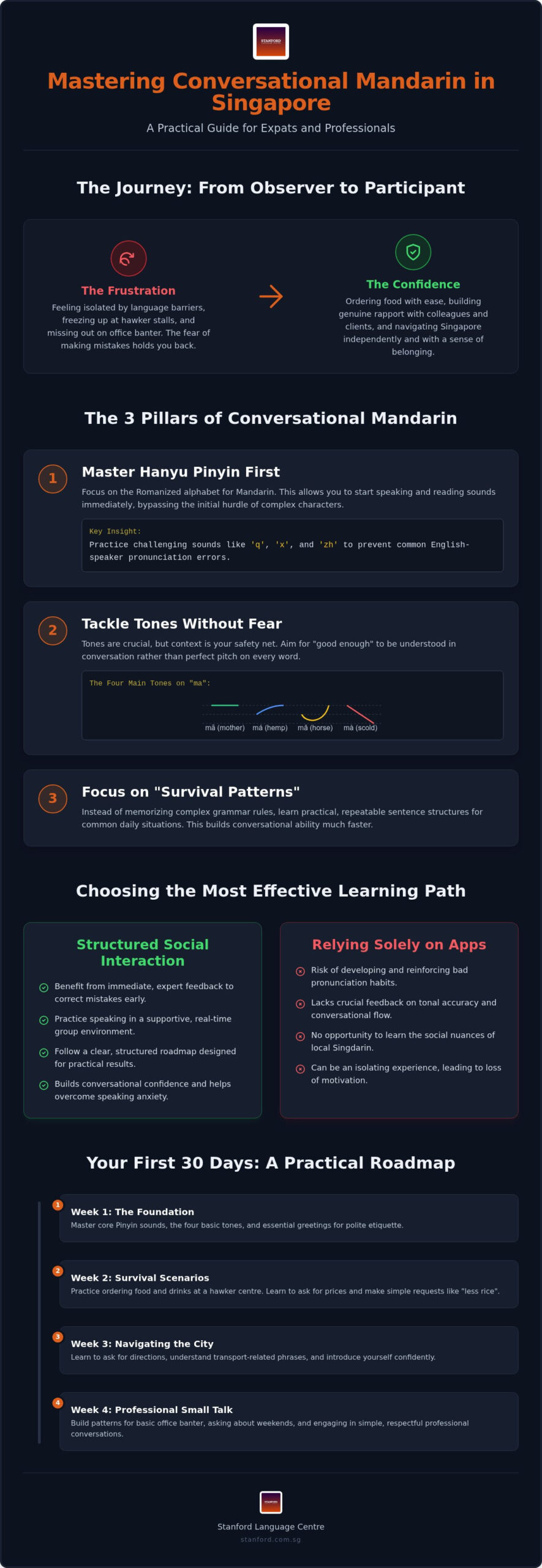
Mastering a new language is about consistency, not intensity. When you break down conversational mandarin for beginners into a 30-day roadmap, the mountain becomes a series of achievable steps. You don’t need to study for hours every day. You just need a clear plan that focuses on the interactions you actually have in Singapore. This timeline ensures you move from silence to basic social participation in just one month.
- Week 1: The Foundation. Focus entirely on Pinyin and the four tones. This is your phonetic map. Spend this week training your ear to distinguish between the rising and falling pitches.
- Week 2: Professional Presence. Move into essential greetings and office etiquette. Learn how to say “Good morning” or “Have you eaten?” to your colleagues. These small gestures build massive rapport.
- Week 3: The Daily Grind. Master numbers and currency. You need this for S$ transactions and queueing. This is also the week to learn your “Kopitiam” survival terms.
- Week 4: Functional Interaction. Start using basic sentence structures. Focus on asking for directions to the nearest MRT or ordering specific dishes at a food court.
Hawker Centre Survival: A Beginner’s Goal
Ordering coffee in Singapore is an art form that uses a unique blend of languages. A major milestone for any beginner is ordering a “Kopi-O” (black coffee with sugar) or a “Teh-C” (tea with evaporated milk) without switching to English. Understanding numbers is equally vital for handling payments and recognizing your queue number at a busy stall. These small wins in the real world provide a massive psychological boost. They prove that your study is paying off. Every time a stallholder understands your order, your motivation to continue learning spikes.
Social Etiquette and Cultural Nuances
Learning the language also means learning the culture. One of the most important concepts is “Face” (Mianzi). It’s about mutual respect and social standing. In a professional setting, how you greet someone often depends on their age and seniority. Addressing an older stallholder as “Uncle” or “Auntie” is a sign of respect that immediately warms the interaction.
To learn effectively, pay close attention to local intonation. The “sing-song” rhythm of Singaporean speech is a great guide for mastering tones. Don’t just read from a book; listen to the people around you in the office pantry or on the bus. If you’re ready to start your journey with professional guidance, explore our beginner Mandarin course schedules to find a class that fits your busy lifestyle.
Level 1 Mandarin at Stanford Language Centre: What to Expect
Our “Student-First” philosophy is simple: we prioritize practical results over theoretical complexity. You won’t spend hours memorizing abstract grammar rules that you’ll never use. Instead, our Level 1 curriculum focuses on the “survival patterns” you need to navigate life in Singapore. Since 2004, we’ve helped thousands of learners move from total beginners to confident speakers. Our goal is to lower the barrier to entry, making conversational mandarin for beginners accessible to everyone, regardless of their professional schedule.
Class size matters. We keep our groups small to ensure every student gets to speak in every single session. You aren’t just a face in a crowded lecture hall; you’re an active participant. This environment allows our teachers to provide immediate tonal feedback, which is vital for long-term retention. Located conveniently near City Hall, our centre is the perfect stop for working adults looking to upskill without a long commute. You get professional reliability in a warm, welcoming atmosphere that encourages growth.
Tailored Programs for Different Backgrounds
We understand that different learners face different challenges. That’s why we offer specialized approaches for Japanese and Korean speakers, addressing the specific phonetic hurdles they often encounter. Our mandarin course for expats singapore is designed to make you feel at home from day one. We offer flexible options to suit your lifestyle, including weekly small group classes and private 1-1 lessons for those who prefer a more customized pace. Whether you’re here for a few years or making Singapore your permanent home, we have a path that fits. For a detailed breakdown of what the first course covers, our Mandarin Level 1 for adults practical guide walks you through exactly what to expect, from HSK vocabulary targets to managing your study schedule around a busy career.
How to Get Started with Your UTAP Claim
If you’re an NTUC member, you can make your learning even more cost-effective. In 2026, claiming your training benefits through the Union Training Assistance Programme (UTAP) is a straightforward process. This program allows you to offset a portion of your course fees, making professional development more accessible than ever. Our Level 1 course is the perfect entry point. It’s a recognized way to boost your cultural intelligence and build rapport with local clients and colleagues. Don’t let the fear of tones hold you back any longer. It’s time to take the first step toward independence in the Lion City. Register for our next Conversational Mandarin Level 1 intake and start speaking with confidence.
Start Speaking with Confidence Today
Mastering the basics of Mandarin is more than just a new skill; it’s your key to unlocking a deeper connection to life in Singapore. By focusing on the essential pillars of Pinyin and tones, you can bypass the stress of complex characters and start communicating immediately. While apps offer convenience, nothing replaces the real-time feedback and active recall found in a supportive, small-group environment.
Stanford Language Centre brings over 20 years of experience in adult language training to help you succeed. Our classes prioritize maximum speaking time, building the practical confidence you need for office banter or hawker centre errands. For eligible members, our programs are NTUC UTAP claimable, making your path to fluency even more accessible. If you’re ready to master conversational mandarin for beginners, we are here as your supportive partner. You’ll be navigating the city and building rapport with locals before you know it.
Start Your Mandarin Journey: View Our Level 1 Course Schedule
Frequently Asked Questions
Is conversational Mandarin difficult for absolute beginners to learn?
Learning conversational mandarin for beginners is very manageable when you focus on speaking rather than reading. The grammar is logical and lacks the complex conjugations found in many Western languages. By prioritizing Hanyu Pinyin and the four tones, you build a solid foundation quickly. Our supportive environment helps you overcome the initial learning curve. You’ll find that mastering “survival patterns” for daily life in Singapore is an attainable and rewarding goal.
How long does it take to become conversational in Mandarin?
Most students reach a basic conversational level within three to six months of consistent study. Our Level 1 course is designed to get you talking from the very first session. By the end of ten weeks, you should be able to handle simple greetings, order food, and manage basic social interactions. Progress depends on your practice outside of class. Consistent exposure to local intonation in the office or heartlands speeds up your results significantly.
Do I need to learn Chinese characters to speak Mandarin?
You don’t need to learn Chinese characters to speak Mandarin effectively. Our conversational mandarin for beginners program uses Hanyu Pinyin, which is a Romanized system. This allows you to focus entirely on your pronunciation and listening skills. While characters are beautiful, they can be overwhelming for busy professionals. By skipping them initially, you accelerate your ability to communicate in real-world settings like hawker centres or business networking events without feeling bogged down by theory.
What is the difference between Mandarin and Cantonese in Singapore?
Mandarin is one of Singapore’s four official languages and is widely used in business and education. Cantonese is a dialect primarily spoken within the older Chinese community and some social circles. While both share some cultural roots, they are not mutually intelligible. Learning Mandarin is much more practical for expats and foreigners today. It provides a broader bridge to connect with the local population and regional business partners across Asia in a professional capacity.
Can I use NTUC UTAP to pay for my Mandarin course at Stanford?
Yes, you can use NTUC UTAP to offset your course fees at Stanford Language Centre. Eligible NTUC members can claim up to 50% of the unfunded course fee, subject to an annual cap. This makes our Level 1 Mandarin course an excellent choice for professional development. We provide the necessary documentation to help you with your claim process in 2026. It’s a great way to invest in your skills while effectively managing your training costs.
What happens if I miss a class in a small group setting?
If you miss a class, we offer flexibility to help you stay on track. You can often join a concurrent session or receive the course materials and a brief update on what was covered. Our small group setting ensures that the teacher can quickly help you catch up during the next session. We understand that busy professionals have unpredictable schedules. Our goal is to provide a low-stress environment where you don’t feel left behind by occasional absences.
Are there specialized Mandarin classes for Japanese or Korean expats?
Yes, we offer specialized Mandarin classes tailored specifically for Japanese and Korean speakers. These programs address the unique linguistic challenges and phonetic differences these learners face. Because our teachers understand these specific backgrounds, they can provide more effective feedback on pronunciation and grammar. This customized approach helps students from Japan and Korea feel more comfortable and progress faster. It’s part of our commitment to being a relatable, inclusive, and highly effective language learning partner.
Where is Stanford Language Centre located for in-person classes?
Stanford Language Centre is conveniently located near City Hall. This central location makes it easy for professionals to attend in-person classes right after work or during their lunch breaks. Our facilities are designed to be warm and welcoming, providing the perfect atmosphere for adult learners. Being in the heart of the city means you are just minutes away from major office hubs. It’s a practical and efficient choice for anyone living or working in Singapore.