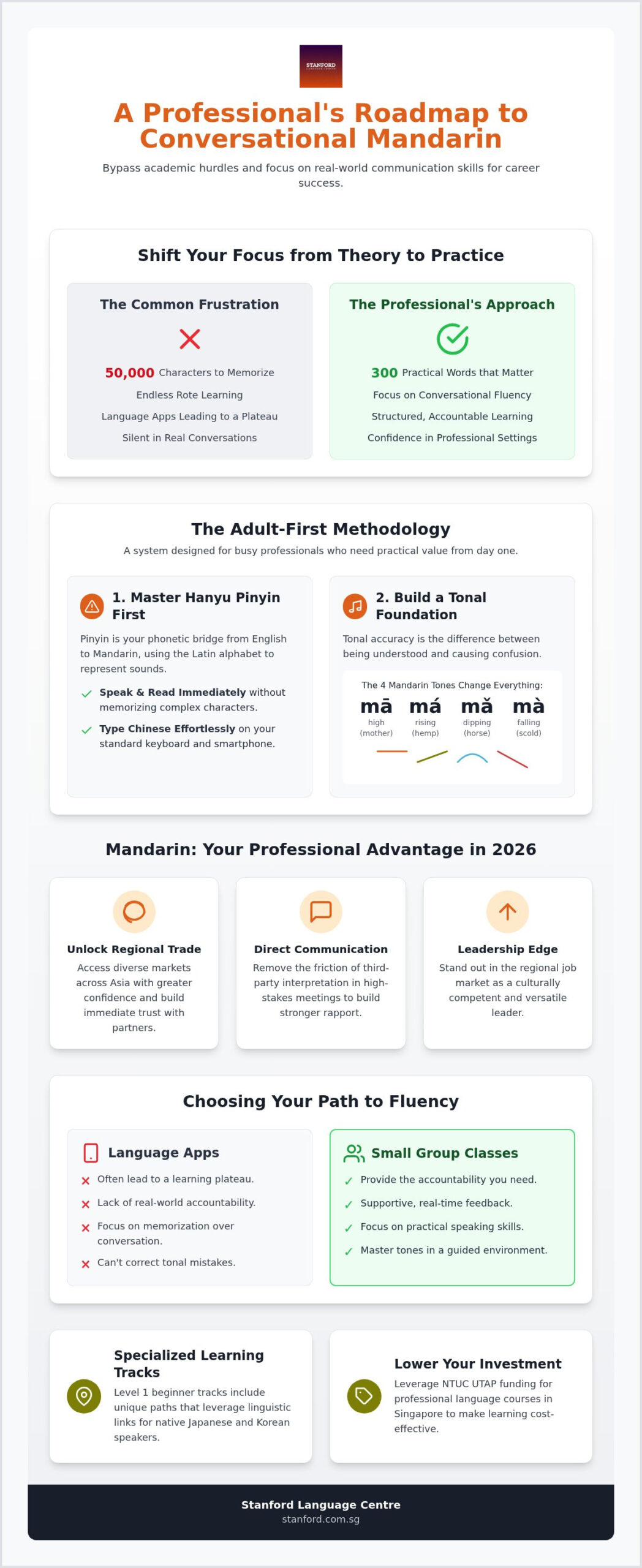
What if you could stop worrying about 50,000 characters and focus on the 300 words that actually matter for your next board meeting? Many expats want to learn chinese mandarin but feel paralyzed by the thought of complex tones and endless memorization. You’ve likely tried the popular apps that promise fluency in minutes, only to find yourself silent when a local colleague speaks. It’s frustrating to feel like a beginner when you’re a leader in your professional life. We understand that your time is your most valuable asset.
This guide offers a practical, adult-focused roadmap designed specifically for busy professionals. You’ll discover how to bypass academic hurdles and focus on conversational skills that work in real-world settings. We’ll show you how to navigate professional environments with confidence and find a cost-effective path using NTUC UTAP funding. From overcoming the fear of tones to finding the right small group environment, you’re about to see that Mandarin isn’t just attainable; it’s a tool for your success. Let’s look at how you can start speaking with clarity and confidence today.
Key Takeaways
- Identify how Mandarin serves as a vital career differentiator in 2026, shifting your corporate networking from casual to essential.
- Use an adult-first methodology to learn chinese mandarin by prioritizing Pinyin and ear training over complex character memorization.
- Understand why language apps often lead to a learning plateau and how small group classes provide the accountability you need.
- Find out how to lower your investment by leveraging NTUC UTAP funding for professional language courses in Singapore.
- Explore specialized Level 1 tracks designed for beginners, including unique paths that leverage linguistic links for Japanese and Korean speakers.
Why Learn Chinese Mandarin as a Professional in 2026?
The regional job market is evolving at a breakneck pace. In 2026, the ability to communicate in the most widely spoken language in the world is no longer just a “nice-to-have” addition to your CV. It has become a vital asset for anyone serious about corporate networking in Asia. When you decide to learn chinese mandarin, you’re investing in a skill that opens doors that remain closed to monolingual professionals. It’s about more than just words. It’s about showing your partners and clients that you value their culture enough to meet them halfway. This simple act of effort builds immediate trust that can’t be bought.
Mandarin for Career Advancement
Regional trade thrives on clear, direct communication. If you’re working in a multinational firm, your ability to speak Standard Chinese can be the deciding factor in securing a new contract or lead. It allows you to speak directly with colleagues and clients without relying on a middleman. This direct line of communication builds a level of rapport that’s impossible to achieve through a translator. The “Professional Mandarin” advantage in 2026 is the ability to bridge cultural gaps through functional, high-impact communication that drives regional trade and strengthens corporate alliances.
- Unlocking Trade: Access diverse markets across the region with greater confidence and ease.
- Direct Communication: Remove the friction of third-party interpretation in high-stakes meetings.
- Leadership Edge: Stand out in the regional job market as a culturally competent and versatile leader.
Social Integration for Expats
Living in a new country can often feel like being stuck in an “expat bubble.” You might frequent the same places and speak only to people who share your native tongue. However, learning the basics of Mandarin allows you to step outside that comfort zone. It helps you understand local nuances and cultural etiquette that are often lost on those who don’t speak the language. By mastering everyday conversation, you build long-term rapport with your local community. This integration isn’t just about social life. It translates directly into your professional settings by helping you navigate multicultural environments with grace.
Beyond the office, there’s a significant cognitive benefit. Language learning is one of the best ways to maintain cognitive health as an adult. It keeps the mind flexible and improves problem-solving skills. When you learn chinese mandarin, you’re giving your brain a rigorous workout that enhances your focus and memory. It’s a pragmatic choice for your career and a healthy choice for your mind. You’ll find that the mental agility gained in the classroom helps you stay sharp during long workdays.
Mastering the Basics: The Adult-First Methodology
Adults don’t learn like children. You don’t have years to spend on rote memorization before you start speaking. You need a system that delivers practical value from day one. When you learn chinese mandarin as a busy professional, you need to bypass the academic fluff. The goal is conversational fluency that works in a boardroom or at a business lunch. We call this the adult-first methodology. It focuses on functional communication rather than theoretical perfection. By prioritizing what you can use today, you stay motivated and see progress fast.
Understanding Hanyu Pinyin
Pinyin is the phonetic bridge between English and Mandarin. It uses the Latin alphabet to represent the sounds of the language. In your first six months, Pinyin is your most valuable tool. It allows you to read and speak without needing to recognize thousands of complex characters. Many Western speakers find certain sounds like “j”, “q”, and “x” tricky at first. We focus on clearing these hurdles early. Once you master the phonics, you can even type Chinese on your laptop or smartphone using a standard keyboard. This immediate utility is why we emphasize Pinyin as the foundation for every professional learner.
The Tonal Foundation
Mandarin is a tonal language. There are four distinct tones that change the meaning of a word entirely. Think of it like a musical pitch. If you get the tone wrong, you might say “mother” when you meant “horse.” Tonal accuracy is the make or break of Mandarin because it’s the difference between being understood and causing total confusion. We use visual drills to help you “see” the pitch as it rises or falls. Training your ear takes practice, but it’s much easier when you have a supportive environment. If you’re ready to start, our small group mandarin class for expat students focuses heavily on these foundational speaking skills.
Don’t fall into the “Character Trap.” Many students get bogged down trying to write characters before they can even order a coffee. For a professional, speaking must come first. High-frequency vocabulary provides the best return on your time. Focus on words related to your industry and daily life. This approach aligns with the career benefits of learning Chinese, as employers value your ability to communicate and build relationships over your ability to handwrite calligraphy. By focusing on speech, you’ll find you can navigate the professional landscape much sooner than you expected. It’s about being pragmatic, not perfect.
Choosing Your Path: Language Apps vs. Structured Classes
Deciding how to learn chinese mandarin is your first big hurdle. You’ve likely seen the ads for apps that promise fluency in just ten minutes a day. While these tools are great for building a basic vocabulary list, they often lead to a frustrating plateau. You can recognize words on a screen, but you can’t hold a conversation at a networking event. Apps lack the immediate, nuanced feedback required to master those tricky tones we discussed earlier. Without a real person to correct your pitch, you might spend months practicing the wrong way. Real fluency requires interaction that an algorithm simply can’t provide.
The Case for Small Group Learning
Small groups strike a perfect balance for most adults. They offer a safe environment where you can practice speaking with fellow beginners who share your professional background. You get to hear different voices and accents, which trains your ear much faster than a digital recording. A professional instructor provides the structured feedback that helps you avoid bad habits. If you’re looking for a solid foundation, a conversational mandarin level 1 course is an excellent starting point. It gives you the accountability of a weekly schedule and the support of a peer group. You’ll find that learning with others makes the process much more engaging and less intimidating.
Private Tuition for Fast-Track Results
Sometimes, your schedule doesn’t fit a standard classroom. If you’re a frequent traveller or a senior executive, private 1-1 lessons might be your best bet. This path allows you to customise your lessons to include specific industry jargon. Whether you’re in finance, tech, or logistics, you can focus on the vocabulary that matters to your daily work. Your instructor can spend more time addressing your individual weaknesses in pronunciation or grammar. It’s an intensive, fast-track approach that yields results quickly. You get the full attention of a mentor who understands your specific goals and constraints.
Choosing between online and on-site learning depends on your lifestyle. Online classes offer maximum flexibility for busy professionals who need to learn chinese mandarin from home or the office. On-site classes provide a more immersive experience and a stronger sense of community. Many expats find that a structured on-site class helps them stay committed and build local connections. The key is to find a method that fits your routine so you don’t give up when work gets busy. You want a path that leads to real conversational ability, not just a high score on a mobile app.
Navigating the Learning Landscape in Singapore
Singapore is a unique hub for language. If you want to learn chinese mandarin here, you must know that Simplified Chinese is the national standard. It’s the script used in business, government, and local media. While Traditional Chinese is used in other regions, Simplified is much more practical for your career in Singapore and mainland China. Choosing the right environment is equally vital. Many local hubs are designed for children’s exam preparation. These centres focus on academic drills and school syllabi. As an expat, you need a “Professional Adult” focus. You need language that fits your boardroom meetings and client dinners, not a primary school classroom.
Financial Support and Grants
Expats often overlook local funding opportunities. You can significantly reduce your costs through the Union Training Assistance Programme (UTAP). This is a grant for NTUC members to help with the cost of skills training. It’s a pragmatic way to manage your professional development budget. To use this support, you must be an NTUC member before the course begins. You also need to ensure you choose a Professional Adult Chinese learning in Singapore program that is specifically registered for UTAP support. After completing your course with a high attendance rate, you can submit your claim via the NTUC portal. This simple process makes high-quality training much more accessible.
- Step 1: Register for NTUC membership.
- Step 2: Enroll in a UTAP-supported Mandarin course.
- Step 3: Maintain at least 75% attendance.
- Step 4: Submit your claim within six months of finishing.
Corporate Language Solutions
Companies that invest in their teams see a clear return. Customised workshops can be designed for your specific industry. Whether your team needs to communicate with regional offices or handle local client relations, Corporate Mandarin Language Training is the answer. These sessions can be held on-site at your office or off-site at a dedicated centre. This flexibility ensures your workflow isn’t disrupted. Measuring ROI is simple; you’ll see it in improved team cohesion and smoother business transactions. It’s about giving your workforce the tools to build stronger relationships with Mandarin-speaking partners. When you learn chinese mandarin as a team, you create a shared culture of growth and adaptability.
Ready to take the next step? Explore our NTUC Utap claimable Mandarin class options and start your journey today.
The Stanford Approach: Tailored Mandarin for Every Learner
Stanford Language Centre has been a trusted part of the local community since 2004. We don’t just teach a language; we act as a supportive mentor for your entire journey. When you decide to learn chinese mandarin with us, you’re entering a space designed specifically for adults. There are no children’s lessons here. We focus on foundational Level 1 programs that get you speaking from your very first hour. Our approach is unpretentious and honest. We prioritize what works in the real world over theoretical complexity. We believe that Mandarin is attainable; it’s simply a matter of providing the right environment.
Specialized Classes for Expats
One of our most unique features is our specialized tracks for specific nationalities. We recognize that Japanese and Korean speakers share linguistic commonalities with Mandarin, particularly regarding character roots. However, they also face specific phonetic challenges that other learners might not encounter. We offer a specialized Small group Mandarin class for Japanese and a Small group Mandarin class for Korean to address these nuances directly. By grouping learners with similar linguistic backgrounds, we create a more efficient and targeted learning path. These small group dynamics also foster a sense of community among foreigners. You aren’t just a student; you’re part of a peer-to-peer network of professionals who understand your specific constraints.
Your First Steps at Stanford Language Centre
In your first Conversational Mandarin lesson, you can expect a low-stress, welcoming atmosphere. We skip the high-brow linguistic jargon that often intimidates new learners. Instead, we dive into real-world Singaporean scenarios. You’ll practice ordering at a local hawker centre, navigating transport, and basic professional introductions. Our “no-frills” focus ensures you get the best return on your time. We keep our classes small to ensure you get the personalized attention you deserve from our passionate experts. It’s a student-first mentality that prioritizes your comfort and practical results.
Getting started is straightforward and efficient. You can easily register for our NTUC Utap claimable Mandarin class to help manage your professional development costs. While our programs are eligible for UTAP support for working professionals, please remember they are not SkillsFuture claimable. Our team is here to guide you through the registration process and help you claim your benefits once you complete the course. Whether you’re looking to learn chinese mandarin for a promotion or to better integrate into your new home, we’re your approachable allies in reaching that goal. Success is within reach when you have a partner who understands your needs.
Ready to Master Mandarin for Your Professional Future?
Mastering the basics of a new language can transform your career and social life in Singapore. It’s about moving beyond the limitations of apps and academic drills. Real conversational confidence comes from a path that prioritizes practical speech. By leveraging local funding like NTUC UTAP, you’re making a smart, pragmatic investment in your professional growth. Since 2004, we’ve helped expats navigate these challenges with a no-frills, adult-focused curriculum that delivers results.
Whether you’re joining our specialized tracks for Japanese and Korean speakers or starting as an absolute beginner, you’ll find a community of supportive allies here. It’s time to stop feeling like an outsider. Start building the trust that drives regional business and meaningful connections. You don’t need to fear the tones or the characters when you have the right roadmap designed for your busy schedule.
Start your Mandarin journey today with our Level 1 Conversational Course and see how quickly you can achieve basic fluency. We’re here to support you every step of the way. Your decision to learn chinese mandarin starts with a single step. Let’s make it happen together.
Frequently Asked Questions
Is it possible to learn Mandarin as an adult with no prior experience?
Yes, it’s entirely possible and very common for adults to start with zero background. Our Level 1 programs are specifically designed for absolute beginners. We focus on Hanyu Pinyin as a phonetic bridge, which allows you to start speaking without the immediate pressure of reading characters. This adult-first approach ensures you gain practical skills quickly. You’ll find that starting as an adult allows you to apply logical frameworks to the language structure effectively.
How long does it take to reach basic conversational fluency in Mandarin?
Most learners achieve basic conversational fluency within three to six months of consistent, structured study. A typical 10-week course provides the foundation needed for daily interactions and simple professional introductions. Your progress depends on your practice outside the classroom and your engagement with native speakers. While you won’t be fluent overnight, focusing on high-frequency vocabulary ensures you can navigate common Singaporean scenarios relatively quickly. Consistency is the most important factor in your success.
Can I use SkillsFuture credits for Mandarin courses at Stanford Language Centre?
No, Stanford Language Centre does not accept SkillsFuture credits for our courses. Instead, we focus on providing high-quality, professional training that is eligible for NTUC UTAP funding. This grant allows union members to claim back a portion of their course fees, making the path to learn chinese mandarin more cost-effective. We suggest checking your UTAP eligibility before enrollment to maximize your professional development budget while benefiting from our specialized adult curriculum and supportive environment.
What is the difference between Mandarin and Chinese?
“Chinese” refers to a broad family of languages and dialects used across the region. Mandarin is the specific, standardized version that serves as the official language in Singapore and mainland China. When you choose to learn chinese mandarin, you are studying the standard dialect used in business, media, and government. While other dialects like Cantonese or Hokkien are spoken locally, Mandarin is the most practical choice for professional networking and regional trade in 2026.
Are the classes at Stanford Language Centre conducted online or in-person?
We offer both online and on-site learning options to fit your busy professional schedule. Online classes provide maximum flexibility for those who travel frequently or prefer to learn from home. On-site classes at our centre offer a more immersive experience and the chance to build a community with fellow expats. Both formats follow the same pragmatic curriculum and are led by our experienced instructors. You can choose the mode that best aligns with your routine and learning style.
What makes the Japanese and Korean specialized classes different?
These classes are unique because they leverage the linguistic commonalities between Japanese, Korean, and Mandarin. Japanese and Korean speakers often recognize character roots, which speeds up their understanding of vocabulary. However, they also face specific phonetic challenges that differ from Western learners. By grouping these students together, our instructors can use targeted pedagogical techniques that address these specific needs. This specialized approach ensures a faster, more intuitive learning experience for native speakers of these languages.
How does the NTUC UTAP claim process work for language courses?
The UTAP process is straightforward for working professionals. First, ensure you’re an NTUC member before your course starts. You must maintain at least 75% attendance to qualify for the claim. After completing the course, log in to the NTUC portal to submit your claim within six months of the end date. This grant helps cover a significant portion of the fees for our Mandarin, Thai, and Vietnamese classes. It’s an excellent way to fund your professional development through a supportive mentor.
Do I need to learn how to write Chinese characters to speak Mandarin?
No, you don’t need to master writing characters to become conversationally fluent. Our Level 1 courses prioritize speaking and listening through Hanyu Pinyin. For most busy professionals, the ability to communicate verbally is far more urgent than handwriting calligraphy. While you’ll naturally learn to recognize some common characters through your course materials, we don’t let writing drills slow down your conversational progress. You can even use Pinyin to type Chinese on your digital devices for professional communication.